


 Claim Ownership
The Innovation Attorney Podcast
Subscribed: 0Played: 2
Subscribe

© Michael Kimball
Description
The Innovation Attorney is a publication about the intersection of venture capital, technology, public policy and law.
theinnovationattorney.substack.com
theinnovationattorney.substack.com
286 Episodes
Reverse
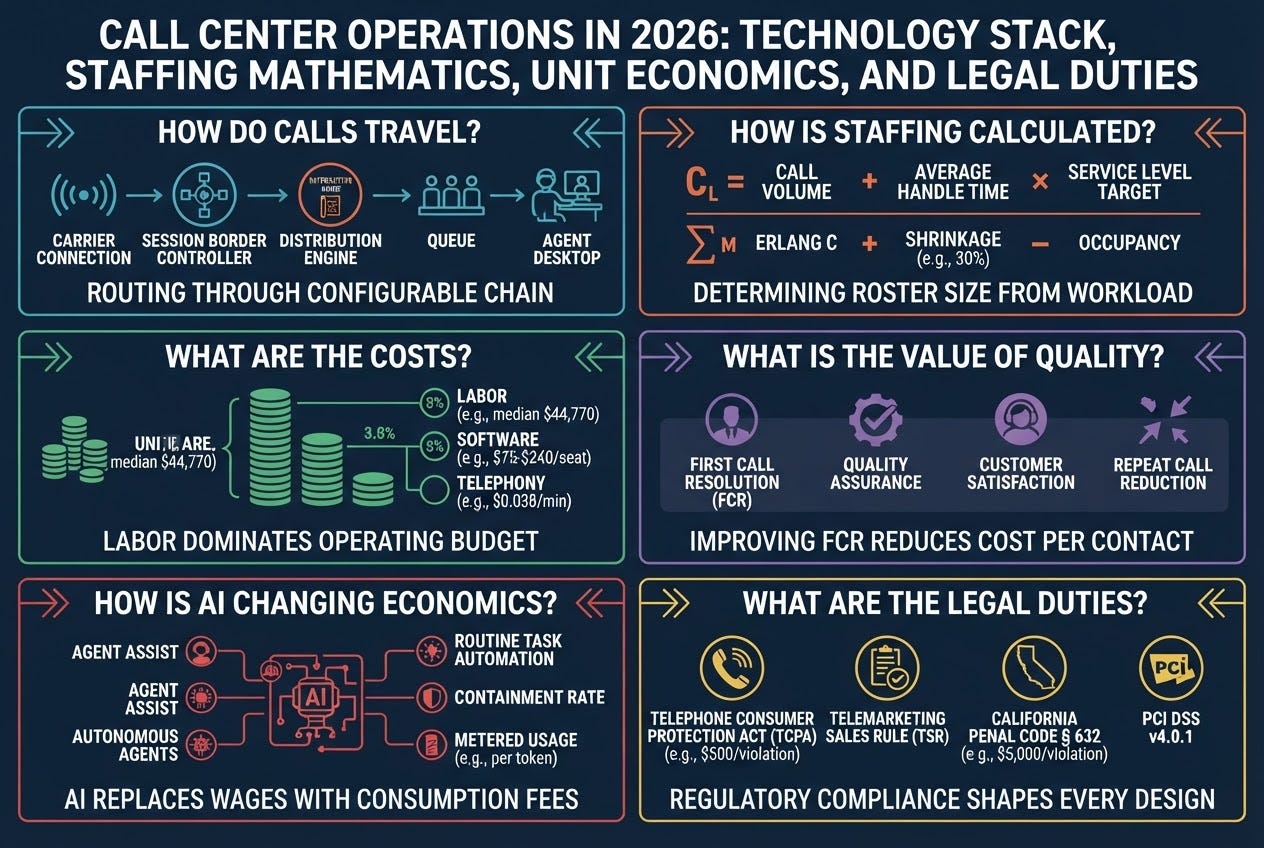
Executive SummaryA call center works by routing customer contacts through automatic call distribution and staffing queues with Erlang C mathematics, and queued for a customer hold time based on the company’s desired hold time.Every inbound call arrives over a carrier connection, passes a session border controller, meets an interactive voice menu, and lands in a queue where a distribution engine matches it to an agent by skill, priority, and availability.26,21 Staffing follows from call volume, average handle time, and a service level target: 100 calls in a half hour at 300 seconds each, answered within 20 seconds 80 percent of the time, needs 21 agents on the phones and 30 on the roster after 30 percent shrinkage.18,23 Labor consumes roughly three quarters of the operating budget, and a 100 agent floor at the federal median wage carries $4,477,000 in annual wages before software, benefits, or facilities.23,1Commercially, one major cloud platform lists seats from $75 to $240 per user per month and another meters voice at $0.038 per minute, so software costs 2.0 to 6.4 percent of the wage bill for 100 seats.29,27 Artificial intelligence is the variable in dispute. A forecast dated March 5, 2025 predicts that autonomous agents will resolve 80 percent of common issues by 2029, while a survey of 321 service leaders dated December 2, 2025 found that 20 percent had cut staffing because of AI.9,11 The Telephone Consumer Protection Act, the Telemarketing Sales Rule, California Penal Code § 632, and PCI DSS version 4.0.1 shape every design choice, and statutory damages run from $500 to $5,000 per violation.2,3,8,36How Did the Modern Call Center Develop?The modern call center developed from a century old queueing formula, a telephone network that moved from physical circuits to internet protocol, a labor market that moved offshore, and a body of consumer protection law that began to reach automated calling with the Telephone Consumer Protection Act of 1991.18,2A. K. Erlang, a Danish mathematician, developed the mathematics that planners still use more than a century ago, and the Erlang C variant answers one planning question: given a rate of call arrivals and a mean handle time, how many agents hold the chance of waiting to the level a service target allows.18 As a matter of queueing theory, the formula assumes that callers wait as long as necessary, that no caller redials after hanging up, and that every agent works at the same pace. Real queues violate all three assumptions, which is why every planner who uses the formula adjusts its output with shrinkage and occupancy rules.The telephone network underneath the queue changed more than the queue did. Enterprises ran calls over PRI circuits, fixed bundles of voice channels delivered by a carrier, and carriers have pushed customers to SIP trunks through price increases and abrupt sunset notices.21 A SIP trunk carries calls as internet protocol traffic, which lets a company size call paths to actual demand, centralize connections at a few data centers, and add redundancy by geography. Each SIP location generally needs its own session border controller, and porting numbers from PRI to SIP takes about 20 to 30 days per order.21Cloud delivery then converted a capital purchase into a metered subscription. Vendors now publish list tiers priced per user per month, per voice minute, per chat message, and per email, and they sell the same platform under named seat, concurrent seat, and consumption licenses.29,27,32 One platform vendor describes an omnichannel cloud contact center as a single system that unifies voice, chat, email, messaging, and social interactions so that customers can switch channels without starting over.30Labor moved to wherever a wage and a language skill could be combined. The Philippine IT and business process management industry grew from $22.9 billion in revenue and 1.15 million workers in 2016 to $40.3 billion and 1.89 million workers in 2025, an increase of 76 percent in revenue and 64 percent in headcount, and its association forecasts $42.3 billion for 2026.22Domestically, the Bureau of Labor Statistics counted about 2,666,000 customer service representatives in 2025.1The law arrived in layers. The Telemarketing Sales Rule amendments of 2008 made the abandonment safe harbor enforceable on October 1, 2008, the prerecorded message opt out requirements on December 1, 2008, and the prior express written agreement requirement on September 1, 2009.3 The Federal Communications Commission ruled on February 8, 2024 that AI generated voices are artificial voices under the Telephone Consumer Protection Act.4,5 The Eleventh Circuit vacated the one to one consent requirement on January 24, 2025, PCI DSS version 4.0.1 became the live payment card standard on March 31, 2025, and a federal court in the Northern District of California let a class action against an AI customer service provider proceed on August 11, 2025.6,36,7In three decades of negotiating technology licenses, telecommunications service terms, and SaaS agreements, I have watched one clause move between vendor and customer each time a pricing model changed: the definition of a billable unit. When a contact center contract meters by the minute, the definition of a minute decides who pays for ring time, queue time, and the seconds after the caller hangs up. That clause draws less attention at signing than any other commercial term and more disputes at renewal, and it matters more as AI platforms meter by the message, the token, and the resolution.Detailed FindingsThe six findings below answer the head query in the order a caller experiences it. A call travels through a defined chain of systems, a staffing formula decides how many people wait at the end of that chain, a cost model prices both, a resolution rate decides whether the call was worth taking, artificial intelligence is rewriting the price of the answer, and a set of statutes decides how every call may be placed, recorded, and paid for. Each finding opens with the established position, explains the mechanism, supplies the evidence, works an example with real numbers, states where sources disagree, and closes with the practical consequence for a decision maker.How Does a Call Travel from a Carrier to an Agent Desktop?Established PositionA call center delivers each contact to a qualified agent through a chain of carrier trunk, border controller, interactive voice menu, distribution engine, queue, and agent desktop, and every cloud platform reproduces that chain as software configuration.26,28 Four roles interact with the platform. Customers contact the center by any channel, agents handle and document contacts, supervisors monitor and coach, and administrators provision phone numbers, define queues and routing profiles, and build the flows that connect them.28 Operations also employ workforce management specialists, quality assurance analysts, and data analysts.33MechanismThe carrier hands the call to the enterprise as a SIP session, and the session border controller authenticates it, protects the network edge, and passes it to the contact center platform.21 The interactive voice menu then gathers identifiers. Caller ID supplies a number and sometimes a name, automatic number identification can pull the customer record from a database, and menu prompts can ask for an account number before any agent is involved.26The distribution engine applies routing criteria such as agent skill, availability, language, VIP status, and location. Round robin spreads calls evenly, skills based routing scores agents against the call and picks the best match, and priority routing sends high priority callers to the most qualified agents first.26 When no agent is free, the caller joins a queue ordered by urgency, language, time of day, or day of week, and the system assigns the next queued call in real time as an agent becomes available. Computer telephony integration then pops the customer record onto the agent’s screen, and recording and quality monitoring tools run beside the call.34Supporting EvidenceCloud pricing pages show the unit of account for each step. One provider lists $0.038 per voice minute, $0.010 per chat message, $0.080 per email, and $0.014 per SMS message, with standard telephony rates added to voice.27 One enterprise suite stores the customer record in a single data layer, adds a generative assistant for suggested replies and conversation summaries, and routes requests from any channel to the best suited representative.31 On the measurement side, a 2024 industry survey reported that 85 percent of centers measure abandonment rate, 84 percent measure average handle time, 77 percent measure quality, and 76 percent measure average speed of answer.14The network layer carries its own evidence. A published migration guide states that SIP typically requires fewer call paths than the PRI channels in a legacy distributed network, that IP access should be sized for total call path load under failover, and that failover behavior varies by provider and access type, with private circuits sometimes outperforming internet access.21Worked ExampleTake the 100 call half hour at 300 seconds of handle time. A caller dials a toll free number that was ported to SIP, the border controller admits the session, and the menu captures an account number. With 21 agents staffed, the Erlang C model gives an average speed of answer of 16.0 seconds across all calls, a 23.2 percent chance that a given call waits at all, and 82.6 percent of calls answered within 20 seconds.18 The call lasts five minutes, so a platform that meters voice at $0.038 per minute bills $0.19 for it, before the standard telephony charge.27The model output comes from my own calculation using the Erlang C formula, and each of those figures changes if the handle time moves by even 30 seconds: at 360 seconds the same 100 calls need 25 agents.Contested AreasVendors and practitioners disagree on how much of the c
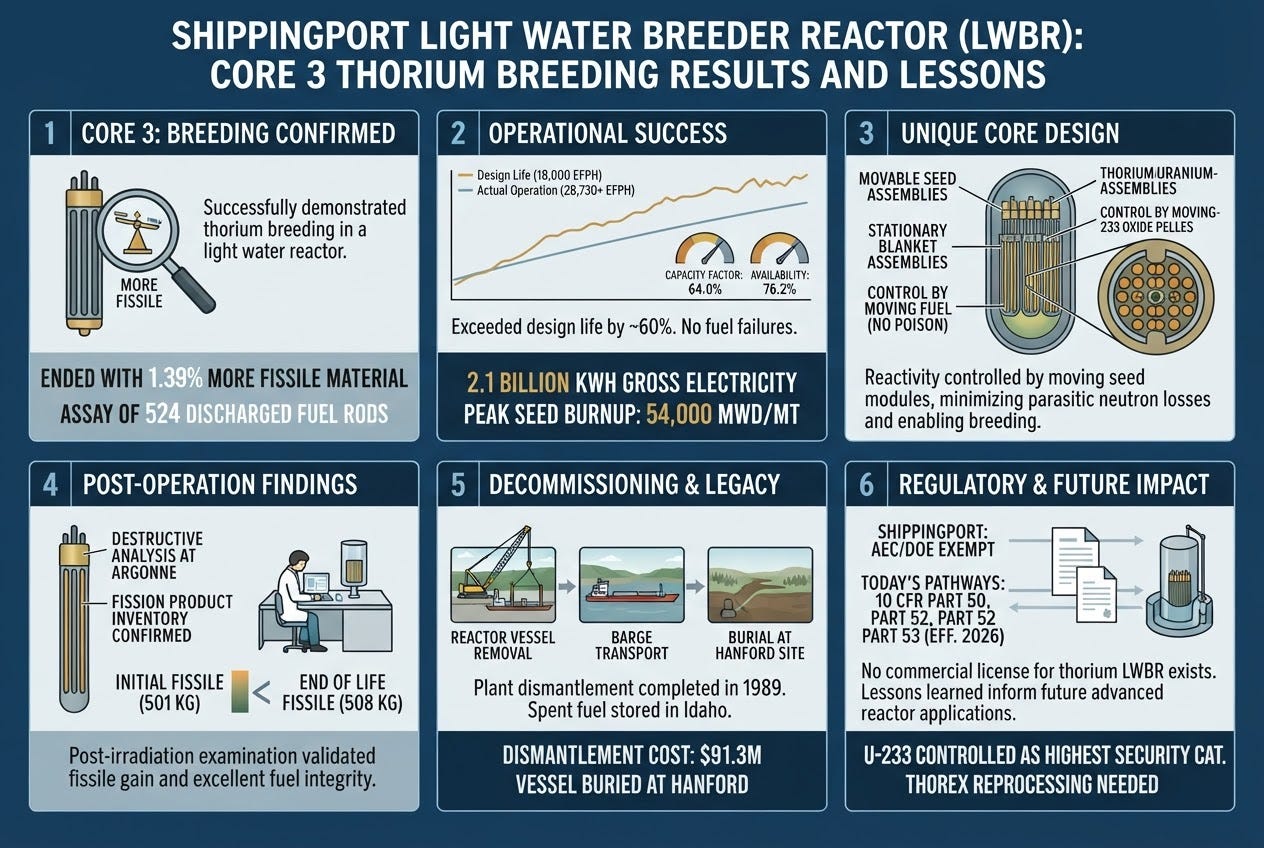
The Shippingport Light Water Breeder Reactor, which ran from 1977 to 1982, demonstrated that a thorium and uranium 233 core can breed fuel, ending with 1.39 percent more fissile material.Core 3 at the Shippingport Atomic Power Station in Pennsylvania produced about 2.1 billion kilowatt hours of gross electricity over roughly 29,000 effective full power hours, and assay of 524 discharged fuel rods confirmed the gain in fissile inventory. Examiners found no fuel element defects. Power operation stopped on October 1, 1982, and the Department of Energy completed dismantlement in 1989 for $91.3 million.Shippingport was the first full scale American reactor built only to make civilian electricity. Its third core used pellets of thorium oxide and uranium 233 oxide in Zircaloy 4 tubes, and it controlled reactivity by moving fuel in place of neutron absorbing control rods. That choice removed a source of parasitic neutron loss, and the loss was the margin that made breeding possible in light water.For energy investors, utilities, and policy professionals, the record carries a plain commercial message. The physics worked in 1982. The fuel cycle around it needs recycled uranium 233, shielded fabrication, and reprocessing that has never operated at industrial scale, and those requirements kept the concept off the market. The federal outlay for the Shippingport pressurized water and breeder programs was estimated at $622.2 million in 1975, and the breeder core never entered commercial service.Shippingport was exempt from licensing by the Nuclear Regulatory Commission, so no licensing record exists for a thorium fed light water reactor. A developer today would proceed under 10 CFR Part 50, Part 52, or the optional Part 53 that took effect on April 29, 2026, and uranium 233 is controlled as special nuclear material of the highest security category. The sections below trace the history, the engineering, the cost, the back end of the fuel cycle, three documented precedents, the strongest case against thorium breeding, and the decisions that follow for each audience.Background and HistoryHow Did Shippingport Become the First Full Scale Civilian Reactor in America?Shippingport became the first full scale civilian power reactor in America because a cancelled aircraft carrier reactor was redirected to Pennsylvania in 1953. In April 1953 the Atomic Energy Commission proposed canceling the carrier propulsion reactor under development at the Westinghouse Bettis laboratory and moving its funds to a civilian power plant. On December 8, 1953 the President of the United States proposed the Atoms for Peace program before the United Nations General Assembly, and the Commission sought a utility partner to build the plant.Duquesne Light Company won the partnership. Its bid supplied the land, the turbine generator, and $5.0 million toward light water reactor research, and the contract was signed in March 1954. Ground was broken on September 6, 1954 before about 1,400 guests, with the first scoop of earth activated by remote control from Denver. The Division of Naval Reactors under Rear Admiral Hyman Rickover held primary responsibility for the reactor, and the site sat on the Ohio River about 25 miles from Pittsburgh.The reactor was a pressurized water design with a primary system near 2,000 pounds per square inch, four steam generators, and a single turbine. Rickover chose uranium dioxide fuel in Zircaloy cans over a uranium molybdenum alloy, and the choice became the standard for the civilian industry. The plant reached criticality at 4:30 a.m. on December 2, 1957, delivered first power to the grid on December 18, and reached its full 68,000 kilowatts on December 23, 1957.What Happened to Core 1 and Core 2?Core 1 and Core 2 proved the seed and blanket concept at commercial scale. Core 1 was installed in October 1957, weighed 58 tons, and carried 165 pounds of 93 percent enriched uranium as seed inside 14.2 tons of natural uranium as blanket, and it produced close to 2 billion kilowatt hours before replacement in 1964. Core 2 operated from February 3, 1965 to February 4, 1974, raised electrical capacity from 60,000 to 100,000 kilowatts, and produced almost 3.5 billion kilowatt hours. It used 20 seed assemblies with hafnium control rods and 77 blanket assemblies.A turbine generator mechanical failure took the plant offline on February 4, 1974. The Energy Reorganization Act of 1974 split the Atomic Energy Commission in January 1975 into the Nuclear Regulatory Commission and the Energy Research and Development Administration, which held Naval Reactors, and the Department of Energy absorbed that administration in 1977.Why Did the Atomic Energy Commission Build a Breeder Core for Shippingport?The Commission approved the breeder research program in December 1965 as a path to stretch the uranium supply, since a reactor that made more fissile fuel than it consumed would need less mined ore. A 1961 advisory committee had already concluded that future plants needed to be far larger than 60 megawatts, and the Naval Reactors team studied designs of up to 750 megawatts. The Water Cooled Breeder Program ran from 1965 to 1987.Fabrication of the breeder core finished in 1976 to 1977. The core reached initial criticality on August 26, 1977, and the President directed it to full power by closed circuit television on December 2, 1977. The 1975 audit had scheduled installation for early 1976, so the core arrived about a year late. It then ran for almost five years.When uranium proved plentiful in the 1980s, the case for a breeder weakened. The plant ended power operation on October 1, 1982, and a 1980 landmark designation by the American Society of Mechanical Engineers recorded the facility’s place in the history of the profession. The core was removed, examined, and sent to Idaho, and the plant went to decommissioning.Two statutes frame the date. The Atomic Energy Act of 1954, signed on August 30, 1954, opened civilian nuclear power to private participation days before ground was broken at Shippingport. The Price Anderson Act, enacted on September 2, 1957, set the liability regime for private reactors three months before the plant reached criticality, and Shippingport’s federal ownership kept its nuclear portion outside that licensing system.Detailed FindingsWhat Does the Shippingport Record Establish in Brief?The record establishes four facts. The core bred fuel: 524 rods assayed at 1.39 percent more fissile material than at loading. The core performed: about 29,000 effective full power hours against an 18,000 hour design life, a 76.2 percent availability, and no fuel failure. The program cost the federal government an estimated $596.9 million through fiscal year 1980, with Duquesne Light adding $25.3 million. The back end left 47 liners of discharged fuel in Idaho and a decommissioned site that cost $91.3 million to clear.Why Does the Core Matter to Current Developers?It matters because no other thorium cycle reactor has shown thermal breeding at this power level. The International Atomic Energy Agency calls the Shippingport reactor the major thorium based reactor in the world to demonstrate thermal breeding, with a breeding ratio above 1. Every current thorium fuel proposal inherits both the physics margin and the fuel cycle burden that Shippingport documented.What Remains Uncertain?The margin is 1.3 to 1.4 percent, and a commercial plant would need to sustain it across repeated recycle with uranium 233 fabrication in shielded cells. No reprocessing plant for thorium has reached industrial maturity, and the Nuclear Regulatory Commission has no licensing precedent for the fuel. Those two facts decide whether anyone builds a successor.Legal and Regulatory ImplicationsWas Shippingport Licensed by the Nuclear Regulatory Commission?No. A June 1979 Commission letter states that Shippingport was owned by the Department of Energy, operated by Duquesne Light Company for the Department, and exempt from Commission licensing under the Atomic Energy Act of 1954 and the Energy Reorganization Act of 1974. The breeder core therefore never went through a safety evaluation under 10 CFR Part 50, and no licensing precedent exists for thorium and uranium 233 fuel in a light water reactor.How Would a Thorium Fueled Reactor Be Licensed Today?A developer would apply under 10 CFR Part 50, Part 52, or the new Part 53. The Commission published the Part 53 final rule at 91 Fed. Reg. 15696 on March 30, 2026, effective April 29, 2026, as an optional risk informed, technology inclusive licensing pathway required by the Nuclear Energy Innovation and Modernization Act of 2019. The Commission estimated net averted costs of about $152 million at a 7 percent discount rate and $203 million at 3 percent. The 2014 review prepared for the Commission lists the technical basis a thorium applicant must build: protactinium 233 decay and reactivity after shutdown, gamma shielding for uranium 232 daughters, reprocessing by the THOREX process, and criticality control at fresh fuel enrichments of 10 to 20 percent for once through designs.How Is Uranium 233 Controlled as a Nuclear Material?Uranium 233 is special nuclear material under the Atomic Energy Act, and the Commission and the International Atomic Energy Agency treat it with plutonium and highly enriched uranium as the highest security category. A commercial holder needs a license under 10 CFR Part 70, material control and accounting under Part 74, physical protection under Part 73, and an export license under Part 110 for any foreign transfer. The uranium 232 gamma field gives some intrinsic barrier, which supports the case for thorium fuels, and the same field is the reason fabrication needs shielded cells.Who Bears Liability for a New Reactor and Its Waste?The Price Anderson Act of 1957, codified at 42 U.S.C. § 2210, supplies the liability regime for every licensed commercial reactor, and the Nuclear Waste Policy Act of 1982 assigns the Departm
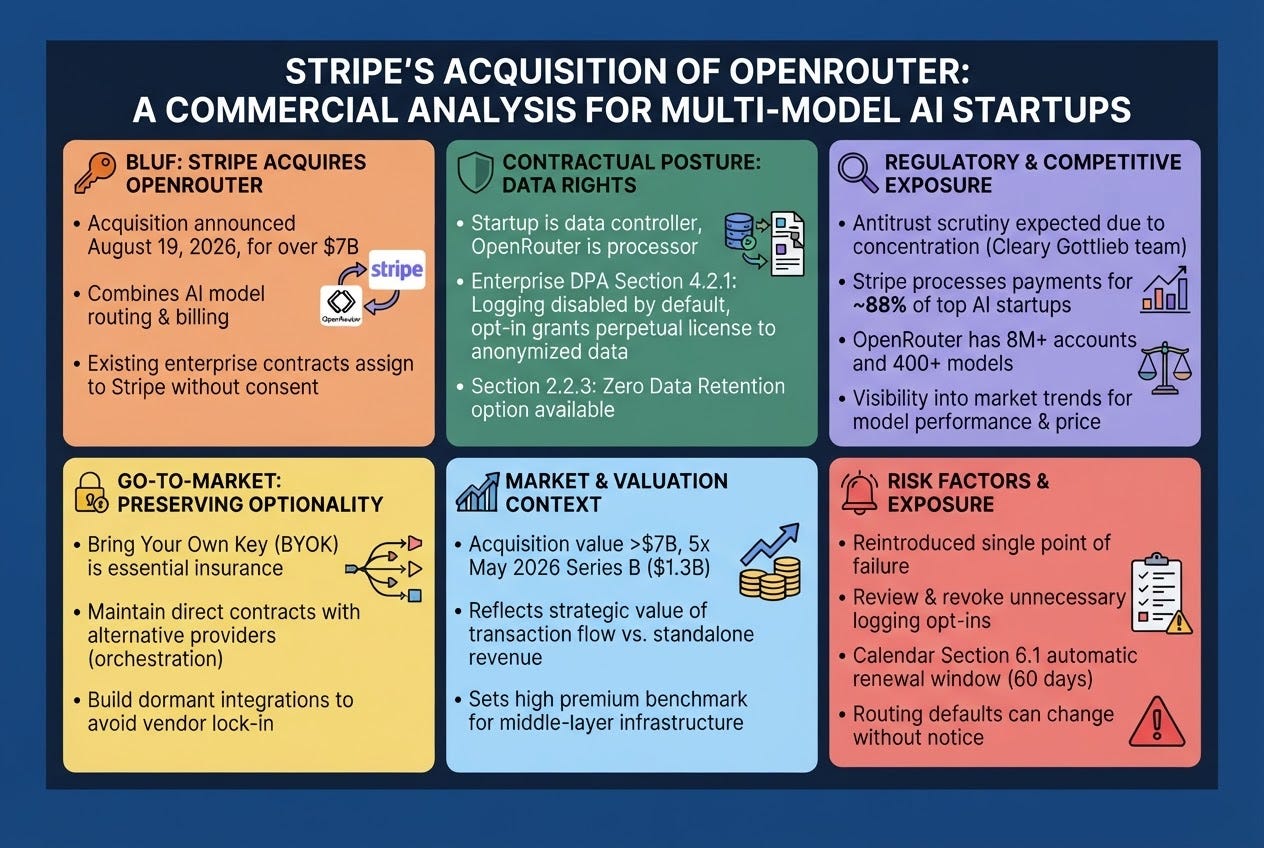
Stripe’s agreement to acquire OpenRouter for more than $7 billion, announced on August 19, 2026, places the metering, billing, and routing layer that many startups use to reach competing AI models inside the commercial structure of a single payments company. The acquisition does not rewrite OpenRouter’s published enterprise contract today, but it does activate an assignment clause that lets the existing agreement transfer to Stripe without the customer’s separate consent. Any founder or general counsel whose product depends on OpenRouter’s routing across more than 400 models now has a narrow window to read that contract, confirm its data handling terms, and decide whether multi-model independence survives a single-owner routing layer.A. Executive SummaryStripe’s agreement to acquire OpenRouter for more than $7 billion, announced on August 19, 2026, requires every startup routing AI traffic through the platform to audit its data processing agreement. OpenRouter connects customer applications to more than 400 AI models from more than 80 providers, and the enterprise version of that service already contains an assignment clause, at section 11.8 of its terms, that permits a merger or an asset sale to transfer the contract without the customer’s individual consent. Stripe’s own August 19 announcement names NVIDIA, Zoom, and Lovable as existing customers of the combined offering, and OpenRouter’s chief executive stated publicly that the company would keep its current name, product, and roadmap.The assignment clause already resolves whether the contract survives the deal. The routing defaults, the fee structure, and the data handling commitments that made OpenRouter useful in the first place now have to survive contact with a payments company that already processed OpenRouter’s own billing before the acquisition and that counts a large share of the current generation of well funded AI companies among its payment customers. This report sets out the established facts of the transaction, the specific contract terms a multi-model customer should review before the deal closes, the antitrust and data privacy exposure that the transaction’s own counsel staffing indicates, and the go to market choices available to a company that wants to preserve optionality across model providers regardless of who owns the routing layer.OpenRouter’s prior financing, a $113 million Series B round in May 2026 that valued the company at $1.3 billion, makes the acquisition price more than five times that mark roughly three months later, a valuation jump that carries its own commercial information about what Stripe believes the routing layer is worth once it sits beside a billing system Stripe already owns.B. Detailed FindingsIntellectual Property, Data Rights, and Contractual PostureThe document that controls a multi-model startup’s position after this acquisition is not the acquisition agreement itself: it is the enterprise Data Processing Agreement OpenRouter already has in place with its customers. Under that agreement, the customer is the data controller and OpenRouter is the processor, so OpenRouter may handle customer prompts and completions only on the customer’s documented instructions. Section 4.2.1 keeps prompt and chat logging disabled by default; a customer must affirmatively opt in through the admin dashboard before OpenRouter retains any input content beyond the categorization step needed to route the request. Opting in carries a cost the contract states plainly: once logging is enabled, the same section grants OpenRouter a broad, perpetual, irrevocable, and sublicensable license to the resulting de-identified and aggregated content, including the right to license or sell anonymized user content that is not tied back to the customer. Section 2.2.3 separately lets a customer select Zero Data Retention to opt out of having an underlying model provider train on its inputs and outputs, an option that is available but not the default state of an account.The clause with the most immediate consequence for this transaction is section 11.8, the assignment provision. It bars either party from assigning the agreement without the other party’s consent, with one carve out: an assignment to an entity that merges with OpenRouter or that acquires all or substantially all of its assets requires no customer consent at all. That carve out is what lets Stripe absorb OpenRouter’s existing enterprise book of business without renegotiating individual contracts one at a time, and a customer who wants to raise an objection before the data processing terms change has no contractual right to demand that conversation. Section 7.2 separately permits either party to disclose the agreement’s terms in confidence to an actual or prospective acquirer, the provision that let Stripe conduct diligence on OpenRouter’s customer contracts before signing. Cleary Gottlieb’s public description of its deal team for OpenRouter names a dedicated intellectual property and data privacy practice group alongside its antitrust group, staffing that indicates contract portability and data rights were negotiated issues in the transaction rather than an afterthought.Regulatory and Competitive ExposureAntitrust review is already a live consideration in this transaction. The Cleary Gottlieb team representing OpenRouter in the sale includes a named antitrust partner, staffing that would not appear on a deal of this kind absent an expectation of regulatory scrutiny. The underlying commercial fact that generates that scrutiny is concentration: Stripe’s own August 19 announcement states that eighty eight percent of the companies on a recent ranking of the fifty most valuable private AI companies already use Stripe for payments, and OpenRouter brings roughly 8 million developer accounts and connections to more than 400 models into the same corporate family. Combining the metering and billing layer with the routing layer gives one company visibility into which AI models are winning which workloads and at what price, a form of market information no single routing vendor or payments vendor holds on its own today.Data privacy exposure sits beside the antitrust question. OpenRouter’s enterprise Data Processing Agreement already commits to Standard Contractual Clauses and a United Kingdom international transfer addendum for cross border transfers, to notifying customers of new subprocessors with thirty days to object, and to notifying a customer of a legally binding government request for that customer’s data unless the law forbids disclosure. None of those commitments is automatically void because OpenRouter’s parent changes. What changes, as a practical matter, is the subprocessor list itself: once OpenRouter sits inside Stripe’s corporate structure, Stripe affiliates handling payment, tax, or billing functions may need to be added to that list, which triggers the thirty day objection window and gives an enterprise customer a concrete, time limited opportunity to review the new arrangement rather than simply filing a notice away unread.Go to Market and Commercial StructureA startup that built its product on OpenRouter’s promise of switching between competing models without rewriting integration code now faces a go to market choice that did not exist in the same form before the acquisition was announced. Bring your own key, the feature that lets a customer route through OpenRouter using its own direct account and pricing with an individual model provider rather than OpenRouter’s blended account, remains the most direct insurance against a single owner controlling the routing layer. A startup that already holds direct contracts with two or three model providers and uses OpenRouter only for orchestration keeps the ability to route around OpenRouter entirely if its terms change. A startup that routes exclusively through OpenRouter’s own blended account has delegated both its vendor selection and its negotiating position to a platform a payments company now owns, a position that becomes visible only at the next contract renewal or the next unannounced pricing change.The commercial middle path is a direct contract with at least one alternative routing or gateway provider, maintained as a working integration even while OpenRouter remains the primary path. Keeping that second integration current, rather than treating it as a one time proof of concept, is what turns a future migration into a scheduling decision instead of an engineering project. The economics support this hedge: OpenRouter’s own structure already takes a platform fee of roughly 5 percent of the inference spend it routes, a figure that was public before the acquisition and that a startup should expect to climb once that fee sits alongside Stripe’s existing payment processing economics on the same transaction.Market and Valuation ContextThe price itself tells a founder something concrete about how a strategic acquirer values a routing layer, even though the final consideration has not been confirmed in a public filing. OpenRouter raised $113 million in a Series B round in May 2026 at a $1.3 billion valuation, led by CapitalG, Alphabet’s growth investment arm, alongside Sequoia Capital and Andreessen Horowitz. An agreement reached roughly three months later at more than $7 billion values the same company at more than five times its most recent primary round, a markup that reflects strategic value to Stripe beyond what OpenRouter’s own revenue would support on a standalone multiple. For comparison, Stripe’s previous largest acquisition was Bridge, a stablecoin infrastructure company it bought for $1.1 billion in 2024; the OpenRouter price is more than six times that figure, a change in how large an acquisition Stripe is willing to make outside its core payments business.A founder negotiating a term sheet or a strategic partnership with any infrastructure vendor that sits between the company and its customers or suppliers should read this tr
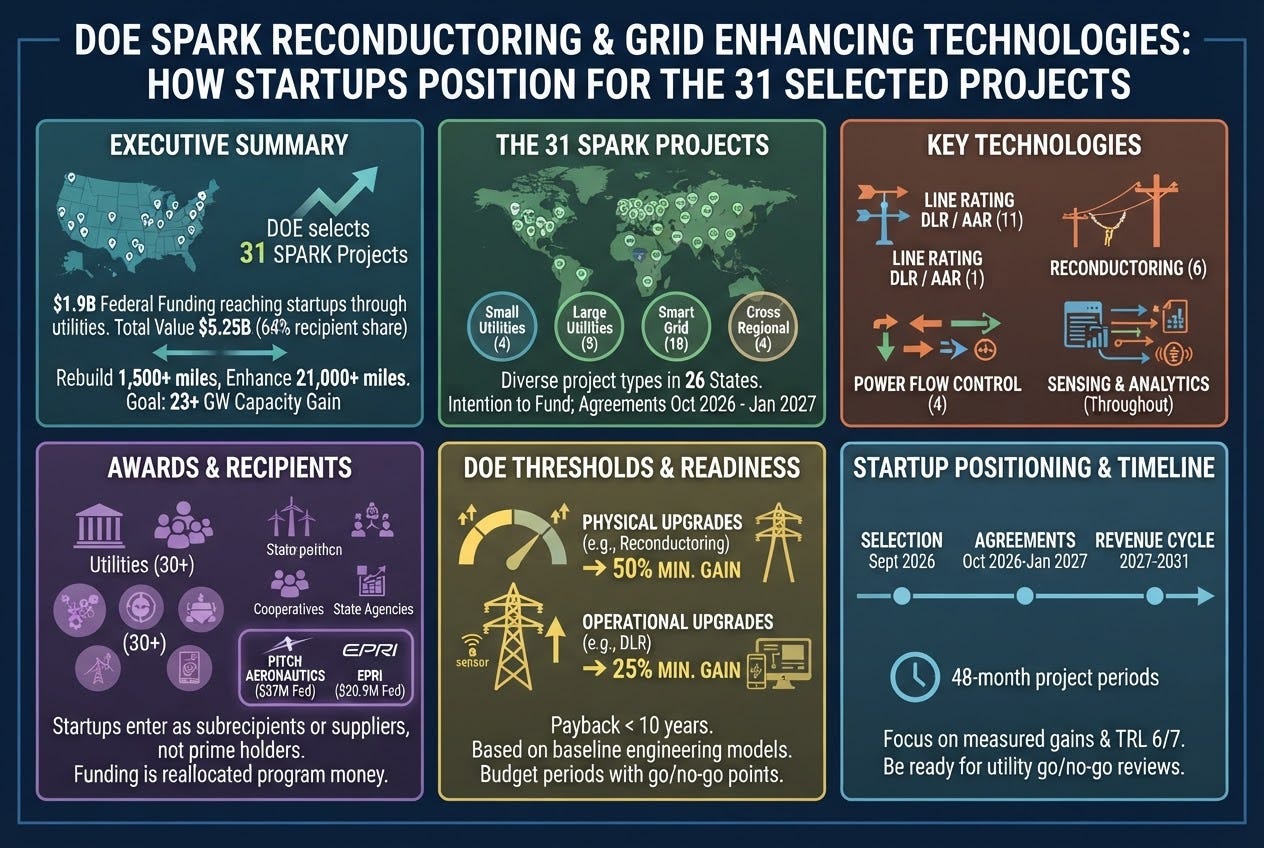
The Department of Energy selected 31 SPARK reconductoring and grid enhancing technology projects on September 24, 2026, committing about $1.9 billion that startups can reach through utility recipients. Total project value reaches $5.25 billion because recipients contribute $3.35 billion, about 64 percent of the total. The projects will reconductor or rebuild more than 1,500 miles of line and apply grid enhancing technologies across nearly 21,000 miles, a ratio of about 14 to 1, for a stated gain of more than 23 GW.Money per mile explains where startup contracts will land. The Entergy project covers about 1,125 miles at a total value of $27.4 million, roughly $24,000 per mile. The PPL Montour rebuild covers 29.3 miles at $142.9 million, roughly $4.9 million per mile. Sensing, line rating software, and power flow hardware cover far more wire per dollar than conductor does, so the larger number of vendor contracts goes to the cheaper technologies, while conductor makers win fewer and larger orders.Startups hold almost none of the awards. Utilities, cooperatives, and state agencies hold them, with two recipients outside that group: the startup Pitch Aeronautics at $37.0 million federal and the Electric Power Research Institute at $20.9 million. Selection is an intention to fund. Agreements are expected between October 2026 and January 2027, project periods run up to 48 months, and the notice sets minimum capacity gains of 50 percent for physical upgrades and 25 percent for operational technologies. Startups should position now around measured, contractable capacity gains and the technology readiness levels the notice requires, because utility purchasing follows the signed agreements.Detailed FindingsWhat Did the Department of Energy Select Under SPARK?DOE selected 31 projects in 26 states on September 24, 2026, funded from the Grid Resilience and Innovation Partnerships program that the 2021 infrastructure law authorized at up to $10.5 billion over five years. The money is reallocated program funding. DOE describes the selections as intentions to fund, and the figures stay preliminary until agreements are signed. The notice of funding opportunity, number 0003580, issued on March 12, 2026, with applications due May 20, 2026. DOE’s program page lists different dates, February 25 and May 5; the notice document itself controls here.The 31 divide into four small utility projects, five large utility projects, 18 smart grid projects, and four cross regional projects. Summing the federal shares in DOE’s list gives $1,893 million, which matches the $1.9 billion headline: $476.4 million in the grid resilience topic area, $606.5 million in the smart grid topic area, and $810.4 million in the grid innovation topic area. Total project value sums to $5,252 million. The four cross regional awards, to Colorado, Oklahoma, Ohio, and Indiana, take 43 percent of the federal dollars. DOE describes one of them, the Three Corners Connector between the Southwest Power Pool and the Western Interconnection, as a new high capacity transmission link, which places it outside the reconductoring work.Which Technologies Appear in the 31 Project Descriptions?Line rating technology appears in more project descriptions than any other single technology. Eleven of the 31 descriptions name dynamic line rating or a line rating or capacity rating system: Kit Carson Electric Cooperative, Rocky Mountain Power, the Tennessee Valley Authority, American Electric Power, Entergy, Eversource, New England Power, NorthWestern Energy, Orlando Utilities Commission, Pitch Aeronautics, and Public Service Company of New Mexico.Four descriptions name power flow control or stabilization hardware. NorthWestern Energy pairs advanced power flow control with dynamic line rating on a Montana and Wyoming transfer path, at $26.5 million federal on $53.0 million total. CenterPoint Energy Houston Electric lists an advanced transmission system stabilization device at $50.0 million federal. Duquesne Light lists stabilization devices at $22.2 million federal. The New York Power Authority lists a static synchronous compensator at the Marcy site, $50.0 million federal on $270.0 million total. Together the four draw $148.7 million in federal funds.Reconductoring appears by name in a smaller group. Arizona Electric Power Cooperative, Kit Carson, PPL Electric, Orlando Utilities Commission (high temperature low sag conductor), Pitch Aeronautics (targeted wire upgrades for Ameren Missouri, Ameren Illinois, and Farmington Electric Utility System), 1803 Electric Cooperative (wire replacement), and Indiana (reconductoring across the PJM and MISO seam) each carry conductor work. Several other projects list transmission line upgrades without stating a conductor type.Sensing and analytics appear throughout. Kit Carson pairs line rating with advanced sensors and data analytics. New England Power lists targeted field sensors and automated operations software. Powder River Energy lists real time sensors and AI models for planning and predictive maintenance. Guam Power Authority lists AI enabled operational tools. The Orlando project lists AI tools that reduce the number of sensors required, which states a design goal of fewer physical sensors per mile through modeling.What Does the 14 to 1 Mile Ratio Mean for Vendors?The ratio means grid enhancing technology vendors will see more contracts and conductor vendors will see larger ones. DOE’s totals give nearly 21,000 miles of grid enhancing technologies against more than 1,500 miles reconductored or rebuilt; some of the enhanced miles may overlap rebuilt lines, and DOE has not published the overlap. The two examples with public detail show the spread in cost. The Entergy project covers about 1,125 miles of existing line for $27.4 million total, about $24,000 per mile, with dynamic line rating, targeted surveys, substation and terminal upgrades, and hardware integration over four years. The PPL Montour project rebuilds 29.3 miles of a 230 kV corridor for $142.9 million total, about $4.9 million per mile, roughly 200 times the Entergy figure. The scopes differ: the Entergy figure includes substation work across 1,125 miles, and the PPL figure includes new structures, dual optical ground wire, and distributed acoustic sensing.The performance each buys also differs. Entergy states a minimum 25 percent increase in transfer capability on selected corridors, with early modeling showing 29 to 61 percent more available capacity across the project area. A 2024 study from the Goldman School of Public Policy at the University of California, Berkeley and GridLab found that advanced conductors raise line capacity 50 to 110 percent, usually cost about half as much as a new line for the same capacity, and take 18 months to three years to build. A rebuilt line carries more current in every hour. A line rating system releases headroom when weather cools the wire, and one trade report puts the gain at 20 to 40 percent on cool, windy nights, with less on hot, still days. That figure comes from a single secondary source and should be treated as a vendor range, not a measured result. Published coverage reports no split of the 23 GW between firm and conditional capacity.Who Receives the Awards and Where Do Startups Enter?Utilities, cooperatives, and state agencies receive nearly all of the awards, and a startup reaches the money as a subrecipient or a supplier. Two recipients sit outside that group. The Electric Power Research Institute receives $20.9 million federal on $41.7 million total to deploy advanced transmission technologies on FirstEnergy and Salt River Project systems. Pitch Aeronautics receives $37.0 million federal on $75.6 million total for weather based dynamic line rating software and targeted reconductoring at three host utilities. The Pitch structure shows a software company can carry the prime award while utilities serve as host sites.The notice permits for profit organizations as subrecipients. It bars entities of concern, requires a written waiver for each foreign subrecipient with no appeal of a denial, and requires all work to be performed in the United States unless DOE approves a waiver. Public vendor ties already exist. CTC Global announced that its carbon core ACCC conductor is part of the PPL Montour project, which also includes dual optical ground wire and distributed acoustic sensing. Ameren’s Illinois transmission company runs a pilot with Heimdall Power sensors, 15 installed and 15 more planned in 2026; the public record does not tie that pilot to SPARK, yet it places two rating approaches inside the same utility family that Pitch will serve.What Performance Thresholds Does the Notice Impose?The notice sets a 50 percent minimum increase in transfer capability for physical upgrades such as reconductoring and a 25 percent minimum for operational or digital upgrades such as dynamic line rating, topology optimization, and dynamic protection. The smart grid topic area requires a quantified increase with baseline and projected values in MW and percent but states no percentage threshold. Every topic area requires baseline and post project transfer capability supported by engineering models, simulations, or validated performance data.Technology readiness minimums apply: level 6 for advanced transmission technologies and high performance conductors, level 7 for all other technologies. Projects must show a payback of ten years or less when claiming the affordability benefit. Awards carry one budget period with go or no go decision points, so continued federal funding depends on measured performance. DOE plans to feed project data into its Metrics and Benefits Program. Cost share runs at least 50 percent of total project cost in the smart grid and grid innovation topic areas, and at least 25 percent for eligible small utilities in the grid resilience area. These conditions function as acceptance tests that the funder wrote into the grant, and every v
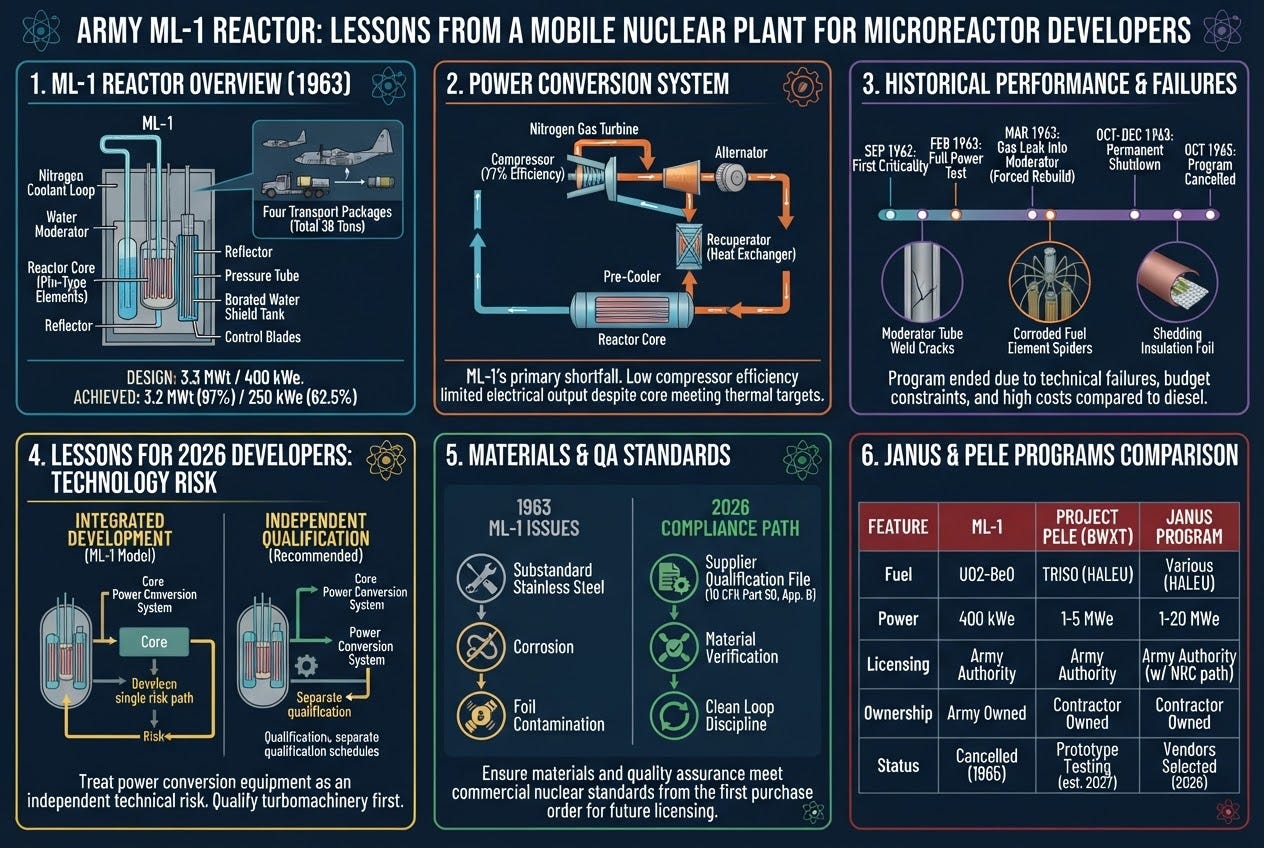
The Army ML-1 reactor reached 3.2 megawatts thermal in 1963 and delivered only 250 kilowatts electric, which tells microreactor developers to qualify their turbomachinery before they finance a core. The core produced 97 percent of its design heat, and the compressor, running at 77 percent efficiency, held the plant to 62.5 percent of its 400 kilowatt electric target. The Army cancelled the program in 1965 without fielding a unit.On August 26, 2026, the Army named five installations and five vendors for its Janus microreactor program, with about $2.2 billion committed over fiscal years 2027 to 2031 and a requirement that at least one reactor operate by September 30, 2028. Every one of those schedules assumes that the hardware between the core and the wire works the first time it runs together. The Army has made that assumption before.How Did the ML-1 Work?Aerojet General Nucleonics built the ML-1 at the National Reactor Testing Station in Idaho as a mobile plant that could ride in four transport packages, weighing about 38 tons in total. Nitrogen with 5 percent oxygen flowed through 61 pin type fuel elements of enriched uranium dioxide and beryllium oxide, left the core near 1,200 degrees Fahrenheit, and spun a closed cycle gas turbine. Water around the pressure tubes moderated the neutrons. A 500 foot exclusion zone replaced the heavy shield a normal plant would carry.What Happened in the March 1963 Test?The March 1963 test report shows 3.2 megawatts thermal against a 3.3 megawatt design, and 250 kilowatts electric against a 400 kilowatt design. Reactor inlet pressure came in at 274 pounds per square inch absolute against a design value of 315. The test report puts the shortfall on compressor efficiency, and I read that as the most important number in the file. The nuclear island delivered 97 percent of its design heat, and the machinery that converted that heat to electricity was custom built for the plant.The next failures arrived quickly. Coolant gas leaked into the moderator water after the first 100 hour high power run, which forced a rebuild. Foil that covered the regenerator insulation tore loose under aerodynamic buffeting and sent particles through a closed gas loop. The quarterly report of February 15, 1964 recorded massive corrosion on fuel element lower spiders and traced it to substandard material, and it recorded that the plant had not operated at all in the preceding quarter.Why Does a 1963 Gas Loop Matter to a 2026 Investor?It matters because the Janus vendors carry the same chain of risk, and the capital goes in before the chain has run once. In my years as a submarine nuclear officer, foreign material exclusion around any closed system was the discipline we drilled hardest, since loose debris in a loop does not stay where it was left. The ML-1 foil is that hazard in a different plant.In thirty years of counseling technology companies, I have watched first customers ask for the supplier qualification file before they ask for the technical specification. A nuclear buyer will ask for the same file, and a developer who expects to move from an Army authorization to a commercial license should hold its suppliers to the quality assurance criteria in Appendix B to 10 CFR Part 50 from the first purchase order.Fuel adds a constraint that the ML-1 program never faced. Janus reactors use high assay low enriched uranium to make TRISO fuel, and an Army official has said that national supply cannot yet fuel all 20 planned reactors. The Department of Energy plans to spend $2.7 billion over 10 years on enrichment services. Project Pele, the BWXT transportable reactor, received 40,000 TRISO fuel compacts at Idaho National Laboratory on November 5, 2025, and it can begin formal testing as early as 2027.Who Licenses and Insures a Microreactor on an Army Base?The Army licenses the Janus reactors under its own nuclear authority, and it says it is working with the Nuclear Regulatory Commission so vendors can later seek commercial licenses. The Commission’s Part 53 final rule, published at 91 Federal Register 15696 on March 30, 2026 and effective April 29, 2026, supplies an optional technology inclusive pathway for that later step, including Section 53.250 on defense in depth. The Price-Anderson Act, 42 U.S.C. 2210, runs through December 31, 2065, and covers Commission licensees. A contractor owned reactor on an Army installation needs a different indemnity, such as Public Law 85-804 relief or a Department of Energy contractor indemnity, and I found no public statement of which one the Janus agreements use.The ML-1 ended in 1965 when budgets tightened and the plant still had not finished a sustained run. A 1964 economic analysis put its ten year cost near ten times that of a diesel plant, and an Army official said on June 18, 2026 that a microreactor at $1 per kilowatt hour would not work against natural gas that costs the Army about 40 cents in austere locations. The 1964 cost comparison and the 2026 fuel price point to the same hurdle for any fielded nuclear plant.What Should Founders and Investors Ask Before the First Power Test?Ask for the measured efficiency of the first compressor or turbine on a test stand. Ask for the supplier qualification file on every pressure boundary material. Ask which indemnity covers the plant and who holds the risk when the contract ends. Ask how the Army operating record will convert into a Part 53 application. The ML-1 produced 62.5 percent of its target power in 1963, and a developer who can state its own equivalent number before the test deserves more confidence than one who cannot.The next piece in this series covers Vandellos I in Spain, a gas cooled reactor that a turbine hall fire ended in 1989, and it will show how the placement of rotating machinery and oil systems near a nuclear core decides whether one equipment failure stays one equipment failure.Interested in analysis about the intersection of tech, policy and the law? Check out my Substack channel. https://theinnovationattorney.substack.com/ This is a public episode. If you'd like to discuss this with other subscribers or get access to bonus episodes, visit theinnovationattorney.substack.com/subscribe

Comments

Download from Google Play

Download from App Store
 United States