


 Claim Ownership
The Boyz of Edtech | K–12 Education Insights
Subscribed: 0Played: 1
Subscribe

© 2026 Old Soul
Description
Explore the latest education business trends, entrepreneurship, and school leadership insights with us. We bring you expert discussions on district leadership, edtech innovation, education policy insights, and K-12 education advancements. Join us for valuable perspectives on edtech trends, startup founders in education, and strategies for effective school operations and relationship building.
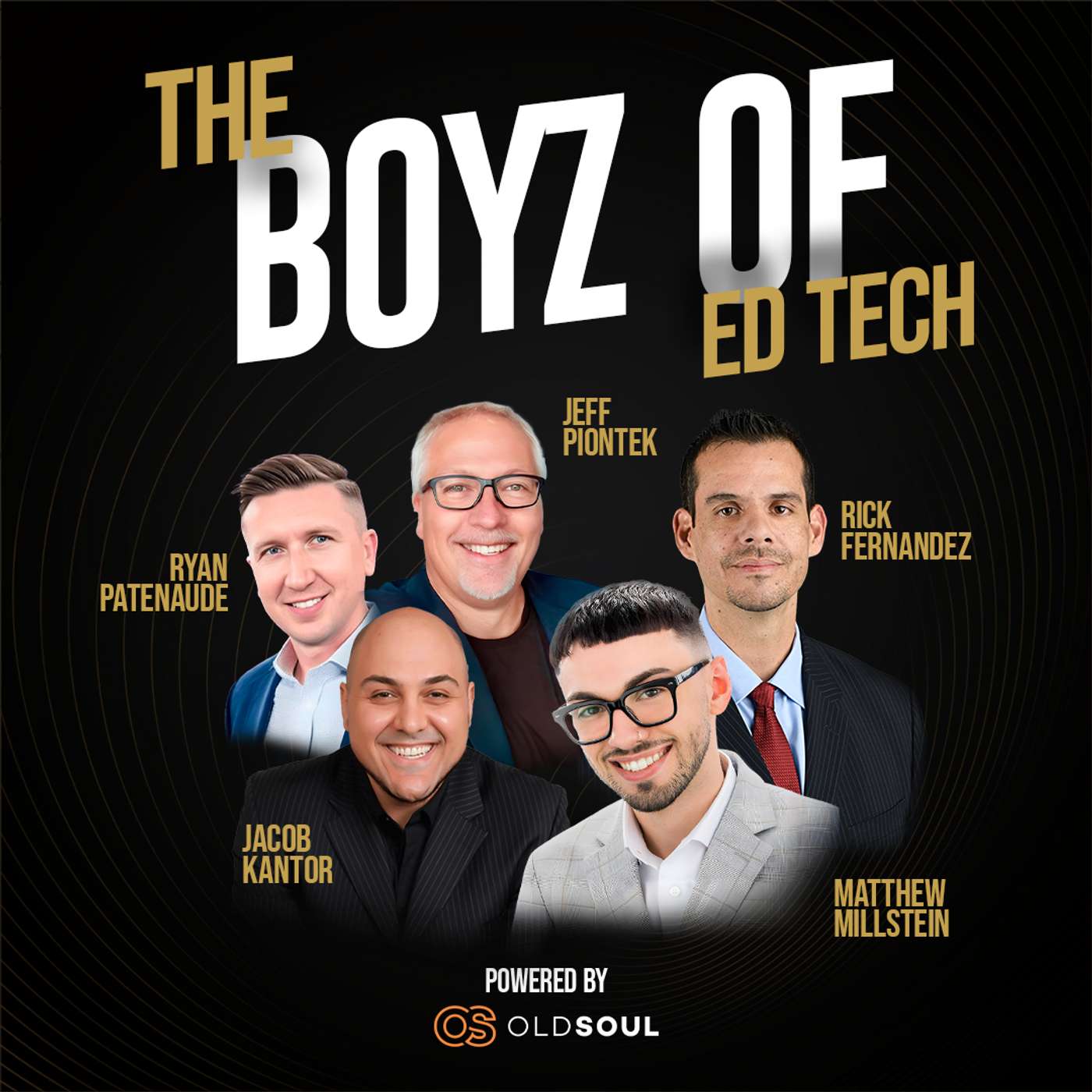
Hosted by Dr. Rick Fernandez, Jacob Kantor, Jeff Piontek, Ryan Patenaude, Matthew Millstein, and powered by Old Soul.
Hosted by Dr. Rick Fernandez, Jacob Kantor, Jeff Piontek, Ryan Patenaude, Matthew Millstein, and powered by Old Soul.
25 Episodes
Reverse
In this episode of The Boyz of EdTech, Rick Fernandez, Matthew Millstein, Jeff Piontek, and Jacob Kantor welcome David Sturtz, CEO of Sturtz & Company, for a different perspective on education innovation. Rather than focusing on classroom technology, the conversation examines the buildings, budgets, enrollment trends, and long-term planning decisions that shape what districts can ultimately provide for students. David shares his unconventional path from running a tutoring business to helping school systems across the country rethink facilities, bonds, and master planning.David explains why many districts are operating school portfolios designed for a different era. Buildings constructed decades ago were created around different enrollment patterns, instructional models, staffing needs, and economics. Today, districts are being asked to provide special education, intervention, career pathways, expanded student services, and more while maintaining aging facilities and navigating rising operating costs. For David, the challenge is not simply deciding whether to renovate or replace a building. It starts with designing a district that can sustainably support the student experience leaders want to provide.The conversation explores David's approach to connecting enrollment, staffing, facility condition, utilization, cost per pupil, capital availability, and educational adequacy into a comprehensive planning process. He explains why districts should establish minimum viable enrollment, evaluate how efficiently buildings are being used, and continually revisit long-term facilities plans rather than treating master planning as a one-time event. The goal is to help districts move toward a portfolio of schools that is newer, fewer, physically stronger, and financially sustainable.The group also discusses community engagement, declining enrollment, future-ready school design, and the difficult politics surrounding consolidation and school closures. David argues that communities need more than a list of buildings and budget numbers. They need to understand why change is being considered, what constraints districts face, and how different options affect students over time. Ultimately, the episode challenges district leaders to plan before financial pressure forces emergency decisions, using facilities not as an isolated operational concern, but as a strategic tool for directing more resources toward teaching and learning.Connect with the BoyzRick Fernandez: https://www.linkedin.com/in/dr-rick-fernandez-40692434/Matthew Millstein: https://www.linkedin.com/in/matthew-millstein/Jacob Kantor: https://www.linkedin.com/in/thejacobkantor/Ryan Patenaude: https://www.linkedin.com/in/ryanpatenaude/Jeff Piontek: https://www.linkedin.com/in/jeffpiontek/Key Moments05:22 Why some older school buildings have outlasted newer facilities08:25 The growing maintenance challenge facing aging school buildings10:07 Designing school portfolios around today's student population12:39 Why facilities planning needs to be a continuous long-term process15:29 Designing districts before designing individual schools18:20 David introduces his approach to comprehensive facilities planning19:56 Bringing communities into difficult facilities decisions24:00 Connecting the number of schools to spending on direct instruction27:00 Using enrollment, utilization, condition, and cost to evaluate schools32:18 How better-designed schools can create more inspiring learning environments35:45 Why districts need a complete view of their facilities ecosystem38:17 Explaining the 'why' behind consolidation and restructuring decisions42:33 Planning school portfolios around future enrollment, not just today's numbers47:26 Why the cost of maintaining the status quo can exceed the cost of changeConnect with David SturtzLinkedIn: https://www.linkedin.com/in/david-sturtz-37b3199 Website: https://www.sturtzco.com/ Interested in joining the show? Fill out the form: https://forms.gle/SRVhzpXikBombee38Listen to the episode: https://youtu.be/hnbrHwODgdM
In this episode of The Boyz of EdTech, recorded at EdTech Week, Jacob Kantor and Matthew Millstein sit down with Robin Cowie, CEO of Skillmaker, and Camden Weis, Founding Partner and Chief Revenue Officer, to revisit the year since Skillmaker won the EdTech Week pitch competition. Robin and Camden share how the experience became a launchpad for investment, partnerships, and a deeper connection between their employer-first strategy and the education and workforce ecosystem.Robin traces Skillmaker's roots back to his father's work using first-person video to train workers in South African gold mines. That fascination with immersive learning followed Robin through filmmaking, including The Blair Witch Project, gaming, and eventually workforce development. Today, Skillmaker combines immersive training, simulation, AI-powered smart glasses, assessment, and industry certifications to help automotive technicians learn faster and receive support directly in the flow of work.The conversation explores why Skillmaker chose to work with employers before expanding into schools, trade programs, and CTE. Robin and Camden explain how working directly with technicians helped them challenge assumptions and improve the product in real working environments. Rather than building a finished solution and hoping the market would adopt it, they placed an early version into shops, listened closely to technicians and partners, and used that feedback to strengthen everything from the learning experience to the hardware itself.Connect with the BoyzRick Fernandez: https://www.linkedin.com/in/dr-rick-fernandez-40692434/Matthew Millstein: https://www.linkedin.com/in/matthew-millstein/Jacob Kantor: https://www.linkedin.com/in/thejacobkantor/Ryan Patenaude: https://www.linkedin.com/in/ryanpatenaude/Jeff Piontek: https://www.linkedin.com/in/jeffpiontek/Key Moments03:19 How EdTech Week became a launchpad for Skillmaker05:10 Turning a pitch competition into investment and strategic partnerships09:08 The origins of Skillmaker's immersive learning approach12:00 How smart glasses and VR support automotive technicians15:42 Using competency assessment to accelerate workforce training16:55 Building AI that 'makes jobs, not takes jobs'17:56 What changed for Skillmaker after winning the pitch competition19:43 Why Skillmaker put an early product directly into the market22:37 Letting customers shape and strengthen the product25:22 Challenging assumptions and finding ground truth without ego29:19 Why purpose-built, responsible AI matters30:35 Restoring the value of skilled trades for the next generation33:51 Building a bridge between high school students and employers35:04 Using measurable outcomes to assess, accelerate, and assist learnersConnect with Robin CowieLinkedIn: https://www.linkedin.com/in/robincowie Website: https://robincowie.com/ Connect with Camden WeisLinkedIn: https://www.linkedin.com/in/camden-james-weis-99604281 Website: https://www.camdenjames.com/ Interested in joining the show? Fill out the form: https://forms.gle/SRVhzpXikBombee38
In this episode of The Boyz of EdTech, Rick Fernandez, Matthew Millstein, and Jeff Piontek sit down with Michael Preston, Executive Director of the Joan Ganz Cooney Center at Sesame Workshop. Michael shares the path that took him from growing up with Sesame Street and experimenting with an early home computer to working in New York City schools, helping launch what became Computer Science for All, and eventually leading an R&D center focused on helping the technology and media sectors design better experiences for children.The conversation explores what the computer science movement can teach education as AI reshapes how students learn and work. Michael argues that computer science was never simply about teaching a programming language. It was about helping young people understand how technology works, question outputs, experiment, iterate, and develop confidence in their own ability to create. Those same principles become even more important as AI makes it easier for students to outsource parts of the thinking process.Michael also challenges educators and EdTech companies to put children directly into the design process. Drawing on the Cooney Center's work, he explains why students should be partners from the earliest stages of product development, when their ideas can still meaningfully shape what gets built. The group discusses screen time, phone bans, oral language, human relationships, teacher involvement, evidence of learning, and the tension between technology that expands agency and technology that can quietly take it away.Looking toward the future, Michael argues that preparing students for an unpredictable workforce is less about identifying the perfect technical skill and more about developing rigorous curiosity, adaptability, agency, and a willingness to struggle with difficult problems. Reflecting on the legacy of Joan Ganz Cooney and Sesame Street, he leaves educators and product leaders with a larger design question: if technology can shape children's experiences at enormous scale, how can we intentionally design it around the kind of world, relationships, and opportunities we want children to have?Connect with the BoyzRick Fernandez: https://www.linkedin.com/in/dr-rick-fernandez-40692434/Matthew Millstein: https://www.linkedin.com/in/matthew-millstein/Jacob Kantor: https://www.linkedin.com/in/thejacobkantor/Ryan Patenaude: https://www.linkedin.com/in/ryanpatenaude/Jeff Piontek: https://www.linkedin.com/in/jeffpiontek/Key Moments01:20 Michael's journey from early computing to education innovation05:34 What Computer Science for All was really designed to give students06:18 Why computer science remains relevant in the age of AI10:36 Rethinking attention, learning stamina, and how kids learn today13:04 Protecting student thinking and agency when using AI16:07 Why children should help design the technology built for them19:49 What students and teachers are saying about technology and AI24:26 Protecting human relationships, oral language, and student voice29:23 Preparing young people to use AI without outsourcing their thinking32:41 What students need for a workforce we cannot fully predict33:41 Building rigorous curiosity and comfort with uncertainty38:07 What Sesame Street's legacy can teach today's EdTech designers40:48 Resources and research from the Joan Ganz Cooney Center41:30 Why EdTech leaders should include students in product decisionsInterested in joining the show? Fill out the form: https://forms.gle/SRVhzpXikBombee38
In this episode of The Boyz of EdTech, Rick Fernandez, Matthew Millstein, and Jacob Kantor sit down with Bobby Offterdinger, CEO of TAM to Target, for a tactical conversation about what actually works when selling into K-12. Bobby shares his journey from elementary school teacher and reading specialist to instructional technology, EdTech sales, and eventually launching TAM to Target to help companies build more effective go-to-market strategies across education and the public sector.Bobby breaks down why more meetings do not automatically translate into more revenue. Successful EdTech companies still need product-market fit, message-market fit, sales acumen, and a clear understanding of district procurement. The group explores growing opportunities in CTE and career readiness, why some legacy products are leaving room for new competitors, and how founders can connect a specific district leader's pain point to a specific solution rather than overwhelming prospects with every feature their product offers.The conversation also gets practical about outbound sales. Bobby explains why phone outreach continues to outperform cold email for TAM to Target, how founders should test different messages before scaling volume, and why genuine curiosity and empathy are fundamental sales skills. They discuss researching prospects before meetings, choosing go-to-market channels based on the type and price of a product, and understanding why selling an enterprise-wide system requires a very different motion from selling a smaller solution below procurement thresholds.Bobby also shares how AI is reshaping the SDR function. Instead of expecting one person to research accounts, build lists, write outreach, call prospects, and manage every other part of prospecting, TAM to Target separates go-to-market engineering from the human conversations SDRs are best positioned to handle. The episode closes with a rapid-fire discussion on cold email, phone calls, sales signals, storytelling, and why the strongest K-12 sales conversations still come back to preparation, relevance, trust, and listening with empathy.Connect with the BoyzRick Fernandez: https://www.linkedin.com/in/dr-rick-fernandez-40692434/ Matthew Millstein: https://www.linkedin.com/in/matthew-millstein/ Jacob Kantor: https://www.linkedin.com/in/thejacobkantor/ Ryan Patenaude: https://www.linkedin.com/in/ryanpatenaude/ Jeff Piontek: https://www.linkedin.com/in/jeffpiontek/ Key Moments03:26 Why Bobby launched TAM to Target05:55 What separates meetings from actual EdTech revenue09:53 Why CTE and career readiness are gaining momentum14:00 Finding message-market fit before scaling outreach16:01 Testing soft versus direct calls to action16:28 Why phone outreach remains powerful in K-1219:02 Replacing the product dump with curiosity and empathy22:07 Matching your go-to-market channel to the type of product24:12 The district pain points that change and the ones that stay constant27:43 Why founders still walk into sales meetings unprepared29:51 Rethinking the traditional SDR role with AI and go-to-market engineering33:03 Using AI to create more time for human sales coaching39:33 Why great salespeople get buyers to tell their own stories43:33 Rapid-fire lessons on cold outreach, signals, and smarter prospectingConnect with Bobby OffterdingerLinkedIn: https://www.linkedin.com/in/bobbyoffterdinger Website: https://tamtotarget.com/ Interested in joining the show? Fill out the form: https://forms.gle/SRVhzpXikBombee38
In the first edition of EdTech Unwrapped, The Boyz of EdTech welcome Mauricio Szajman and Axel Petochi, Co-Founders of BaboBot, to put their product in the hot seat. Mauricio and Axel walk Rick Fernandez, Matthew Millstein, and Jeff Piontek through BaboBot, an AI-powered information management platform designed to connect the systems and information schools already use and make that knowledge easier for families, students, and staff to access.Axel shares how the idea started at Babson College with a simple problem: finding out what was being served in the cafeteria. A small tool that texted students the daily menu quickly attracted roughly a quarter of the school, revealing a much larger problem around fragmented information. That early experiment eventually evolved into BaboBot, which aims to give school communities one place to ask questions and receive personalized answers based on the information relevant to them.During the live demo, Mauricio shows how parents can ask about events, field trips, forms, and their children, while administrators can explore attendance trends, safety information, staff schedules, and other operational questions. The platform connects information from documents, Google Drive, emails, websites, and school systems, provides citations with its answers, identifies conflicting information, and escalates unanswered questions to staff rather than simply guessing.The Boyz then dig into the questions school leaders and EdTech buyers are likely to ask, including onboarding, privacy, permissions, analytics, integrations, communication workflows, and differentiation from established platforms. Mauricio and Axel also share where BaboBot is headed, including WhatsApp access, deeper integrations, proactive communications, and automations that can turn school information into action. The broader vision is to move beyond another communication tool and create an AI-powered operating layer that brings siloed school data into one central brain.Connect with the BoyzRick Fernandez: https://www.linkedin.com/in/dr-rick-fernandez-40692434/Matthew Millstein: https://www.linkedin.com/in/matthew-millstein/Jacob Kantor: https://www.linkedin.com/in/thejacobkantor/Ryan Patenaude: https://www.linkedin.com/in/ryanpatenaude/Jeff Piontek: https://www.linkedin.com/in/jeffpiontek/Key Moments00:59 How BaboBot connects school information in one place02:25 How a college cafeteria problem inspired BaboBot03:57 Live demo of the parent and family experience10:45 What onboarding looks like for schools and districts13:29 How users get access through existing school rosters14:51 Protecting school data while using an LLM16:15 Helping prospective families explore schools and programs16:56 Inside BaboBot's administrator portal and knowledge base23:26 Turning platform activity into useful district reporting25:53 Personalizing information based on each user's role27:31 The Boyz begin their product feedback30:14 Meeting families where they already communicate31:04 Building an AI brain that can turn school data into actionConnect with Axel Petochi and Mauricio SzajmanAxel Petochi LinkedIn: https://www.linkedin.com/in/axel-petochi-7b86b91ab Mauricio Szajman LinkedIn: https://www.linkedin.com/in/mauricio-szajman Website: https://babobot.com/ Interested in joining the show? Fill out the form: https://forms.gle/SRVhzpXikBombee38Listen to the episode: https://youtu.be/hnbrHwODgdM

Comments

Download from Google Play

Download from App Store
 United States