


 Claim Ownership
Duane Forrester Decodes
Subscribed: 0Played: 7
Subscribe

© Duane Forrester Decodes
Description
AI is rewriting how brands get found, cited, and trusted. Duane Forrester breaks down what that means for practitioners and marketing leaders who can't afford to get it wrong.
duaneforresterdecodes.substack.com
duaneforresterdecodes.substack.com
26 Episodes
Reverse
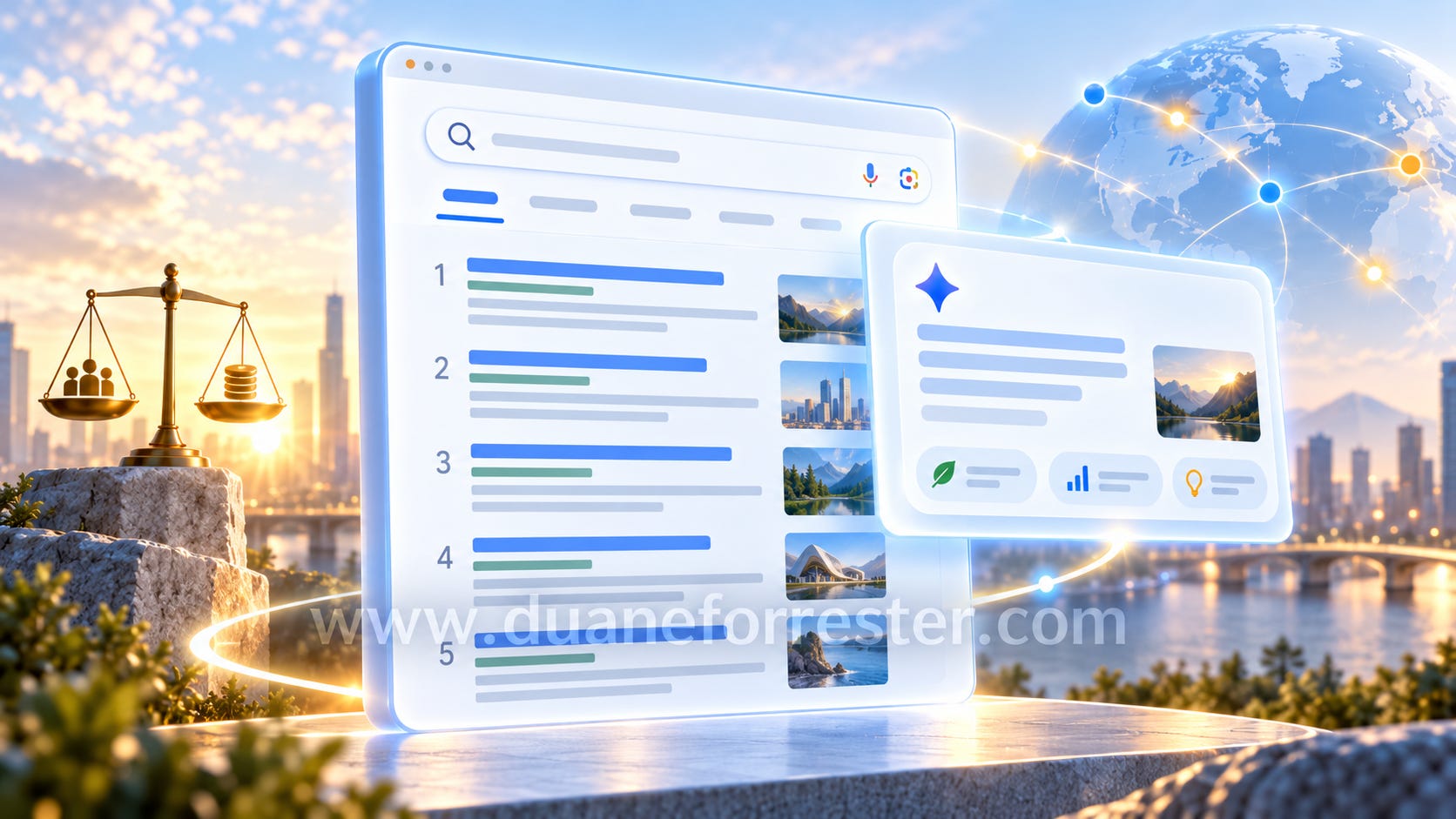
Show Notes: The SERP Stops Being the Default Between 2028 and 2030, and the Place It Moves To Already ExistsGoogle's own statementsGoogle: A new era for AI Search (I/O 2026): Liz Reid's I/O announcement; Gemini 3.5 Flash as the default model in AI Mode, the rebuilt search box, AI Mode passing one billion monthly users.Search Engine Roundtable: Google Chrome Won't Make AI Mode the Default Search Experience: Rajan Patel calling the Chrome Canary flag an error and saying Google isn't planning to make AI Mode the Chrome default.Search Engine Journal: Google Rolls Out New "Web" Filter for Search Results: The May 2024 launch of the links-only Web filter, announced by Danny Sullivan.Google: Q2 2026 earnings call, remarks from our CEO: Sundar Pichai on AI Mode costs hitting their lowest level since launch and AI Overviews and AI Mode merging into one experience.Alphabet Q2 2026 earnings call transcript: Full transcript, including the 1% decline in Network advertising revenue.Google: Everything you need to know from 2026 (Google Marketing Live recap): Google's own GML recap covering ads inside AI Mode and the "reinventing what an ad is" statement.Google Search Central: Mobile-first indexing has landed: Google declaring mobile-first indexing complete in October 2023, the seven-year precedent used for the forecast timeline.Adoption and behavior dataPew Research Center: Google users are less likely to click on links when an AI summary appears: Browsing study of 900 US adults; 18% of searches produced an AI summary, with clicks on traditional results falling from 15% to 8% of visits.AI News: Similarweb's 2026 Generative AI Landscape on AI Overviews: AI Overviews on 43% of US searches, up from 15% a year earlier; AI Mode visit growth; the 5.4% increase in query length.Similarweb: Zero-Click Marketing and the 2026 data: AI Mode at 0.34% of Google searches from January to April 2026, and AI Mode referral rates of 1.6% to 2.5% against 17% to 19% for traditional search.OpenAI: Scaling AI for everyone: OpenAI's February 2026 announcement of 900 million weekly ChatGPT users.PPC Land: Google faces bipartisan brief urging tougher remedy: Coverage of the amicus brief in the DOJ appeal, including its point that no industry-standard measurement of AI Overview prevalence exists.Regulation and litigationAdvanced Television: CMA imposes Google publisher AI opt-out: The UK Competition and Markets Authority's June 3, 2026 conduct requirement on AI Overviews and AI Mode opt-outs.SCL: European Commission investigates Google for using online content for AI purposes: The December 2025 EU investigation into AI Overviews, AI Mode, and publisher content.MLex: US DOJ, states argue appeal of Google Search ruling, ask for harsher remedies: The July 2026 cross-appeal brief, including the "competitive window may close" warning.Related reading from Duane Forrester DecodesCohorts, Clusters, and the Coming AI Ad System: My August 2025 piece describing query-time, auto-generated ads, the system now arriving inside AI Mode.Three Predictions for 2027, and Why You Won't Be Able to Check Them: The 2027 predictions piece referenced in this episode.Google Now Has the Math to Rank Without an Index, and the Results Page Does Not Survive It: Last week's piece on the DeepMind research behind ranking without an index.The Machine Layer: My book on how these systems work underneath search and AI answers. Get full access to Duane Forrester Decodes at duaneforresterdecodes.substack.com/subscribe
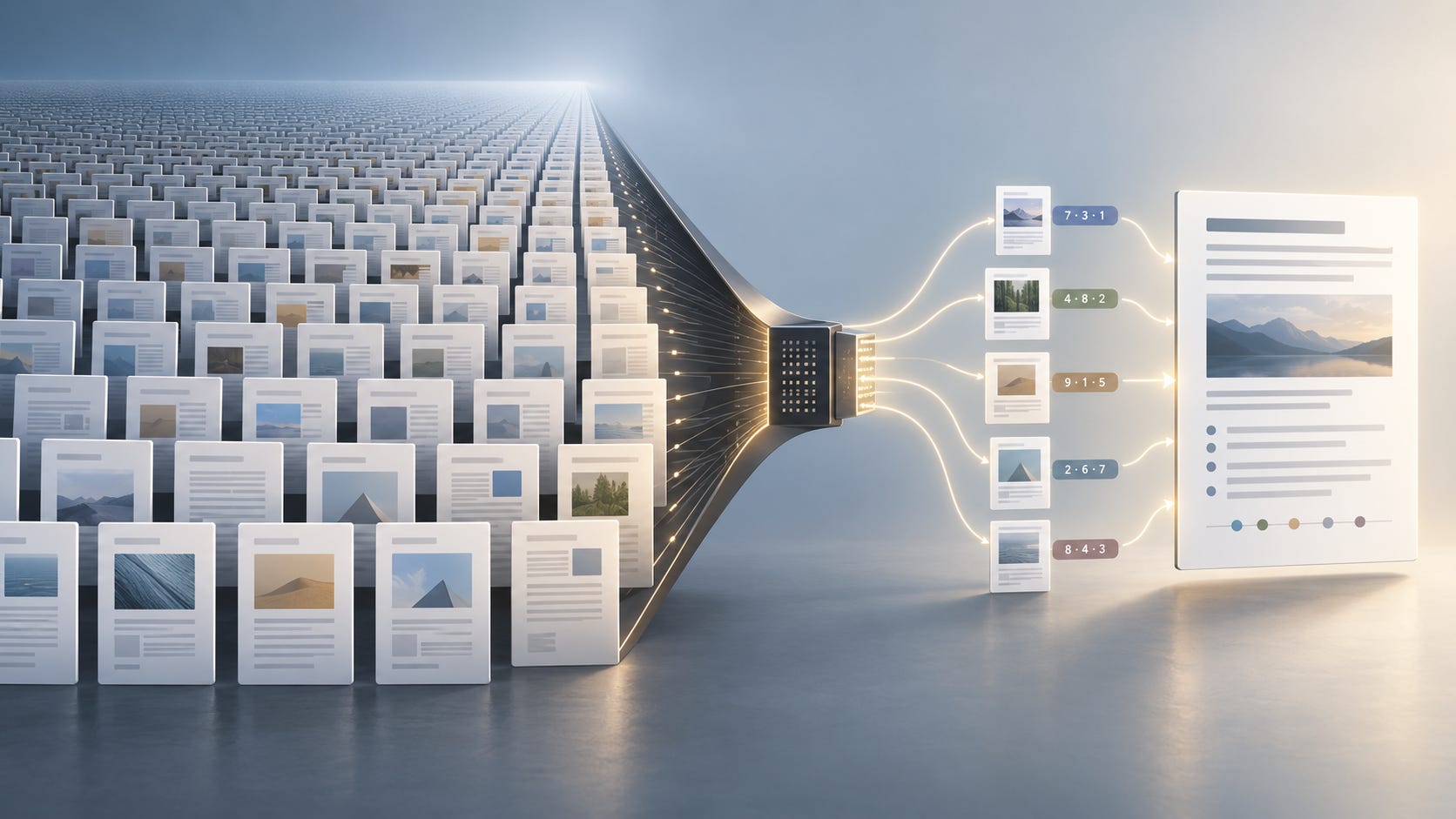
Show Notes: Google Now Has the Math to Rank Without an Index, and the Results Page Does Not Survive ItReferences mentioned in this episode, in the order they come up.Google Now Has the Math to Rank Without an Index, and the Results Page Does Not Survive It. This week's article on Duane Forrester Decodes. Link to be added on publication.Google DeepMind Develops New AI Search Ranking Model. Roger Montti, Search Engine Journal. The piece this episode builds on; the clearest walkthrough of the dual encoder and cross encoder mechanics.Autoregressive Ranking: Bridging the Gap Between Dual and Cross Encoders. Google DeepMind, UMass Amherst, UT Austin, January 2026. The paper: the linear-growth proof for dual encoders and the SToICaL training loss.Rethinking Search: Making Domain Experts out of Dilettantes. Metzler, Tay, Bahri, Najork, Google Research, 2021. The proposal that started the arc; carries its own disclaimer that it is not a product roadmap.Transformer Memory as a Differentiable Search Index. Tay et al., Google Research, 2022. The DSI prototype: a single Transformer mapping queries directly to document identifiers.DSI++: Updating Transformer Memory with New Documents. Mehta et al., Google, EMNLP 2023. The freshness problem: continually indexing new documents causes forgetting of old ones, plus the mitigations.WordNet. Princeton University. The lexical database used as one of the two evaluation sets; its noun hierarchy supplies the ground-truth rankings.Alphabet Second Quarter 2026 Results. SEC 8-K, Exhibit 99.1. Source for the $63.27 billion Google Search and other figure and the 17 percent growth rate.Google Marketing Live 2026. Google, May 20, 2026. The announcement of Gemini-built ad formats for AI Search, tailored to the individual query.Cohorts, Clusters, and the Coming AI Ad System. Duane Forrester Decodes, August 2025. Where Intent Vector Bidding was coined and the query-time ad system described.Mechanism Design for Large Language Models. Dütting et al., Google Research. Best paper, The Web Conference 2024. The token auction: advertisers bidding on generated text token by token.The Machine Layer. Duane's book on how content earns its place inside AI retrieval systems. Get full access to Duane Forrester Decodes at duaneforresterdecodes.substack.com/subscribe

Show notes: AI Changed the Buyer in Months. Businesses Change in Years.References mentioned in this episode:LLMs Are Time Machines That Don't Tell You How Far You Went - Last week's piece on the confidently underinformed buyer, path metadata, and why citation is presence, not traffic.Pew Research Center: Americans and AI 2026 - Survey of 5,119 US adults (February 2026 fieldwork). Chatbot adoption, daily use, and information search as the top use.Why Part of Your AI Authority Takes Years, Not Campaigns. And Why It Comes From Other People. - August piece on how category authority accrues in models and where it comes from.When AI Has Nothing On Your Company, It Describes Someone Else. - Why a gap in what models know about you gets filled by a substitute, and why content audits miss it.The GEO Tooling and Data Market Has a Trust Problem - The tooling-first instinct and why the measurement market needs scrutiny before purchase.Google Analytics: What's New (AI Assistant channel, May 13, 2026) - Google's own description of the GA4 AI Assistant channel and what it tracks.Introducing AI Performance in Bing Webmaster Tools Public Preview - Microsoft's February 2026 announcement of citation reporting across Copilot and Bing AI answers.duaneforrester.com - Consulting on GEO and SEO.The Machine Layer - The book, on Amazon. Get full access to Duane Forrester Decodes at duaneforresterdecodes.substack.com/subscribe

Show Notes: LLMs Are Time Machines. The Problem Is Where They Drop You.Sources and links referenced in this episode:Melumad & Yun, PNAS Nexus, October 2025. Seven experiments, 10,462 participants, on how learning from AI syntheses compares with learning through web search.https://academic.oup.com/pnasnexus/article/4/10/pgaf316/8303888Pew Research Center, July 2025. Browsing-panel study of 900 US adults across 68,879 Google searches, measuring click behavior when an AI summary is present.https://www.pewresearch.org/short-reads/2025/07/22/google-users-are-less-likely-to-click-on-links-when-an-ai-summary-appears-in-the-results/Fisher, Goddu & Keil, Journal of Experimental Psychology: General, 2015. Nine experiments on how internet search inflates self-assessed knowledge.https://pubmed.ncbi.nlm.nih.gov/25822461/Lee et al., CHI 2025. Microsoft Research and Carnegie Mellon survey of 319 knowledge workers on AI confidence and critical thinking.https://dl.acm.org/doi/full/10.1145/3706598.3713778Lewandowski, Information Research, 2026. Exploratory study on information regret and answer engines.https://doi.org/10.47989/ir31ISIC65159When AI Has Nothing On Your Company, It Describes Someone Else. The companion piece on why this failure is invisible to content audits.https://duaneforresterdecodes.substack.com/p/when-ai-has-nothing-on-your-companyThe Machine Layer.https://www.amazon.com/Machine-Layer-Visible-Trusted-Search/dp/B0G2WZKM59/ref=sr_1_1 Get full access to Duane Forrester Decodes at duaneforresterdecodes.substack.com/subscribe

Everyone Is Quoting the Same Number and Getting Different AnswersReferences from this episode:Cloudflare, Crawl-to-Refer Ratios on Cloudflare Radar - the primary source for everything in this episode. The full formula, the June 19 to 26 2025 sample week, the user-agent aggregation, the Google ASN exclusion, and the native-app Referer caveat that says the calculations may overstate the ratios by an amount that is unclear.Cloudflare, Control Content Use for AI Training - the separate June 2025 figures I mentioned, where Anthropic sits at 73,000 to one against the 70,900 in the post above. Same publisher, same month, different window.Cloudflare, From Googlebot to GPTBot: Who's Crawling and Who's Clicking - background on the crawl-to-click gap and how the ratios have moved since launch.Cloudflare Radar AI Insights - the live dashboard. Worth pulling your own figure here rather than quoting somebody else's, and worth noting which window you selected when you do.Google, Search updates from I/O 2026 - the source for the AI Mode scale claims, including the growth rate published without a base.The Machine Layer - my book, if you want to go further into how these systems get measured and mismeasured. Available here.The written version is on the Substack. If you have hit a metric in this space that fell apart once you asked what was in the denominator, leave a comment there or reach out directly. Specific examples are more useful than the general argument. Get full access to Duane Forrester Decodes at duaneforresterdecodes.substack.com/subscribe

Comments

Download from Google Play

Download from App Store
 United States