


 Claim Ownership
Terminal Value
Subscribed: 0Played: 0
Subscribe

© 2026 Nik Singh
Description
Terminal Value is a market landscape podcast that breaks down where value accrues in AI, software, and technology markets through deep dives with founders, operators, and investors.
Terminal Value is hosted by Nik Singh and is currently not monetized. Content is for general information and education, not investment, financial, legal or tax advice. Company discussions are not recommendations to buy or sell securities. Views are the speakers’ own and reflect the recording date.
Terminal Value is hosted by Nik Singh and is currently not monetized. Content is for general information and education, not investment, financial, legal or tax advice. Company discussions are not recommendations to buy or sell securities. Views are the speakers’ own and reflect the recording date.
18 Episodes
Reverse

In this episode of Terminal Value, I’m joined by Karl Alomar, Managing Partner at M13 and former Chief Operating Officer of DigitalOcean, to discuss where value may accrue as AI models become cheaper, why proprietary context and data matter, and what makes an application difficult to replace.We cover DigitalOcean’s developer-first strategy and just-in-time capacity planning, the GPU shortages that gave neoclouds their opening, inference efficiency, model pricing, real-time data infrastructure, and AI products embedded in core business operations. Karl also shares his view on AI-enabled microbusinesses, the value of operating experience in venture capital, the tension between company-building and secondary liquidity, and the identity and security layers AI agents may need.Terminal Value: https://www.youtube.com/@Terminal-Value-PodcastChapters0:00 Why the real AI moat sits outside the model0:35 Introduction to Karl Alomar and M131:30 Why DigitalOcean succeeded against larger cloud providers3:50 GPU scarcity, neo-cloud economics, and capacity planning13:50 How software can dramatically improve GPU efficiency20:55 Open-source models, pricing pressure, and application-layer moats31:45 Real-time data infrastructure and AI embedded in business workflows38:40 How AI could reshape employment and create millions of micro-businesses42:40 Why operator experience matters as venture funds get bigger48:15 Private AI valuations, secondary markets, and the challenges of going public57:40 How experience shapes investors and the value of ambitious young founders1:01:05 Why AI agents will need identity, verification, and security1:02:50 Closing takeawaysDisclaimer: For information and education only; not investment advice or a recommendation to buy or sell securities. Views are the speakers’ own.

Work happens across Slack, Notion, Linear, GitHub, meetings, and the desktop. The problem is not a lack of tools. It is the context lost between them.In this episode, Nik Singh sits down with Parris Khachi to explore Highlight's approach to proactive workplace AI. Parris explains why the next AI interface may not be a chat box and how Highlight uses screen, meeting, and integration context to make assistance more proactive.The conversation also covers privacy and user control, individual versus team context, model economics, product-led adoption, competition with incumbents, and why teams should automate coordination without outsourcing judgment.Highlight AI: https://highlightai.com/Parris Khachi: https://www.linkedin.com/in/parris-k-7928b011/Terminal Value: https://www.youtube.com/@Terminal-Value-PodcastChapters00:00 Cold open00:56 Introduction01:31 Where context gets lost across work tools05:03 Highlight's mission and the coordination tax06:04 The AI intern that follows the work13:01 Screen context, privacy, and user control18:18 Choosing models across capability, speed, and cost21:43 Ideal users, deployment, and adoption27:28 How AI could change team structure29:32 Competition and the interface after chat33:51 Highlight's long-term vision36:10 Closing takeawaysDisclaimer: For information and education only; not investment advice or a recommendation to buy or sell securities. Views are the speakers' own.

In this episode of Terminal Value, I'm joined by Cy Khormaee, founder and CEO of Aegis AI, an AI-native email security company that recently raised a $36 million Series A led by Battery Ventures, to discuss why email security is becoming an AI-versus-AI problem, how personalized threats are bypassing legacy rules, and what changes when AI begins handling the intelligence layer of cybersecurity.We cover how email security evolved from reputation-based appliances to machine learning and rules, why LLM-based reasoning can investigate each message in context, how Aegis uses specialized multi-agent models instead of frontier APIs, why proprietary email data creates a compounding advantage, how automated incident response can shrink exposure from hours to milliseconds, what security buyers need to trust autonomous systems, why AI-native architecture can challenge incumbents, how the category could expand from protecting the corporate inbox to protecting the person, and why Cy hires for slope in an uncertain future.0:00 Hook: Why email security is becoming AI versus AI0:40 Intro to Cy Khormaee and Aegis AI1:45 How email security evolved from reputation and rules to AI4:55 How AI is making phishing attacks more personalized and harder to detect9:35 How Aegis uses multi-agent reasoning to stop email threats12:50 Why rule-based security breaks as threats change faster15:45 How proprietary email data creates a compounding AI advantage18:00 How automated response changes accountability and earns trust25:10 Why Aegis builds specialized models instead of relying on frontier models31:45 How AI-native architecture can overcome incumbent data advantages39:25 From securing email to protecting the person41:15 Why Cy hires for slope in an uncertain AI future42:50 Closing takeaways

In this episode of Terminal Value, I'm joined by Dylan Robbins, founder and CEO of Lucra, which recently raised $20 million led by ARK Invest Venture Fund to build competitive loyalty infrastructure, to discuss why traditional points programs often struggle to drive adoption, how games and immediate rewards can make loyalty feel worth using, and why the real moat sits in the payments, identity, fraud, and compliance stack underneath the experience.We cover Lucra's shift from a consumer app to an embedded B2B platform, how the company sells to venues and proves payback, why customers that try to build the stack themselves often come back, how Crown brings mobile games into the days between venue visits, how Bracketology extends the model into reality TV, what loyalty could look like when rewards are narrower and immediate, and why Dylan thinks the AI funding boom may be crowding out other kinds of innovation.0:00 Hook: Why building loyalty in-house costs more than brands expect0:45 Intro to Dylan Robbins and Lucra1:43 Why traditional loyalty programs struggle to drive adoption4:17 How Lucra replaces points with immediate rewards6:23 From customer goals to integration, payback, and ROI11:20 Market size, pricing, and the path to self-serve integration15:22 Lucra’s three growth pillars: IRL, mobile games, and reality TV17:26 Why brands eventually buy instead of build21:12 How Crown connects physical venues to mobile games25:27 How Bracketology expands Lucra into reality TV30:09 What loyalty could look like in five years31:54 Why the AI funding boom may be hurting startup innovation34:05 Closing takeaways
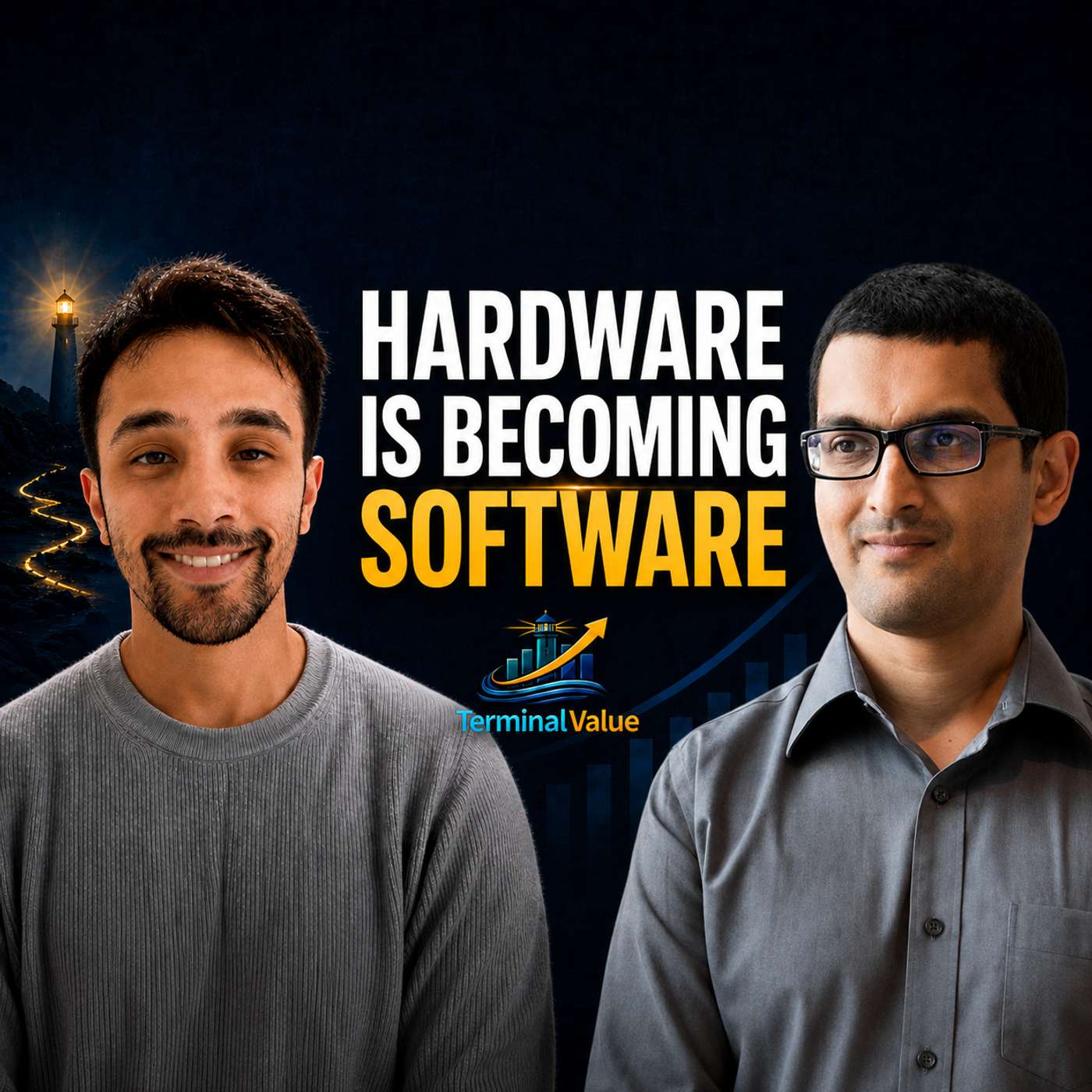
In this episode of Terminal Value, I'm joined by Viral Shah, co-founder and CEO of JuliaHub, the company behind Dyad — a physics compiler paired with AI agents for engineering and simulation — to discuss why physical product engineering has been so hard to automate, what an AI agent actually needs to model the real world, and whether hardware development can start to look much more like software.We cover the "engineering V" and why every step runs in its own siloed tool, why the real TAM is the trillions spent designing products rather than the billions spent on simulation software, how Dyad works as a compiler that fuses disparate physics into one simulation, why calibration — not modeling — is the hard part, how Instron cut crash-test-rig calibration from over a day to under a minute, why trusted reusable model libraries make hardware feel like software (text, Git, CI/CD, agents), how agent pricing shifts from per-seat licenses to token consumption, why the harness can matter more than the frontier model, why engineering shows high expected but low observed AI impact today, and why Viral believes hardware engineering is going to become like writing software.0:00 Hook: Why hardware engineering could become like software0:35 Intro to Viral Shah, JuliaHub, and Dyad1:25 How engineers move from product requirements to validated designs4:41 Why engineering software is fragmented across specialized tools12:16 Where Dyad fits and why JuliaHub built a physics compiler19:17 How real-world data calibrates simulation models23:21 Building trusted models that can be reused like software libraries26:17 Where Dyad is being used across aerospace, semiconductors, and infrastructure29:10 How agentic engineering changes seat-based software pricing31:37 Why the agent harness can matter more than the frontier model35:44 Why AI adoption in engineering still lags software38:13 Why Viral Shah believes hardware development will become more like software41:04 Closing takeaways on Dyad and the shift toward computational engineeringDisclaimer: For information and education only; not investment advice or a recommendation to buy or sell securities. Views are the speakers’ own.

Comments

Download from Google Play

Download from App Store
 United States