


 Claim Ownership
Nature Signals Podcast
Subscribed: 0Played: 7
Subscribe

© Ruth Thornton LLC
Description
A newsletter about nature, the animals and plants that share the world with us and the human actions affecting it - both good and bad.
ruththornton.substack.com
34 Episodes
Reverse

Why is the world failing to protect nature by 2030? Despite ambitious global commitments to halt biodiversity loss and restore ecosystems, the world’s countries are falling behind on the targets they agreed upon, and a lack of political will, funding and concrete action is putting the future of nature at risk.In this episode, we look at the findings of COP17, the U.N. Biodiversity Conference held in Yerevan, Armenia, and examine why global efforts to protect biodiversity are falling short. We explain the 23 targets of the Kunming-Montreal Global Biodiversity Framework, including the 30x30 goal to protect 30% of the world's lands and waters by 2030.We also explore the enormous funding gap for nature, environmentally harmful subsidies, the disappointing results of the Cali Fund and the influence of corporate lobbyists on international negotiations.Drawing on assessments by the U.N., Campaign for Nature and DeSmog, as well as warnings from scientists and business leaders, we examine what COP17 achieved, what remains unresolved and what must happen next to stop the extinction of animals and plants and protect the natural world.The written article is available on my website here: ruththornton.com. Key points:1:44 - Why is the extinction of animals and plants so invisible?3:11 - What is the Biodiversity Conference - COP17, and how is it different from COP31?5:33 - The 23 targets to get us on track to save nature by 20307:19 - The harmful nature subsidies that outperform spending in support of nature 30 to 19:55 - “30 x 30” is not on track10:51 - Conference outcomes and next steps Links to reports and other resources:United Nations Biodiversity Conference 2026 in Yerevan, Armenia: COP17Kunming-Montreal Global Biodiversity Framework, adopted at COP15, the 2022 U.N. Biodiversity Summit.The Convention on Biological Diversity.IPBES (Intergovernmental Science-Policy Platform on Biodiversity and Ecosystem Services), 2019: Global Assessment Report on Biodiversity and Ecosystem Services.World Economic Forum, 2026: The Global Risks Report.U.N. Environment Programme, 2026: State of Biodiversity Action.U.N. Environment Programme, 2026: State of Finance for Nature - Nature in the Red: Powering the trillion dollar nature transition economy.Campaign for Nature: 30x30 Global Assessment 2026 report.The Cali Fund - financial mechanism to share the profits from the use of genetic materials with biodiversity-rich countries.U.N. Biodiversity Conference: Yerevan PathwayDilys Roe, The Lancet Planetary Health, 2019: Biodiversity loss - more than an environmental emergency. Nature Signals, by Ruth Thornton, 2/28/2026: Nature is in trouble. So why aren't we talking about it?ScienceDaily, 1/20/2012: Biodiversity crisis is worse than climate change, experts say.AFP, 10/31/2026, by AFP staff: Nations commit to get nature goals back on track.Mongabay, 10/31/2026, By John Cannon: Leaders grapple with finance and harmful subsidies at UN's COP17 biodiversity conference.The Guardian, 10/31/2026, by Patrick Greenfield: Calls grow for COP summit reforms as countries remain on track to fail nature targets.DeSmog, 11/10/2026, by Rachel Sherrington, Clare Carlile, Brigitte Wear: UN fails to disclose company names on biodiversity summit delegates list. SkyTruth: 30x30 Progress Tracker interactive map. Get full access to Nature Signals at ruththornton.substack.com/subscribe

PFAS, often called “forever chemicals,” are common toxic pollutants that are now ubiquitous in the environment. But what does their presence in fish and drinking water mean for the health of people and wildlife?In this episode, we examine a study by researchers at Indiana University and the Ecology Center in Ann Arbor, Michigan that found at least one of 14 PFAS chemicals in every fish tested in Michigan’s Huron and Rouge River watersheds. Researchers also found particularly high levels in fish livers and eggs, raising concerns about wildlife that eat fish whole. Even the levels in the filets could exceed Michigan’s fish consumption guidelines.We hear from Erica Bloom and senior scientist Gillian Miller of the Ecology Center, Cheryl Murphy, director of Michigan State University’s Center for PFAS Research, and Gary Ankley, a former toxicologist at the U.S. Environmental Protection Agency.The discussion explores PFAS health risks, gaps in scientific knowledge about thousands of these chemicals that are still manufactured and released into the environment, and new technologies that could help researchers identify harmful compounds and reduce exposure.Learn why PFAS contamination is a growing environmental and public health concern—and what science is doing to address it.The written article is available on my website here: ruththornton.com. Key Points:1:29 - PFAS contamination was found in every fish studied3:51 - Only a handful of thousands of PFAS chemicals are regulated5:24 - How scientists are studying the 'forever chemicals'7:27 - Growing awareness of the problem can lead to reducing our exposure Links to resources:Capozzi et al., 2023: From watersheds to dinner plates: Evaluating PFAS exposure through fish consumption in Southeast Michigan. Chemosphere, 345:140454.US EPA Toxicity Forecasting: ToxCastNational Institute of Environmental Health Sciences: Perfluoroalkyl and polyfluoroalkyl substances (PFAS).European Food Safety Authority: Per- and polyfluoroalkyl substances (PFAS).U.S. Environmental Protection Agency: PFAS explained.Michigan PFAS in Drinking Water RulesMichigan Eat Safe Fish GuidesGreen Choice Lifestyle's Products with PFAS to Avoid guide Get full access to Nature Signals at ruththornton.substack.com/subscribe

In this anniversary episode of Nature Signals, environmental journalist and science writer Ruth Thornton reflects on one year of sharing science-based stories about nature, wildlife and biodiversity conservation. She discusses her journey from conservation professional to environmental journalist, tracing how childhood adventures in the Austrian Alps and American national parks inspired a lifelong passion for nature and wildlife.Ruth explains why, after more than 20 years working in conservation, she returned to school midcareer to pursue a master’s degree in journalism and how her hands-on field experience shapes her approach to writing about nature.Looking ahead, Ruth shares her plans for Nature Signals, including articles building on each other to form a more complete picture of the state of biodiversity. She also discusses her commitment to rigorous research, independent fact-checking and accurate environmental journalism in an era of widespread disinformation and AI.Explore Nature Signals for evidence-based insights into conservation, biodiversity loss, ecology and solutions for protecting the natural world. The written article is available on my website here: ruththornton.com.#EnvironmentalJournalism #ScienceWriting #Biodiversity #Conservation #Wildlife #NaturePodcast #PersonalEssayKey points:1:06 - What led me to change my career4:34 - Where Nature Signals is headed6:43 - A word on fact-checking and essay schedules7:53 - A note on AI8:20 – How to support my writing Get full access to Nature Signals at ruththornton.substack.com/subscribe

In this episode, we explore why the global insect decline matters far beyond pollination. A new paper in the journal Nature Reviews Biodiversity brings together findings from nearly 300 studies to document the many ways insects support wildlife and ecosystems.Eliza Grames, an assistant professor at Binghamton University and a lead author of the review, explains how insects serve as food for birds, bats, mammals, reptiles and amphibians—and provide a surprising range of other services. They help build shelters, protect nests, recycle nutrients, control disease-carrying insects and even contribute to wound care and grooming among some animals.We also discuss the growing insect biodiversity crisis, including evidence that insect abundance and biomass are declining by an average of 1% to 2% a year. Chris Elphick, a professor at the University of Connecticut and a contributor to the study, explains why insect conservation should be considered part of wildlife conservation.The researchers also offer a hopeful message: because many insects reproduce quickly, the right conservation efforts can sometimes produce rapid results.The written article is available on my website here: ruththornton.com.#Insects #BiodiversityCrisis #InsectDecline #Conservation #Wildlife #InsectApocalypse Links to resources:Cooke et al., 2026: The importance of insect biodiversity for vertebrates. Nature Reviews Biodiversity.Status of Insects: An international Research Coordination Network.National Science FoundationScience, 4/25/2026, by Jeffrey Mervis: Trump fires every member of the U.S. National Science Foundation's governing body.The New York Times, 10/2/2026, by Adam Sella, Christopher Flavelle and Irena Hwang: Agency diverted $1.4 Billion in science funds mandated by Congress.Edwards et al., 2025: Rapid butterfly declines across the United States during the 21st century. Science, 387(6738): 1090-1094.Tamburini et al., 2019: Pollination contribution to crop yield is often context-dependent: A review of experimental evidence. Agriculture, Ecosystems & Environment, 280: 16-23. Get full access to Nature Signals at ruththornton.substack.com/subscribe
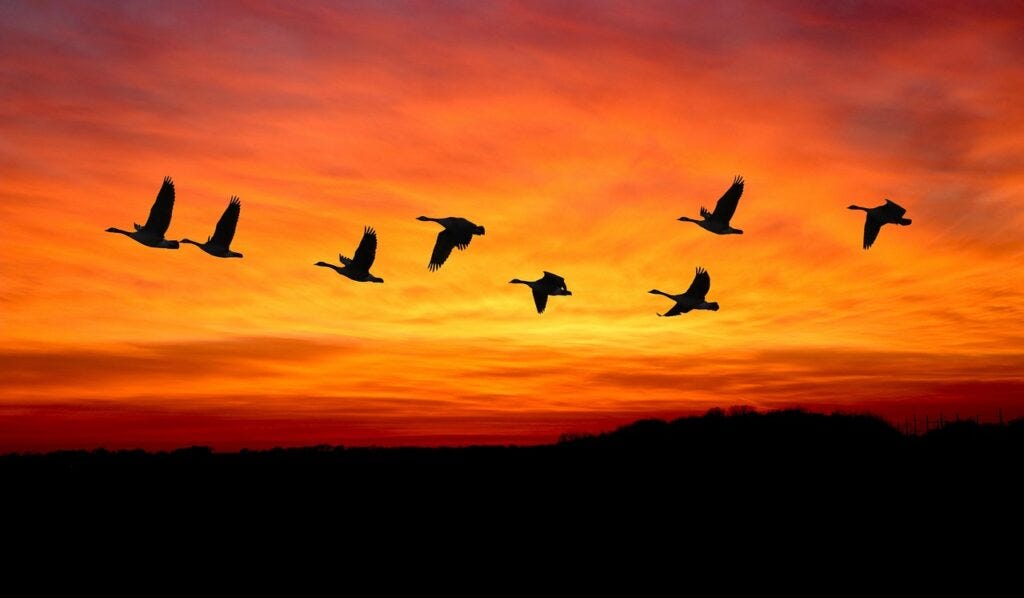
This episode explores the latest biodiversity news, from bird migration and animal behavior to the growing threat of climate change to coral reefs.We begin with the annual fall migration, examining why artificial light can be dangerous for birds and how dimming lights at night may help prevent deadly collisions with buildings. The New York Times reporter Ishani Desai cites Adriaan Dokter of Cornell University’s BirdCast, who says that at least one billion birds die each year after striking buildings. We also discuss a BirdLife International report, reported by the Guardian’s Patrick Barkham, finding that one in nine migratory bird species are threatened with extinction.Then, Scientific American’s Clarissa Brincat explores whether birds actually enjoy flying, drawing on research led by behavioral biologist Jorg Massen at Utrecht University in the Netherlands. We also look at remarkable tool use and social learning in critically endangered pygmy raccoons, discovered by researchers at Miami University and reported by Isabel Gil with Scientific American.Finally, Vox reporter Benji Jones examines efforts to identify heat-tolerant corals as warming oceans put reefs under increasing pressure.Together, these stories offer a snapshot of biodiversity threats—and the scientific efforts to understand and protect the natural world.The written article is available on my website here: ruththornton.com.Key points:0:55 – Help migrating birds by dimming your lights at night.3:03 - One in nine migratory bird species are threatened with extinction.4:24 - Do birds actually enjoy flying? The answer appears to be yes.7:09 - An endangered young raccoon made her own toy, then taught her family how to do it.8:50 - Oceans are getting hotter - now scientists are racing to identify coral reefs that can tolerate the heat.Links to articles and other resources:• The New York Times, 9/12/2026, by Ishani Desai: As millions of birds migrate, residents are asked to turn off the lights. • Live bird migration maps: CornellLab BirdCast• The Guardian, 9/11/2026, by Patrick Barkham: One in nine migratory birds threatened with extinction, global report says. • BirdLife International: State of the World's Birds• Scientific American, 9/8/2026, by Clarissa Brincat: Do birds enjoy flying? Scientists asked cockatoos.• Massen et al., 2026: Do birds enjoy flying? An analysis of affect after flight in galah (Eolophus roseicapilla). Behavior, 2026.• Scientific American, 3/11/2025, by Jacek Krywko: The secret to understanding animal consciousness may be joy. • Scientific American, 9/3/2026, by Isabel Gil: This tiny raccoon turned trash into toys - and taught her family how, too. • O'Neil, Szydlowski and Rivas-Camo, 2026: Preliminary evidence of material culture in the critically endangered pygmy raccoon (Procyon pygmaeus). Wild, 3(3), 33.• Video: Raccoons making toys!• International Union for Conservation of Nature Red List: Pygmy raccoon (Procyon pygmaeus).• Vox, 8/25/2026, by Benji Jones: Inside the race to buy coral reefs more time.• Ferrario et al., 2014: The effectiveness of coral reefs for coastal hazard risk reduction and adaptation. Nature Communications, 5: 3794. • Reguero et al., 2021: The value of U.S. coral reefs for flood risk reduction. Nature Sustainability, 4: 688-698. Get full access to Nature Signals at ruththornton.substack.com/subscribe

Comments

Download from Google Play

Download from App Store
 United States