


 Claim Ownership
Theory of Change
Subscribed: 14Played: 37
Subscribe

© Copyright Devex
Description
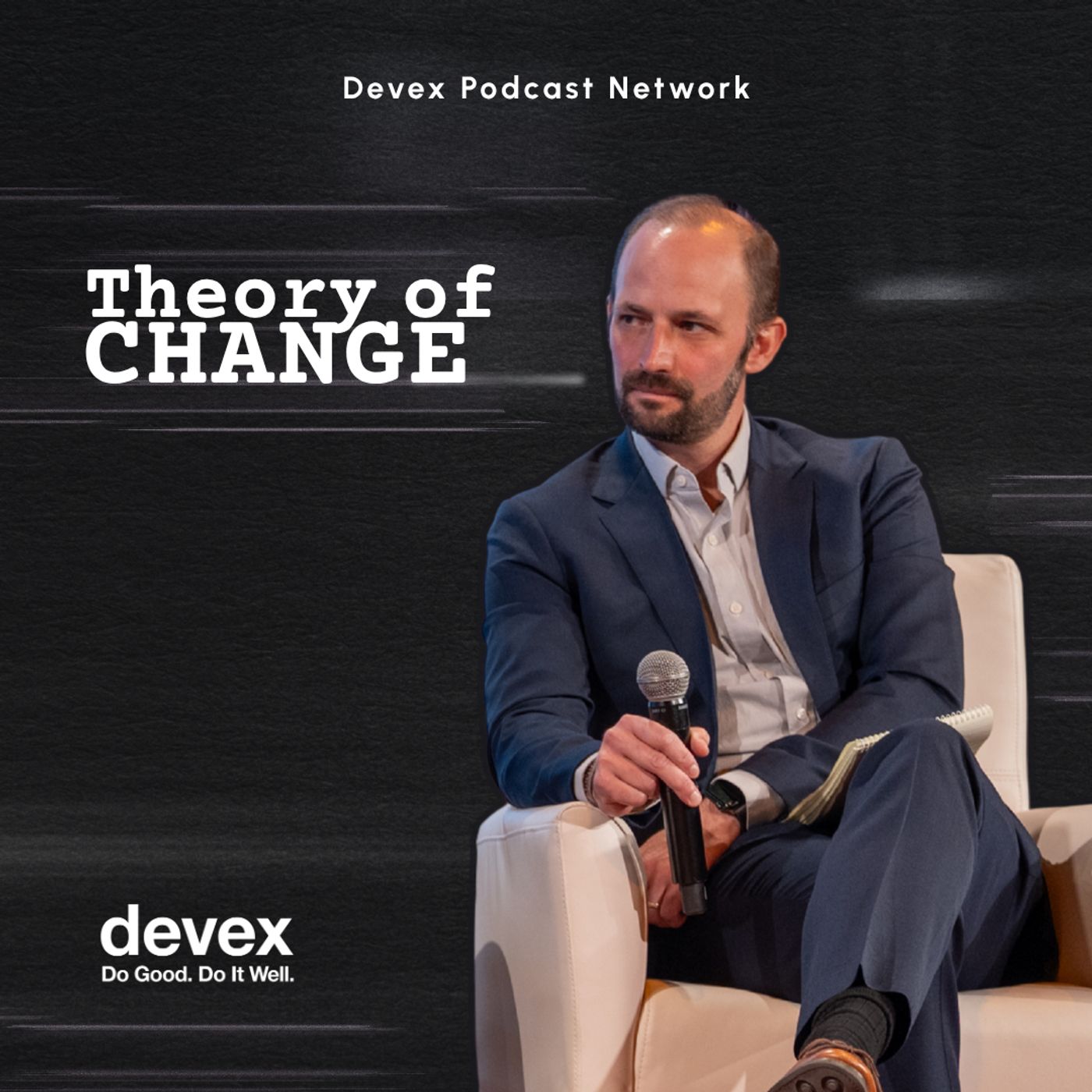
Theory of Change is a podcast about the future of global development — and the people trying to reshape it.
Hosted by Devex Senior Reporter Michael Igoe, the show features candid conversations with leaders in philanthropy, foreign policy, technology, finance, media, and humanitarian aid about the forces transforming how global change actually happens: power, politics, money, influence, and ideas.
Not a panel. A conversation with a real person.
Episodes are published every Tuesday.
Subscribe to our YouTube channel:
https://www.youtube.com/@devex
The podcast is produced by Devex Associate Editor Thomas Cserép and Mai Ylagan.
20 Episodes
Reverse
If a Washington, D.C., think tank publishes a voluminous policy paper, but barely anyone reads it, does it have an impact? Not really, according to Todd Moss, long-time development think tank leader and founder of the Energy for Growth Hub.Moss, who joined Devex’s Theory of Change podcast, sees a glaring mismatch between many organizations that claim to be in the business of informing policy decisions and the government officials who actually make those decisions.“The top 10 think tanks in the U.S. produced 1,500 reports last year,” Moss said, referencing recent estimates. “Some of them have real nuggets of wisdom, but lots of them are just incredibly boring and pointless, and no one will read them.”For Moss, the insistence on producing heavy reports and staging ceremonial public panels represents a deeper structural failure: losing sight of actual policy outcomes. Busy government officials, buried under back-to-back 15-minute meetings, rarely have the bandwidth to digest 14-page executive summaries, let alone full-length volumes. What they need instead, he said, is clear decision memos, outside experts who understand institutional politics, and — in many cases — years of strategic patience.Moss points to a recent breakthrough his own organization contributed to by deploying that playbook: the World Bank’s decision to lift its long-standing ban on financing nuclear energy projects. Changing the mind of a notoriously risk-averse, multishareholder institution took seven years of painstaking mapping, cross-party coalition building, and direct engagement with inside allies, he said.“I was literally told, you will never be able to change this. We will never do this,” Moss said. “When I think about lessons from this, I think about tactics, alliances, and patience.”
What happens when an organization built on maximum cost-effectiveness discovers that one of its flagship programs isn't delivering the results it promised?For Evidence Action, the answer was clear — if uncomfortable: follow the data, own the mistakes, and scale back.In a recent episode of Devex’s Theory of Change podcast, Evidence Action’s new CEO, Danielle Bayer, unpacked the nonprofit organization’s recent decision to wind down its Dispensers for Safe Water program across parts of East Africa, the backlash that followed, and what high-integrity implementation looks like in an evolving development landscape.“Most organizations choose to make decisions and keep them internal,” Bayer said. “In this particular instance, we not only said that the program didn't work as we thought it should, but also that we made mistakes here.”The decision to publicly air these operational mistakes sparked intense debate within the effective altruism and global development communities. While many praised the nonprofit's radical transparency, some critics questioned whether pointing to evidence was being used as a shield for poor implementation.Bayer was candid about the trade-offs: “Admitting mistakes is hard, and it may mean you lose trust with some funders and the public. The truth is all organizations make mistakes. If we're not being transparent, it’s not that mistakes aren't happening — it's just that people aren't sharing them.”She also spoke about what the future of cost-effectiveness looks like in the face of sharply declining global health aid, how Evidence Action codesigns programs with partner governments, and why she urges caution in the face of an upswell of interest in artificial intelligence.
The recent history of U.S. foreign aid has been dominated by budget cuts, institutional dismantling, and massive workforce reductions.Against this backdrop, the U.S. President’s Emergency Plan for AIDS Relief, or PEPFAR, feels less like a template for modern foreign policy and more like a relic of an unrecognizable past. In an era defined by political fragmentation and widespread skepticism of government-led aid projects, the idea that Washington could launch a massive, $15 billion global initiative to tackle an active health crisis overseas seems almost quaint.Yet on the latest episode of Devex’s Theory of Change podcast, author and veteran global health reporter John Donnelly argues that this distance is precisely why we need to look back at PEPFAR today.In his new book “Lifeline: The Story of PEPFAR, the Greatest Humanitarian Initiative of Our Time,” Donnelly traces how a high-risk political gamble under President George W. Bush morphed into what many consider the single greatest humanitarian achievement of modern times — saving an estimated 26 million lives over two decades.In this episode, Donnelly breaks down the mechanics of that success — and what PEPFAR’s two-decade arc teaches us about government capability, bipartisan political coalitions, and the risks of prolonged emergency intervention.
The California-based drone delivery company Zipline made waves last year when it secured a $150 million pay-for-performance grant from the U.S. State Department to scale up its operations in Africa.That announcement came just months after the State Department took control of the U.S. government’s foreign aid portfolio in the wake of USAID’s dismantling, and the deal with Zipline was portrayed as an emblem of the new direction of U.S. global health aid.One year later, Zipline is working through the sometimes arduous process of negotiating with partner country governments over the terms of their expansion. But the company’s ambitions extend well beyond the five African countries included in the State Department grant. At the same time, a new partnership with Uber has the company poised for massive expansion inside the United States, from healthcare to consumer goods — driving estimates of Zipline’s potential valuation to $20 billion.Zipline is expanding into urban environments, launching its precision delivery platform in cities such as Kigali, Rwanda, while scaling healthcare partnerships in the U.S. with major institutions like the Cleveland Clinic and the Veterans Affairs hospital system. The same autonomous tech that delivers critical blood products in West Africa is now poised to power instant delivery for retail and food.Zipline’s Africa CEO and head of international expansion, Caitlin Burton, joined Devex’s Theory of Change podcast for a live recording at the Devex Impact House in New York. Burton shared the company’s growth story — from its origins in Rwanda to Uber Eats — and its planetary ambitions.“We have to grow way faster over the next five years than we did in the last five years,” Burton said. “We are just now getting to national scale in really, really, really important places. We need to do that in many, many more places.”Behind Zipline’s expansion plans, there is also a critique of legacy global health institutions and funding structures, which the company found resistant to what they could offer.“People were staking out territory instead of operating a system, and that was weird to us,” Burton said.“There are three things you really need in a health system: you need well-trained health workers that are compensated ... you need the drugs themselves, and then you need a way to get them to the patient,” Burton said. “Everyone seemed to have forgotten about the supply system.”
In a live episode of the Theory of Change podcast, Buddy Shah, CEO of the Clinton Health Access Initiative and chair of the Anthropic Long Term Benefit Trust, shared an inside look at the intersection of global health, market-shaping agreements, and artificial intelligence."The mistake that many of us are making ... is looking for an AI point solution. What's a cool use case where you can develop an AI tool and slot it into an existing system? And I think the much more important question is: If you could redesign the system for a world where you have very powerful AI tools, what would that look like?" Shah said during the podcast, which was recorded last week at the Devex Impact House in New York on the sidelines of the United Nations General Assembly. Shah pulled back the curtain on CHAI’s landmark deal to secure generic manufacturing of lenacapavir — a twice-yearly injectable drug offering 99% effectiveness against HIV infection. By negotiating the price down from $28,000 per year in the U.S. to $40 per patient per year in lower-income countries, Shah explained how CHAI, Gilead, generic manufacturers, and global health partners believe they are creating a path that could spell the end of HIV over the next decade.Addressing his dual role managing corporate governance at Anthropic, Shah previewed how artificial intelligence could fundamentally reshape health delivery in low- and middle-income countries through mobile diagnostics and AI clinical assistants. He emphasized that LMICs may leapfrog high-income nations in adopting these technologies, while highlighting how incoming philanthropic capital from the AI sector could help fund major systemic solutions.

Comments

Download from Google Play

Download from App Store
 United States