


 Claim Ownership
PAYMENTS FM
Subscribed: 1Played: 0
Subscribe

© PAYMENTS FM
Description
PAYMENTS FM is a podcast for merchants, platforms, marketplaces, and payment product teams.
Each episode features operators, founders, product leaders, and payments experts discussing payment strategy, payment operations, billing, compliance, risk, fintech infrastructure, and money movement.
Listen for practical conversations about how payment systems work in production and what teams can do to improve them.
payments.fm
15 Episodes
Reverse

At Money20/20, I spoke with Steve Boms, Executive Director of the Financial Data and Technology Association (FDATA). FDATA represents financial technology companies whose products depend on access to financial data with the permission of consumers or businesses.Why this mattersSteve makes a distinction between a market where data-sharing products are available and one where people have consistent rights to use them.In the U.S., financial data connections often depend on arrangements between the institution holding the account and the third-party provider. Those arrangements can determine the data available, the way it can be accessed, and the conditions attached to access. Steve argues that a consistent right to share data with an authorized provider would give customers more choice and reduce the importance of individual commercial agreements.Open banking is not the same as open dataI challenged Steve on the name “open banking.” To a consumer, it can sound as though financial information is becoming public.That is not how consumer-permissioned data sharing is intended to work. The idea is that you decide which provider can access specified information to perform a service you have chosen.Steve also pushed back on my concern that users do not know what they share. He pointed to disclosures and consent flows created by data aggregators, even without a uniform U.S. open-banking rule. My question remains whether those practices are consistent enough across the market.The useful distinction is between a provider’s current consent process and an enforceable, widely applicable right to access and share data.What Section 1033 changesThe 2024 CFPB rule was designed to establish requirements for covered financial institutions and authorized third parties. Steve describes it as the foundation for clearer disclosure, consent, data protection, and API access expectations.FDATA supported much of that framework and has been advocating for a new version that preserves its underlying consumer data-rights principles.Canada provides a useful comparison. In March 2026, Canada enacted a new Consumer-Driven Banking Act to establish a legal framework for customer-directed data sharing. Enacting a framework does not mean every connection is already operational, but it offers a clearer statutory direction than the uncertain U.S. implementation path.Agentic commerce raises the stakesWe also talked about the attention paid to agentic commerce at Money20/20.A useful framework needs to establish what the customer authorized, what the agent can do, when new permission is required, and who is responsible when something goes wrong.Steve’s position is that rules for consumer-directed data access are part of the foundation for this next generation of financial services.What it means for your teamIf you build financial products, use data aggregators, or consider adding pay-by-bank, treat data access as part of the product and operating model, not just an integration step.Your product may work technically with the institutions in your test environment while customers at other banks experience different coverage or terms. Consent design, access revocation, failure handling, and customer support should be part of product discovery and provider selection.For teams exploring AI agents, write down the boundary between reading information, giving recommendations, and initiating financial activity before designing the experience.Resources* FDATA* Steve Boms — FDATA leadership biography* CFPB — Personal financial data rights and litigation status* Canada — Consumer-Driven Banking Act (2026)* FDATA — Access to Action: Agentic Fintech & Write Access* PAYMENTS FMRelated episodes* Open Banking and Pay-by-Bank with Anubhav Pradhan, ShiftMate — Open Banking and Pay-by-Bank with Anubhav Pradhan, ShiftMate. SubscribePAYMENTS FM covers how payments work in practice for merchants, platforms, and product teams. Subscribe for conversations with people working on financial products and infrastructure.PAYMENTS FM is a reader-supported publication. To receive new posts and support my work, consider becoming a free or paid subscriber. Get full access to PAYMENTS FM at payments.fm/subscribe

In this episode, I spoke with Emi Keshler, Director of Partner Development at Payabli. We talked about what a successful embedded payments program looks like. We discussed buyer experience, merchant experience and everything in between.State of Payments survey: It takes about four minutes, anonymous responses are welcome, and we will publish the results at the end of the year.What a successful payments program means to you?Success is having control over the program: reliable metrics, a forecast for the next quarter, and operational processes that support the payment volume.For a first-year program, she suggests about 40% merchant attachment rate and 30–40 basis points of transaction margin as starting assumptions. The margin figure also needs a clear definition. In Emi’s example, charging 2.9% against processing costs of 2.5% leaves a spread of 0.4 percentage points, or 40 basis points, on processed volume. A platform still needs to account for its own operating costs when evaluating the business case.How to succeed with merchant onboardingTrack the merchant journey in enough detail to see where progress stops. A single onboarding completion rate will not show all of the important stages. An approved merchant can still need help before processing successful payments.* Onboarding applications started. Identify merchants who began the application and have not completed it. Give the team a defined follow-up process.* Underwriting pending. Watch which applications are waiting for approval and what information is missing.* Approved but not processing. Check whether the merchant has the equipment, configuration, migrated tokens, and training needed to begin.* Testing and early use. Separate small test transactions and occasional payments from regular processing.* Fully activated merchants. Define what business-as-usual usage looks like for the vertical, then measure it.* Dormant accounts. Continue monitoring merchants after activation so the team can investigate declining usage.What it means for your teamEmi breaks the experience into three groups, each with a different reason to care about payments.* Buyers. They need appropriate payment methods and a straightforward way to pay. Repeated data entry, disconnected systems, and difficult service after the payment can affect whether they return.* Merchants. They need to take payments, issue refunds, and reconcile without unnecessary manual work. The number of clicks, training time, and movement between systems affect both efficiency and employee experience.* Back-office and finance teams. They need to understand the economics and the value to the business. Their questions concern the return on investment, the books, and the operating model.The administrative experience deserves particular attention. Emi describes a veterinary practice employee finishing a long shift and then spending another hour looking for a small reconciliation discrepancy. Her suggestion is to sit down and reconcile a day of activity the way an end user would. Include the payment methods they actually accept, such as cash, checks, ACH, and cards, and see where someone has to leave the workflow to find an answer.What to do next* Walk through the full onboarding journey. Pre-fill information the platform already has, and account for the handoff between the person completing the application and the authorized signatory.* Explain the information request. Give merchants a short FAQ covering what is being collected, why it is needed, and what happens next.* Involve risk and underwriting early. Help the team understand the platform’s typical merchants before applications arrive, so it can recognize expected activity and investigate exceptions.* Prepare for activation. Start token migrations early, configure tools, and arrange training that fits the merchant’s environment. Card-present businesses may also need hands-on hardware setup.* Test the daily workflow. Check reliability under real working conditions and reconcile a representative day of transactions. Make sure the team understands refunds and other routine operations.* Assign payments ownership. Designate someone accountable for adoption, economics, and ongoing performance. Emi notes that a large platform with an existing merchant base may need a dedicated payments leader sooner than a new startup.Questions to ask internally* Who owns payments performance after the integration launches?* How many approved merchants have reached regular processing?* Where does onboarding stop, and who follows up at each stage?* Can an employee reconcile a full day without manually combining information from several systems?* Can support demonstrate the features we sell and explain their value for the customer’s industry?* Does our business case include pay-in and payout costs, staffing, and the work required to increase adoption?* When a merchant prefers an off-platform method, have we measured the administrative work and reconciliation it adds?Related episodes* Jo Phillips and Will Corbera, Payabli. The broader business of embedded payments for vertical software platforms. Why Vertical Software Platforms Are Becoming Payments Companies: Jo Phillips & Will Corbera, Payabli.* Joshua Silver, Rainforest. Payment models and ownership for software platforms. Payments For Platforms: Joshua Silver (Rainforrest). Get full access to PAYMENTS FM at payments.fm/subscribe

Jo Phillips and Will Corbera, co-founders of Payabli, joined PAYMENTS FM to talk about why vertical software platforms are becoming payments companies, how they think about risk and pricing, and what separates a payments program that works from one that fails.Why this mattersVertical software platforms have been adding payments for close to a decade. Companies like ServiceTitan, Mindbody, and Toast did it early, moving off legacy processors and generic gateways into something built for their own industry.The decision is easy to state and hard to execute. A platform has to decide how much of the payments business to own, how to price it, which risk model to use, and which of its industries actually need something more specialized than an off-the-shelf provider.Jo Phillips and Will Corbera built the payments business at ServiceTitan before starting Payabli. Jo led sales there; Will had already built one of the industry’s first payment facilitators, focused on property management. Together, they turned ServiceTitan’s payments into a large revenue driver and a better customer experience, and that work is what led them to start Payabli.Payments can be 20 percent or more of a platform’s revenue, but that number is not automatic. It depends on pricing, on the vertical, and on whether the platform built a genuinely embedded experience or just added a link to a third-party checkout.Most platforms will not need to become a full payment facilitator. Understanding the referral, managed, and full PayFac options, and knowing which one fits, is one of the more consequential decisions a platform makes. Get full access to PAYMENTS FM at payments.fm/subscribe
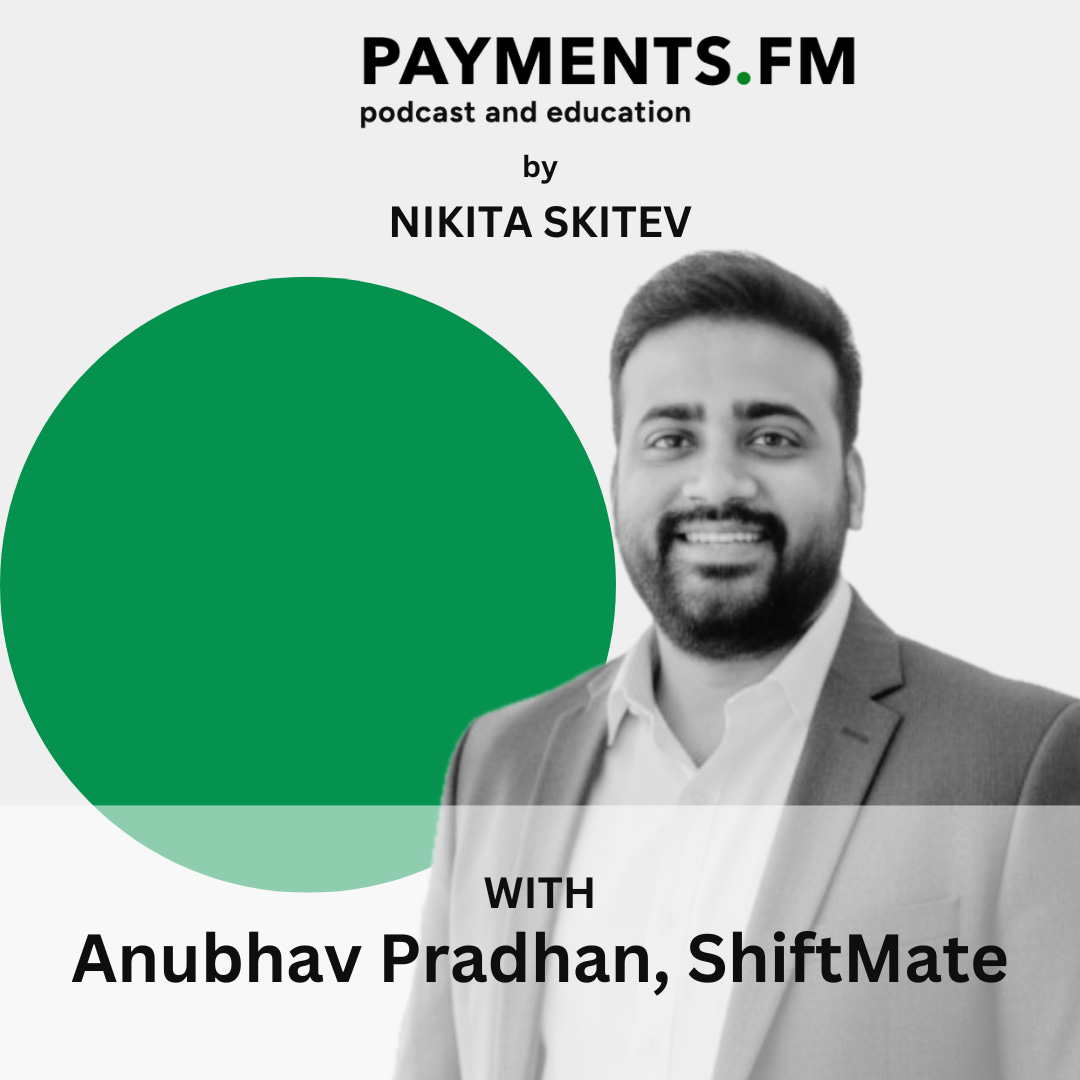
Today we talked to Anubhav Pradhan, co-founder of ShiftMate. We discussed the future of open banking and Pay-by-Bank. Discover how these technologies empower consumers with data control and offer new growth opportunities for financial institutions.Key TopicsDifferences between open banking and Pay-by-BankRegulatory impacts on data ownership and consentLeveraging data for customer relationship managementReal-time payments and their industry impactTimestamps:01:10 - Pay-by-Bank explained02:17 - Consumer data aggregation03:11 - Payment methods and trends05:10 - Building trust through open banking06:08 - Adoption statistics07:02 - Role of platforms like Plaid08:10 - Institutional challenges10:23 - Infrastructure and compliance11:16 - US adoption nuances12:30 - Strategic advantages14:48 - Data ownership debates15:21 - Marketplace fees16:41 - Consumer rights and regulations18:03 - Infrastructure costs19:02 - Open banking as a growth driver20:01 - Merchant data access risks21:22 - Regulatory safeguards22:48 - Preventing data misuse23:33 - Potential for data abuse26:08 - Successful strategies30:48 - Motivations for small banks33:36 - Practical advice35:00 - Foundational data work37:48 - Payment challengesConnect with Anubhav:https://www.linkedin.com/in/anubhav-pradhan-27b96583/ Get full access to PAYMENTS FM at payments.fm/subscribe

In this episode, we explore how subscription and e-commerce companies can harness data, AI, and innovative payment strategies to boost growth and improve customer engagement. Andrei Rebrov, co-founder of Finsi and former CTO of Scentbird, shares practical insights on building effective analytics systems and integrating AI for smarter decision-making.In this episode:00:00 - Increasing e-commerce conversions through customer payment options00:26 - Andrei Rebrov introduces his background and current focus in data analytics01:54 - The problem of blind decision-making in subscription and retail businesses02:24 - The rise of data-driven approaches in subscription companies like Scentbird03:59 - Defining what analytics really means for business insights04:42 - Moving beyond dashboards to actionable knowledge for executives06:38 - The technique of asking "five whys" to drill down into data anomalies08:21 - Challenges of connecting multiple disconnected data sources08:50 - The importance of clean, stitched data for effective AI analysis10:17 - How AI can rapidly analyze correlations across multiple data points11:54 - Real-world examples of anomaly detection and Get full access to PAYMENTS FM at payments.fm/subscribe

Comments

Download from Google Play

Download from App Store
 United States