


The Dov Baron Show
Subscribed: 7,431Played: 68,467
Subscribe


© Dov Baron International
Description
The Dov Baron Show: Unmasking Hidden Truths for High-Profile Deep Thinkers
This isn't just another leadership podcast. It's a high-stakes exploration into the minds of those shaping the world... minus the usual talking points.
Every episode is a raw, unscripted collaboration between my guest and me, Dov Baron, as we dive into the truths no one else dares to ask about. My guests? Often unknown to the general public but absolute titans in their fields—the kind of people high-profile leaders turn to when they need an edge.
Here, generous curiosity meets bold conversation. Expect a mix of playful irreverence and deep intellectual firepower that forces you to rethink what you thought you knew.
If you're the kind of leader who craves depth over soundbites and insight over ego-stroking, hit subscribe—because this is where real thinkers come to sharpen their edge.
1203 Episodes
Reverse

April 1989. A young woman jogging in Central Park is beaten so badly she spends nearly two weeks in a coma. Within days, New York has its verdict. The papers call the accused a "wolf pack": five Black and Latino teenagers from Harlem, aged fourteen to sixteen, who would become known as the Central Park Five. Four of them have confessed on videotape.This episode puts you at the newsstand that morning and asks the question most of us would rather skip: what would you have decided? Then it follows that verdict, and the five boys it landed on, through the thirteen years that came after.Along the way, Dov Baron shows how fast a verdict about a stranger really forms. Princeton researchers timed it, and the answer is about the length of a blink. What happens when you give people more time is the finding worth repeating at your next dinner.Then the episode turns the mechanism around. In 2019, a short video from the Lincoln Memorial produced a national verdict on a teenager from Covington Catholic High School within hours. The opposite political direction. A very different cost. The same machinery.Through the lenses of history, neuroscience, mass psychology and Emotional Meaning Architecture, the episode asks who wrote the list of faces you were taught to fear. It draws a clear line between the associations people choose, which tell you something, and the ones they don't, which tell you nothing about character.You leave with a practical tool, the association check: three questions to run before you judge a stranger, a job candidate or a headline.And it ends in Harlem, in 2023, with what a second look can do.Episode highlights:- What you would have decided at a New York newsstand in 1989, and how fast- The surprising thing extra time does to a snap judgment- Why two cases with opposite politics ran on the same machinery- The association check: three questions for your next stranger, hire or headline- What happened in Harlem in 2023Topics covered (keyword paragraph):Topics in this episode include the Central Park FiveThe Exonerated Five, wrongful convictions, false confessions, guilt by association, first impressions and snap judgments, the psychology of faces and trustworthiness, cognitive bias, media framing and moral panic, the Covington Catholic video, stereotypes, race and the justice system, hiring bias, Emotional Meaning Architecture, and how to pause before judging a stranger.About the show:The Polymathic Perspective is a documentary-style solo podcast where Dov Baron examines the emotional logic beneath power, culture, identity, and meaning, drawing on psychology, neuroscience, history, and philosophy. Each episode holds rigorous science and honest interpretation in the same frame, and tells you which is which. If your curiosity has been called a liability, this is the show that proves it is your greatest asset.About Dov Baron:Dov Baron is a Vancouver-based leadership speaker, executive advisor, and author. He is the author of The Art of Belonging: How Conformity Silences Genius and How to Unleash It, and the creator of two proprietary frameworks, the Emotional Source Code and Emotional Meaning Architecture, which underpin his advisory work with founders and senior executives. Alongside The Polymathic Perspective, he hosts The Dov Baron Show, a guest-interview program on leadership and meaning.Connect with Dov:Website: https://DovBaron.comWork with Dov: [email protected] Dov Baron Show (interview podcast): https://DovBaron.com/podcastsBook, The Art of Belonging: [link]Subscribe, rate, share:If this one made you think twice about a stranger, or a headline, send it to one person who'd want to hear it. Word of mouth is how documentary podcasts grow. Follow the show so next week's episode, on one of the oldest complaints about new technology, finds you as it drops.Citations:Willis, J., & Todorov, A. (2006). First impressions: Making up your mind after a 100-ms exposure to a face. Psychological Science, 17(7), 592-598. https://doi.org/10.1111/j.1467-9280.2006.01750.xThe Central Park Five, History.com: https://history.com/articles/central-park-fiveYusef Salaam elected to the New York City Council, CBS News: https://www.cbsnews.com/news/yusef-salaam-new-york-city-council-harlem
Connect with Dov Baron:https://[email protected], review, and send this episode to the most thoughtful builder you know. That is how the algorithm finds the people who still ask why. Hosted by Simplecast, an AdsWizz company. See pcm.adswizz.com for information about our collection and use of personal data for advertising.

 1
Dr. Nadya Zhexembayeva grew up in Kazakhstan in a family the Soviet Union had branded enemies of the state. When the Union collapsed in 1991, her country had no currency for nearly three years. Her family's life savings were exchanged overnight for two frozen chickens. She was 12. She watched everything collapse, not as a news event, not as history, but as a Tuesday.Most people who survive that kind of rupture spend the rest of their lives searching for solid ground. She spent the next four decades studying why some people, some organizations, some entire systems don’t just survive upheaval. They get rich from it.Nadya is the founder of the Reinvention Academy and the originator of the Chief Reinvention Officer role. She has taught more than a million people across forty countries. She spent fourteen years as an executive inside one of the world’s largest mining companies and discovered that almost everything she had spent her career teaching no longer worked in the world we are actually living in. That reckoning became the foundation for everything she now builds.Her new book is The Reinvention Advantage: How to Survive and Monetize Volatility in a World That Won’t Settle Down, published by Wiley, November 24, 2026.Topics include: Why the organizations waiting for stability are the ninety-one percent who get eatenHow hyperinflation wipes out a family's savings overnightThe externalized identity that made you exceptional and is now the thing holding you back.Why most Fortune 500 boards can't agree on one sentence of the value they create.The West Virginia coal miner story and the difference between thesis, antithesis, and synthesis.What should die in every high-performing leader right now.One move for the leader who knows the runway is three years and is frozen.What the 12-year-old girl in Kazakhstan says to the woman who built a world.CONNECT WITH NADYA ZHEXEMBAYEVAWebsite: https://chiefreinventionofficer.comBook: https://reinventionadvantage.comNewsletter: Free, four minutes per week at https://chiefreinventionofficer.comWORK WITH DOVWebsite: https://DovBaron.comEmail: [email protected] this conversation moved you, please rate, review, and subscribe.
Connect with Dov Baron:https://[email protected], review, and send this episode to the most thoughtful builder you know. That is how the algorithm finds the people who still ask why. Hosted by Simplecast, an AdsWizz company. See pcm.adswizz.com for information about our collection and use of personal data for advertising.

Season 5 of The Polymathic Perspective, The Living Paradox, begins with a car that had no business being on Dov Baron's street. Salford, northern England, the late 1960s. A Rover P5B, the car of prime ministers, pulls up outside a very poor house. An elegant woman, Mrs. Roth, steps out, and her driver carries in food and clothes: help from well-off Jewish families looking after poor Jewish families like Dov's. Inside the house, gratitude, and the quiet shame of needing help. Outside, the neighbors and their verdict on anyone with money. Lucky. Ungrateful. They don't know how good they've got it.The boy at the window believed both at once, and never noticed they couldn't both be true.This episode asks why the evidence at his front door didn't change his mind about the wealthy one bit. The answer is a well-documented habit of the mind called subtyping. When someone contradicts our verdict about a group, we file them as the exception, "one of the good ones," and the verdict survives untouched. A single, shining exception, Dov argues, is the best bodyguard a verdict ever had.From there, the episode sets out the season's three levels of living with complexity: the ambiguous, the contradictory, and the truly paradoxical. Then it follows Dov's own frozen verdict into adulthood. The Salford kid who resented the posh, yet longed to talk like a TV gentleman. The businessman who undercharged for years and lost work because his fee signaled low value. And a room of executives who never fully committed to a program he'd priced as if it were worth very little.Dov answers two sharp critiques of his own story, then hands you a practice for the week: find your Mrs. Roth. Think of someone you've filed as an exception, and ask what verdict they've been protecting.The season question starts here. Did you build the verdict on reasons, or the reasons around the verdict?Episode highlights:- Why a prime minister's car outside a poor Salford house changed nothing about how a family saw the rich- The "mine's alright" effect, and how one good person protects a prejudice- The three levels of a living paradox: ambiguous, contradictory, paradoxical- How a childhood verdict quietly cost Dov gigs, money, and a room's commitment- A practice for this week: find your Mrs. RothTopics covered:Topics in this episode include the living paradox, stereotypes and how they survive, subtyping and the "one of the good ones" effect, cognitive bias, prejudice and class, growing up poor, charity and shame, inherited beliefs, Emotional Meaning Architecture, undercharging and pricing your value, self-sabotage and money beliefs, nuance in an age of headlines, and the question of whether you built your verdicts on reasons or built reasons around them.Further reading Citations and sources:Weber, R., & Crocker, J. (1983). Cognitive processes in the revision of stereotypic beliefs. Journal of Personality and Social Psychology, 45(5), 961-977. https://doi.org/10.1037/0022-3514.45.5.961Adam Adamant Lives! (BBC One, 1966-1967). https://en.wikipedia.org/wiki/Adam_Adamant_Lives!About the show and about Dov Baron: Connect with Dov:Website: https://DovBaron.comWork with Dov: [email protected] Dov Baron Show (interview podcast): https://DovBaron.com/podcastsBook, The Art of Belonging: [link] Subscribe, rate, share:If this one made you think of your own Mrs. Roth, send it to one person who'd recognize themselves in it. Word of mouth is how documentary podcasts grow. Follow the show so Episode 2, and the one word that ended a conversation in Whitehall, finds you as it drops.
Connect with Dov Baron:https://[email protected], review, and send this episode to the most thoughtful builder you know. That is how the algorithm finds the people who still ask why. Hosted by Simplecast, an AdsWizz company. See pcm.adswizz.com for information about our collection and use of personal data for advertising.

Why You’re Just Three Nights From Losing Your Mind?Her mother was dying. Instead of saying goodbye the way mothers usually do, she looked at her daughter and asked, "What are you waiting for?"That was not a gentle question. It was the kind of question someone asks when they no longer have the luxury of waiting for you to figure it out for yourself.The daughter is Dr. Sarah Sarkis. Clinical psychologist and executive advisor at the intersection of psychology, neuroscience, and human performance. Her work has been featured in The New York Times, CNBC, Women's Health, and Huffington Post. She advises Fortune 100 CEOs and elite athletes.Before any of that, she trained in inpatient psychiatric settings with treatment-resistant illness, and worked with incarcerated populations in forensics. She comes from what she calls a lineage of gladiators. Her grandfather was a mob-connected bookie who controlled a territory from Maine to Florida. Her father built a legal restaurant empire out of what that world taught him about survival, discipline, and shame. Sarah is the youngest of six children born in ten years.She did not escape that lineage. She metabolized it. And she built a framework from what the metabolizing did to her.In this conversation, Sarah names on record something that will land hard with any executive, athlete, or founder running on sleep debt and conviction: that most high performers are three nights of lost sleep away from psychosis. And that you need humility most when you are succeeding.She also tells you something that sounds like heresy in a high-performance-obsessed culture. She does not care about your performance. She cares about your process. And she will not pretend otherwise.Topics include: What she calls a Crooked A (the opposite of the Type A achiever)The thin line between a psychotic break and executive overdriveWhy she will not take the job of fixing a team unless the leader goes firstWhat she learned about reading people from a dyslexic father in late-night people-watching sessionsAnd the private cost her clients will never admit publicly. CONNECT WITH DR. SARAH SARKISWebsite: https://drsarahsarkis.comInstagram: @drsarahsarkisNewsletter available at the site; podcast coming soon WORK WITH DOVWebsite: https://DovBaron.comEmail: [email protected] you found this conversation useful, please rate, review, and subscribe.Please rate, review, and subscribe wherever you listen.
Connect with Dov Baron:https://[email protected], review, and send this episode to the most thoughtful builder you know. That is how the algorithm finds the people who still ask why. Hosted by Simplecast, an AdsWizz company. See pcm.adswizz.com for information about our collection and use of personal data for advertising.
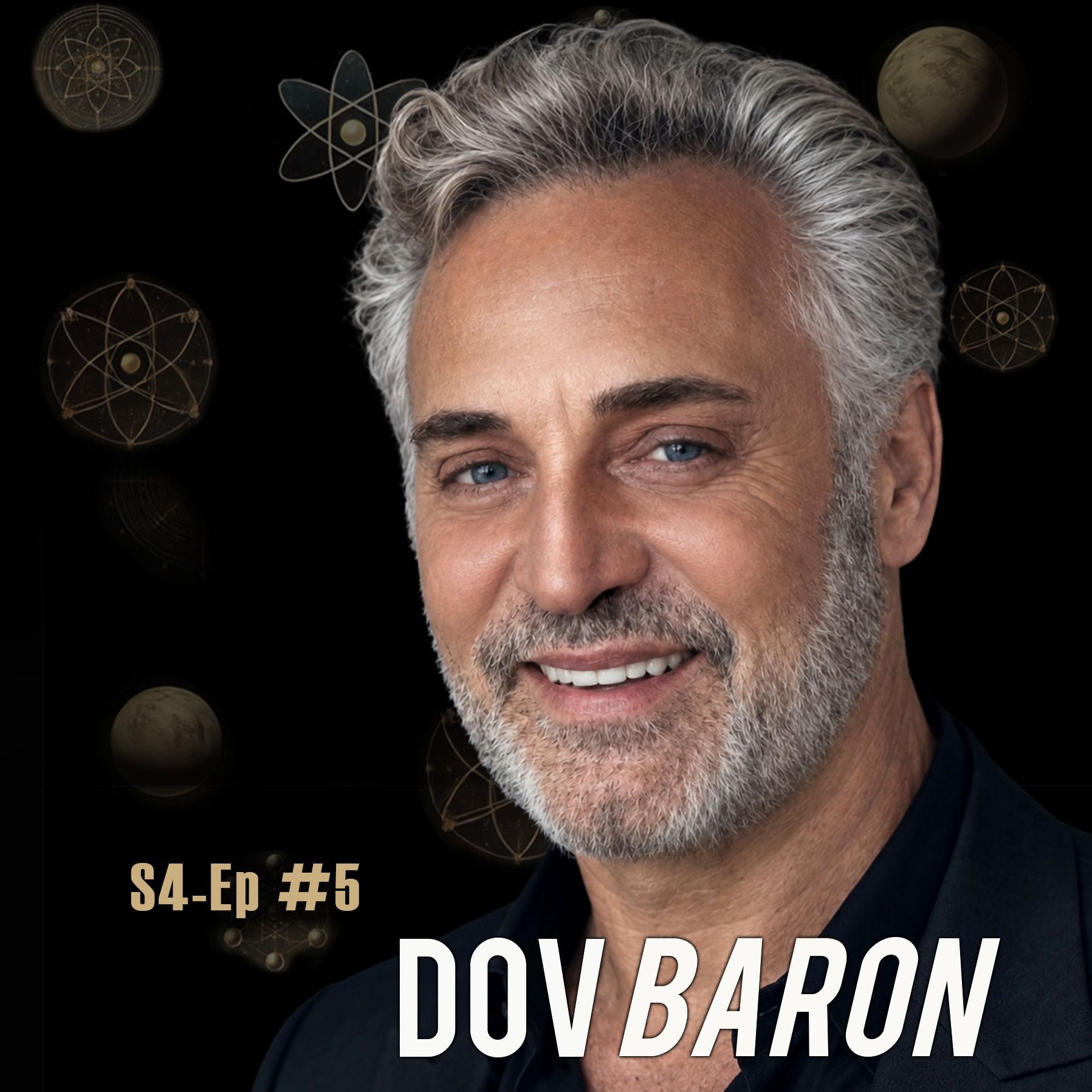
DescriptionDov Baron opens the Season 4 finale on the hardest night of his life as a father. At a memorial, frustration that had nothing to do with his adult son Michael came off him and landed on Michael anyway. Michael went silent, stopped taking his calls. When Dov drove over, his son said through a closed door, "I'm tired of him bullying me." And instead of defending himself, Dov went in, sat down, and for once in his life listened. What he heard was that he had done to his son the exact thing that had been done to him a thousand times as a boy.That story is the doorway into the idea the whole season has been building toward. Meaning is biological; it is written into your body, and it does not stay there. It carries, in a measurable field between people, and it shapes everything from a single cell to a civilization. You are, every day, playing a note into that field, with every word, look, judgment, and silence, mostly without ever hearing it.The episode moves through the science of why your state is contagious (two nervous systems near each other pull into the same rhythm), the Emotional Meaning Architecture that decides which note you play on automatic, and the cellist Vedran Smailović, who carried his cello into the ruins of Sarajevo and chose to play beauty into a field of war.Then it turns the whole thing onto you, with a five-part examination you can run on your own life: your body, your inheritance, your daily deposit, and the ripple you leave in everyone you touch. The instrument you need for it is the one Dov left you with last time: generous curiosity, the courage to ask, to listen, and to love, turned for once on yourself. The field is listening. The finale asks what you are going to play.Episode highlights - The night Dov's son told him the truth through a closed door, and what it cost to actually hear it- Why you are never neutral, and your mood is landing on everyone in the room- The order meaning runs in: meaning, then feeling, then behaviour, for decades, unheard- The cellist who played Albinoni in the ruins of Sarajevo, and the note he chose- A five-part examination of what you are really putting into the field- A first look at Season 5, The Living ParadoxTopics covered (keyword paragraph, indexed by Apple search)Topics in this episode include what you put into the field, emotional resonance and co-regulation, brain-to-brain coupling, why emotional states are contagious, Emotional Meaning Architecture, inherited behavior and intergenerational patterns, fatherhood and reconciliation, generous curiosity, the Cellist of Sarajevo and Vedran Smailović, Albinoni's Adagio, meaning and purpose, self-examination, and a preview of Season 5, The Living Paradox.Citations (sources)Hasson, U., et al. (2012). Brain-to-brain coupling. Trends in Cognitive Sciences, 16(2), 114-121.Stephens, G. J., Silbert, L. J., & Hasson, U. (2010). Speaker-listener neural coupling. PNAS, 107(32), 14425-14430.Lehrer, P., & Gevirtz, R. (2014). Heart rate variability biofeedback. Frontiers in Psychology.McGowan, P. O., et al. (2009). Nature Neuroscience, 12, 342-348. (meaning inscribed early in life)Heijmans, B. T., et al. (2008). PNAS, 105(44), 17046-17049. (Dutch Hunger Winter)Vedran Smailović, the Cellist of Sarajevo. https://en.wikipedia.org/wiki/Vedran_Smailovi%C4%87Baron, D. (2024). A Manifesto for World Peace: Generous Curiosity. [dovbaron.com link]About The Polymathic Perspective The Polymathic Perspective is a documentary-style solo podcast where Dov Baron examines the emotional logic beneath power, culture, identity, and meaning, drawing on psychology, neuroscience, history, and philosophy. Each episode holds rigorous science and honest interpretation in the same frame, and tells you which is which. If your curiosity has been called a liability, this is the show that proves it is your greatest asset.About Dov BaronDov Baron is a Vancouver-based leadership speaker, executive advisor, and author. He is the author of The Art of Belonging: How Conformity Silences Genius and How to Unleash It, and the creator of two proprietary frameworks, the Emotional Source Code and Emotional Meaning Architecture, which underpin his advisory work with founders and senior executives. Alongside The Polymathic Perspective, he hosts The Dov Baron Show, a guest-interview program on leadership and meaning.Connect with DovWebsite: https://DovBaron.comWork with Dov: [email protected] Dov Baron Show (interview podcast): https://DovBaron.com/podcasts Book, The Art of Belonging: https://DovBaron.comSubscribe, Rate, Share If this finale made you hear a note you'd been playing without knowing it, send it to one person who needs it. Word of mouth is how documentary podcasts grow. Follow the show, because Season 5, The Living Paradox, is where we go next.Apple episode keywords:what you put into the field, dov baron, polymathic perspective, resonance, co-regulation, emotional contagion, emotional meaning architecture, generous curiosity, cellist of sarajevo, vedran smailovic, albinoni adagio, fatherhood, reconciliation, meaning, the living paradox
Connect with Dov Baron:https://[email protected], review, and send this episode to the most thoughtful builder you know. That is how the algorithm finds the people who still ask why. Hosted by Simplecast, an AdsWizz company. See pcm.adswizz.com for information about our collection and use of personal data for advertising.

Comments

Download from Google Play

Download from App Store
 United States