


 Claim Ownership
My Pharma Reviews
Subscribed: 0Played: 4
Subscribe

© Salil Kallianpur
Description
64 Episodes
Reverse
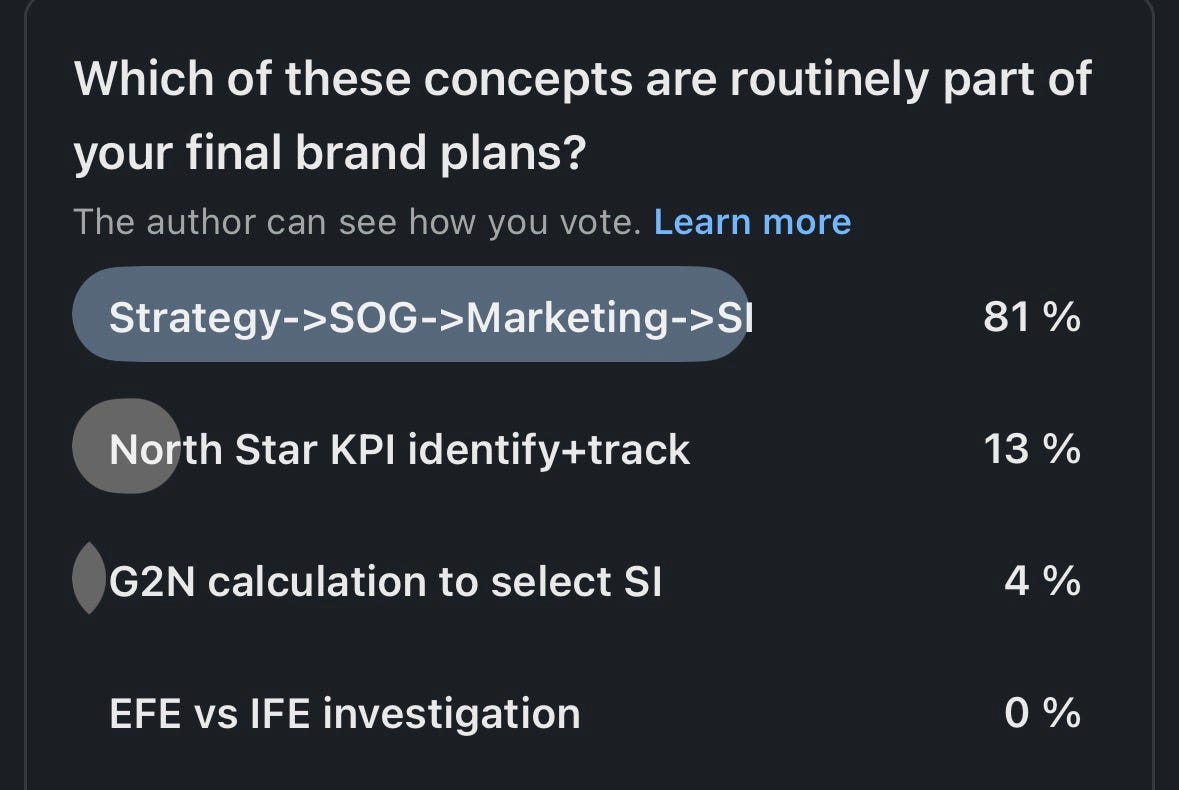
The most interesting part of my conversation with Mr. Raja MVSMA was that a brand plan is not complete when it is approved. It is only considered complete when it changes behaviour in the market.We began with a LinkedIn poll in which 81% of respondents chose the familiar sequence of Strategy → Sources of Growth → Marketing → Strategic Initiatives.But is that enough?Raja made an important distinction. He said the first 50% of brand planning happens in the boardroom while the other 50% happens on the ground through execution, salesforce understanding and disciplined governance.Some really interesting points from our talk:* Start with customer behaviour, not activities. What exactly do you want the customer to think or do differently?* Think beyond the HCP. Competition, customer and channel (Raja’s 3C framework) must connect before initiatives are designed.* Distinguish marketing from trading. More CMEs, roundtables, discounts and omnichannel activity do not automatically build a brand.* Choose a North Star KPI. It must reflect the brand’s strategy and lifecycle, not simply default to sales growth.* Measure impact, not attendance. An event’s success is not the number of doctors who showed up, but whether the communication changed their thinking or behaviour.* Make the brand manager own the P&L. Growth without an understanding of gross-to-net, manpower, sales and marketing costs is an incomplete business plan.I asked him a question which I believe, captures the challenge that brand managers face all the time. How do you choose/prioritise the customer behaviour you intend to change and how can you ensure that translates into profitable, sustainable growth?Perhaps this is the real capability gap in Indian pharma brand planning. We have become reasonably good at preparing plans. We need to become much better at making choices, understanding business economics and translating strategy into field execution. For every brand manager, business head and marketing leader preparing for 2027–28 - are we building a brand plan, or merely completing a planning exercise or filling a template?Listen in if you’d like some fresh ideas. This is a public episode. If you would like to discuss this with other subscribers or get access to bonus episodes, visit mypharmareviews.substack.com

The central question facing Indian pharma is whether it has built the organisational architecture to capture the value of innovation.In this episode of My Pharma Reviews – The Podcast, I speak with Anupama Rao Singh - EVP at Dr Reddy’s, about if India may be becoming a sourcing hub for innovation without becoming an innovation hub itself. She thinks licensing an innovative asset is only the first step in a long journey, and building the clinical capabilities, commercial ecosystems, regulatory depth, capital commitment and organisational patience to extract its full value is an entirely different challenge.We explore:* Why signing an innovation deal is not the same as building innovation capability.* Why Indian pharma may be renting innovation rather than owning its economic value.* Whether the emerging-market advantage is sustainable or simply a temporary window.* How changing regulatory dynamics in Latin America could reshape competitive advantage.* Why innovative assets cannot be managed using the same operating models, KPIs and investment horizons as generics.* What Indian pharma needs to change in its capital allocation and organisational design.A sourcing hub captures commercial margins. An innovation hub captures a much larger share of the value created. The difference is not ambition. It is capability, capital and organisational design.For Indian pharma is sourcing a waypoint on the journey to innovation, or are we in danger of making it our destination? If you are a pharma executive, CEO/promoter, investor or industry leader, this is a conversation worth listening to.🎙️ Watch/listen to the latest episode of My Pharma Reviews – The Podcast: A Reality Check on India’s Biotech Ambition. This is a public episode. If you would like to discuss this with other subscribers or get access to bonus episodes, visit mypharmareviews.substack.com

Indian pharma has spent time, money and effort trying to reach more doctors, add more field force and expand distribution. But once that is done, a more consequential part of the deal remains unacknowledged and unowned. Hence today I asked my guest who owns the customer relationship after the prescription is written?The answer has implications for commercial productivity, channel economics and more importantly, how pharma companies allocate (or leave) capital between building capabilities and accessing them through partners.This conversation examines why the last mile is not merely a distribution problem. It is a strategic question about control, data and value creation. My guest says that for pharma CXOs, the challenge is not simply to reach more towns. It is to make every incremental rupee of commercial investment work harder and asks if pharma thinks about building reach or building a more valuable business?Listen in to one of the most comprehensive understanding of the pharma supply chain.This is my conversation with Mr. Rajasekhar Parcha, founder and CEO of GoApptiv. This is a public episode. If you would like to discuss this with other subscribers or get access to bonus episodes, visit mypharmareviews.substack.com
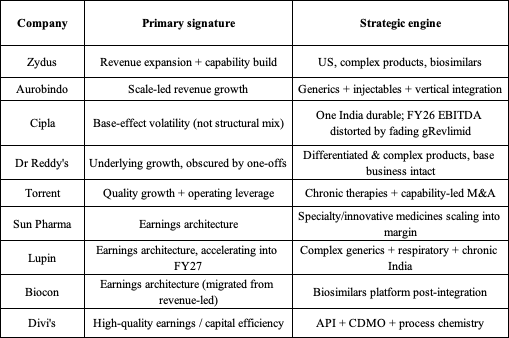
Which Indian pharma company is growing the fastest?Wrong question. The right one is, which company is making its next rupee of revenue more valuable than its last, and can prove it’s still true a year from now?Some companies are building revenue. Some are converting revenue into EBITDA. A few are rebuilding the economic architecture of the business entirely. And at least one, this year, looked like it was doing the third thing and was actually just riding a fading product out the door.Revenue is the headline. EBITDA is the signal. Earnings architecture is the strategy. And telling the three apart, quarter by quarter, is the entire job.Look at this chart. And listen to the new episode. This is a public episode. If you would like to discuss this with other subscribers or get access to bonus episodes, visit mypharmareviews.substack.com

Everything else “strategic” like semi-conductor chips, rare earth minerals, cloud computing etc., is de-risking away from China while biopharma is de-risking into it.The US-China biotech deal value went from $5B in 2020 to $136B last year. Chinese companies originated 46 of 104 new active substances approved globally in 2025 - more than the US and Europe combined. And three days ago, China made the ambition official by releasing a state plan targeting 25% of the world’s first-in-class drugs by 2030.Meanwhile, Pfizer’s own strategic adviser ranks China a “distant third” threat, behind the IRA and MFN pricing. Maybe true for Pfizer’s margin but an odd way to describe a country that just legislated a 25% target.For Indian pharma, the usual “if the world is de-risking from China, we benefit” is only half right. We’re gaining ground in manufacturing and CDMO. We’re absent from the race that actually compounds - who originates the medicine in the first place.New episode of My Pharma Reviews — The Podcast is out. Listen in!Meanwhile, here is the paper I referenced on the show. This is a public episode. If you would like to discuss this with other subscribers or get access to bonus episodes, visit mypharmareviews.substack.com

Comments

Download from Google Play

Download from App Store
 United States