


 Claim Ownership
The Coordination Tax
Subscribed: 0Played: 0
Subscribe

© In Parallel
Description
The podcast about the invisible cost every organisation pays when the picture at the top stops matching the reality on the ground.
14 Episodes
Reverse
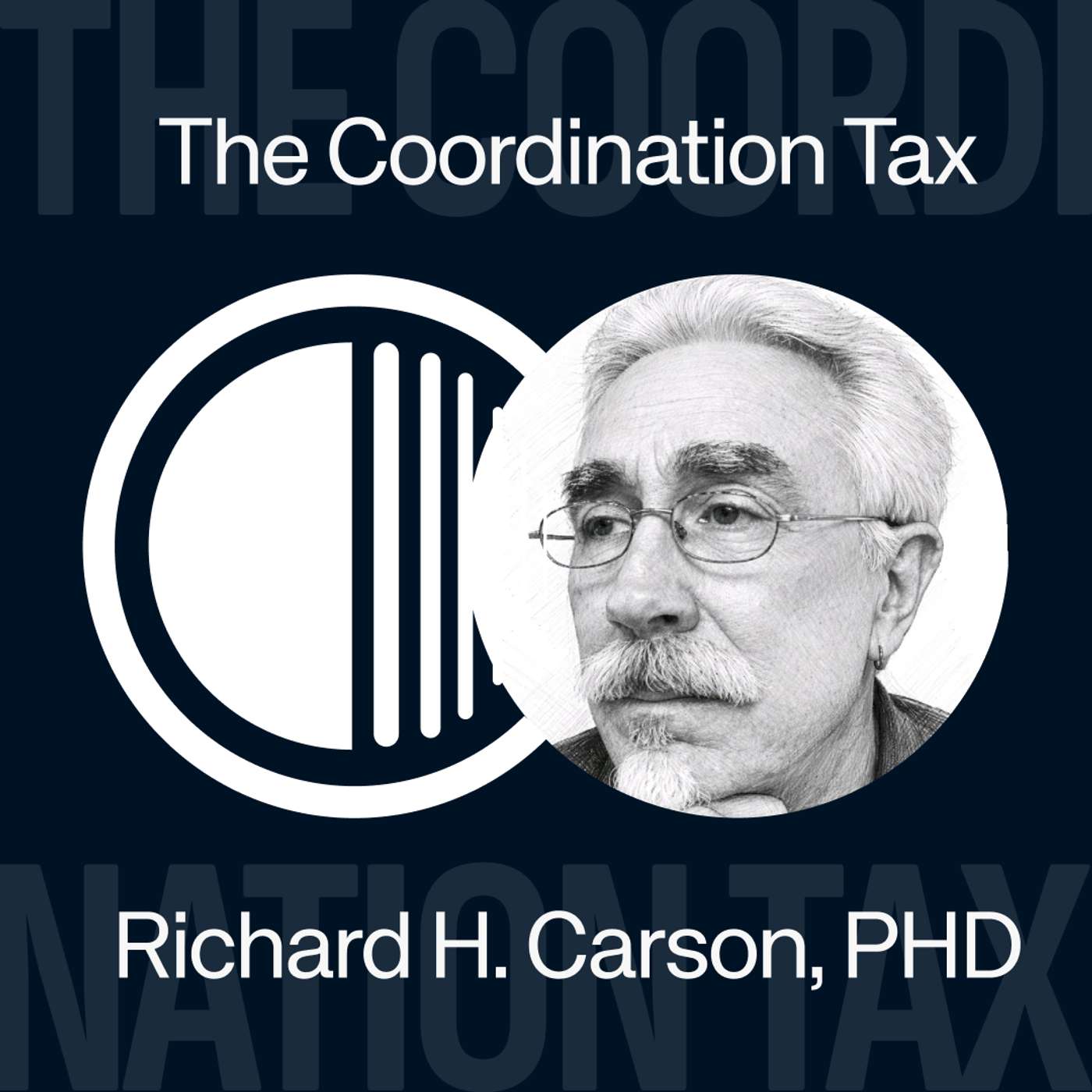
Every organization employs someone whose job is to clean up after disasters. Almost none employs someone whose job is to see change coming. Richard H. Carson, PhD — 40-year veteran of county governments, regional planning agencies, nonprofits, and the state of Oregon — argues that this one asymmetry explains most of why organizations lurch between crises instead of adapting. In this conversation, Richard walks through what he learned across four decades of running the kind of organizations most people only complain about.Richard holds a doctorate in change management and has spent his career inside the organizations academics write books about — county governments in Oregon, Clark County, regional planning bodies, nonprofits, and large private-sector stakeholders including Japanese industrial investors. He has studied every major change management model published since Kurt Lewin founded the field in 1947. His book, available at bookofchange.com, is the culmination of that work: a three-phase, ten-step model built on a diagnostic tool he adapted from the US National Institute of Health.In this conversation, Richard unpacks why learning to listen is the single hardest skill for ambitious leaders — a lesson that started, embarrassingly, with his own wife — and how he once found an organization where the manager was making people report their activities in 15-minute increments. He walks through why most of the major change management models published since 1947 are “consultant loss leaders” rather than real frameworks, why the real problem in most change initiatives sits with the board or the CEO who commissioned them, and why every organization needs a change manager — a proactive counterpart to the risk manager — looking over the horizon. He talks about why you don’t want yes-people around you, how to be direct across cultures (he spent years learning this with Japanese investors), and why “don’t leave fingerprints” is one of the hardest lessons leaders in high-visibility roles have to learn. He closes on what he got wrong in his 30s and the first thing a leader should do when a change initiative is quietly managing them instead of the other way around.CHAPTERS[00:00] Cold open + intro[00:57] The lesson Richard learned from his wife — “I want you to listen”[02:26] The manager who had people report in 15-minute increments[03:49] Why change management hasn’t changed since 1947[05:30] Richard’s 3-phase, 10-step model[06:24] The nonprofit board that was itself the problem[07:48] Why you don’t want yes-people around you[10:24] Risk manager vs change manager — the asymmetry nobody notices[12:40] Keep a low profile — “don’t leave fingerprints”[14:36] Why 70% of change initiatives fail[18:00] Change management in government vs private sector[20:20] Why leaders have to get out of the office[23:30] Working with Japanese stakeholders — directness across cultures[25:08] Diagnosing organizations like physicians diagnose patients[27:48] What Richard got wrong in his 30s[30:45] What to do when change is managing you insteadGuest & show links:Richard H. Carson, PhD on LinkedIn: https://www.linkedin.com/in/richard-h-carson-phd-mpa-7030b213/Book of Change: https://bookofchange.comIn Parallel: https://www.in-parallel.comCoordination Tax Index 2026: https://www.in-parallel.com/coordination-tax/#report

Most companies describe culture as a statement — values, mission, bios on a wall. Adam Christing — professional master of ceremonies, founder of Clean Comedians, and author of The Laughter Factor — argues that culture is actually a feeling, something you can walk into a room and sense within seconds. And the fastest shortcut to shifting it, he says, isn't a new mission statement or offsite. It's humor — used by leaders who understand that we feel before we think.Adam has spent more than 30 years in corporate rooms as an emcee, keynote speaker, and comedian. He has delivered more than 4,000 humor presentations across Fortune 1000 companies, runs the Clean Comedians agency, and knows over a hundred professional comedians (most of them, he says, deeply serious people). His book The Laughter Factor is the result of decades of experimenting with how humor actually shifts a room — and what leaders get wrong when they try to be the funniest person at the table instead of the orchestrator of fun.In this conversation, Adam unpacks why culture is an experience rather than a statement, why the root word of "culture" is "cult" (a shared association around a leader), and why the root word of "humor" is "human." He walks through what he does when he walks into a boardroom and feels something is off, why self-effacing humor is a shortcut to trust, and why leaders don't need to be funny — they need to be the orchestrator of fun, the conductor who puts the spotlight on their team. He shares the dad-jokes-on-3x5-cards exercise he runs with Fortune 1000 teams, the three things never to joke about (politics, prejudice, profanity), and his "if in doubt, leave it out" rule. He closes on AI: why the real danger isn't replacement, it's losing participation — the actual thing humor creates — and the one thing every leader should do this week to shift the culture of their team.CHAPTERS[00:00] Cold open + intro[01:20] Walking into a boardroom and feeling the culture before you see it[02:06] "We feel before we think" — culture as experience[03:42] The root of "culture" is "cult"[04:47] What a master of ceremonies actually does[07:37] Humor + heart = authenticity[09:15] Self-effacing humor as a shortcut to trust[11:47] The root of "humor" is "human"[14:00] You don't have to be funny — be the orchestrator of fun[18:30] The dad-jokes-on-3x5-cards exercise[20:27] Politics, prejudice, profanity — three to avoid[23:06] Test your humor like a marketer[26:13] The danger with AI — losing participation[28:30] The one thing to do this week — hook their attentionGuest & show links:Adam Christing on LinkedIn: https://www.linkedin.com/in/adam-christing/The Laughter Factor + Laugh Language quiz: https://thelaughterfactor.comClean Comedians: https://cleancomedians.comIn Parallel: https://www.in-parallel.comCoordination Tax Index 2026: https://www.in-parallel.com/coordination-tax/#report

Every leader is quietly passing an addiction on to their team — the addiction to urgency. Jennifer Recla — leadership coach who's worked with hundreds of leaders across nonprofits, mission-driven organizations, and large financial institutions — argues that most of what feels like a "busy" workday isn't a workload problem at all. It's a mindset problem. And most leaders have no idea how much of the chaos in their teams they're personally creating.Jennifer has spent her career coaching leaders across nonprofits, smaller organizations, and larger institutions to build sustainable schedules, healthier team dynamics, and clearer communication. Her clients typically come to her exhausted — working nights and weekends, drowning in emails, without time to think about strategy or develop the people around them. She's built diagnostic tools like the urgency mindset index to help leaders see where they land on the spectrum and how to move.In this conversation, Jennifer unpacks why the single behavior driving organizational chaos isn't a behavior at all — it's a mindset. She walks through the urgency mindset spectrum (low urgency → strong urgency → urgency addiction), why emails and notifications are the biggest hidden time suck, and why a healthy leader has to consciously leave some work for others to pick up. She reframes managing up as a two-way skill — how helping your leader uncover what they actually mean strengthens trust rather than eroding it, and why doing it too often signals a bigger problem. She shares what mission-driven organizations get right about values and relationships that bigger companies quietly abandon. She closes on AI: why it won't replace people, why leaders now need to ramp up their people skills instead of scaling them down, and the three things every leader who creates clarity actually does — ending with the four questions every leader should ask their team this week.📥 Download the Coordination Tax Index 2026: https://www.in-parallel.com/coordination-tax/#reportCHAPTERS[00:00] Cold open + intro[00:58] Why leaders create chaos — mindset, not behavior[01:27] The urgency mindset — what it actually looks like[02:36] The first diagnostic — audit your workload[04:22] Why emails and notifications are the biggest time suck[06:31] The urgency mindset index — where do you land?[08:04] Side effects when the team can't read the leader[10:07] Managing up as a two-way skill[12:58] What smaller and mission-driven organizations get right[16:38] AI won't replace people — why you need MORE people skills now[17:55] Three things a leader who creates clarity does[19:19] The four questions to ask your team this weekGuest & show links:Jennifer Recla on LinkedIn: https://www.linkedin.com/in/jenniferrecla/Website: https://www.jenrecla.com/In Parallel: https://www.in-parallel.comCoordination Tax Index 2026: https://www.in-parallel.com/coordination-tax/#report

Most organizations run on a fiction — that job descriptions describe jobs, that OKRs measure value, that personality tests reveal something real. Barry Wolfe — HR consultant and author of It's All in Your Head — argues that HR is the last line of defense against the chaos this creates, and that the actual foundation of a well-run company is one document, under 300 words, that answers two questions almost nobody bothers to ask.Barry has spent decades working with HR leaders and business owners to help them build organizations where every role has a clear connection to the value the business creates. His book It's All in Your Head: Why Psychology Doesn't Help Your Employees Deliver Value — and What Can is the culmination of a two-year deep dive into the science, and often the pseudo-science, behind the tools HR uses every day. He is the creator of the value-centric leadership framework and runs Argos HR.In this conversation, Barry unpacks why HR is the last line of defense against organizational chaos, why OKRs quietly stop at "deliverables" instead of value, and why every role in a company should have 3-5 clear value outcomes — or be reconsidered entirely. He walks through the surprising history of the DISC personality test (invented by William Moulton Marston, the Harvard psychologist who also created Wonder Woman) and explains why business owners buy pseudo-science: they're not really paying for the tests, they're paying for easy answers to hard questions. He introduces the Same Page — a document of fewer than 300 words that should be readable by a machine operator and a CEO alike, and should be the basis of everything the organization does. He closes on AI: why he's sceptical of the "killer robots" narrative, why LLMs cannot write your same page for you, and the one question every leader should reflect on this week.CHAPTERS[00:00] Cold open + intro[01:08] HR as the last line of defense against chaos[04:00] The first signs HR isn't doing its job[05:34] Why OKRs stop short of actual value[08:03] The two questions every leader must answer[10:06] Why every role needs 3-5 value outcomes[14:10] The strange history of the DISC test (and Wonder Woman)[17:20] Why business owners keep buying pseudo-science[18:09] The Same Page — a 300-word document that runs everything[21:13] Whether AI will actually replace jobs[23:16] Why AI can't tell you what your same page is[29:35] The one reflection every leader should do this weekGuest & show links:Barry Wolfe on LinkedIn: https://www.linkedin.com/in/barryrwolfe/It's All in Your Head on Amazon: https://www.amazon.com/Its-All-Your-Head-Psychology-ebook/dp/B0FD84SNGGArgos HR: https://www.argoshr.com/In Parallel: https://www.in-parallel.comCoordination Tax Index 2026: https://www.in-parallel.com/coordination-tax/#report

Every disruption looks like a peace-time problem until the swordsman meets the bullet. Alberto Torres — former Nokia executive, ex-McKinsey partner, and author of The Z Curve — sat inside one of the most famous corporate collapses of the last two decades. In this conversation he walks through what actually happened at Nokia, why great peace-time leaders quietly fail in war-time, and what every company facing AI right now should learn from the companies that got disruption right (and the ones that didn't).Alberto has spent his career at the sharp end of disruption. He joined Nokia in 2009 as part of the leadership team trying to turn the ship around, ran Vertu (Nokia's luxury phone business) and the accessories group before that, and later held roles at Opera, Bang & Olufsen, and Adobe, where he now works. Before Nokia he was a partner at McKinsey. His book The Z Curve was written to give managers facing disruption today — especially around AI — a more aggressive playbook for surviving it.In this conversation, Alberto unpacks why Stephen Elop wasn't the only culprit in Nokia's collapse, why empowerment is the right leadership model in peace-time and the wrong one in disruption, why "you don't get radical action by averaging opinions," and why the people who vote for continuity are always right — until they're not. He walks through his S-curve/Z-curve framework for reading a disruption in real time, the sword-vs-bullet metaphor at the heart of the book, and the two companies (Adobe and Netflix) that got self-disruption right by cannibalising their own successful business. He closes on AI: why he thinks it's the next internet-scale disruption, why "the winners will be picked in the next few years," and the one thing every leader should do this week if they suspect their company is at the start of a Z-curve.📥 Download the Coordination Tax Index 2026: https://www.in-parallel.com/coordination-tax/#reportCHAPTERS[00:00] Cold open + intro[01:26] Stephen Elop wasn't the only culprit — an insider view of Nokia's collapse[04:57] Why organizations live in split reality[07:12] The swordsman and the bullet[10:16] Peace-time leadership vs war-time leadership[10:57] 400 beautiful hardware models — and no software strategy[13:22] Joining Nokia in 2009[16:15] The S-curve theory and why we couldn't see it coming[19:55] Continuity voters, fatalists, and the muddled middle[25:36] Olli-Pekka Kallasvuo — the peace-time CEO[26:40] "You don't get radical action by averaging opinions"[27:00] The Z-curve — the ignored half of the S-curve[34:24] The Dreams framework — how Adobe transformed[38:15] Netflix cannibalising itself — how to disrupt yourself[40:07] AI is the next Nokia moment[46:02] What to do this week if you're facing disruptionGuest & show links:Alberto Torres on LinkedIn: https://www.linkedin.com/in/torresalberto/The Z Curve on Amazon: https://www.amazon.com/Z-Curve-Alberto-Torres/dp/1917391676In Parallel: https://www.in-parallel.comCoordination Tax Index 2026: https://www.in-parallel.com/coordination-tax/#report

Comments

Download from Google Play

Download from App Store
 United States