


 Claim Ownership
Breast Cancer Briefing
Subscribed: 0Played: 0
Subscribe

Description
Breast Cancer Briefing, hosted by Sara Nunnery, MD, MSCI, is a podcast series that breaks down the latest news in breast cancer research, one conversation at a time.
16 Episodes
Reverse

Breast Cancer Briefing, hosted by Sara Nunnery, MD, MSCI, a breast medical oncologist and the director of Breast Cancer Research at Tennessee Oncology in Nashville, is a podcast series that breaks down the latest news in breast cancer research, one conversation at a time.In this episode, Dr Nunnery sat down with Sarah Premji, MD, a breast medical oncologist at Sarah Cannon Research Institute Oncology Partners and the assistant director of breast cancer research at Sarah Cannon Research Institute in Nashville, Tennessee.The experts discussed key breast cancer data presented at the 2026 ESMO Congress, beginning with the 6-year analysis of the phase 3 NATALEE trial (NCT03701334). Dr Premji explained that adjuvant ribociclib (Kisqali) plus endocrine therapy continued to generate an invasive disease–free survival benefit vs endocrine therapy alone in patients with hormone receptor–positive, HER2-negative early breast cancer, and that a descriptive overall survival benefit also held promise. Although this analysis was nominal and not alpha controlled, she characterized the efficacy findings as clinically meaningful and consistent with findings from the phase 3 monarchE trial (NCT03155997) of abemaciclib (Verzenio) plus endocrine therapy in this patient population. The conversation then compared the 2 CDK4/6 inhibitors, including considerations for treatment duration, gastrointestinal toxicity associated with abemaciclib, QT prolongation seen with ribociclib, step-up dosing, and reassurance about dose reductions.Turning to antibody-drug conjugates, Drs Nunnery and Premji reviewed approved agents and their targets and payloads, highlighting data suggesting that cross-resistance between antibody-drug conjugates (ADCs) with the same topoisomerase I inhibitor payload may limit sequential benefit. They then examined 3 novel ADCs. In the phase 3 HORIZON-Breast06 trial (NCT05814354) in patients with HER2-low metastatic disease, the HER2-directed ADC trastuzumab rezetecan (SHR-A1811) improved median progression-free survival vs chemotherapy. In the phase 3 APEX-Breast01 trial (NCT06561607), the biparatopic HER2-directed ADC TQB2102 yielded a median progression-free survival (PFS) improvement vs chemotherapy in HER2-low recurrent or metastatic disease. Finally, the EGFR/HER3 bispecific ADC izalontamab brengitecan (BL-B01D1) improved the median PFS vs chemotherapy in heavily pretreated patients with hormone receptor–positive, HER2-negative disease in the phase 3 PANKU-Breast01 trial (NCT06343948). Dr Premji emphasized that future trials should use ADCs as comparators and that novel payloads are needed.

Breast Cancer Briefing, hosted by Sara Nunnery, MD, MSCI, a breast medical oncologist and the director of Breast Cancer Research at Tennessee Oncology in Nashville, is a podcast series that breaks down the latest news in breast cancer research, one conversation at a time.In this episode, Dr Nunnery sat down with Sarah L. Sammons, MD, an associate professor of medicine, the co-director of the Breast Cancer Evaluation and Treatment Program, co-leader of Breast Medical Oncology, and the co-director of the Multidisciplinary Brain Metastases Clinic at the University of Maryland Marlene and Stewart Greenebaum Comprehensive Cancer Center in Baltimore.The experts discussed the management of HER2-positive metastatic breast cancer and brain metastases. Dr Sammons explained that brain metastases arise when primary breast cancer cells migrate through the bloodstream, noting that HER2-positive and triple-negative breast cancer subtypes carry the highest risk. She argued that current ASCO and National Comprehensive Cancer Network guidelines should be reconsidered to permit screening brain MRIs when findings would change treatment, emphasizing quality-of-life end points over overall survival.Turning to therapy, Dr Sammons reviewed local treatment options and the evolving understanding of the blood-brain barrier, highlighting that both TKIs and antibody-drug conjugates can penetrate the central nervous system. She then provided insights on data from the phase 3 HER2CLIMB-05 trial (NCT05132582), which supported the October 2026 FDA approval of tucatinib (Tukysa) added to trastuzumab (Herceptin) and pertuzumab (Perjeta) maintenance, extending median progression-free survival vs placebo plus trastuzumab and pertuzumab when administered following induction treatment.Dr Sammons distinguished maintenance strategies by hormone receptor status, favoring the phase 3 PATINA trial regimen (NCT02947685) for estrogen receptor (ER)–positive disease and the HER2CLIMB-05 regimen for ER-negative disease. She also addressed treatment tolerability considerations, including diarrhea and transaminase elevations.Finally, the experts contextualized first-line sequencing following the FDA approval of fam-trastuzumab deruxtecan-nxki (Enhertu) plus pertuzumab, discussed leptomeningeal disease, explored the emerging role of circulating tumor DNA, and outlined future research directions, including VEGF bispecific antibodies and novel brain-penetrant agents.

Breast Cancer Briefing, hosted by Sara Nunnery, MD, MSCI, a breast medical oncologist and the director of Breast Cancer Research at Tennessee Oncology in Nashville, is a podcast series that breaks down the latest news in breast cancer research, one conversation at a time.In this episode, Dr Nunnery sat down with Hil Moss, MBA, MPH, a breast cancer survivor and the co-founder and chief executive officer of OncoveryCare, the first virtual survivorship clinic delivering cancer survivorship care.Their conversation centered on the often-overlooked gap in breast cancer survivorship care, beginning with Moss's personal story. Diagnosed with breast cancer at age 28, just weeks into her MBA program, Moss described a 15-month active treatment phase that anchored her in a clear plan, as well as the disorienting transition that followed once her treatment ended. She explained that the period after active treatment surfaced both mental health challenges and difficult physical effects, including adverse effects associated with tamoxifen.Moss then contextualized why the cancer care system underinvests in survivorship, framing it as a care-model design problem. She explained that the episodic, high-throughput oncology model was built decades ago for a smaller population at a time when survival rates were far lower, and emphasized that this model has not been reconceptualized for today's growing population of survivors living longer with late cancer and treatment effects. She described the resulting problem, in which patients bounce between oncology and primary care.Turning to OncoveryCare, Moss detailed its telemedicine model, which integrates directly with oncology teams and deploys a survivorship-trained team to address both the visible symptoms and invisible risks of survivorship, as well as behavioral health support. Finally, Moss advocated for the measurement of hard survivorship outcomes, including medication adherence and mortality, highlighted an endocrine therapy survivorship program, and urged clinicians to simply ask patients about their survivorship challenges to determine how best to help them in the months and years following their treatment.
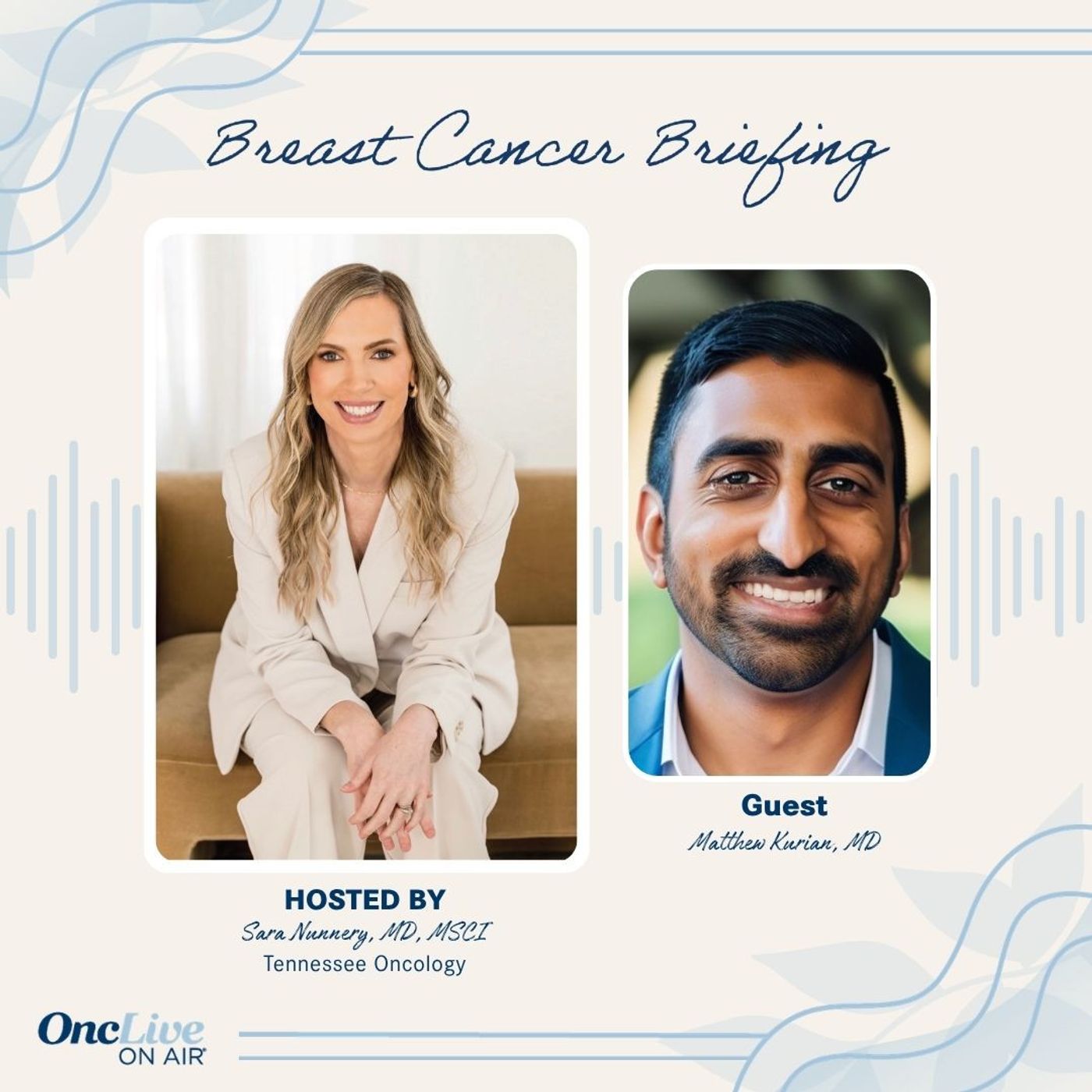
Breast Cancer Briefing, hosted by Sara Nunnery, MD, MSCI, a breast medical oncologist and the director of Breast Cancer Research at Tennessee Oncology in Nashville, is a podcast series that breaks down the latest news in breast cancer research, one conversation at a time.In this episode, Dr Nunnery sat down with Matthew Kurian, MD, a hematologist/oncologist at St. Elizabeth Healthcare in Edgewood, Kentucky, as well as an assistant professor of medicine at the University of Kentucky College of Medicine in Highland Heights.The experts discussed the role of artificial intelligence (AI) in oncology, beginning with foundational concepts. Dr Kurian explained that AI comprises systems trained to recognize patterns from large datasets, distinguishing generative large language models, such as ChatGPT, from retrieval-grounded tools, such as OpenEvidence, which draw from trusted sources like ASCO and the National Comprehensive Cancer Network (NCCN) Guidelines. He cautioned about pitfalls of AI, including hallucinations and automation bias, and stressed the importance of verifying AI outputs and using effective prompts.The conversation then addressed AI scribes, with Dr Kurian citing data showing that primary care physicians derive the most benefit from these tools, whereas surgical specialists derive the least. He noted that although scribes help clinicians be more present, these tools have not reduced time spent working after hours, which he attributed to an efficiency paradox in which saved time is reabsorbed by additional patients or tasks.Turning to FDA-authorized AI devices, Dr Kurian traced AI’s history in mammography from computer-aided detection to Clairity Breast, which uses existing mammograms to calculate a 5-year breast cancer risk in patients starting at age 35 years. He also discussed access and reimbursement limitations associated with this technology.Finally, Dr Kurian issued a call to action urging ASCO and the NCCN to require prospective validation before integrating AI tools, warning against reliance on outdated retrospective data and the risk of widening disparities, while emphasizing balanced, responsible adoption of these tools.

Breast Cancer Briefing, hosted by Sara Nunnery, MD, MSCI, a breast medical oncologist and the director of Breast Cancer Research at Tennessee Oncology in Nashville, is a podcast series that breaks down the latest news in breast cancer research, one conversation at a time.In this episode, Dr Nunnery sat down with Dana Bonaminio, MD, a breast radiologist and the director of breast imaging at Ascension Saint Thomas in Nashville, who is also a breast cancer survivor and community advocate.The experts discussed breast cancer screening amid recent conflicting guidelines, beginning with an overview of the breast radiologist's role across screening, diagnosis, and image-guided procedures. Dr Bonaminio shared her own diagnosis at age 44, which was detected on supplemental MRI and underscored her advocacy for breast cancer screening in women with dense breasts.The conversation then addressed breast density, which Dr Bonaminio explained affects approximately 50% of women, constitutes an independent risk factor, and can mask cancers through overlying tissue. She noted that women exceeding a 20% lifetime risk should undergo a supplemental MRI. She also reassured that breast implants do not preclude effective mammography. Dr Bonaminio also clarified the distinction between screening mammograms and diagnostic imaging, which is warranted for any symptoms, such as a lump, pain, or nipple discharge.Turning to emerging technology, Dr Bonaminio detailed contrast-enhanced mammography, which she is bringing to Nashville, describing its ability to subtract normal tissue and highlight enhancing cancers, particularly in extremely dense breasts. She anticipated it becoming standard of care and serving as a staging tool.The experts then contrasted screening guidelines, with Dr Bonaminio advocating for annual mammography starting at age 40 and cautioning against biennial or delayed approaches. She also reviewed artificial intelligence–based risk assessment tools, including Clairity Breast, as well as more traditional models.Finally, Dr Bonaminio highlighted her advocacy work, which includes founding a Nashville chapter of Pink Ribbon Good, which provides free rides, meals, and peer support to patients with breast cancer.

Comments

Download from Google Play

Download from App Store
 United States