


 Claim Ownership
Start Now with Greg M. Ostroff
Subscribed: 0Played: 0
Subscribe

© Greg Ostroff
Description
Start Now: How Ordinary Earners Build Lasting Wealth and Financial Freedom. This is the audio edition of the plain-language book on building your own tax-free pension — using nothing more than a Roth IRA and one low-cost index fund. Start Now is educational, not investment, tax or legal advice. Nothing in it is a recommendation to buy or sell any security. Consider your own situation, and talk to a professional where it matters. The book was written with the help of AI tools; the argument, the numbers, the stories, and every judgement are the author's.
startnowbook.substack.com
18 Episodes
Reverse
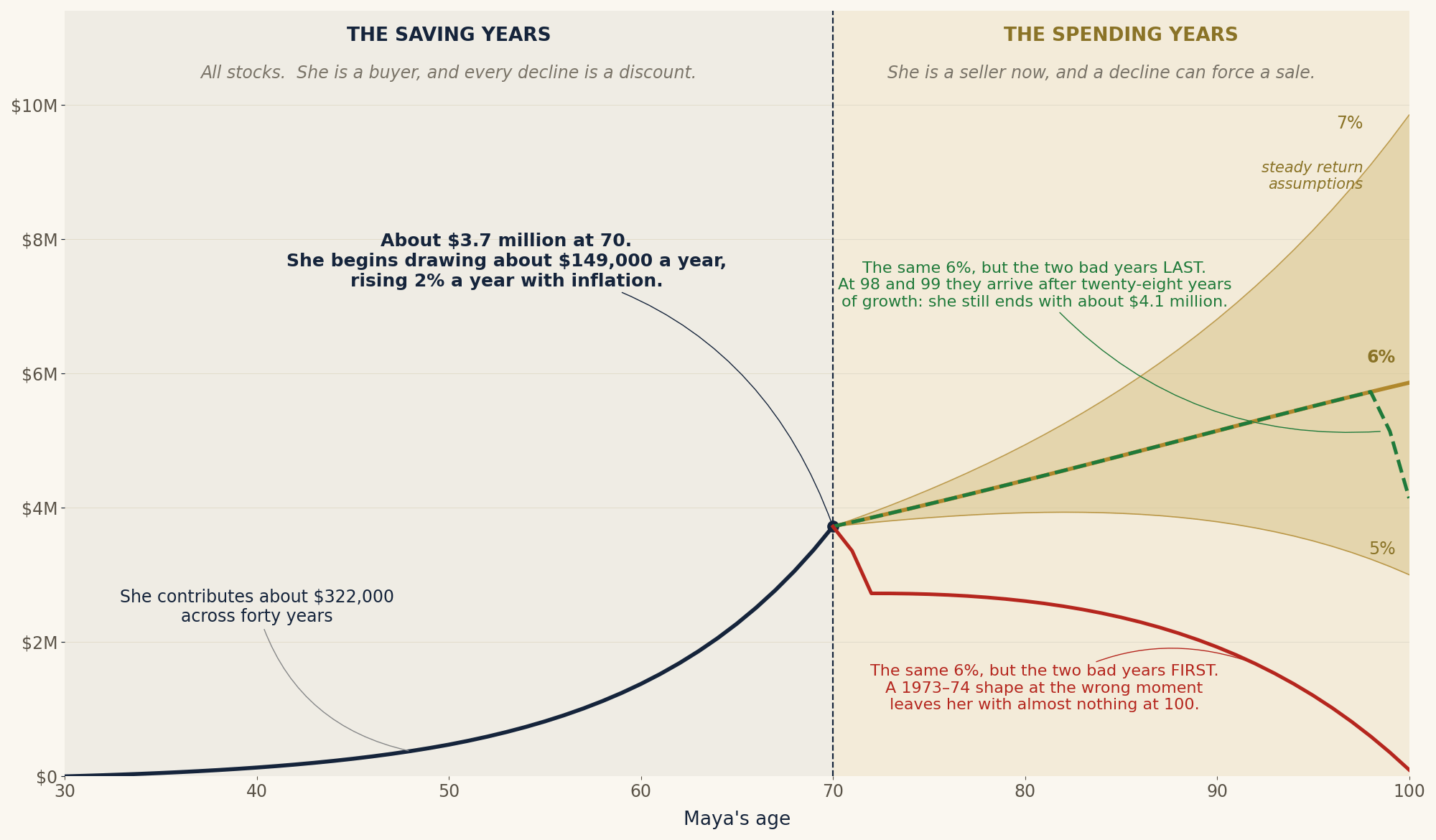
Start NowStart Now · Part 18. A free book, published one piece at a time: how ordinary earners build lasting wealth and financial freedom. New here? Start here →Greg M. Ostroff, CFAThe second job runs on different rules, and this chapter lays them out.Everything so far has been about the accumulation years. Spending the money down is a different problem. Buy, hold, and never sell is what built it; that rule, on its own, does not tell you how to live on it. This chapter does.While you’re saving, you’re a buyer. When the market falls, your next contribution buys more shares for the same money, and those cheaper shares have years to recover and grow. Once you retire and start living on your savings, you’re a seller. Now a falling market can force you to sell shares at low prices to pay your bills, and the shares you sell at the bottom are gone: they can never recover or compound again. Two retirees can earn the same average return over thirty years and end up in very different places, depending only on when the bad years arrive. Planners call this sequence-of-returns risk. It’s the real reason to hold some cash and bonds in retirement: not because they’re the better investment, but because they’re what you spend from, so a decline never forces you to sell stocks.A crash at the wrong moment shows what that means. A severe downturn right as you begin drawing the money down can strain even a sound retirement plan, because you are selling shares to fund the 4 percent distribution into a falling market. The U.S. “lost decade” of 2000–2009 is the cautionary case. The index returned about negative 0.9 percent a year, a total-return figure: the price fell about 2.7 percent a year, and reinvested dividends added back about 1.8%. That turned $10,000 into roughly $9,000 over a full decade, the only negative decade since the 1930s. A retiree who drew an income through that stretch from U.S. stocks alone would have felt real pain. The defenses are familiar: keep a cash cushion, stay flexible spending in bad years, and know that the S&P 500 isn’t the whole world: in that decade, smaller companies and foreign stocks held up better. Chapter 10 shows how to add them if you want.This is why a prudent investor adds ballast as retirement nears. A slice of the portfolio shifts into safe, low-volatility assets, short-term bonds or cash, earmarked for the next few years of spending. A downturn is then funded from those reserves rather than by selling stocks at the bottom. The withdrawal research does this with a balanced portfolio, roughly half stocks and half bonds. This book does it more simply: keep the long-term money in stocks, and set aside a few years of spending in cash and short-term bonds, so a bad market never forces you to sell. The two-bucket plan below shows how. Accumulating and drawing down are simply not the same job.The chart below follows one saver across both jobs.Read the green and red paths against each other. They earn identical returns: 6 percent in twenty-eight years, and the same two bad years. The only difference is when the bad years come. Meet them at the end, after twenty-eight years of growth, and she still holds about $4.1 million at 100. Meet them at the beginning, while the balance is largest and the withdrawals bite hardest, and she holds about $98,000. About four million dollars separates the two, and nothing produced it but the order of the returns.What the research foundThe Trinity Study ran every thirty-year retirement between 1926 and 1995. A portfolio of half stocks and half bonds, drawn at 4 percent in the first year and raised each year with inflation, lasted the full thirty years in 39 of the 41 periods. Two ran out.31Those two deserve to be taken seriously. They are also the product of two assumptions that no real retiree lives by.The first is that the retiree never adjusts. The simulation raises the withdrawal by the inflation rate every single year without exception, including the year after the portfolio has fallen thirty percent. Nobody behaves that way. Skipping one inflation raise after a bad year, or trimming spending modestly for a year or two, repairs most of what the fixed-rule simulation records as failure. The 4 percent rule was built as a planning benchmark, not as a set of instructions to be followed off a cliff.The second is that spending rises with inflation for thirty straight years. It does not. Household survey data shows real spending in retirement falling by roughly 1 percent a year through most of it, as travel, restaurants and other discretionary spending taper off. A household starting at $100,000 a year reaches a real low near age 84 at about $74,000, a decline of roughly a quarter. Later it turns back up as health costs rise, which is why researchers call the shape the retirement spending smile.32 A retiree who takes the inflation raise only in the years they actually need it is running a materially safer plan than the one the simulation tested.What to do about itNone of this argues against the plan. It argues that the plan has a second half, and that the second half runs on different rules.Hold several years of spending in something that isn’t stocks. Short-term bonds or cash, earmarked for exactly that. In a bad market you spend from the reserve and leave the shares alone. This is the whole defense. The withdrawal research protected retirees by keeping about half their money in bonds. The cash bucket gives the same protection with only two or three years of spending out of stocks.Take the inflation raise only when you need it. This is the single cheapest defense available, and it costs nothing in years when your spending was going to fall anyway.Build your cash bucket in the account you’ll spend from first. The tax-smart order is to draw down taxable and Traditional accounts before the Roth, so that’s where the cash belongs, and moving to cash inside a Traditional IRA or 401(k) costs nothing in tax. Keep the Roth in stocks the longest: its growth is the only growth that’s never taxed. If nearly all your savings are in a Roth, as in this book’s plan, build the bucket there; moving to cash inside a Roth costs nothing either.And notice what is not on this list: predicting the market. You cannot know whether your bad years arrive at 71 or at 91. All you can do is set up your plan so that, whenever they come, they hurt less.The test this book had not run: a bad decade at the finishThe stress tests in the second half of this book put the crash at the start of a working life: Tokyo in 1989, New York in 1929, the dot-com peak. That is the easy case. A young saver keeps buying through the wreckage, and the wreckage becomes the engine. The hard case is the mirror image, a bad decade in the last ten years before the money is needed, when the balance is largest and the contributions are too small to matter. That is the test a retiree actually fears, and it deserves the same honest arithmetic.So run it. Take the floor case from Chapter 3: forty years of contributions at 8 percent, finishing near $2.15 million. Now replace the last ten of those years, ages 60 to 69, with the actual returns of 2000 through 2009, the worst decade in modern American history. The result at 70 is about $940,000, well under half. A single 2008 in the final year alone takes it to about $1.26 million. These are the numbers a plan built on all stocks must be able to look at.Two things follow, and the second is the one that matters. First, no reshuffling of the portfolio undoes it: even a full shift from all stocks to a balanced mix across those ten years, far more than this book asks for, still ends near $1.08 million, because a balanced portfolio also fell in 2008. Second, and this is the real defense, the finish line is not fixed. The saver who met that lost decade at 60 and kept working and contributing to 75, through the five strong years that history actually delivered next, ends at about $1.97 million, 92 percent of the floor case. Ch… This is a public episode. If you would like to discuss this with other subscribers or get access to bonus episodes, visit startnowbook.substack.com
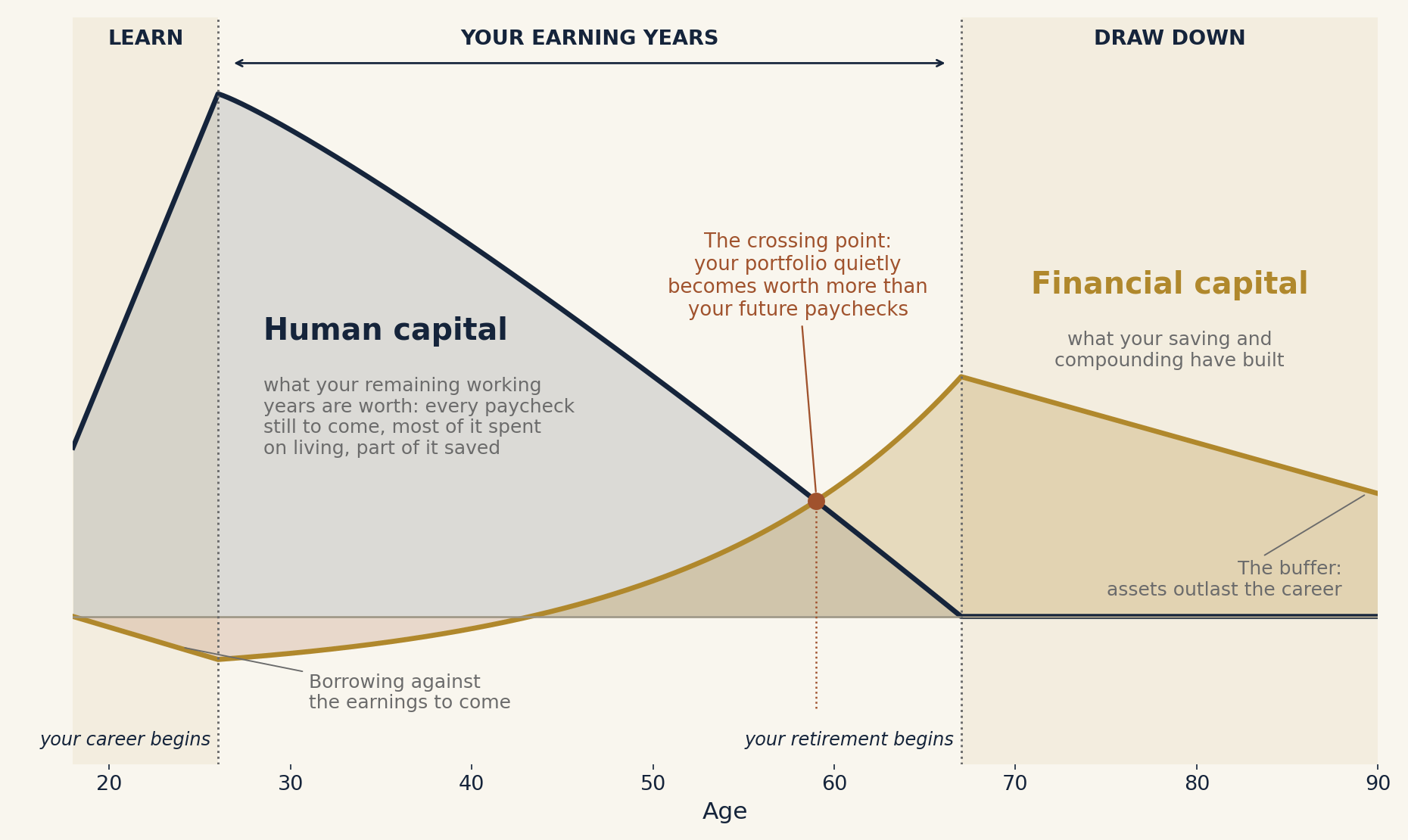
Start NowStart Now · Part 17. A free book, published one piece at a time: how ordinary earners build lasting wealth and financial freedom. New here? Start here →Greg M. Ostroff, CFAThe ten chapters behind you are the plan for building the money. The two ahead are about the shape of the whole thing, and about the other half of the job, spending it well. Start with a picture. Years ago, as our eldest was heading off to college, I wrote him a list of what I knew about money (it closes Book One, under the title “How to Become Wealthy, and Stay That Way”), and a couple of years later I came across an idea from economics that became that list’s companion: a single picture of a complete financial life. I have been drawing that picture, the chart below, for young people ever since, because something reliable happens when you see it. Many of the points on the list stop needing argument. Live below your means, carry no debt, save first, start early: once you see the shape, they become almost self-evident.Look at the chart below. It is not about the market. It is about you.You begin your working life owning almost nothing and holding one enormous asset: the years ahead of you. Economists call it human capital, the value today of every paycheck you have not yet earned. No statement reports it. No app tracks it. And particularly early in your working life, for most people it is their single most valuable asset.The chart above draws two lines. The navy line is your human capital, the value of all the earning years still ahead of you. The gold line is your financial capital, the money your saving and compounding have built. And what those two lines trace together is bigger than a portfolio: it is the complete shape of a financial life cycle, the story of the first line slowly becoming the second.Start at the left. In the learning years, the gold line is below zero. That is not failure; it is strategy. A student loan is a borrowing against the earnings to come, and a degree, within reason, raises the navy line by more than it costs. Not every year in a classroom does that; the test is whether the learning adds earning power. You are investing in the asset nobody can see. And the curve is not drawn once: a return to school, a new skill, a change of career can redraw its shape in midlife.Then the long middle. Every paycheck is your human capital paying out, year by year, like an owner drawing income from a business. Much of it you live on. Converting the rest is your job: human capital in, financial capital out, one contribution at a time. Live below your means and the conversion runs fast. This is all Chapter 10’s routine really is, a machine for making the conversion automatic.Here is the part almost nobody is taught. Your future paychecks are not just an income; they are an asset with a personality. A teacher’s or professor’s earnings arrive steadily for decades, like interest on a bond, and tenure, when it comes, turns the bond into something close to a guarantee. The finance professor Moshe Milevsky put it memorably: some of us are stocks, and some of us are bonds.† The startup founder’s could have huge upside or potentially be worthless, like a concentrated stock position. A surgeon’s cost a decade and a mountain of tuition debt to switch on, then flow like an annuity. This is why a 25-year-old on a steady career path can hold an all-stock portfolio without recklessness: she already owns the steadiest bond there is, her own next forty years of work. Her paycheck is the safe asset. Her portfolio can do the growing. If your earnings are the volatile kind, the same logic runs in reverse, and a larger cushion of safe assets is not timidity but balance. That cushion is really an emergency fund, sized to the swings in your income, and a topic this book leaves for another day.† Moshe A. Milevsky, Are You a Stock or a Bond? (FT Press, 2008). The research behind it is Roger G. Ibbotson, Moshe A. Milevsky, Peng Chen and Kevin X. Zhu, Lifetime Financial Advice: Human Capital, Asset Allocation, and Insurance (CFA Institute Research Foundation, 2007), free at cfainstitute.org.Then, some day in your fifties, or earlier if you save hard, the lines cross, and you will probably never know which day it was. Your portfolio quietly becomes worth more than all your future paychecks combined. Nothing announces it, but you have entered new territory. The portfolio is now the main engine: decades of compounding have finally given it the size to do the heavy lifting, and it grows exponentially larger on its own, as long as you protect it. Protecting it mostly means two things: guarding against lifestyle creep, and not doing a big stupid, the one dramatic act that undoes a decade of quiet ones: borrowing against it for something shiny, betting the pile on a single idea, panic-selling a crash. Your contributions continue, and they certainly help. But compounding now does more and more of the work.Where the navy line reaches the bottom of the chart, human capital is mostly spent. That is what retirement is. From there the task is a glide path, drawing the gold line down slowly enough that it outlasts you. These are the spending years, and they are meant to be enjoyed. You built it precisely so you could enjoy it wonderfully in this chapter of your life. But enjoying them takes a roadmap drawn in advance. Without one it is hard to protect the lifestyle, and harder still to be certain the money lasts as long as you do. Many people keep earning for a stretch, bumping the navy line off the bottom; the sums are usually smaller, and the work, at its best, is done because it matters to you, whatever the paycheck. The gold line lands not at zero but on a buffer: the insurance you never had to use, which becomes the gift you leave behind. Chapter 8 told you the rules flip at the boundary where human capital is mostly spent and the drawdown begins; the next chapter shows exactly how. This chart is why they flip.This frame has a name: life-cycle finance. Franco Modigliani won the 1985 Nobel Prize in economics largely for it, and Robert Merton and Zvi Bodie later extended it to the asset this page is built on, human capital.33 The theory runs deeper than one page, and we may return to it in the future. For now, and for this book, you need only the picture: a lifetime of earning power on one side, a compounding portfolio on the other, and a plan, the one in these pages, for converting the first into the second on purpose.Two hills, one lifeOne hill you're handed: your earning power, spent down a little every working year. The other you build yourself, one contribution at a time, so that it's tall enough to carry you once the first is gone. Everything before this chapter was about building that second hill. The last chapter is about what you do once you're standing on top of it.✦Coming next: 12 · Building It and Spending It Are Different JobsWant the rest as it’s written?New chapters arrive every Sunday, free. Subscribe and each one lands in your inbox.A NOTE FROM THE AUTHORStart Now is free to read and free to share. A new part publishes free every Sunday. Subscribe to get each part in your inbox as it goes out.If you find that it helps you, the kindest thing you can do is pass it forward to one person who needs it.And if you’d like to give back, pay it forward: donate any amount to a cause you believe in. Your money goes straight to the charity you choose. If you’d like a suggestion, I support the Zach Moses Music, Love & Light Fund at the Sweet Relief Musicians Fund, which feeds musicians in need. sweetrelief.org/zachmoses →If these pages have moved you to act, and you’ve opened the account, bought the fund, or set up the transfer, tell me about it: what did you do, what got in the way, what surprised you? Leave a comment or just reply to this email. First name, or none. I read every one.Start Now is educational, not investment, tax, or legal advice. Nothing in it is a recommendation to buy or sel… This is a public episode. If you would like to discuss this with other subscribers or get access to bonus episodes, visit startnowbook.substack.com

Start NowStart Now · Part 17. A free book, published one piece at a time: how ordinary earners build lasting wealth and financial freedom. New here? Start here →Greg M. Ostroff, CFAWhat if you have debt? First, clear the runwayWhen our son Samuel read an early draft, he asked whether the book ever addresses what someone with debt is supposed to do. It is the question most people under thirty would ask when they reach this point in the plan. The plan says fund the Roth as fully as you can; where does that money come from when you already owe it to someone else, a student loan, a car payment, a balance on the card? The answer is that debt is not a reason to skip the plan. Dealing with it is the first step of the plan.A generation ago, most people started their working lives with no debt to speak of. That is no longer the norm. School costs more, and student loans are common. Cars are financed. A phone, a laptop, a pair of shoes can each be split into four payments at checkout. Almost everything is a subscription. None of this makes the plan in this book wrong. It does mean a lot of readers will look at “fund it as fully as you can” and reasonably ask: with what?So here is how to think about the order of things. It is not advice for your situation, which I do not know. It is the way the math works, and one idea sits underneath all of it: paying off a debt is a guaranteed return equal to its interest rate. Pay down a credit card charging 22 percent and you have earned 22 percent, risk-free and tax-free, and no investment in this book can promise that. Compare every debt you carry to the 8 percent floor, and the order mostly decides itself. And keep one other number in view while you read what follows. A maxed Roth is $7,500 a year: $625 a month, about $288 out of every biweekly paycheck, roughly $20 a day. That is the yardstick. Every subscription, every card payment, every “four easy installments” below can be measured against it.* One month of expenses in an emergency savings account, before anything else. Many planners say three months. Get to one first. Give it its own account, and name it, so it is not money you see when you look at your balance. Without it, the next flat tire or dental bill goes on the card at 22 percent, and that undoes everything below.* The employer match, always, even while you are in debt. A dollar matched fifty cents or a dollar is an instant 50 or 100 percent return. No debt on earth costs that much. Contribute up to the match, and not a dollar past it until step 3 is done.* Anything charging more than the floor gets paid off first. Credit cards, which run 20 percent and up. Buy-now-pay-later plans once a payment is missed. Payday loans. Most private student loans, at 8 to 12 percent. Paying the highest rate first has the most financial impact. Paying the smallest balance first builds momentum, because clearing that first debt proves it can be done. Either order beats neither.* Anything charging less than the floor gets the minimum payment, and the Roth gets the rest. Federal student loans at 4 to 7 percent. Most car loans. A mortgage. Over thirty years the floor beats them in expectation, and there is a second reason that is specific to the Roth: the contribution window closes every year.You can always pay a 5 percent loan off faster in 2030. You can never go back and fund your 2026 Roth. Even fifty dollars a month keeps that door open.* Between about 5 and 8 percent is a judgment call, and splitting is fine. Half to the debt, half to the Roth. Nobody gets this exactly right, and nobody needs to.Take Grace, the café owner from Chapter 5, and suppose she starts with $6,000 on a card at 22 percent and a $15,000 car loan at 6 percent. First, a month of expenses, about $4,500, into the emergency account. Then everything spare goes at the card, about $1,000 a month, and it is gone in six months; the car loan gets its minimum, because 6 percent is below the floor. Through all of that she puts $100 a month into the Roth, not because the math says so but because the contribution window closes every year and the habit is worth more than the arithmetic. With the card gone, she builds the cushion out, and because a café’s income rises and falls with the economy, she builds it further than a salaried worker would, closer to six months than three. Then the Roth goes to the max. From a standing start with $21,000 of debt, that is about three years. It is not fast, and it is not the only reasonable order. But it is a well-reasoned one for her situation, the income risk she carries that an employee does not, and the math, and every step of it counts.Now take Dana, a nurse, whose situation is closer to most people's: a salary, a hospital retirement plan that matches 4 percent, $3,000 on a card, and $40,000 of federal student loans at 5.5 percent. Her order is shorter. The month of expenses first. Then the 4 percent into the plan from her next paycheck, because the match doubles it on the spot and nothing else on this list can. Then the card, gone in three months. The student loans sit in the judgment zone between 5 and 8 percent, so she splits: minimum payments plus a little extra, and the rest into the Roth. Her cushion stops at three months, because a paycheck is steadier than a café. From there the Roth goes to the max while the loans run down on schedule. Start to full speed, about eighteen months. Same order, different distances, and in both cases the account is open and compounding from the first year.Once the high-rate debt is gone, go back and build the cushion out, three months for most people, more if your income is the kind that swings. Then the routine in this chapter takes over.Two things worth saying that nobody needed to say a generation ago.* Subscriptions. Most people in their twenties carry eight to twelve of them: streaming, music, storage, an app or two, a gym, a delivery plan, an AI assistant, each anywhere from five to sixty dollars a month. Some are simply the cost of living now, and that is fine. But no single one is noticeable, and together they are often $150 to $300 a month, a quarter to a half of that yardstick. The money for the Roth frequently already exists in the budget but it is leaving in pieces too small to see. Make one list of every recurring charge. Most people cancel a third of it on the spot.* Buy now, pay later. A $160 pair of running shoes shows up at checkout as “four payments of $40”, and $40 is the number your brain approves. Do that a few times and you are carrying six or eight overlapping payment schedules whose total you have never once seen. The answer here is older than the app, and it is the one I was taught: if you cannot pay for it out of your checking account today, or put it on a credit card you will pay in full this month, you cannot afford it yet. Wait, and save up for it. The shoes will still be there.One last fact, and it is one of the most commonly misunderstood things about the Roth. Most people believe every dollar is locked up until 59½. It is not. The dollars you contribute can be taken back out at any time, at any age, with no tax and no penalty. You already paid tax on them, and the IRS does not tax them twice. Only the growth is locked, until 59½ and five years after your first contribution.35 Withdrawals are counted as coming from your contributions first, so a thirty-year-old who has put in $20,000 that has grown to $28,000 could take out up to $20,000 tomorrow with nothing owed. That is why, once the first month of expenses is banked, the Roth can serve as your backup emergency fund, and why you do not have to wait until every dollar of your life is settled to open one. But treat it as breaking the glass, not opening a door. Dollars you take out can never be put back; that year’s room is gone for good. The real penalty is not a tax. It is every year of compounding those dollars would have earned, and taken out young, that is the most expensive money you will ever spend. A dollar pul… This is a public episode. If you would like to discuss this with other subscribers or get access to bonus episodes, visit startnowbook.substack.com
Start NowStart Now · Part 16. A free book, published one piece at a time: how ordinary earners build lasting wealth and financial freedom. New here? Start here →Greg M. Ostroff, CFAYou’ve probably heard of the marshmallow test. A researcher sits a four-year-old down in front of a marshmallow and makes an offer. You can eat this one now, or you can wait about fifteen minutes by yourself, and then you can have two. Then the adult leaves the room.For decades the story we told about that experiment was a story about willpower. The children who waited were said to have done better in life, and the lesson was that self-control is destiny.That version hasn’t held up especially well. When researchers repeated the study with a larger and more varied group of children, most of the advantage turned out to be explained by other things.But something else in that research did hold up, and it’s the part worth knowing. Whether a child waits depends a great deal on whether the adults in that child’s life have been reliable. Children who had been promised things before and then let down ate the marshmallow right away. They weren’t weak. They were being sensible. Waiting only makes sense if you have some reason to believe the second marshmallow is actually coming.That’s the whole of this chapter, and most of this book.What follows takes about fifteen minutes to set up and then asks you to leave it alone for thirty years or more, which is the longest fifteen minutes in personal finance. Buying and selling is more interesting. It feels like doing something. Owning one index fund and then doing nothing feels like doing nothing, because it is.So I’m not going to ask you to be more disciplined than the next person. I’m going to tell you that the second marshmallow is real, and everything in this book is the evidence for it.✦The analysis in this book is the hard part. The doing is simple, almost boringly so. But simple isn’t the same as easy: the mechanics take minutes a year; holding your nerve through the declines along the way is the real test, and very nearly the only thing the whole plan asks of you. Stripped of jargon, the entire strategy reduces to a short routine that requires no market knowledge, no forecasting, and no ongoing decisions.1. Open the account. Open a Roth IRA at any major low-cost brokerage. It takes a few minutes online, and there’s no fee to have one.2. Fund it as early as you can. Each year, move the contribution in as soon as you have the cash, ideally the full annual maximum early in the year rather than waiting until the following April. (The IRS sets each year’s limit the previous autumn, so the maximum is already fixed and known the moment January arrives. There’s nothing to wait and see.) Every month the money sits outside the account is a month it is not compounding. If you can’t fund it all at once, set up an automatic transfer every payday so it happens without your having to think about it.3. Invest it immediately: don’t let it sit as cash. This is the step people most often miss. Money you contribute to a Roth is not invested by default; it lands in the account as cash and stays there, earning almost nothing, until you actually buy something. Put it straight into a single low-cost index fund that tracks the S&P 500 or the total U.S. stock market (or the whole world; section 10.3 shows both).19 One fund is enough: you don’t need a basket of holdings to do this well.4. Then leave it alone. Don’t check it daily. Don’t sell when the market falls. Don’t chase whatever did best last year. The discipline to do nothing, for decades, is the entire skill, and it’s harder than it sounds.First things first. The Whole Plan’s “Do this first” box comes before these four steps: a month of expenses in savings, building toward three; any debt charging more than about 8 percent paid off (Part two of this chapter gives the order); the full match if your job offers a 401(k) (see the note right after Chapter 2, “If Your Job Has a 401(k)”); and basic protection: disability insurance through work, term life insurance if anyone depends on your income, and a named beneficiary on every account. Then run these four steps with your Roth.10.1Invest a lump sum all at onceWhen you have a lump available, a year-end bonus, a gift, the new year’s contribution, the historical evidence favors investing it all at once, rather than feeding it in over several months. Across decades of market data, putting a lump sum to work immediately beat spreading it out about two-thirds of the time, simply because the market rises more often than it falls, so money left waiting on the sidelines usually misses gains.20Spreading purchases out over time, called dollar-cost averaging, isn’t a mistake; the automatic per-payday approach in step 2 is itself a mild form of it, and it can ease the anxiety of investing right before a possible dip. But understand the trade: it’s a comfort measure, not a return-booster. The real enemy is neither method. It’s paralysis, waiting for a perfect entry point that never comes.10.2Why all stocks, and no bonds or cashFor money you truly won’t touch for decades, holding bonds or a large cash cushion mainly does one thing: it lowers your long-run return in exchange for smoothing out swings you don’t actually need smoothed. You’re not going to spend this money soon, so its value bouncing around along the way doesn’t matter, only where it ends up at the finish. Recall that even the worst long stretch for U.S. stocks still compounded near 8% a year. A long-horizon Roth, funded and left untouched, is the textbook case for staying fully invested in stocks and letting time absorb the volatility.NOTEAll stocks - until you near retirementThe all-stock approach belongs to the long accumulation years, and it asks one thing in return: the discipline to hold through deep declines, including drops of 30% or more, without selling.As you near the years you’ll actually live on the money, the logic reverses. A crash while you’re still adding is a gift; a crash just as you begin to withdraw is the opposite: you’d be selling shares into the decline to fund your spending, locking in losses instead of riding them back up. Economists call this sequence-of-returns risk. So as you get close to retirement, the sensible move is to build up a cushion, enough in bonds and cash to cover a few years of spending, so you never have to sell stocks into a bear market, and can simply hold on through it until the market recovers. That’s also a good moment, if you don’t already have one, to sit down with a financial advisor who can help you plan the transition.If holding no cash at all feels too stark, a small allocation is a reasonable middle ground. Warren Buffett’s own instruction for the money he leaves his family, 90 percent in a low-cost S&P 500 fund and 10 percent in short-term government bonds, is one well-known version. Keeping, say, 5 to 10 percent in risk-free assets like short-term Treasuries or money-market funds costs little over a long horizon. Its real value is mostly psychological: a little dry powder means that when the market falls hard you can do something, put cash to work at lower prices, instead of only watching. But be clear-eyed about how much that changes. If you’re still in the saving phase and adding money on a schedule, your contributions are already buying the dip for you. The next downturn, and the one after that, simply become the moments your regular Roth contributions pick up more shares of the same index fund for the same dollars. That’s dollar-cost averaging doing its quiet work, no cash pile required.And this book is an illustration of how compounding works, not personalized investment advice. How much risk suits you is a personal decision that depends on your circumstances and temperament.10.3Which fund: use a low-cost ETFAny low-cost fund that tracks the S&P 500, or the total U.S. market, will do, and the most convenient form is an exchange-traded fund (ETF)… This is a public episode. If you would like to discuss this with other subscribers or get access to bonus episodes, visit startnowbook.substack.com
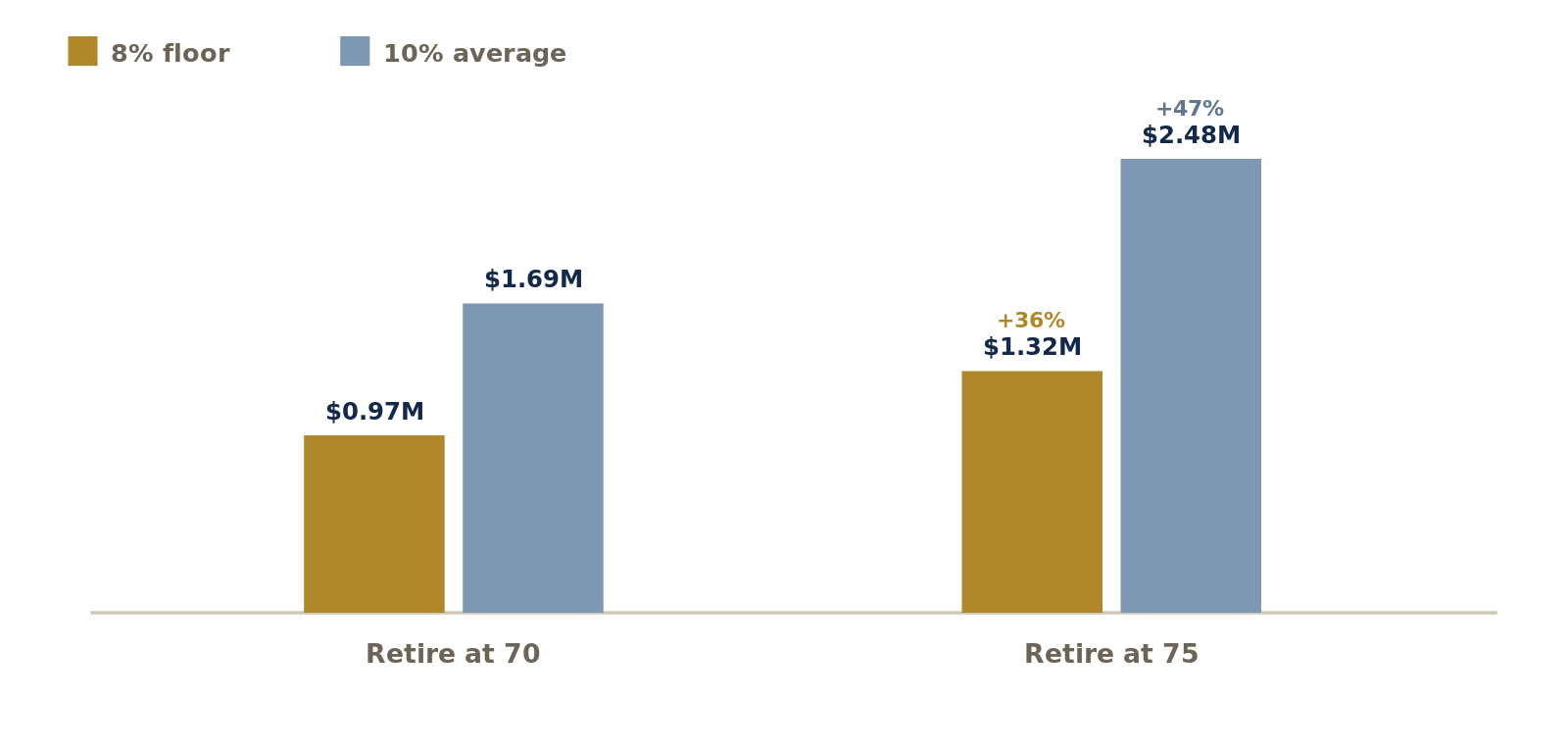
Start NowStart Now · Part 15. A free book, published one piece at a time: how ordinary earners build lasting wealth and financial freedom. New here? Start here →Greg M. Ostroff, CFAThe floor was the plan. The rest is upside.The case studies use the 10% average, but the plan was built to hold up on far less. At the 8% floor, the most unlucky investing lifetime on record, a maxed-out Roth still turns roughly $322,000 of contributions into just under a million dollars of tax-free spending power in today’s money. Even on the worst case the market has produced on record, the plan works.That foundation has a consequence almost no financial plan can claim: nearly all of the surprises run in your favor. Because it already succeeds at the bottom of the range, almost any outcome you actually get (the 10 percent average, or anything close to it) can only make things better. This chapter is about how much better, and why that asymmetry, not any single forecast, is the real reason to start.What could push returns higherThe last chapter named the forces that could drag returns down; several could just as plausibly push them up, and some are already underway. AI could raise productivity the way electricity and the computer once did, and shareholders own that growth. The structural advantages from Chapter 8 and Can America Keep Winning? (deep capital markets, the rule of law, the immigrant-founder pipeline) are all reasons the floor may prove too cautious. And as billions more consumers reach the middle class, much of what they spend flows back to the multinationals you already own.None of these is a promise. Each is a plausible reason the unlucky-investor case we planned around is, in fact, unlikely.9.4The upside you controlHere is the part most books bury. The market’s return is not in your control, but the three levers that matter most are, and all three have uncapped upside.* Starting earlier. Every year you move your start date forward adds a year on the far end, where the doublings are largest. Beginning at 25 instead of 30 doesn’t add a sixth more money. At the floor it adds far more, because that early dollar earns one extra doubling.* Contributing more as you can. We modeled flat contributions. In the real world the IRS limit drifts upward, raises happen, and the same disciplined habit applied to a slightly larger number compounds into a materially larger result.* Working and contributing a little longer. Retirement is not a fixed date, and we are living longer, healthier lives. Moving the finish line from 70 to 75 (five more years of contributions, five more years of compounding before you touch a dollar) lifts the floor outcome from just under a million in today’s money to about $1.3 million, a gain of more than a third in the worst case on record. At the typical and average rates the jump is larger still. Those may be five years you would happily work anyway.Retire at 75 instead of 70, today’s dollars8% floor: $975K → $1.32M · 10% average: $1.69M → $2.48MStarting earlier, contributing more as you can, working and contributing a little longer. These are not market bets. They are personal choices. And unlike the forecasts, their upside sits entirely in your hands.9.5Don’t plan on the upsideThe risk chapter ended with a rule: don’t let the unactionable catastrophes drive your decisions. The upside has a mirror-image rule, and it matters just as much. Don’t plan on it. It is tempting to look at the better outcomes and think that if the market will probably beat 8 percent, I can afford to put in less. Do the opposite. Build the entire plan on the floor. Fund it as though 8 percent is all you will ever get. And then let every better outcome be exactly what it should be: a surprise you never needed.That is the shape of the bet this book asks you to make. You have seen the numbers: even in the worst case ever recorded, you retire with just under a million of today’s dollars, and every better outcome, from the typical lifetime to the long-run average, simply hands you more. Past results do not guarantee future ones, but the historical margin of safety is wide, and the only thing the bet asks of you is that you start now.✦Coming next: Putting It Into Practice, Part one: Open the Account, Buy the FundWant the rest as it’s written?New chapters arrive every Sunday, free. Subscribe and each one lands in your inbox.A NOTE FROM THE AUTHORStart Now is free to read and free to share. A new part publishes free every Sunday. Subscribe to get each part in your inbox as it goes out.If you find that it helps you, the kindest thing you can do is pass it forward to one person who needs it.And if you’d like to give back, pay it forward: donate any amount to a cause you believe in. Your money goes straight to the charity you choose. If you’d like a suggestion, I support the Zach Moses Music, Love & Light Fund at the Sweet Relief Musicians Fund, which feeds musicians in need. sweetrelief.org/zachmoses →If these pages have moved you to act, and you’ve opened the account, bought the fund, or set up the transfer, tell me about it: what did you do, what got in the way, what surprised you? Leave a comment or just reply to this email. First name, or none. I read every one.Start Now is educational, not investment, tax, or legal advice. Nothing in it is a recommendation to buy or sell any security. Consider your own situation, and talk to a professional where it matters. This is a public episode. If you would like to discuss this with other subscribers or get access to bonus episodes, visit startnowbook.substack.com

Comments

Download from Google Play

Download from App Store
 United States