


 Claim Ownership
The GEO Show
Subscribed: 0Played: 0
Subscribe

© Hop AI 2026
Description
All things Generative Engine Optimization (GEO). A breakdown of all that's happening in the world of AI search.
61 Episodes
Reverse

Welcome to The GEO Show, episode 57, the briefing on Generative Engine Optimization and AI visibility. Brought to you by GEOforge.This episode is a special: Paris Childress, founder of Hop AI and co-founder of GEOforge, takes the show to the exhibition floor at brightonSEO in Brighton. On day two, Friday October 9, 2026, he asked the same three questions of 29 guests across 26 interviews: GEO or something else, what is the most overrated tactic, and what is the most underrated one?In this episode:📉 What's overratedListicles and Reddit take the most heat (five guests each), with llms.txt, schema markup, backlinks and one-prompt tracking also named. Guests disagree on llms.txt and schema.📣 Off-site is the sleeperSeven guests point to digital PR, reputation and third-party mentions as the most underrated lever. As Daegan Price of IDHL puts it, what others say about your brand matters more than what you say about yourself.🔄 Refresh and freshnessCecile of AirOps says content refreshed within three months was three times more likely to be cited, and that 85% of AI visibility comes from off-site sources (AirOps research, as stated on tape).🧭 Entities, structure and factsEntity gap analysis (Ryan Law, Ahrefs), entity maps (Dixon, WAIKAY), facts pages (Patrick, Rankscale) and internal linking (Marcus, Conductor).🤖 Test your site with agentsJosh Bliskul of Profound argues teams should usability-test AI agents on their own sites: can they transact, add to cart, and read the page.💼 SEO plus socialRosa and Charlie of Connective3 say combining SEO and social teams pays off, and cite a roughly four million citation B2B dataset where LinkedIn posts overtook LinkedIn articles after early August.🏷️ What do we even call this?Roughly a third of guests said GEO, a smaller group preferred a rival label, a few said AI search, and many shrugged. Several said the market, not practitioners, will settle the name.Paris also gave his talk "Information Gain: The Missing Metric in Every GEO Content Strategy?" at brightonSEO on October 8.Subscribe to The GEO Show wherever you get your podcasts. Full episode on YouTube: https://youtu.be/GEN5sniZx1g💬 Question: Which GEO tactic do you think is overrated, and which one is your sleeper pick?

Welcome to The GEO Show, the briefing on Generative Engine Optimization and AI visibility. Brought to you by GEOforge.In this solo episode, Paris Childress, founder of Hop AI and co-founder of GEOforge, walks through this week's top GEO stories under one theme: execution is commoditizing, but source behavior is not.In this episode:🛠️ Prefer: the execution layerPrefer launches on Product Hunt as an anti-dashboard product: track how ChatGPT, Claude, Gemini, and Perplexity describe a brand, then use agents to act and verify. Visibility-only reporting is becoming a commodity.🔌 Cloudflare makes retrieval switchableCloudflare's web search API (open beta) lets apps swap Ceramic, Exa, and Linkup through one interface. Two similar agents can see different evidence because they use different retrieval providers.🛒 Agentic commerce is permissionedShopify agentic storefronts are active by default for eligible stores. The Wall Street Journal reports Amazon and Kohl's blocking some third-party agents while Walmart, Best Buy, and Gap engage.▶️ YouTube owns Google AI, nowhere elseIn a Haus panel, YouTube appeared in 45% of Google AI Overview answers and 27.4% of AI Mode answers, versus about 1% in Gemini, 0.5% in Perplexity, and 0% across 1,164 ChatGPT answers. Great for Google properties; not a universal GEO play.🍳 KitchenAid: strong in one engine, weak in another5WPR's kitchen appliances index: KitchenAid in 59.2% of ChatGPT answers and 57% of Perplexity answers, versus 22.8% Gemini and 15% Claude. Measure share of voice per engine.🎯 Recognized is not recommendedRecrawl's UK B2B shortlist study: nine of 40 companies never made a shortlist answer, even though every company was recognized when queried by name.📚 Citation influence concentratesCidea vendor research on a B2B buyer panel: a short head of domains can carry a large share of citations. Outreach strategy should match whether your category has a long tail.📦 Local GEO packs off-site distributionVisibility360 packages news, video, podcast, and infographic placements for local businesses (company claims, not independently validated).🛒 GEO on ClutchGEO is now an explicit procurement category on Clutch, with more than 1,500 listed providers. GEO is becoming a normal service buy.🎓 SEL: bigger than SEOSearch Engine Land's SMX master class frames AI brand visibility as a cross-functional problem. Paris argues GEO is migrating into brand marketing and will become marketing in the AI age.Catch Paris at How to Web in Bucharest, then BrightonSEO on Thursday, October 8, at 9:30 AM, on information gain.Subscribe to The GEO Show wherever you get your podcasts. Full episode on YouTube: https://youtu.be/U0biJ2_gH4c💬 Question: If AI recognizes your brand by name but never puts you on the shortlist, what would it take to become recommendable

Welcome to The GEO Show, the briefing on Generative Engine Optimization and AI visibility. Brought to you by GEOforge.In this solo episode, Paris Childress, founder of Hop AI and co-founder of GEOforge, walks through this week's top GEO stories, led by a 1,089-brand study that finds clarity beats schema markup for AI recommendations.In this episode:🧩 Clarity beats schema markupFirst Page Sage tested 4,213 commercial prompts and 657 agent shortlisting tasks across 1,089 brands. Clear offerings and suitability lifted AI recommendations by 11.2 percentage points and consistent brand information by 9.4, while generic schema added just 0.4. FAQ schema and llms.txt showed no measurable lift.🔎 AI Overviews take over branded searchDemandSphere saw the share of its tracked branded keywords with an AI Overview jump from 26% on September 1 to 82% on September 29. Searches for your own brand name are no longer safe from AI summaries.💸 Publishers start getting paid for AI answersCloudflare's Pay Per Use beta lets AI companies pay publishers per cited answer, agent report, or shopping recommendation. Google is reportedly paying about 100 publishers based on how much their content contributes to AI Overviews, AI Mode, and Gemini.📡 A common event model for AI content telemetryThe SPUR Coalition of publishers released version one of a standard that tracks content being retrieved, grounded, cited, presented, and engaged with.⚖️ Chegg and Penske Media suits dismissedJudge Amit Mehta dismissed the antitrust suits over AI Overviews, so licensing, technical controls, and commercial deals are more likely to shape the market.🛒 Safeway shopping inside ChatGPTAlbertsons and OpenAI turn a recipe or list into a cart and checkout, a sign that commerce GEO will need product-level measurement.📊 ChatGPT ads attribution gapsAgencies report conversions and clicks that don't match ChatGPT's own numbers, which keeps ad budgets in test mode.🤖 From share of voice to share of conversionsPublishers now sell GEO services, Profound studies personal shopping agents like Meta Muse, and Paris argues that proactive, always-on agents will make share of voice a short-lived KPI.Catch Paris at BrightonSEO on Thursday, October 8, at 9:30 AM, speaking about information gain.Subscribe to The GEO Show wherever you get your podcasts. Full episode on YouTube: https://youtu.be/hCl1-SqgR-c💬 Question: If schema alone doesn't move AI recommendations, how clearly does your site say what you offer and who it's for?
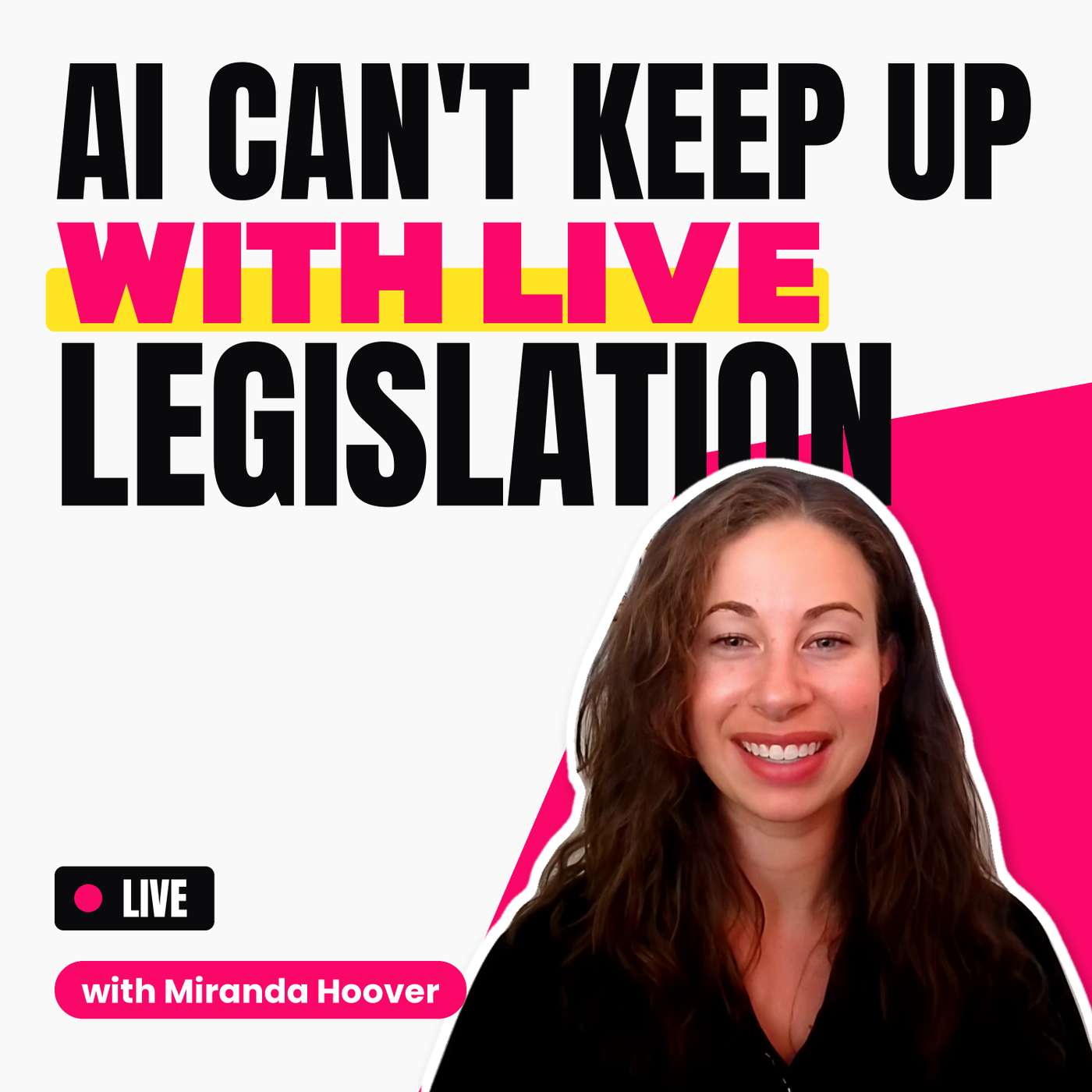
Welcome to The GEO Show, the briefing on Generative Engine Optimization and AI visibility. Brought to you by GEOforge.In this episode, Paris Childress, founder of Hop AI and co-founder of GEOforge, talks with Miranda Hoover, founder and CEO of 3C-House, a Nevada government affairs, lobbying, PR, and business development firm, about why AI can't keep up with live legislation, and what a real-time data feed for AI could look like.In this episode:🔎 From SEO to GEO: is the answer reliable?People now ask AI instead of searching, so Miranda's team checks whether AI answers about a business are reliable, secure, legal, and right. Her rule for clients: trust it, but verify it.🏛️ Why AI answers lag on live billsMiranda explains that for a live bill, AI relies on one or two official websites, and the staff who update them fall behind when legislation moves fast. She recalls a client whose ChatGPT answer placed a bill where it had been 35 minutes earlier. Bill tracking software sources the same sites, so it shares the lag.🧑⚖️ Why AI won't replace lobbyists yetLobbyists sit in the room where bills move and decisions are made in real time. Until AI can follow who is speaking and the nuance of each chamber, Miranda says, her industry is safe.📡 A real-time legislative data feed for AIParis and Miranda sketch a business: AI recorders in legislative sessions feeding a real-time database that AI labs license, the way X feeds Grok. It could be the next generation of bill tracking software, delivered through an MCP connector instead of an interface.🛠️ How 3C-House uses AIOtter.ai for every meeting, Claude across the team (drafting emails into drafts only, weekly automations, project trackers), Claude for building in-house projects, and HeyGen for AI avatars.🧠 A central AI brain for your companyParis wants every meeting transcript, chat, email, and document in one AI system that can flag hidden risks and suggest priorities. He also shares how GEOforge's features have been built with Claude Code since April.🤖 When agents start the conversationProactive assistants like Meta Muse and OpenAI's Dots will start more conversations themselves, which makes prompt tracking and attribution harder, even as AI matters more as a marketing channel.🎙️ Start recording every meetingParis's one piece of advice: record your meetings. The spoken words in every client, prospect, and internal meeting are your company's most valuable context for AI.Subscribe to The GEO Show wherever you get your podcasts. Full episode on YouTube: https://youtu.be/WVZd5miX9LE💬 Question: If AI only trusts a few official sources in your industry, what would it take for your data to become one of them?

Welcome to The GEO Show, the briefing on Generative Engine Optimization and AI visibility. Brought to you by GEOforge.In this solo roundup, Paris Childress, founder of Hop AI and co-founder of GEOforge, covers nine stories from the week in AI search. The lead story: OpenAI's always-on Dots agents, and why prompt tracking will capture less of a brand's AI visibility as agents do more of the prompting.In this episode:🤖 OpenAI Dots and the future of prompt trackingOpenAI launched Dots on September 29: always-on agents powered by GPT-6 Astra, each with its own cloud computer and access to more than 4,000 apps. As agents start conversations on their own, stateless prompt tracking becomes a less complete picture of a brand's AI visibility.🔎 Perplexity trains retrieval to return evidencePerplexity released pplx-embed-v2-context-9b-preview on September 30, a contextual embedding model trained to retrieve both the answer chunk and the supporting context. The unit being optimized for retrieval is becoming an evidence bundle, not an isolated quotable paragraph.⏳ The median AI citation half-life is 11 daysProfound tracked 883,000 pages across seven AI engines. The median page loses half its citation share within 11 days of peaking, and 78% fall to half their peak within two weeks. Engines decide independently, so watch citation persistence and refresh or replace pages as they decline.🏘️ Third parties win commercial citationsIn Writesonic's analysis of 9 million AI answers for 400+ enterprise brands, published on Search Engine Land, third-party sources got 82% of citations on bottom-of-funnel commercial prompts and owned pages just 3%. Owned citations lasted 3 to 9 times longer. The data comes from Writesonic customers, not the whole market.🔌 Buyer intent data inside AI toolsInforma TechTarget launched an MCP server for its Buyer Intelligence, bringing person-level intent data from its audience of about 58 million permissioned members into Claude, ChatGPT, Copilot, Gemini, and custom AI systems.📊 AI visibility moves into communications reporting10Fold launched MetricsMatter 5.0. In its survey of 400 US and European B2B technology marketing decision-makers, 58% include AI search or LLM visibility in integrated reporting, but only 38% connect communications and visibility metrics to pipeline or revenue. Paris's fix: add an AI chatbot option to "How did you hear about us?" on your lead form.📰 PR distribution meets GEO measurementBrandpoint launched Optimize360, which tracks AI visibility with more than 30,000 prompts a month per brand. Brandpoint advertises a network of 3,000+ publications and 800+ guaranteed placements, the hardest part of off-site citation building.🏭 Vertical GEO needs vertical logicZen Media ran 1,000 industrial automation buyer prompts across ChatGPT, Gemini, Perplexity, and Grok. The top 100 vendors averaged 4% visibility, versus 21% for Siemens, and distributors and authorized channels showed up prominently.🇦🇺 Source authority is localFindrix's Australian AI Source Index covers 23,396 buying prompts in nine markets. More than 85% of retrieval in clinics, home services, and finance and accounting came from .au domains, versus 32.9% in B2B software. There is no universal best-sources list.Subscribe to The GEO Show wherever you get your podcasts. Full episode on YouTube: https://youtu.be/t6YnwMMyMe4💬 Question: How will you measure AI visibility when agents, not people, start the conversation?

Comments

Download from Google Play

Download from App Store
 United States