


 Claim Ownership
scientifica sessions.
Subscribed: 0Played: 0
Subscribe

© 2026 Tabari Baker
Description
Hosted by Tabari Baker, CEO of kronos scientifica, scientifica sessions features unscripted conversations with the executives, innovators, and visionaries shaping the future of biotech, medtech, pharma, and healthtech.
Each episode dives into the realities of leadership in a rapidly evolving industry: scaling medical affairs and commercial teams, building investor confidence, navigating regulatory shifts, unlocking digital health and AI, and driving commercialization strategies that matter. Guests share candid stories from the boardroom to the clinic—what worked, what didn't, and what's next.
If you're a CEO, CMO, commercial leader, investor, or startup founder, scientifica sessions gives you insider access to the lessons, strategies, and perspectives that don't show up in press releases or pitch decks.
12 Episodes
Reverse

Episode Description:Dallas is known for energy, finance, and healthcare delivery—but it is quietly building one of the most distinctive life sciences ecosystems in the country.In this episode of scientifica sessions, we travel to Dallas–Fort Worth and sit down at Health Wildcatters in Pegasus Park with five people helping build it: Eric B. Moore of Bio North Texas, James Wang of Mimosa Ventures, Pam Nelson of the Bracane Company, Chantel Jones of Dallas College, and Kelly Cloud of the Dallas Regional Chamber. Together they show how North Texas is defining an identity of its own—not as the next Boston, San Francisco, or San Diego, but as a different kind of big.The conversation follows four segments: the anatomy of the hub, capital and commercialization, infrastructure, and talent. From the more than 70 accredited higher-education institutions to large integrated health systems, a top-tier tech workforce, and one of the country’s strongest cold-chain logistics networks, DFW brings together assets that rarely sit in one region. What ties them together, the guests argue, is a culture of collaboration—a “culture of yes.”We explore how North Texas is:Using industry diversity—energy, fintech, AI, aerospace, and healthcare—as a source of convergence and new innovation.Drawing on state programs like CPRIT and DPRIT, the Skills Development Fund, and life sciences tax incentives to attract and grow companies.Positioning itself for decentralized and community-based clinical trials, using its population scale and large health systems to reach diverse patients where they live.Filling lab space faster than anyone predicted—BioLabs at Pegasus Park reached 80% occupancy in about 18 months against a seven-year projection.Hosting the ARPA-H Customer Experience Hub and anchoring national research collaborations.Building talent pathways from high school bioengineering labs and Dallas College to apprenticeships and upskilling for mid-career workers.What We Covered:Why DFW’s identity is its own—and why trying to copy Boston or San Francisco is the wrong goal.How lower operating costs give companies more runway than coastal hubs.Why the region’s traditional oil, gas, and real estate money is starting to move into biotech.Success stories that were born here or stayed here, from Mucinex to AstraZeneca’s Coppell manufacturing site and its $445 million expansion—and the ones that got acquired away.How “co-opetition” among economic development groups helps the whole region win.Why a sprawling metro has to create density through programming and convening rather than proximity.How Dallas is tapping an underused pool of remote and hybrid pharma talent already living in the region.Why self-efficacy and upward mobility matter as much as hard skills in building the talent pipeline.Takeaway: North Texas isn’t trying to be another coastal hub. It has the institutions, health systems, capital, logistics, and talent to build something new—and its biggest challenge isn’t a lack of assets, it’s awareness of the ones already there.Connect with the guests 🔗 Eric B. Moore, BioNTX | James Wang, Mimosa Ventures | Pam Nelson, Bracane Company | Chantel Jones, Dallas College | Kelly Cloud, Dallas Regional Chamber📩 Connect with the show: [email protected] by Thread and Tensor

Episode DescriptionNorth Carolina is often described through the lens of Research Triangle Park—but the real story is bigger than RTP.In this first episode of Season 2 of scientifica sessions, we come home to unpack how North Carolina became one of the most complete life sciences ecosystems in the country: a hub built not on one asset, but on the full continuum from academic discovery to clinical development, CRO execution, biomanufacturing, and global commercialization.Joined by Christian Brown and Mike Carnes of the North Carolina Biotechnology Center, this conversation explores how a state once known for agriculture, tobacco, and textiles intentionally transformed itself into a globally recognized life sciences engine. From the founding of RTP in the late 1950s to the creation of NC Biotech in 1984, North Carolina’s growth has been shaped by long-term state vision, academic strength, federal research anchors, and a convening infrastructure designed to help companies start, scale, and stay.We explore how North Carolina is:Building across the entire biopharma value chain—from university research and biotech R&D to clinical trials, manufacturing, and sales.Leveraging NC Biotech as a statewide convener, investor, and ecosystem catalyst.Supporting early-stage companies through non-dilutive capital, loan funding, SBIR support, and investor syndication.Growing one of the strongest biomanufacturing workforces in the country through community colleges, BioWork, and university partnerships.Turning RTP 3.0 into a denser, more connected live-work-play innovation environment.Expanding life sciences beyond the Triangle into Holly Springs, Sanford, Wilson, Greenville, Winston-Salem, Charlotte, and other statewide clusters.The conversation also dives into one of the most urgent issues facing American innovation: the uncertainty surrounding SBIR funding and foreign-risk reviews. Mike Carnes explains how opaque funding denials could slow early-stage company formation—not just in North Carolina, but across every U.S. innovation hub. Pasted textWhat We Covered:Why North Carolina’s strength comes from diversification across the full life sciences value chain.How RTP grew from an anti–brain drain strategy into a self-sustaining innovation engine.Why NC Biotech’s early-stage funding model has helped companies raise billions in follow-on capital.How cost of doing business gives North Carolina a major advantage over Boston, San Diego, and the Bay Area.Why workforce—not just real estate or capital—is North Carolina’s clearest competitive advantage.How community colleges, universities, veterans programs, and mentorship create multiple pathways into the industry.Takeaway: North Carolina didn’t become a life sciences hub by accident. It built the infrastructure, talent, capital pathways, and statewide connectivity to move science from idea to patient impact—and it is still building.Connect with the guests 🔗 Christian Brown and Mike Carnes, North Carolina Biotechnology Center📩 Connect with the show: [email protected] by Thread and Tensor

Episode Description:Atlanta is often overlooked in the life sciences conversation—but what if that's exactly the point?In this episode of scientifica sessions, we go inside the Atlanta ecosystem to unpack how a city built on public health leadership, world-class institutions, and deep clinical infrastructure is quietly assembling one of the most strategically compelling life sciences hubs in the United States.Atlanta isn't trying to be Boston or San Diego. It's building something distinctly its own: a scale-up hub rooted in the interplay of the CDC, Emory University, Georgia Tech, a massive and diverse patient population, the world's busiest airport, and a collaboration culture that most markets can't manufacture.We explore how Atlanta is:Defining its identity as a scale-up hub through Georgia's first-ever life sciences roadmapAttracting global companies like UCB to site U.S. manufacturing in the SoutheastBuilding bio-literacy through K-12 programs that have reached over 270,000 students statewideDeveloping clinical infrastructure—including Children's Healthcare of Atlanta, home to more pediatric clinical trial beds than any U.S. children's hospital systemNavigating the capital gap through government funding, foundations, and a maturing local venture ecosystemThe conversation also confronts the valley of death head-on—what it actually looks like when a company survives it through disciplined decision-making, capital efficiency, and the courage to move slowly when everything says move fast.What We Covered:Why assets alone don't create a hub—and what the interplay looks like in AtlantaHow Atlanta's distributed micro-hub structure creates both opportunity and challengeThe real estate decisions that kill companies—and the discipline required to avoid themWhy Atlanta's quality of life and cost structure are becoming a structural competitive advantageHow Georgia's first life sciences roadmap is shaping the ecosystem's next decadeTakeaway: Atlanta didn't stumble into this moment. It built toward it for twenty years. The decade of intentionality starts now.Connect with the guests 🔗 LinkedIn: Maria Thacker Goethe; Steven Damon; Justin Burns, Ph.D.; Andy Roberts📩 Connect with the show: [email protected] by Thread and Tensor.

Episode Description:Massachusetts is often viewed as the epicenter of biotech—but what actually makes this ecosystem work?In this episode of scientifica sessions, we go inside the Commonwealth to unpack the deliberate strategy behind one of the most successful life sciences hubs in the world. Joined by leaders from the Massachusetts Life Sciences Center (MLSC) and founders building within the ecosystem, this conversation moves beyond Kendall Square to reveal a statewide model designed for scale, inclusion, and long-term impact.At the center of it all is MLSC—a quasi-public engine deploying capital, building infrastructure, and shaping policy to ensure innovation doesn’t just start in Massachusetts, but stays and grows there.We explore how Massachusetts has:Built a true public-private partnership across government, academia, and industryUsed non-dilutive funding to de-risk early innovation and unlock venture capitalCreated intentional pathways for underrepresented founders through programs like Mass Next GenExpanded beyond Boston to develop thriving clusters across the entire CommonwealthLeveraged density—not just of capital, but of experience, mentorship, and talent—to accelerate company growthThe conversation also dives into one of the most critical challenges in biotech—the “valley of death”—and how Massachusetts is actively building systems to help companies transition from early discovery to viable, revenue-generating businesses.What emerges is a blueprint: an ecosystem that listens, evolves, and invests with purpose—across talent, infrastructure, capital, and community.If you’re building, investing, or thinking about how to scale innovation in life sciences, this episode offers a rare look at what it takes to get it right.What We Covered:The four pillars of a successful life sciences hub.Why non-dilutive funding is more than capital—it’s protection and development.How MLSC designs programs based on real ecosystem gaps.The role of density in mentorship, talent, and commercialization.Why the future of biotech ecosystems is statewide—not city-bound.Takeaway:Massachusetts didn’t become a global leader by chance—it built an intentional system to make innovation inevitable.Connect with the guests🔗 LinkedIn: Tiffany Walther, PhD; Samantha Johnson; Minmin (Mimi) Yen, PhD, MPH; Asmi Chakraborty, PhD; Ryan Mudawar📩 Connect with the show: [email protected] by Thread and Tensor.
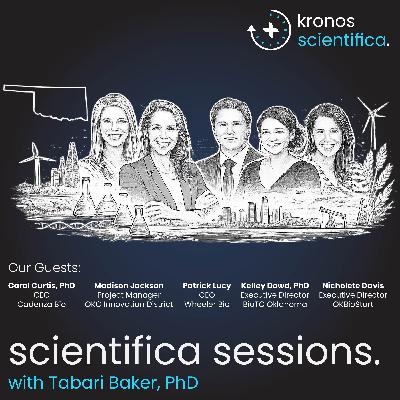
Episode DescriptionWhat if the next great American life sciences hub isn’t on the coasts—but in the heartland?In this episode of scientifica sessions, we look beyond the usual biotech strongholds to explore Oklahoma’s emergence as a new life sciences contender. While Boston and San Francisco dominate the narrative, Oklahoma is quietly building a different model—one that blends energy-sector expertise, agricultural biotechnology, and targeted infrastructure investment to create a distinct innovation advantage.Host Tabari Baker is joined by Oklahoma life sciences leaders:Carol Curtis, PhDNicholete DavisKelley Dowd, PhDMadison JacksonPatrick LucyTogether, they unpack what it really takes to build a life sciences ecosystem from the ground up. This isn’t a generic “emerging hub” story—it’s a candid look at convergent innovation, where energy capital fuels therapeutic development, and regional strengths shape a new path forward.In this episode, you’ll learn:Why Oklahoma’s “late start” may actually be a competitive advantage.How energy-industry capital and operational discipline are being repurposed for biotech.The infrastructure gaps that could accelerate—or constrain—ecosystem growth.What funding models are emerging before traditional venture capital arrives.How Oklahoma is addressing talent development without an established biotech workforce.The unique role of Native American healthcare systems in advancing innovation.Key segments include:The Anatomy of a Hub: Foundational assets and authentic differentiators.Capital and Commercialization: Creative funding approaches and early success stories.Infrastructure and Place: Lab space, cost structure, and quality-of-life advantages.Talent Flywheels: Workforce pipelines and entrepreneurial culture building.Whether you’re an entrepreneur deciding where to launch, an investor searching for untapped opportunity, or a life sciences leader tracking how innovation geography is shifting, this episode offers actionable insight into one of biotechnology’s most compelling frontier markets.Connect with the guests🔗 LinkedIn: Kelley Dowd, Nicholete Davis, Patrick Lucy, Carol Curtis, Madison Jackson📩 Connect with the show: [email protected] by Thread and Tensor.

Comments

Download from Google Play

Download from App Store
 United States