


 Claim Ownership
to know the land
Subscribed: 23Played: 453
Subscribe

© byron
Description
A show about relationships with the landbase, striving to evoke resilience, resistance, and reverence for the land. Interviews with authors, researchers, activists and students of the land.
147 Episodes
Reverse

Cardinals, Blue Jays, Robins, Mourning Doves, Mallards, Black-capped Chickadees. Quite common and familiar birds most folks seem to know. One of the reasons is that they have very distinct patterning and physical traits that render them easily identifiable. Even some of the Sparrows can be differentiated by a slightly advanced beginner.
Flycatchers? They can be tough. When I see a Yellow-bellied Flycatcher (Empidonax flaviventris) in the woods, despite being one of the more recognizable, determinable Empidonax species, I am still left uncertain, full of doubt and just generally end up calling it a Flycatcher.
But I have found since reading Cin-Ty Lee and Andrew Birch’s new book “Field Guide to North American Flycatchers : Empidonax and Pewees”, I have been looking at the birds with a different lens, one that considers a more holistic view, that asks more questions of often overlooked characteristics which can help lead to a solid id.
I spoke with Cin-Ty and Andrew about their new book and how this new method of identification can help us not only better identify some of the Flycatchers, but also to look at how we regard all birds in ways that encounter them more fully, experiencing them in broader context through investigating narrower characteristics.
To learn more : Field Guide to North American Flycatchers : Empidonax and PeweesCin-Ty Lee’s websiteAndrew Birch’s website

Discussing some hows and whys about storytelling as reciprocating interaction and interspecies language making. How can we work with stories to learn, teach and communicate better with each other in regards to the natural world, and then on top of that, how can we hear the stories of the natural world better so we can be a part of the learning, teaching and communication which is always already ongoing?
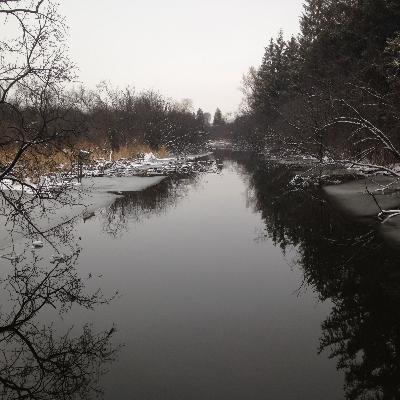
Winter Solstice has returned. Technically it’s in a few days but with the longer nights, it’s certainly being felt. This year I have been out tracking, indoor climbing and baking up a storm at home. It’s been a lovely, snowy descent into the dark.Again, like last year, I have been reading, writing, listening to a lot of film soundtracks and watching silly movies. But I also try to make space for the reverence. Of course, this comes through the tracking, learning and sharing naturalist knowledge, and spending quality time outside, but I also celebrate through stories and songs, both new and ancient, and kept warm beside friends, old and new, nibbling on delicious baked goods. Every day is magical, but the spiraling year allows for seasons and celebrations to be longed for, and appreciated deeply when the those same seasons and celebrations return once again. And, once again, I get to rebroadcast the 1985 radio play by Alison McLeay “Solstice” for the 8th year in a row. I am so grateful to get to air it again and celebrate the season of darkness with a deep dive into the origins of some of the celebrations and stories my ancestors may have participated in and shared this time of year. Get yourself a nice warm drink, a cozy blanket, light a candle and enjoy.
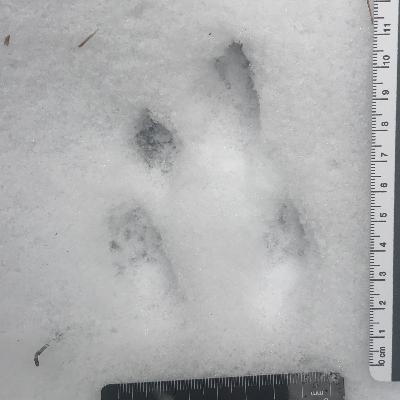
While out tracking in the new snow the other day I came across some relatively small tracks, reminiscent of a Chipmunk (Tamias striatus) or Red Squirrel (Tamiasciurus hudsonicus), though small enough to be a Short-tailed Weasel (Mustela ermina). It took a second before I recognized them as Southern Flying Squirrel (Glaucomys volans) tracks. I have been encountering Southern Flying Squirrels in various ways for a few years, including tracks, scat, feeding sign, live sightings, and I even pet one once, but through all of this, I didn’t know much about them. Hence, inspired by my recent tracking outing, I figured I would take some time to get to know the Southern Flying Squirrel a little better. Hopefully we can learn a little more together.To learn more : Mammal Tracks and Sign by Mark Elbroch and Casey McFarland. Stackpole Books, 2019.The Wild Mammals of Missouri 3rd Ed. by Charles W. Shwartz and Elizabeth R. Shwartz. University of Missouri Press, 2016.Mammals of Algonquin Provincial Park. The Friends of Algonquin Park, 2018. Climate change induced hybridization in flying squirrels by GARROWAY, BOWMAN, CASCADEN, HOLLOWAY, MAHAN, MALCOLM, STEELE, TURNER, WILSON. Global Change Biology, 2009.
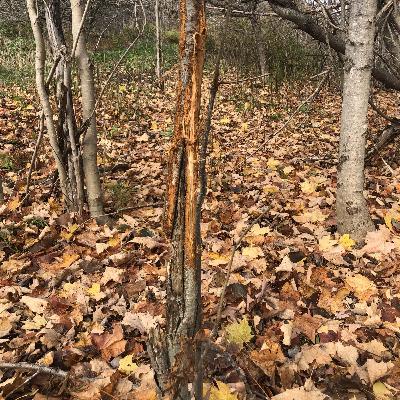
While tracking White-tailed Deer at Mono Cliffs with the Earth Tracks apprenticeship, we saw lots of signs of the rut and the subtle ways deer communicate. We studied three main signs: scrapes, rubs and lick branches. Together, these clues form a multisensory language of scent, sight, and even ultraviolet signals that share details of identity, territory, and mating readiness. These clues along the trail are a real insight into how deer express themselves across the landscape in ways most of us overlook.To learn more : Ep. 256 : Apple Scat of Coyotes and Red FoxGlands on a White-tailed Deer Leg - I copied a lot of my information from that post and used it here as well.Appearances can be Deceiving by Dan Strickland from The Raven talks about… DEER & MOOSE. The Friends of Algonquin Park, 2003. Stokes Guide to Animal Tracking and Behaviour by Donald and Lillian Stokes, Little, Brown and Company, 1986.Field & Stream : The Total Deer Hunter Manual by Scott Bestul & Dave Hurteau. Bonnier, 2013.Rubs and Scrapes Glow Like Highway Reflectors to a Deer’s Eyes by Lindsay Thomas Jr. Deer (The Wildlife Series, Book 3) edited by Duane Gerlach, Sally Atwater & Judith Schnell. Stackpole Books, 1995.The Deer of North America by Leonard Lee Rue III. Lyons Press, 1997.Naturekind : Language, Culture & Power Beyond The Human by Melissa Leach and James Fairhead. Princeton University Press, 2025.Eavesdropping on Animals by George Bumann. Greystone Books, 2024.
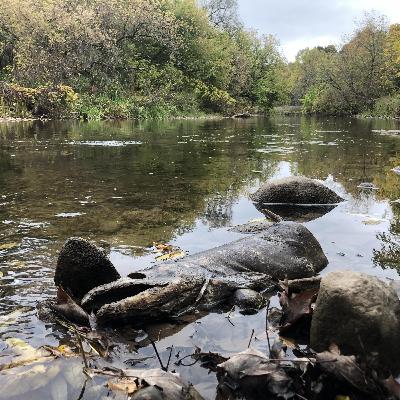
I have missed a few of the notable migrations this year; Salamanders, raptors, and until yesterday, the Chinook Salmon (Oncorhynchus tshawytscha). The salmon are a unique one on this list for me though, special in a strange kind of way. Firstly, fish and I never sat well until I got to know the salmon. They changed how I saw all fish species, and now instead of a feeling of ick, I get a wonder, awe and reverence. Secondly, this migration back to the homeplaces of the individual salmon, while bringing the promise of future life, also means imminent death for the hundreds of fish who make the journey. There is a beauty and sadness in it that floods right through me. This episode was recorded along the banks of the Credit River, which is also a bit of a homecoming for me as well. The Credit is a river I have known, a river which has shaped me deeply and set me on a course I am wading my way through. I am unfathomably grateful for the salmon and for the river for sharing so much with me and helping to shape this episode.To learn more : Freshwater Fishes of Ontario by Erling Holm, Nicholas E Mandrak, Mary E. Burridge. Royal Ontario Museum (ROM), 2010.Fishes of Toronto : A guide to their remarkable world. City of Toronto, Royal Ontario Museum, 2012. (pdf)Salmon Country by Robert H. Busch. Key Porter Books, 2000.

 1
1It isn’t often that I get to see bear scat down here in Guelph, but in Parry Sound, there are many Black Bears, and while visiting the Sound for a trailing workshop, we came across some of their scat. For me, it was an event. A highlight of the weekend visit with friends and practicing our trailing together as a crew. Black Bears are pretty majestic, if that’s the right word, and carry a weight, beyond their materiality, in my imagination of what is “wild”. Even if we don’t get to see the bear, their scat was plenty enough to get me thinking about the plants their consuming, how their digestion works, and how their being themselves impacts and plays with the land they make up and inhabit. Big thanks to Diana Clements for organizing the workshop, and to Matt Nelson for teaching us.To learn more : Towards A Better Understanding of ScatTracking the American Black Bear by Preston Taylor. Self published, 2021.Mammal Tracks and Sign by Mark Elbroch and Casey McFarland. Stackpole Books, 2019.Forest Plants of Central Ontario by Brenda Chambers, Karen Legasy, and Cathy V. Bentley. Lone Pine Publishing, 1996.Up North Again by Doug Bennet and Tim Tiner. McClelland & Stewart Inc, 1997.Information on Trailing Evaluations from Tracker Certification North America
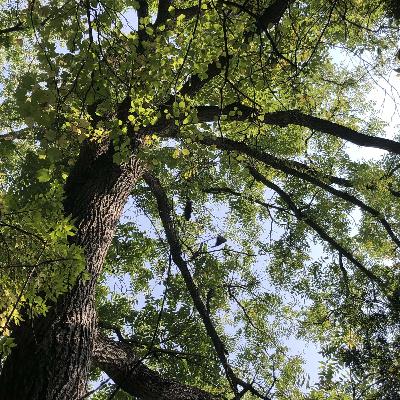
I am in love with Black Walnut (Juglans nigra) and I want shout all about it throughout the late Summer, early Autumn season. They are big, beautiful, and bountiful with their tennis ball sized fruit with bright green husks and nuts snug deep inside. Slowly colonizing the sunlit fields and edges, home to all sorts of creatures both large and small, these towering monuments tell of the abundance of the land. They are amazing allies in healing, mentors in boundaries, relative buffet in mast years, and year round marker of beauty. Who doesn’t want to sing their praises!For this show I really tried to dig into some ecological functions, and really just lean into why I love them so much.Maybe by the end of the show, you’ll love them a little more too?To learn more : Ep. 167 : Black WalnutEp. 228 : Walnut Husk Maggot FlyTrees of the Carolinian Forest by Gerry Waldron. Boston Mills Press, 2003. The Book of … Forest and Thicket by John Eastman and Amelia Hansen. Stackpole Books, 1992.Wild Urban Plants of the NorthEast (2nd ed.) by Peter Del Tredici. Cornell University Press, 2020.Bark: A field guide to trees of the NorthEast by Micheal Wojtech. University Press of New England, 2011.Arboretum America by Diana Beresford-Kroeger. University of Michigan Press, 2003.Wild Plant Culture by Jared Rosenbaum. New Society Publishers, 2023.Manual of Ornithology by Noble S. Proctor & Patrick J Lynch. Yale University Press, 1998.
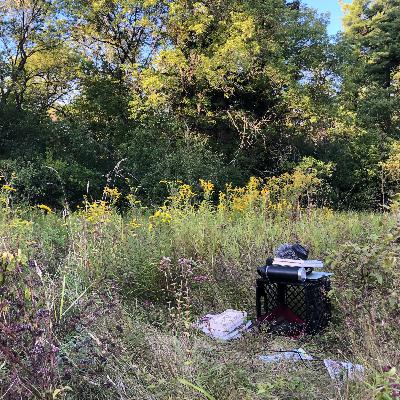
Recently I was talking with one of my adult programs about successional and keystone species. Successional species are those early plants which come into disturbed landscapes, helping to knit the ecological neighbourhood back together. They are quick to come and quick to go, providing the land with nutrients to heal and grow. Keystone species are those species who are provide for many other forms of life. Their work in sustaining the community around them is vast relative to their abundance. They provide food and the place to eat it. The make space for life to thrive and sustain. If the keystone suddenly goes missing than the community make up will drastically change, often for the worse. Goldenrods, especially those which make up the Canada Goldenrod complex are some of the most important successional an keystone species in my area. Over the years I have investigated Goldenrod on different levels, from the technical and scientific to the intuitive and relational. Both vantage points have served in getting to know these amazing and powerful plants better. I decided to head out with a makeshift milkcrate studio to sit with the Goldenrod, Bumblebees and Crickets and make a show together. I hope this helps shed a warm golden glow on these essential components of the Great Lakes bioregion.To learn more :The Asters, Goldenrods and Fleabanes of Grey and Bruce Counties. Owen Sound Field Naturalists, 2000.Wild Urban Plants of the NorthEast (2nd ed.) by Peter Del Tredici. Cornell University Press, 2020.Newcomb's Wildflower Guide by Lawrence Newcomb and Gordon Morrison. Little, Brown, 1977.Stokes Nature Guide to Enjoying Wildflowers by Donald & Lillian Stokes. Little, Brown 1985. Summer Wildlflowers of the NorthEast by Carol Gracie. Princeton University Press, 2020.NorthEast Medicinal Plants by Liz Neeves. Timber Press, 2020.The Book of … Field and Roadside by John Eastman and Amelia Hansen. Stackpole Books, 2003.

Sisters Alex and Tasha Sawatzky’s knowledge of and growing appreciation for the land they lived on was tangible and real, so how could they tell the stories of the species they were coming to know and love, while also countering the dread of our modern world? They decided to start Minnow, a magazine about ecology, conservation and all sorts of species we share a home with. This magazine project has become a bit of a community space for the sisters and others to write of their own knowledge and care for the land, inviting in readers to deepen their own sense of connection and community with the other-than-human world. There are articles cover the gamut of interesting and sometimes threatened species in the Great Lakes region, including Redside Dace, Piping Plover, Hart’s Tongue Fern, and the lovely Chimney Swift. With two issues launched, and a third underway, Minnow has become a bit of a deal amidst friends of mine who are intimately involved with the land. I had to do an interview to learn more. And big thanks to Nava for bridging the gap.To learn more :Minnow Magazine instagram pageMinnow Magazine website with ordering infoMinnow Magazine mailing list
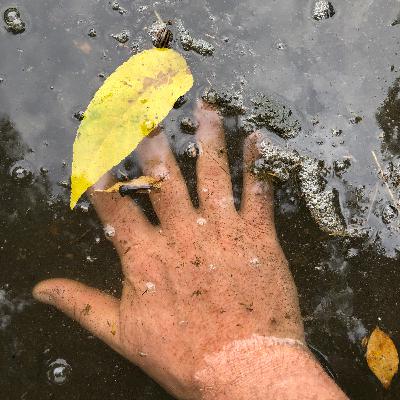
Sight is the dominant sense in humans, followed close behind by hearing and perhaps touch. Many of us have cut ourselves off from the natural world by “gating” our senses, only using what is needed to navigate an urbanized, mechanical, constructed and conditioned environment, and we end up isolating ourselves, and leaving the more than human world behind.In times of ecological, political, and climate horror, I wonder at how we can remain connected with the wilder places we love? How do we engage with the land with all of our bodies and minds, working and practicing the gifts we have inherited from millions of years of evolution? To learn more :Plant Intelligence and the Imaginal Realm by Stephen Harrod Buhner. Bear & Company, 2014.Reconnecting with Nature by Micheal J Cohen, Ed. D. Ecopress, 1997.Spell of the Sensuous by David Abram. Vintage, 1997.

An ancient plant of the genus Equisetum, (the only extent genera of the family Equisetaceae, and only living member of the order Equisetales), Horsetails are some of the most primitive of fern species, being closely related to the Calamites of the Carboniferous era some three hundred million years ago. Inspired by a fun workshop I got to host, along with such an amazing history of evolution though incredible cataclysmic epochs, chock full of climate upheaval, I really wanted to learn more about these amazing plants. Many of the Equisetum genera are now extinct yet there are about 9 species in my area, and of the species which persist in the area, I will be focusing mostly on Rough Horsetail.I hope you enjoy the show.To learn more : Michigan Ferns & Lycophytes by Daniel D. Palmer. University of Michigan Press, 2018.Ferns, Spikemosses, Clubmosses, and Quillworts of Eastern North America by Emily B. Sessa. Princeton University Press, 2024.Peterson Field Guide to Ferns by Boughton Cobb. Houghton Mifflin, 1963.The Flora of Wellington County by Richard Frank and Allan Anderson. Wellington Historical Society, 2009.A Natural History of Ferns by Robbin C. Moran. Timber Press, 2004.

Grey Treefrogs (Hyla versicolor) are my favorite frog species at the moment. They are cute little colour changing, antifreeze laden, Lichen-Spirits who really belt it out when trying to find a date. I have been hearing them pretty much nightly lately, screaming their short trill all over nearly every wetland I encounter as long as it is fairly adjacent to trees. Because of their powerful calls permeating my late night waking life, I have been wanting to take a deeper dive. Hope you enjoy!To learn more :The Dermal Chromatophore Unit by Joseph T. Bagnara, John D. Taylor and Mac E. HadleyMetamorphosis by Peter B. Mills. Self-published, 2016.Energetics of vocalization by an anuran amphibian (Hyla versicolor) Taigen, T.L., Wells, K.D. J Comp Physiol B 155, 163–170 (1985). https://doi.org/10.1007/BF00685209Familiar Amphibians & Reptiles of Ontario by Bob Johnson. Natural Heritage, 1989.Reptiles and Amphibians of Toronto : Biodiversity Series pamphlet (pdf)Amphibians and Reptiles of the Great Lakes Region by James H. Harding & David A. Mifsud. University of Michigan Press, 2017.After the Ice Age by E. C. Pielou. University of Chicago Press, 1991.
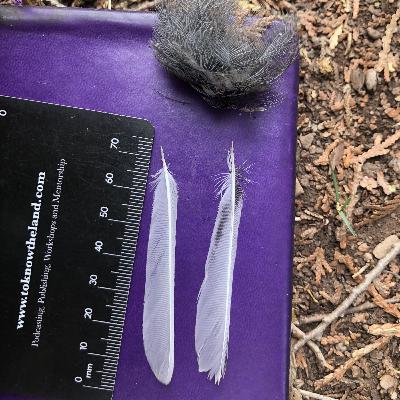
It started with a little hole at the base of an Eastern White Cedar (Thuja occidentalis) tree, and a couple of seeds. Who had collected and consumed the contents of the seeds? What about the feathers? And the boney remnants of bill?Join me as I go deep down a Deer Mouse (Peromyscus maniculatus) hole. To learn more : Mammal Tracks and Sign by Mark Elbroch and Casey McFarland. Stackpole Books, 2019.Natural History of Canadian Mammals by Donna Naughton. Canadian Museum of Nature and University of Toronto Press, 2012.Bird Feathers by David Scott and Casey McFarland. Stackpole Books, 2010.Animal Skulls by Mark Elbroch. Stackpole Books, 2006.

I have been excited about Song Sparrows (Melospiza melodia) for a while. Theirs was one of the first complex songs I learned to identify, and being such a common neighbour on the landscape it’s hard to go a few days without hearing them, even in Winter, but especially in the Spring.While out today, I came across a couple Song Sparrow tracks in the silt newly laid down by the receding Eramosa River flood waters and it pricked my interest to dig in a little deeper to this common figure in my life. To learn more :Song Sparrow tracks on InaturalistBird Tracks and Sign by Mark Elbroch and Eleanor Marks. Stackpole Books, 2001.Bird Song : Identification Made Easy by Ernie Jardine. Natural Heritage, 1996.Peterson Field Guide to North American Bird Nests by Casey McFarland, Mathew Monjello & David Moskowitz. HMH, 2021.Baby Bird Identification : A North American Guide by Linda Tuttle-Adams. Cornell University Press, 2022.Birds of Forest, Yard, & Thicket by John Eastman. Stackpole Books, 1997.
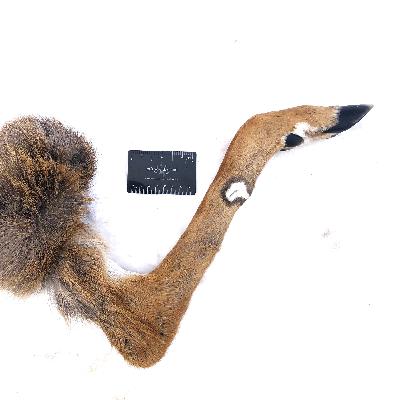
I have found sign of three dead White-tailed Deer in the past three weeks. One, killed by Coyotes. Another, hit by a vehicle, found on the side of the highway. And also, I found a White-tailed Deer leg while trailing a Coyote. All of these encounters have been teaching me a lot about the legs of the deer and I wanted to look a little bit deeper into these moments, and to share the stories. I go on to detail what I have been learning about the legs, especially in the context of the hind legs, about the glands located there. Of course, you can read the blog post, or you can learn a little bit more from listening to the show. Enjoy!To learn more:Glands on a White-tailed Deer Leg blog postThe Deer of North America by Leonard Lee Rue III. The Lyons Press, 1997.Deer (The Wildlife Series, Book 3) edited by Duane Gerlach, Sally Atwater & Judith Schnell. Stackpole Books, 1995.Deer of the Southwest by James R. Heffelfinger. Texas A&M University Press, 2006.Biology and Management of White-tailed Deer Edited by David G. Hewitt. CRC Press, 2011.What The Toes Show - A question of deer hooves - another blog postMammal Tracks and Sign by Mark Elbroch and Casey McFarland. Stackpole Books, 2019.
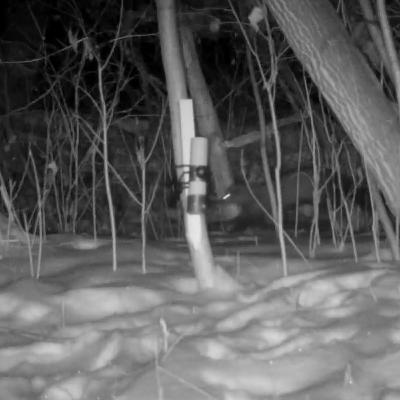
Fishers aren’t known as an urban adapted species. They tend to avoid our built up landscapes and prefer landscapes of mature forests comprised of appropriate denning habitat such as old trees with cavities and lots of course woody debris (think of big piles of dead branches and fallen logs), characteristics not usually found in urban forests. Because of this Fishers avoid our cities… or so we thought.Sage Raymond is a researcher who studies urban adapted Coyotes in Edmonton. While out checking some trail cams intended to catch Coyotes on the landscape, she happened across a Fisher trail in the snow, in a small wooded area along the North Saskatchewan River. Later confirmed with footage from one of the remote cameras, Sage realized that this was a very unusual circumstance. Thankfully she wrote a paper about it and I had to read it, and, again, thankfully, she agreed to talk about her findings on the show. There is a link to the paper below.To learn more:Ep. 159 : Tracking Urban Adapted Coyote Ecologies with Sage RaymondSage Raymond’s Research Gate profileSage Raymond’s instagramFisher Use of an Ecological Corridor Near the City Center of Edmonton, Canada, A City of Over One Million People by Sage Raymond and Colleen Cassady St. Clair. Urban Naturalist, No. 77 (2025).Pictorial Guide of Important Fisher Habitat Structures in British Columbia (pdf)
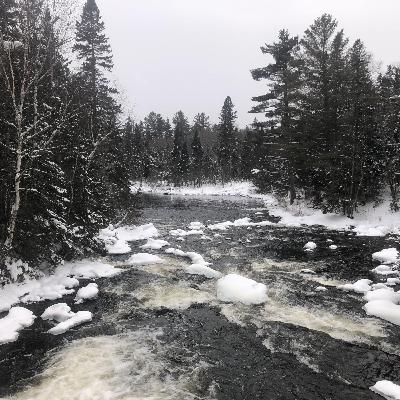
As I mentioned on the previous show about the Lynx trailing trip, I was planning on heading up to Algonquin Park to trail Moose, Algonquin Wolves, Martens, Snowshoe Hare, Flying Squirrels, and whomever else’s trails we may come across. Well, I went and it was great. So good that I wanted to offer a bit of a report back from the trip and tell some stories of what we saw. This is the 24th year of this trip, and I am so grateful to get to not only be there, but to be helping lead the week. Kid me would be stoked… hell, adult me is still stoked!Big thanks to Alexis for being a great colleague and mentor, and to everyone who came. It was a blast.To learn more :Algonquins of Ontario overview of land claimMore information on the trip from EarthTracks.ca
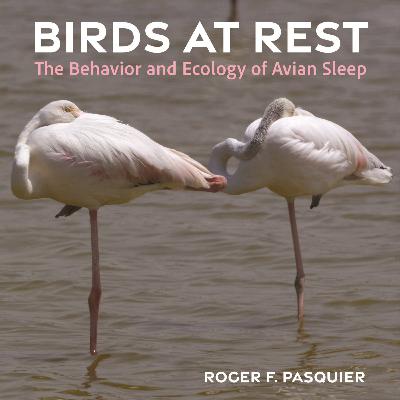
I have had a lot of conversations with biologists and ornithologists over the years, trying to learn about how different animals sleep. Are the functions of sleep in humans similar to similar animals? What about different kinds of animals, like insects, or birds?More recently I have seen the Canada Geese along the Eramosa River where I live, standing or sitting still on the frozen river and wondered what’s up with the one-legged standing? When I got to thinking about birds resting, roosting and sleeping, I realized that I had a bunch of questions. Sometimes a book comes along with some good insight into the subjects I am wondering about, and at this moment, it was Roger Pasquier, and his new book Birds at Rest: The Behavior and Ecology of Avian Sleep, which helped to answer many of my questions. I arranged for an interview was very glad to talk to him. Do small songbirds have any special adaptations for sleeping through long freezing winter nights? Does photoperiod change the amount of time birds sleep? How does the changing climate affect birds at rest? Do birds dream?Roger Pasquier has taken the time to collect the information from a ton of various studies into avian rest and sleep and consolidated them into a useful and interesting book, and then taken the time to discuss some of this research on the show. Again, I am forever grateful to the folks who can help us, me, learn to better know the land. To learn more :Birds at Rest : The Behavior and Ecology of Avian Sleep by Roger F. Pasquier. Princeton University Press, 2025.

I just got home from an amazing week away up North in Elk Lake, Ontario, Robinson-Huron treaty territory, trailing Lynx with Earth Tracks. It was an amazing time and I had a ton of fun. We trailed Lynx for days, as well as get on some trails of other animals including Peromyscus mice, Short and Long-tailed Weasels, Marten, Snowshoe Hares, Fisher, Grey Wolves, Moose, and more. There are so many stories to tell and so much to integrate over the next few weeks, but I wanted to share some highlights of these weeklong tracking expeditions.
I am so grateful to mentor, colleague and friend Alexis Burnett for organizing this week, and for the Lynx for laying the trails for us to follow.
To learn more :Earth Tracks.ca

Comments

Download from Google Play

Download from App Store
 United States