


‘Criminalizing Homelessness Only Perpetuates It’: CounterSpin interview with Scout Katovich on criminalizing poverty
Description
Janine Jackson interviewed the ACLU’s Scout Katovich about forced institutionalization of poor and disabled people for the August 1, 2025, episode of CounterSpin. This is a lightly edited transcript.
Janine Jackson: Poverty and homelessness—and their confluence with mental health challenges, including addiction—reflect societal and public health failures. But rather than take on rising rents and home prices, unlivably low wages and the retraction of social services and healthcare, the Trump White House has issued an executive order titled “Ending Crime and Disorder on America’s Streets,” that calls for involuntary institutionalization and the elimination of federal support for evidence-based lifesaving programs. Oh, and also increased “data collection” on unhoused people.
As Southern Legal Counsel puts it, the order is a “continuation of [this administration’s] strategy of depicting anyone whose rights they seek to take away as inherently dangerous.”
This White House is what it is, but this development also trades on years of media coverage that defines poverty, and the cascade of harms attendant to it, as a “crisis” not so much for the people who experience it, as for those made uncomfortable by being exposed to it.
Scout Katovich is senior staff attorney with the ACLU’s Trone Center for Justice and Equality. She joins us now by phone from the Bay Area. Welcome to CounterSpin, Scout Katovich.
Scout Katovich: Thank you, I’m happy to be here.
JJ: There’s been some coverage of this July 24 executive order, but I know that many listeners won’t have heard about it. Could you just please tell us what this order says, and what it calls for?
SK: Absolutely. So this order came out last week, and it is somewhat wide-ranging in terms of the mechanisms that it puts in place, but the gist of it is that it’s taking aim at people who are at the intersection of homelessness, mental health disabilities and substance use. And what it does is it directs federal agencies to use the power they have over funding, as well as over technical assistance, to encourage states and local governments to criminalize people for living on the streets, to push people into involuntary treatment and civil commitment, including lowering standards to get there, and to destroy programs like housing first and harm reduction that we know save lives.
So the way that the Trump administration is trying to go about this remains a bit to be seen, because it’s directing agencies to take certain actions. And so we’ll see what those agencies do. But it is really troubling in terms of the entire framing of pushing for criminalization and institutionalization as a “solution” to homelessness. We know that’s not a solution. We know that that only makes homelessness, mental illness, substance abuse worse, and it’s really troubling to see this coming out from the federal government, though I can’t say it’s too much of a surprise.
JJ: The order basically says, “Let’s get them into treatment,” which sounds good as a phrase, if you are just blissfully ignorant of anything to do with unhoused people or the history of involuntary warehousing. But for a lot of folks, it sounds like, “Well, golly, just help them.” What do people who think “get them into treatment,” what do they need to understand?
SK: That’s a great point. And this is not the first time that compassion has been co-opted. We actually see this on the left as well, as Governor Newsom in California pushed for the CARE Courts as this compassionate solution, and, really, it was doing a lot of the same thing: targeting unhoused people perceived as having mental illness for forced treatment and institutionalization.
And what this kind of cloaking in care does is it obscures the fact that involuntary treatment is not effective. If you care about providing people who need help with help, the most effective way to do that is by providing accessible, voluntary services that match a person’s need. And it’s really disingenuous for the federal government to be saying this now, saying people need care, while at the same time blasting Medicaid, and stripping all the voluntary mental health treatment, substance abuse treatment, that actually works.
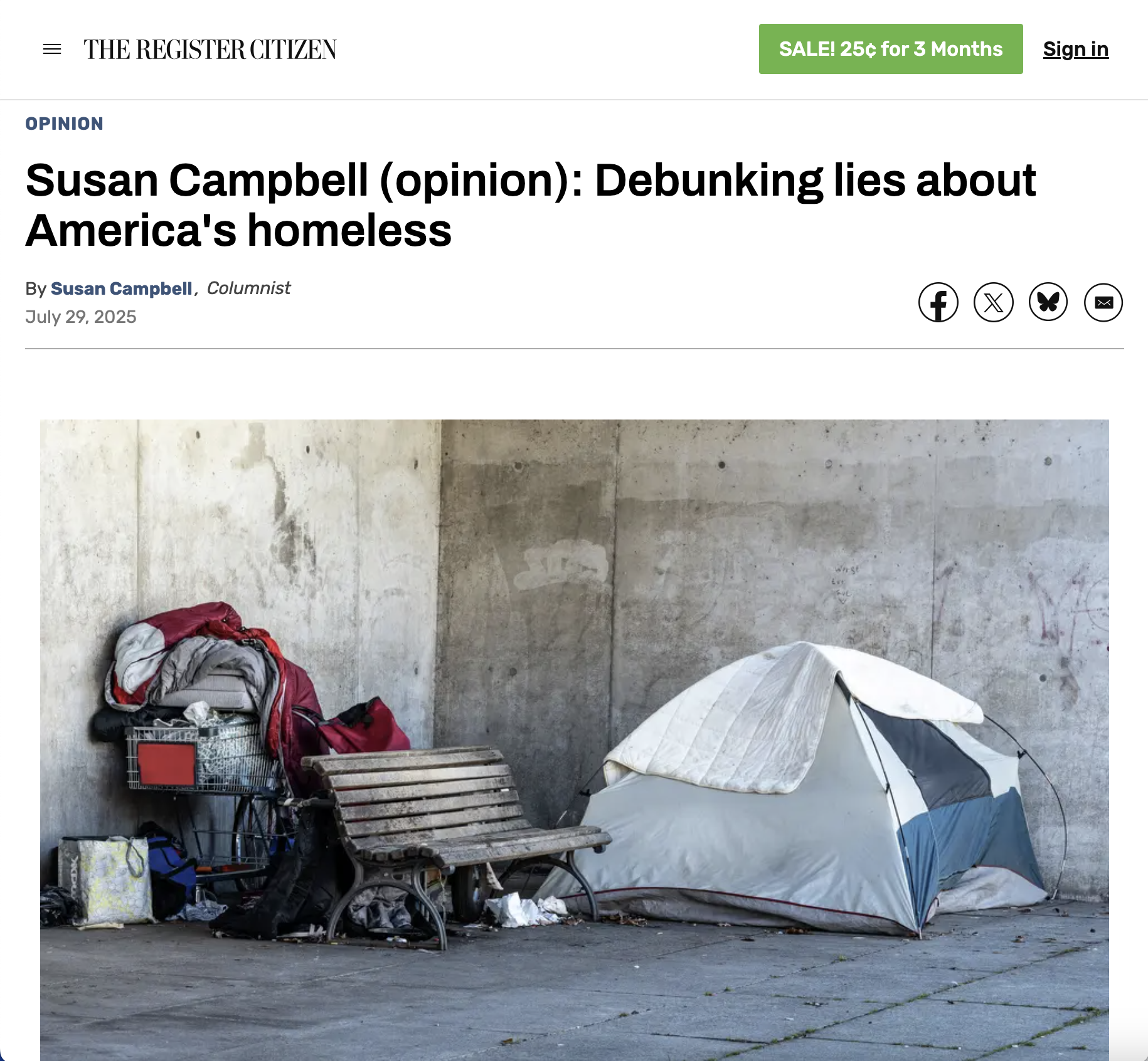
The Register Citizen (7/29/25)
JJ: The University of New Haven journalism professor Susan Campbell, in one of the few media pieces that I’ve seen so far, describes this order as essentially “fact-free.” And she was noting some kind of baseline falsehoods, like it starts out saying the “overwhelming majority of individuals [who are unhoused] are addicted to drugs, have a mental health condition, or both.” And it also says both federal and state governments “have spent tens of billions of dollars on failed programs that address homelessness but not its root causes, leaving other citizens vulnerable to public safety threats,” which is another thing.
I know it’s a lot. But it seems like there are some undergirding ideas for this measure that are simply without foundation.
SK: That’s absolutely correct. The idea that homelessness is caused by individual failures or individual conditions is just absolutely false. We know that we have an affordable housing crisis in this country, and there are, in addition to the nearly 1 million people who are homeless on any given night, there are millions more Americans who are spending over half of their income on rent.
We can’t close our eyes and pretend that this is an issue that’s just about an individual’s inability to get treatment for themselves. We have a structural problem here that we need to address, and without addressing the underlying housing crisis, we are not going to solve homelessness.
JJ: Boston Globe columnist Joan Vennochi is no doubt speaking for many in saying, “Don’t law-abiding citizens have a right to live without
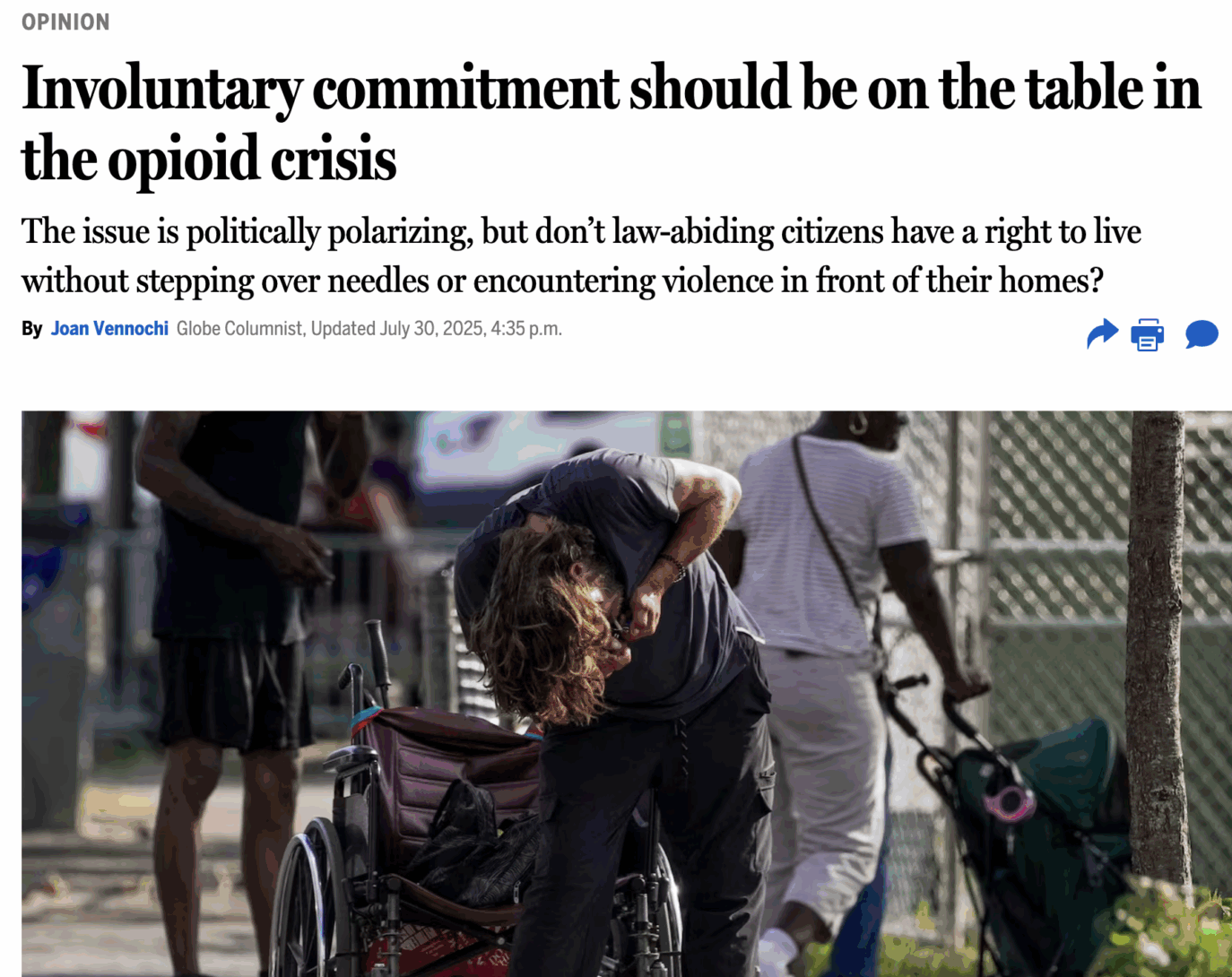
Boston Globe (7/30/25)
stepping over needles or encountering violence in front of their homes?” in an op-ed that is headlined, “Involuntary Commitment Should Be on the Table in the Opioid Crisis.”
Alright, I have thoughts. Not for nothing, but the words <a href="https://www.


 United States
