


💻 The Hardest Part Isn’t the Dissertation — It’s What Comes After
Description
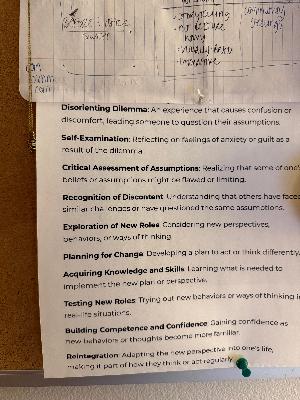
So, I had this realization the other day. I was just sitting at my desk and looked up at the bulletin board I keep above my computer, still full of notes from my doctoral days, and there it was, the ten phases of transformational learning proposed by Jack Mezirow in his Transformative Learning Theory glaring right at me.
And then I had a lightbulb 💡 moment. Wow, I’m right in the middle of the last two phases:
Phase 9: Building Competence and Confidence — gaining confidence as new behaviors or thoughts become more familiar.
Phase 10: Reintegration — adapting the new perspective into one’s life, making it part of how you think or act regularly.
Now, these phases don’t necessarily happen in order, but the research says they’re the hardest ones to go through. And let me tell you, the research is right, because I’m living it right now.
So I thought, well, maybe I should talk this out. Because that’s what I do. And maybe some of you are in these phases too, in your own way, even if you’ve never named them.
For those who don’t know, transformational learning has basically been my life for the last two years. It’s what I studied, it’s what I researched, it’s what I lived while doing my doctorate. And when I look back, I can actually see myself moving through the phases, not in a straight line, but hitting those different moments that Mezirow and his colleagues outlined. And now? Now I’m stuck…or maybe just sitting…in reintegration.
Reintegration is where you’re supposed to take all the knowledge, all the perspective shifts, all the growth, and weave it into your actual life. Not your academic papers or your dissertation, but your real, everyday life. The one with kids, with work, with bills, with everything else you’re carrying. And honestly? Easier said than done. It sounds straightforward when you read it in theory: take what you’ve learned and apply it.
But living it. Living it is another thing entirely.
And I think that’s where support matters most. In my research, I found this over and over again: you need people. You need community. You need some kind of space to process, because otherwise it’s just you, floating around with this big identity shift that you don’t quite know what to do with. And I can’t help but wonder, what if higher ed actually focused on that? Not just delivering knowledge or handing you a diploma, but walking with you through this messy reintegration stage.
When I started my program, my focus was clear, or at least I thought it was. I was going to change the educational system in Benin. That was it. I had a plan. I imagined creating an organization that could support students, teachers, and communities. I thought this degree would give me the skills to make it happen. But as I went through the program, things shifted. My focus shifted. I became more interested in the process itself, in how transformational learning works, because I realized it’s not just something that happens in a classroom. It happens in life. It happens when you move to a new country, or when you homeschool your kids, or when you take on a role you never imagined you’d have. It happens all the time.
And the funny thing is, most of us don’t even realize it when it’s happening. Unless we name it, we can’t see it clearly. But once you do see it, once you say, “Oh, that’s what this is,” it changes everything.
Now, here’s where it gets personal. My doctoral program was completely online. I never set foot in the Mary Lou Fulton School at Arizona State University. I never met my professors in person. I was lucky enough to meet two of my classmates, but I only knew the others through Zoom.
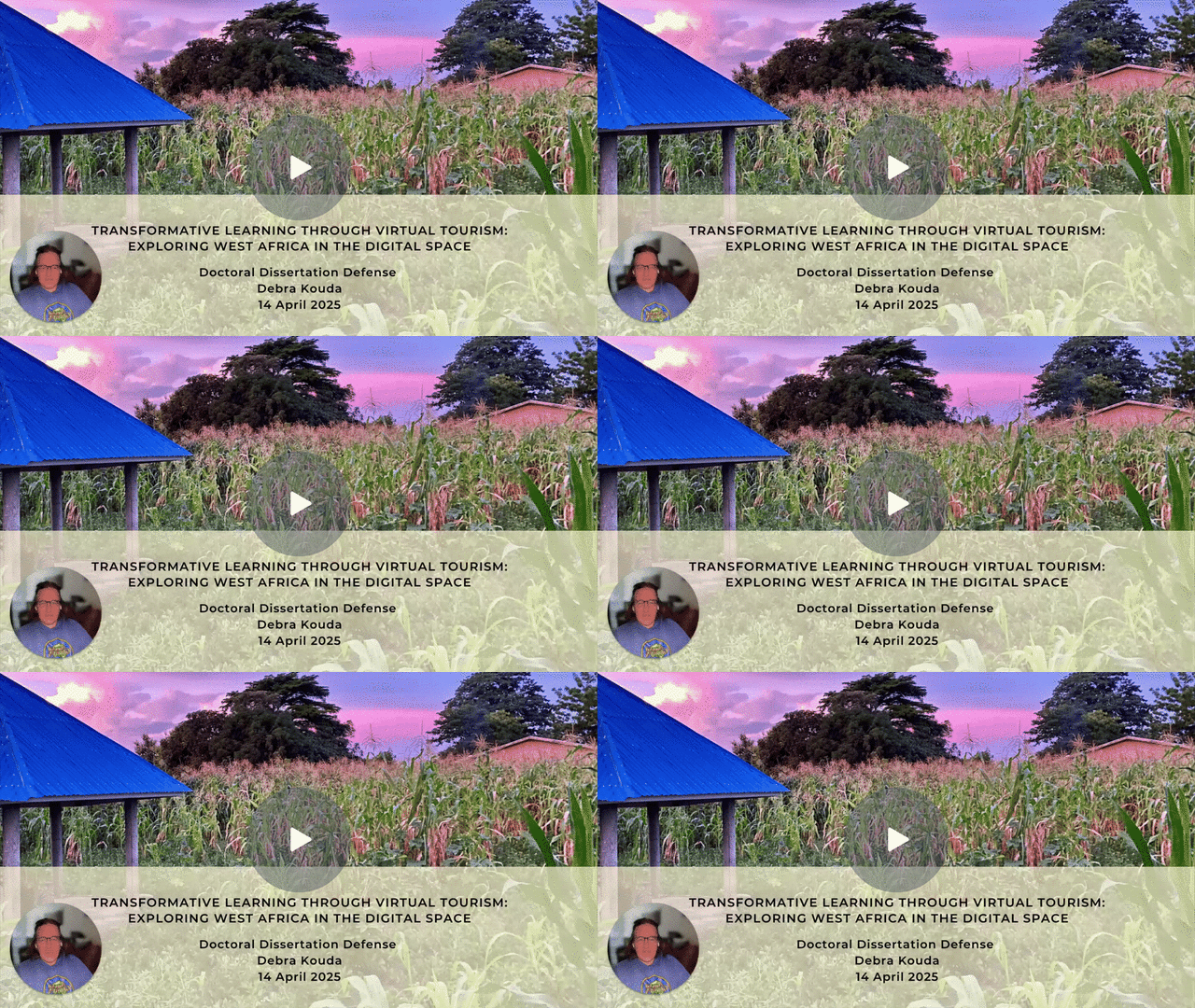
And when it all wrapped up, when I defended my dissertation, made my revisions, submitted the final copy…that was it.
Done.
No graduation ceremony for me, by choice. No closure. Just… over.
And frankly? It felt like being dropped off a cliff. One day, I was deep in edits and revisions, living and breathing my dissertation. The next day, silence.
Sure, I got the surveys asking, “What did you think of the program? What are you doing now?” But that was it. No one checked in to ask, “Hey, how are you navigating this new identity?” No one said, “How’s reintegration going?” It was more like, “Congratulations, Doctor. Good luck out there.”
And that’s tough. Because, as Dan Butin (2010) explains in The Education Dissertation: A Guide for Practitioner Scholars, which we read in our first semester:
“Now complete, your dissertation process allows you to sail off on a very different kind of journey” (p. 148).
That journey is one that involves those last two phases of transformational learning, and it’s a phrase I certainly did not fully understand until the degree was in my hand and the dissertation was finished.
Now, let me back up for a minute, because there was one thing that made my program doable. And that was community. Around my second semester, January of 2022, I joined what we ended up calling the Goldilocks Community of Practice. This was a little group of us who just found each other, and we decided to meet twice a week. We did homework together, we had real discussions, and we supported each other. We even recorded some of our sessions to submit as assignments. And that community gave me what the official program didn’t.
But here’s the thing. Once we all graduated, the goal was gone. The whole reason we were meeting, to get through the doctorate together, disappeared. And people started trickling away. Some went back to their jobs. Some leaned into the degree for promotions or leadership roles. And that makes sense…life keeps moving. But the community lost its center. A few of us still talk, but it’s not the same. And the wheels started turning in my head: what if universities created something like that, but official? What if support communities continued after graduation, so reintegration wasn’t something you had to stumble through alone?
Because reintegration is not automatic. It’s emotional. It’s confusing. Some people step into it easily; they’re ready to claim the “Doctor” title and run with it. Others, like me, wrestle with it.
I still find myself asking:
What do I actually do with this degree?
How do I live into this identity?
Where do I take my ideas so they don’t just sit in a notebook?
And I’ll be honest: it can feel really lonely. I don’t work in a university. I don’t have an academic community around me. I homeschool my kids, I manage a household, and I work on entrepreneurial projects. I’ve been called a thought leader, which is flattering, but also frustrating, because there’s no map. I have ideas that I know could be useful, ideas about education and transformation and community, but finding a place where those ideas can grow? That’s the part where I’m stuck.
And if I’m being really honest here, online programs don’t help with that. Sometimes they feel like a numbers game. Load up the students, get them through the modules, and hand out the diplomas. In-person programs naturally create connections because you’re in the same room, bumping into people in hallways, and grabbing coffee after class.
Online? None of that happens unless someone builds it on purpose.
And most programs don’t. Most rely on the learning management system, the LMS, to do the work. But an LMS isn’t built for connection, or at least the ones that I have been a part of have not. It’s built to organize content, keep the grades in one place, host the modules, and track the assignments. That’s it. And yet outside academia, in the world of professional courses and the creator space, communities are popping up everywhere. It’s where people gather, where they stay motivated, where the learning actually sticks. Why hasn’t higher ed caught up?
Through all my time in the online education space, I’ve come to believe that online programs should be harder to design than in-person ones, because connection doesn’t happen naturally online; it has to be created. And yet so many are designed the exact opposite. If universities really cared about transformational learning, they’d invest in that. They’d make community the centerpiece, not an afterthought.
Without it, you end up with students like me: graduating, sitting in phases nine and ten, feeling a little lost, a little frustrated, and a lot alone.
So maybe that’s where my work is now. Maybe I need to create the kind of community I wish I had. Because transformational learning doesn’t end when you get the diploma. That’s actually when it begins. That’s when you have to figure out how to carry those new perspectives, those new ways of seeing the world, into your actual life.
And no one should have to do that alone.
Get full access to Life with Debra K at debrakouda.substack.com/subscribe








 United States
