


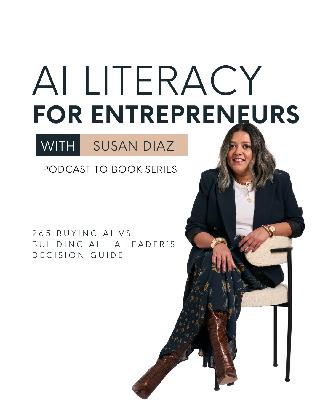
265 Buying AI vs Building AI - A Leader's Decision Guide
Description
Most teams are stuck in tool obsession: "Should we build agents?" "Should we buy this AI platform?" In this solo, workshop-style episode, host Susan Diaz pulls you back to reality with a simple decision guide: buy vs bolt-on vs build, four leadership filters, and a practical workflow exercise to help you choose the right approach - without falling for agentic fantasies.
Episode summary
Susan opens with a pattern she's seeing everywhere: 75% of AI conversations revolve around tools - agents, platforms, add-ons - and they're often framed as all-or-nothing decisions. She reframes it: AI is best understood as robotic process automation for the human mind, not a single agent replacing a person or a department.
This episode is structured like a mini workshop. Susan asks you to grab paper and map a real workflow step-by-step - because the decision isn't "which AI tool is hot" it's what job are we automating.
Then she defines the three choices leaders actually have:
-
Buy: purchase an off-the-shelf solution that works as-is.
-
Build: create something custom (apps, integrated experiences, models).
-
Bolt-on: the underrated middle path - use tools you already have (enterprise LLMs, suites), then add custom GPTs/projects, prompt templates, and lightweight automations.
She introduces a six-level "ladder" from better prompts → templates → custom GPTs/projects → workflow automation → integrated systems → custom builds, and offers a gut-check on whether your "agentic dreams" match your organizational capacity.
Key takeaways
Start with the job-to-be-done, not the tool. The most common mistake is choosing tech before defining the workflow. A workflow is simply a chain of small tasks with clear verbs and steps.
AI is RPA for your brain. Think "Jarvis" more than "replacement." It's about removing repetitive noise while keeping human judgement, discernment, and creativity in the lead.
Buy vs Build vs Bolt-on:
-
Buy when you need reliability, guardrails, enterprise support, and the use case is common (summaries, note-taking, analytics).
-
Build when the workflow is your differentiation, data is proprietary, outcomes are strategic, and you can support ongoing maintenance and governance.
-
Bolt-on for most teams: fast, cheaper, easier to change. Start by layering custom GPTs/projects and lightweight automation on top of existing tools and licences.
Six levels of maturity (a ladder, not a leap):
-
Better prompts (one-off help)
-
Templates / prompt libraries (repeatable help)
-
Custom GPTs / projects (consistent behaviour + knowledge)
-
Workflow automation (handoffs between steps)
-
Integrated systems (data + permissions + governance)
-
Custom builds (strategic + resourced)
Four decision filters for leaders:
A) Repeatable workflow or one-off?
B) Is the value in the tech itself, or in how you apply it?
C) Data sensitivity and risk level? (enterprise controls matter)
D) Do you have operating maturity to run it? (monitoring, owners, governance, feedback loops)
Automation ≠ autopilot. Automation is great. Autopilot is abdication. If you ship first-draft AI output without review, you'll get "garbage in, garbage out" reputational risk.
A simple friction-mapping exercise:
Map a 10-step workflow (open, check, find, copy, rewrite, compare, ask someone, format, send, follow up).
Circle the friction steps.
Label each friction point:
R = repeatable
J = judgement-heavy
D = data-sensitive
Then choose: buy / bolt-on / build based on what dominates.
Reality check for "agentic dreams":
Before building:
Do you have a documented workflow?
Do you have a human owner reviewing weekly?
Do you have a feedback loop?
If not, you're building a liability, not a system.
The real bet isn't build vs buy. It's this: "What repeatable work needs a personalised tool right now?"
Episode highlights
[00:02 ] Why most AI conversations are tool-obsessed (agents, platforms, add-ons).
[01:50 ] "RPA for the human mind" + the Jarvis analogy.
[04:14 ] Workshop setup: buy vs bolt-on vs build + decision filters.
[05:15 ] Step 1: define the job-to-be-done (not the department).
[08:13 ] The 10-step workflow template (open → follow up).
[10:49 ] Definitions: buying AI vs building AI vs bolt-on AI.
[14:13 ] The ladder: prompts → templates → custom GPTs → automation → integrated systems → builds.
[16:42 ] Filter A: repeatable vs one-off (and why repeatable is bolt-on territory).
[18:27 ] Filter C: data sensitivity and enterprise-grade controls.
[19:45 ] Filter D: operating maturity—where agentic dreams go to die.
[20:08 ] Automation vs autopilot (autopilot = abdication).
[21:24 ] Circle friction points + label R/J/D to decide.
[25:42 ] Reality check: documented workflow, owner, feedback loop.
[26:33 ] The takeaway: personalised tools for repeatable work beat agent fantasies.
Try the exercise from this episode with your team this week:
-
Pick one recurring, annoying-but-important job.
-
Map it in 10 simple steps.
-
Circle friction points and label R / J / D.
Decide: buy, bolt-on, or build—and write: "For this workflow, we will ___ because the biggest constraint is ___."
Connect with Susan Diaz on LinkedIn to get a conversation started.
Agile teams move fast. Grab our 10 AI Deep Research Prompts to see how proven frameworks can unlock clarity in hours, not months. Find the prompt pack here.








 United States
