


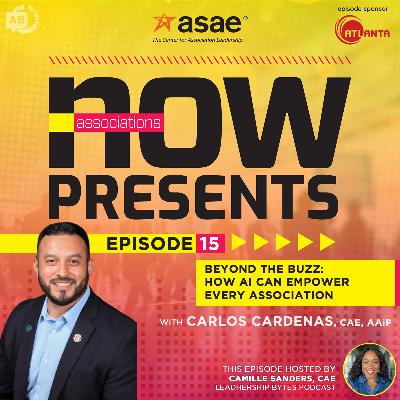
Beyond the Buzz: How AI Can Empower Every Association
Description
In celebration of National Hispanic Heritage Month, guest host Camille Sanders, CAE, director of chapter operations and programs at ISACA and host of LeadHERship Bytes, sits down with Carlos Cardenas, CAE, AAiP, senior strategic advisor at DelCor and co-founder of Association Latinos, for a forward-thinking discussion on the future of AI in associations. Carlos shares how his personal journey with AI began during retirement planning and evolved into a passion for helping associations—especially smaller ones—use AI strategically to thrive. The conversation explores practical concepts like the “quarterback agent” for task management, the value of experiential learning, and aligning AI tools with real business goals. Together, they highlight how associations can embrace AI innovation while ensuring inclusivity and equity for Latinx members and beyond.
Check out the video podcast here:
This episode is sponsored by the Atlanta Convention and Visitors Bureau.
Associations NOW Presents is produced by Association Briefings.
Transcript
Camille Sanders: [00:00:00 ] Welcome to this month's episode of Associations NOW Presents, an original podcast series from the American Society of Association Executives. I'm your host today, Camille Sanders. In addition to my role as director of chapter operations and programs at ISACA, I also host LeadHERship Bytes, an independent podcast highlighting the career and personal journeys of inspiring women across industries.
You can find it on any major podcast platform. Now, before we dive in, we would like to thank this episode sponsor the Atlanta Convention and Visitors Bureau Now. Let's get into the really fun stuff. I'm very excited for today's conversation where we're talking about the future of AI in associations with Carlos [00:01:00 ] Cardenas, the senior strategic advisor at DelCor, and a co-founder of Association Latinos.
Welcome, Carlos.
Carlos Cardenas: Hi Camille. How are you? Thanks for having me.
Camille Sanders: You are very welcome. We're excited to talk with you today. So I just want to be fully transparent with our audience that I know Carlos personally and I know about. Some of your exciting writings and the things that you've been doing in terms of educating associations around experimentation and adaptation of ai.
And I know that journey started for you with something really personal around your retirement planning, and that's a really unusual journey. That's not where most of us start. So can you talk to us a little bit about what sparked that idea for you?
Carlos Cardenas: Sure. No, I will say just like everybody else, right?
October, 2022, OpenAI dropped chat GPT version 3.0, [00:02:00 ] and it shook the world. It shocked the world, and so everybody started to experiment and say, how does this relate to me? How can I use this? How can I leverage it? I wrote a LinkedIn article in January talking about the directions that it could go. One of 'em was a travel advisor, one of 'em was a strategic advisor.
A couple other things as well. Fast forward a couple years, right? And so I'm, I'm relatively young, I won't say my age, but I like to think about the future. I like to think about financial independence, not necessarily retirement, but financial independence. And so I started to go down the road of what does retirement, or what does financial independence look like for me?
And you've got your traditional 401k in the workplace and you've got your employer match. Outside of that, you might do Roth IRAs, you might dabble in crypto, you might have some other investment vehicles, and so I do a lot of the work myself. And so [00:03:00 ] I look at websites, I look at market trends, but I'm like, how can I leverage some of these tools to help me so I don't have to do a lot of the heavy lifting?
I like to experiment. I downloaded open source models of my own. I purchased an NVIDIA graphics card. I've got that installed on my home desktop computer. But I run these models and experiment with them, and I use generative I to help me build agents. So I can have one agent that does it all, and you might get to that later on, but I felt I wanted to build an ecosystem of agents to help me with these various aspects.
So what I've been able to do so far in terms of retirement or financial independence is build an agent. I'll say it's probably 70% of the way done, but it goes to the marketplace. It looks at the s and p 500, and it comes back and it gives me that information, and then it builds a dashboard for me. So I can look at my financial portfolio and I can have it send me emails.
[00:04:00 ] And so basically it's my assistant to say, how am I doing? The market took a downturn, or it's doing, it's on fire, right? What does that mean? What does my five year-, what does my nine year-outlook look like? Do I need to make adjustments in my 401k? So that's kind of surface level. We could talk 60 minutes about this, but I'll stop there.
Camille Sanders: Yeah. No, I love that and I thank you for that example because I think it's a really practical example to show how people can use AI in our personal lives, right? To help us with future planning. And I, for one, had never thought about that. So thank you. Thank you again for that, and I think it leads nicely into something bigger.
That you've talked about in a recent article that you wrote and published, you talked about the fact that AI isn't at this point really about innovation, it's more about survival, especially for smaller [00:05:00 ] associations, and you even called it this moment, a breaking point for associations, and that's a powerful.
Really strong message and I'm curious about what makes you feel that sense of urgency right now?
Carlos Cardenas: I think it's clear if you follow investments, if you follow the big, the tech bros, so to speak, right? In terms of what they're doing. Generative AI is not going anywhere. People use it on a personal level and they've been able to multiply their cap capabilities.
But when you go to the association level for us, you look at association membership and, and I'll say for ASAE membership, since we're on this podcast, I believe something around 80% of all associations, and I don't know if they're specific to ASAE, but they're small staff associations. Their annual revenues are somewhere between, uh, I'll say a million or [00:06:00 ] less.
And that's a wide range. So people wear multiple hats. And so now you've got, you're bogged down into the tactical things. You don't have opportunities to take that hat off and be more strategic. And so administrative overhead comes front and center and, and I think these agent AIs or these AI systems perfect candidate to be able to offload some of those administrative burdens, so to speak, to free you up for the more strategic aspects of it.
And so that's why I feel like it is critical. It's critical now, right? People are stuck in the mud, so to speak, and maybe I see it as a consultant. Their technology posture is not where it needs to be, and so I feel like this is a perfect opportunity for leadership boards to be looking at these technologies to say, how do we leverage it in the workplace?
Again, we can use it on a personal [00:07:00 ] level, but. How do we bring that into the workplace and bring ourselves into the future? How do we experiment? How do we build that culture of learning?
Camille Sanders: Yeah.
Carlos Cardenas: So again, that surface level answer, but that's how I thought about this.
Camille Sanders: That's really good. And in that same piece, you introduced this concept of a quarterback agent, which I think is really timely.
It's football season, and I liked the concept because again, it makes AI feel more approachable. Can you break that down a little bit for us and talk about what exactly is a quarterback agent? And why is orchestration so much more important than just having this one catchall tool?
Carlos Cardenas: I'll start from the model perspective, and you've got your chat GPT version 5.0.
You've got from Anthropic, you've got cloud version 4.0, 4.1. You've got these multiple [00:08:00 ] flavors that try to do it all. If you look at the open source market, you've got specialized models, more lightweight models, maybe from an energy standpoint. They do not consume as much energy. They do not need as much computation, and so rather than thinking about one person, one agent to do it all, I like to distribute that workload and think about specialty agents, and I can have multiple specialty agents.
If I'm managing, I'm at the center of them all and managing them all. I feel like I'm just perpetuating and repeating a current problem. And so therein comes the orchestrator or quarterback agent. The, it's, think of it as a digital twin, a mirror of you that you're trying to train this particular model, and that quarterback agent can work with the other one.
So let me give you an example. Now, let's just say you've got a project, project a, we'll call it. You maybe have a [00:09:00 ] statement of work or project deliverables, and so you could have a specialized project manager agent that can think about all of the deliverables that need to happen. Some of the project outcomes, some of the timelines.
You might have a business analyst agent where you feed some of the brick requirements from. Think of your discovery meetings. Think of a communications agent that is specialized in outreach. Drafting emails and writing letters and drafting RFPs and writing executive summaries. And so they each have their own specialty and






 United States
