


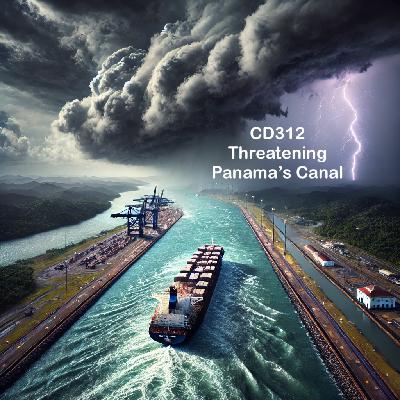
CD312: Threatening Panama's Canal
Update: 2025-03-09
Description
President Trump has been threatening to "take back" the Panama Canal since he regained power. In this episode, listen to testimony from officials serving on the Federal Maritime Commission who explain why the Panama Canal has become a focus of the administration and examine whether or not we need to be concerned about an impending war for control of the canal. View the show notes on the Congressional Dish website at https://congressionaldish.com/cd312-threatening-panamas-canal/ Please Support Congressional Dish – Quick Links Contribute monthly or a lump sum via PayPal Support Congressional Dish via Patreon (donations per episode) Send Zelle payments to: Donation@congressionaldish.com Send Venmo payments to: @Jennifer-Briney Send Cash App payments to: $CongressionalDish or Donation@congressionaldish.com Use your bank's online bill pay function to mail contributions to: 5753 Hwy 85 North, Number 4576, Crestview, FL 32536. Please make checks payable to Congressional Dish Thank you for supporting truly independent media! Background Sources Recommended Congressional Dish Episodes CD292: Sabotaging Palestine CD287: War Money Current Events around the Panama Canal "Panama president calls Trump's talk of 'reclaiming' the Panama Canal a lie." March 5, 2025. the Associated Press. "Blackrock to buy Hong Kong firm's Panama Canal port stake amid Trump pressure." Sabrina Valle, Suzanne McGee, and Michael Martina. March 4, 2025. Reuters. "Mapping China's Influence around the Panama Canal." Matt Murphy, Jake Horton and Erwan Rivault. February 14, 2025. BBC. "Low water levels in Panama Canal due to increasing demand exacerbated by El Nino event." May 1, 2024. World Weather Attribution. "59 Iran-Linked Ships Stripped of Panamanian Flag, US DOS Confirms." World Maritime News Staff. March 15, 2019. World Maritime News. "Chinese Consortium to Build Fourth Panama Canal Bridge." July 29, 2018. Reuters. Panama Canal Treaty of 1977 "Panama Canal Treaty of 1977." U.S. Department of State. The Chinese "Belt and Road Initiative" "Belt and Road Initiative." Michele Ruta. March 29, 2018. World Bank Group. The Trump-Gaza Video Donald Trump shares 'what's next' for Gaza AI video on his Truth Social Platform February 26, 2025. Sky News. Laws Section 19 of the Merchant Marine Act Audio Sources President Trump Threatens to "Reclaim" The Panama Canal during his March 4, 2025 Presidential Address Examining the Panama Canal and Its Impact on U.S. Trade and National Security Senate Committee on Commerce, Science, and Transportation January 28, 2025 Watch on YouTube Witnesses: Louis E. Sola, Chairman, Federal Maritime Commission (FMC) Daniel B. Maffei, Commissioner, FMC Eugene Kontorovich, Professor, Scalia Law School, George Mason University Joseph Kramek, President & CEO, World Shipping Council Clips 17:30 Sen. Ted Cruz (R-TX): Between the American construction of the Panama Canal, the French effort to build an isthmus canal, and America's triumphant completion of that canal, the major infrastructure projects across Panama cost more than 35,000 lives. For the final decade of work on the Panama Canal, the United States spent nearly $400 million, equivalent to more than $15 billion today. The Panama Canal proved a truly invaluable asset, sparing both cargo ships and warships the long journey around South America. When President Carter gave it away to Panama, Americans were puzzled, confused, and many outraged. With the passage of time, many have lost sight of the canal's importance, both to national security and to the US economy. 18:45 Sen. Ted Cruz (R-TX): But the Panama Canal was not just given away. President Carter struck a bargain. He made a treaty. And President Trump is making a serious and substantive argument that that treaty is being violated right now. 19:10 Sen. Ted Cruz (R-TX): President Trump has highlighted two key issues. Number one, the danger of China exploiting or blocking passage through the canal, and number two, the exorbitant costs for transit. 19:20 Sen. Ted Cruz (R-TX): Chinese companies are right now building a bridge across the canal at a slow pace, so as to take nearly a decade. And Chinese companies control container points ports at either end. The partially completed bridge gives China the ability to block the canal without warning, and the ports give China ready observation posts to time that action. This situation, I believe, poses acute risks to US national security. 19:50 Sen. Ted Cruz (R-TX): Meanwhile, the high fees for canal transit disproportionately affect Americans, because US cargo accounts for nearly three quarters of Canal transits. US Navy vessels pay additional fees that apply only to warships. Canal profits regularly exceed $3 billion. This money comes from both American taxpayers and consumers in the form of higher costs for goods. American tourists aboard cruises, particularly those in the Caribbean Sea, are essentially captive to any fees Panama chooses to levy for canal transits, and they have paid unfair prices for fuel bunkering at terminals in Panama as a result of government granted monopoly. Panama's government relies on these exploitative fees. Nearly 1/10 of its budget is paid for with canal profit. 21:25 Sen. Ted Cruz (R-TX): Panama has for years flagged dozens of vessels in the Iranian ghost fleet, which brought Iran tens of billions of dollars in oil profits to fund terror across the world. 21:40 Sen. Ted Cruz (R-TX): And Chinese companies have won contracts, often without fair competition, as the infamous Belt and Road Initiative has come to Panama. China often engages in debt trap diplomacy to enable economic and political coercion. In Panama, it also seems to have exploited simple corruption. 32:40 Louis Sola: The Panama Canal is managed by the Panama Canal Authority, ACP, an independent agency of the Panamanian government. The ACP is a model of public infrastructure management, and its independence has been key to ensure a safe and reliable transit of vessels critical to the US and global commerce. 33:25 Louis Sola: In contrast, the broader maritime sector in Panama, including the nation's ports, water rights, and the world's largest ship registry, falls under the direct purview of the Panamanian government. 33:35 Louis Sola: Unfortunately, this sector has faced persistent challenges, including corruption scandals and foreign influence, particularly from Brazil and China. These issues create friction with the ACP, especially as it works to address long term challenges such as securing adequate water supplies for the canal. 33:55 Louis Sola: Although the ACP operates independently, under US law both the ACP and the government of Panama's maritime sector are considered one in the same. This means that any challenges in Panama's maritime sector, including corruption, lack of transparency, or foreign influence, can have a direct or indirect impact on the operations and long term stability of the canal. This legal perspective highlights the need for diligence in monitoring both the ACP's management and Panama government's policies affecting maritime operations. 34:30 Louis Sola: Since 2015, Chinese companies have increased their presence and influence throughout Panama. Panama became a member of the Belt and Road Initiative and ended its diplomatic relations with Taiwan. Chinese companies have been able to pursue billions of dollars in development contracts in Panama, many of which were projects directly on or adjacent to the Panama Canal. Many were no bid contracts. Labor laws were waived, and the Panamanian people are still waiting to see how they've been benefited. It is all more concerning that many of these companies are state-owned, and in some cases, even designated as linked to the People's Liberation Army. We must address the significant growing presence and influence of China throughout the Americas and in Panama, specifically. 35:20 Louis Sola: American companies should play a leading role in enhancing the canal's infrastructure. By supporting US firms, we reduce reliance on Chinese contractors and promote fair competition. 36:55 Daniel Maffei: Because the canal is essentially a waterway bridge over mountainous terrain above sea level, it does depend on large supplies of fresh water to maintain the full operations. Panama has among the world's largest annual rainfalls. Nonetheless, insufficient fresh water levels have occurred before in the canal's history, such as in the 1930s when the Madden Dam and Lake Alajuela were built to address water shortages. Since that time, the canal has undertaken several projects to accommodate larger, more modern ships. In the last couple of years, a trend of worsening droughts in the region, once again, has forced limits to the operations of the canal. Starting in June of 2023 the Panama Canal Authority employed draft restrictions and reduced the number of ships allowed to transit the canal per day. Now the Panama Canal limitations, in combination with the de facto closure of the Suez Canal to container traffic, has had serious consequences for ocean commerce, increasing rates, fees and transit times. 39:30 Daniel Maffei: Now, fortunately, Panama's 2024 rainy season has, for now, alleviated the most acute water supply issues at the canal, and normal transit volumes have been restored. That said, while the Panamanian government and Canal Authority have, with the advice of the US Army Corps of Engineers, developed credible plans to mitigate future water shortages, they also warned that it is likely that at least one more period of reduced transits will occur before these plans can be fully implemented. 41:55 Eugene Kontorovich: We shall see that under international law, each party to the treaty is entitled to determine for itself whether a violation has occurred. Now, in exchange for the United States ceding control of the canal which it built and maintained, Panama agreed to a special regime of neutrality. The essential features of this regime of

Comments
In Channel



Download from Google Play

Download from App Store
 United States
00:00
00:00
x

