


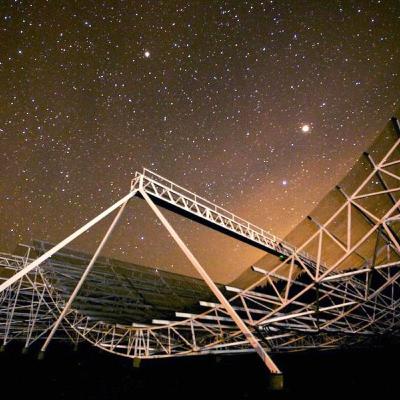
CHIME’s Cosmic Echo: The First Detection of the 21 cm Auto-Power Spectrum.
Description
Reference Article: Detection of the Cosmological 21 cm Signal in Auto-correlation at z ∼ 1 with the Canadian Hydrogen Intensity Mapping Experiment, by The CHIME Collaboration.
Summary:
We delve into a groundbreaking astronomical achievement: the **first detection of the cosmological 21 cm intensity mapping signal in auto-correlation at $z \sim 1$** using the Canadian Hydrogen Intensity Mapping Experiment (CHIME). This discovery utilizes 94 nights of observation data, covering a frequency range from 608.2 MHz to 707.8 MHz, corresponding to a mean redshift of approximately $z \sim 1.16$.
The detection was highly significant, measured at **$12.5\sigma$**. This marks a major milestone, as it establishes the 21 cm auto-power spectrum as a direct and potent cosmological probe, eliminating the dependence on external galaxy surveys to study large-scale structure.
Key Discussion Points:
- The Challenge: Detecting the cosmological 21 cm signal is extremely challenging because astrophysical radio foregrounds are several orders of magnitude brighter.
- Pipeline Advancements: The success relies on significant improvements to the CHIME data processing pipeline. These advancements include novel RFI (Radio Frequency Interference) detection and masking algorithms, achromatic beamforming techniques, and applying foreground filtering *before* time averaging to minimize spectral leakage. The Hybrid Foreground Residual Subtraction (HyFoReS) algorithm was also deployed to correct residual bandpass errors.
- Robustness and Validation: The measurement is exceptionally reliable, having been established through a comprehensive suite of validation tests. Key checks demonstrated that the signal is consistent across independent right ascension bins, declination bins, and different baseline configurations, ruling out baseline-dependent, RA-dependent, or declination-dependent systematics. Crucially, the consistency of the signal in Stokes-Q data with noise rules out significant polarized foreground leakage.
- Consistent Results: The auto-correlation result is statistically consistent with previous cross-correlation measurements performed using the same CHIME data stacked on eBOSS quasars, providing strong evidence against contamination from systematics.
- Cosmological Implications: The measurement constrains the clustering amplitude of neutral hydrogen (HI). For the full band, the derived amplitude parameter is $A^2_{\text{HI}} = 2.59^{+1.26}_{-0.78}(\text{stat.})^{+2.45}_{-0.47}(\text{sys.})$. Independent detections were also made in two sub-bands (9.2$\sigma$ at $z \sim 1.24$ and 8.7$\sigma$ at $z \sim 1.08$), showing consistency between the different redshift slices.
- Future Outlook:This detection sets the stage for precision 21 cm cosmology. Future work aims to include the nearly 7 years of archival CHIME data to reduce statistical uncertainties, push measurements to higher redshifts (400–600 MHz band), and develop new techniques to recover linear scales in the power spectrum, potentially enabling measurements of Baryon Acoustic Oscillations (BAOs).
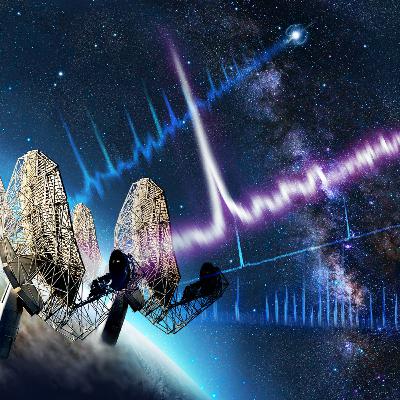
Acknowledements: Podcast prepared with Google/NotebookLM. Illustration credits: CHIME/Andre Recnik



 United States
