


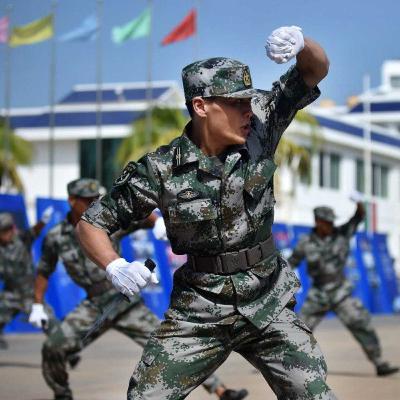
China’s Quiet Army: Inside the Radical Rebirth of the Militia System
Description
In this episode of The War Lab, we unpack one of the least understood but most consequential transformations underway in China’s military ecosystem: the sweeping overhaul of its nationwide militia system. Far from a relic of Maoist “people’s war,” the militia is being re-engineered into a modern, specialized reserve force tied directly into the PLA’s joint warfighting architecture—and the implications for regional conflict are profound.
We trace the origins of Beijing’s 2018 reform campaign, driven by a blunt internal assessment: before China could build a strong militia, it had to build a real one. That meant rooting out fake enlistments, hollow units, bureaucratic double-counting, and peacetime dysfunction. Only after that cleanup could the transition to “getting strong” begin—a transition aimed squarely at wartime readiness.
From cyber specialists embedded in major tech firms, to maritime militia units operating alongside the China Coast Guard in contested waters, China’s once-disparate militia forces are now being shaped into a highly structured support arm for PLA operations across every domain: air, land, sea, space, and the electromagnetic spectrum. We break down how this new force is organized, what missions it’s being trained for, and how Beijing is using financial incentives, civilian–military partnerships, new training bases, and joint exercises with the PLA to hardwire militia units into campaigns that could shape the opening hours of a Taiwan or South China Sea conflict.
But the reforms also face friction: limited budgets, uneven implementation, short training cycles, and the inherent challenge of turning civilian professionals—often available for only 7–12 days a year—into reliable wartime assets. We examine these limitations honestly, while highlighting pockets of real capability that Beijing is clearly proud of, from advanced UAV reconnaissance teams to elite cyber units providing security during major political events.
Finally, we explore what indicators analysts should watch as China moves toward the next Five-Year Plan: whether rhetoric shifts beyond the “real-to-strong” phase, whether training days increase, and whether militia units appear more consistently in full-scale PLA joint exercises. Because taken together, these reforms represent something far larger than a reserve-force tune-up—they reveal how China is mobilizing its entire national base of talent, technology, and industry for modern conflict.
If you want to understand China’s real mobilization power—and the strategic warning signs hidden in plain sight—this is an episode you won’t want to miss.













 United States
