


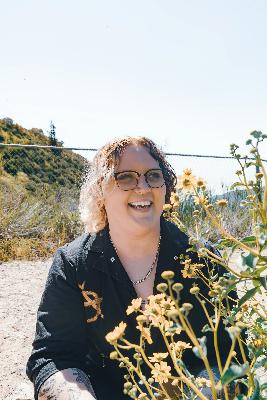
Continued Conversations with Asher Phoenix
Description
Everyone please welcome my newer friend and fellow actor Asher Phoenix to A Broadway Body: Continued Conversations! Asher and I met through a dear friend (hi, Kate Stoss), and I’m so beyond grateful for our discussion about body image. In our conversation, we discovered we both work through the Internal Family Systems modality in our own therapy sessions, and Asher speaks on how some parts of themself (like their eating disorder) are not enemies but simply broken friends, and how much of a better world we’d live in if we could view those in the world around us that are hurting in this way too. The way Asher speaks to empowering their trans subjects in their photography work is chef’s kiss, and they have so many important nuggets of wisdom on how we can do better for the trans community in the arts.
Asher is an actor and photographer currently based in Kansas. Their passion is portraiture for trans people and they focus on helping trans people embrace their bodies in front of a camera, which I truly believe is insanely impactful work. Keep an eye out for their future work in clinical psychology - I cannot wait to see where Asher’s future work leads them! Asher shares their story with such generosity and compassion, and I really cannot wait for you to hear our conversation!
Spoiler alert: if you have not seen “The Civility of Albert Cashier,” Asher does spill how the musical ends (for good reason)
“I really am most passionate about doing portrait shoots where the subject is not comfortable in their skin and very clearly needs guidance into being comfortable in front of the camera. And I've had the honor of doing body neutrality practices with my clients where they come to me and they're like, “I don't like the way I look, but I trust you to make something out of this.” And then I'll lead them through a guided meditation-type thing where I'm just like, “Name the part of the body that brings you the most insecurity, and tell me something neutral about it. Tell me what its function is.” And so, for me, I guess an example of this for me would be I am insecure about my hands, which are very strategically tattooed. But they hold my camera, and that's – the coolest thing is that they serve a purpose and a function for me every single day creatively, and I am grateful for that.“
- Asher Phoenix
Megan Gill: I would just love to learn a little bit more about your lens and where you're coming from the artistic, creative perspective as well.
Asher Phoenix: Yeah, totally. I, so as far as theater goes, I have been doing it since I was, like, seven years old. I grew up begging to play boys’ roles, and my parents still had no idea I was trans. But I guess most notably I played Randolph McAfee in Bye Bye Birdie. And it was the first time I had ever had to bind my chest for a role, and that was at Friends University my freshman year. And I just remember the costuming designer profusely apologizing as she handed me a binder and I put it on and was like, “Whoa, this is me. This is cool. Yeah.”
And then I insisted that it was more logistically sound to wear boxers with my costume so that I had something sturdy for the mic pack to hold onto. But really I was just taking a deep dive into exploring gender. And I don't know, that role really opened up my entire world as far as gender expression and coming out as trans goes.
And a few months after that, I went to Chicago to see The Civility of Albert Cashier, their initial run. For those listening who don't know what Albert Cashier is, it's a musical about a transgender Civil War veteran who was found out once he was placed in a nursing care facility, and had his pension taken away, had to go on trial ultimately just for being trans. And, spoiler alert, he ended up dying because he was forced into a dress and tripped on the dress, fell, and went into cardiac arrest.
Megan Gill: Oh, my.
Asher Phoenix: And he was a real person. His grave is a four-, or five-hour drive from where I'm staying now. So I really wanna make it up there just to pay respects to a Civil War veteran who literally changed my whole life and will continue to do so if Albert continues to get the stage time that it deserves.
But professionally, I pivoted when I left college my sophomore year to pursue photography, music photography, concert photography. But I really am most passionate about doing portrait shoots where the subject is not comfortable in their skin and very clearly needs guidance into being comfortable in front of the camera. And I've had the honor of doing body neutrality practices with my clients where they come to me and they're like, “I don't like the way I look, but I trust you to make something out of this.” And then I'll lead them through a guided meditation-type thing where I'm just like, “Name the part of the body that brings you the most insecurity and tell me something neutral about it. Tell me what its function is.”
And so, for me, I guess an example of this for me would be I am insecure about my hands, which are very strategically tattooed. But they hold my camera, and that's the coolest thing is that they serve a purpose and a function for me every single day creatively, and I am grateful for that.
Megan Gill: Yeah, that’s beautiful.
Asher Phoenix: This last August, I had the pleasure of doing media and photography work for The Civility of Albert Cashier's run in Los Angeles, and it was like the first fully produced and costumed – and even the script was rewritten a little bit because there was, arguably, some trans trauma porn that happened in the original where they showed Albert's death, and it just wasn't necessary. It hit, but it was hard to watch in a way that it shouldn't be for trans people. And so, they rewrote the ending to just give a narrative of what happened in his last years, which I think props to Jay and Keaton and Joe for coming up with the new finale that they did because it was incredible. But yeah, I got to do photography work for that and write a little writeup about my story and how The Civility of Albert Cashier has impacted my story for LA Times, which is, like, the greatest honor.
Truly, I consider myself a multifaceted artist. I love writing, I love photography, but I also still really enjoy performing. Just navigating a medical transition with being on stage has been difficult because I went through a good two years where I just couldn't sing, and it was so sad. But it comes back eventually. It just is a major waiting process, and that sucked for the time being. But I'm grateful to have found my voice again.
I actually just recently – my college choir director had her last concert at Friends University and invited alumni to come back and sing a couple songs, and I got to learn the tenor part and sing with my new voice, and it was a lot of fun.
Megan Gill: Ah, that's amazing. That's powerful. I’m glad you had that opportunity, especially at a place like your college –
Asher Phoenix: Me too.
Megan Gill: – a place that you have ties to that you've previously studied at. Oh, that's so great. Thank you so much for sharing all of that. There are so many things to talk about!
I just think it's really cool and impactful that you had the opportunity to take photography of this musical that had such an impact on you. I’m not sure how many years prior you first saw it?
Asher Phoenix: Nine years. Eight years? Something like that.
Megan Gill: Oh, my gosh, wow! Okay, either way that really hits that eight, nine years later you got to come back and capture this piece through a different creative lens. I just think that's so powerful, and I'm so glad that you had that opportunity, and I hope that you get to do more – I hope that you get to follow the show as it's produced elsewhere because it needs to be produced elsewhere, like you were saying.
I was reading up on the Jagged Little Pill – what happened with that musical as far as the casting goes, because I wasn't super familiar myself until you had mentioned it to me. So I went on a little bit of a deep dive. And just reading about how many non-binary and trans characters there actually are written into musicals is really not okay and truly just not reflective of our world. Yeah, I would love to talk a little bit more about that and about your experience watching on as this huge Broadway musical decided to just completely rewrite this non-binary character into a cis female character, and the harm that was done by a cis female actor even being cast in the role in the first place.
Asher Phoenix: Yeah. Yeah, that was a major blow. I grew up listening to Alanis, and I love her, and like she's been such a Madonna for the queer community, such a fierce advocate. And then she goes on to be part of the making of the script for Jagged Little Pill, and expectations for other people get us nowhere in life. But I guess I just had this expectation that – I don't know, a hope that she would be more fierce of an advocate for keeping that role as non-binary.
I have to give Lauren Patton, I think, credit because it was actually a big wake up for them as far as gender goes. But trans roles are not there for cis people to realize that they're trans. Trans roles are there for trans people to be cast as them from the get-go.
Megan Gill: Amen.
Asher Phoenix: And I'm so glad that Lauren is now on their own gender diversity exploration process, whatever. I just think that if I were in her shoes as someone who thought they were cis, I would




 United States
