


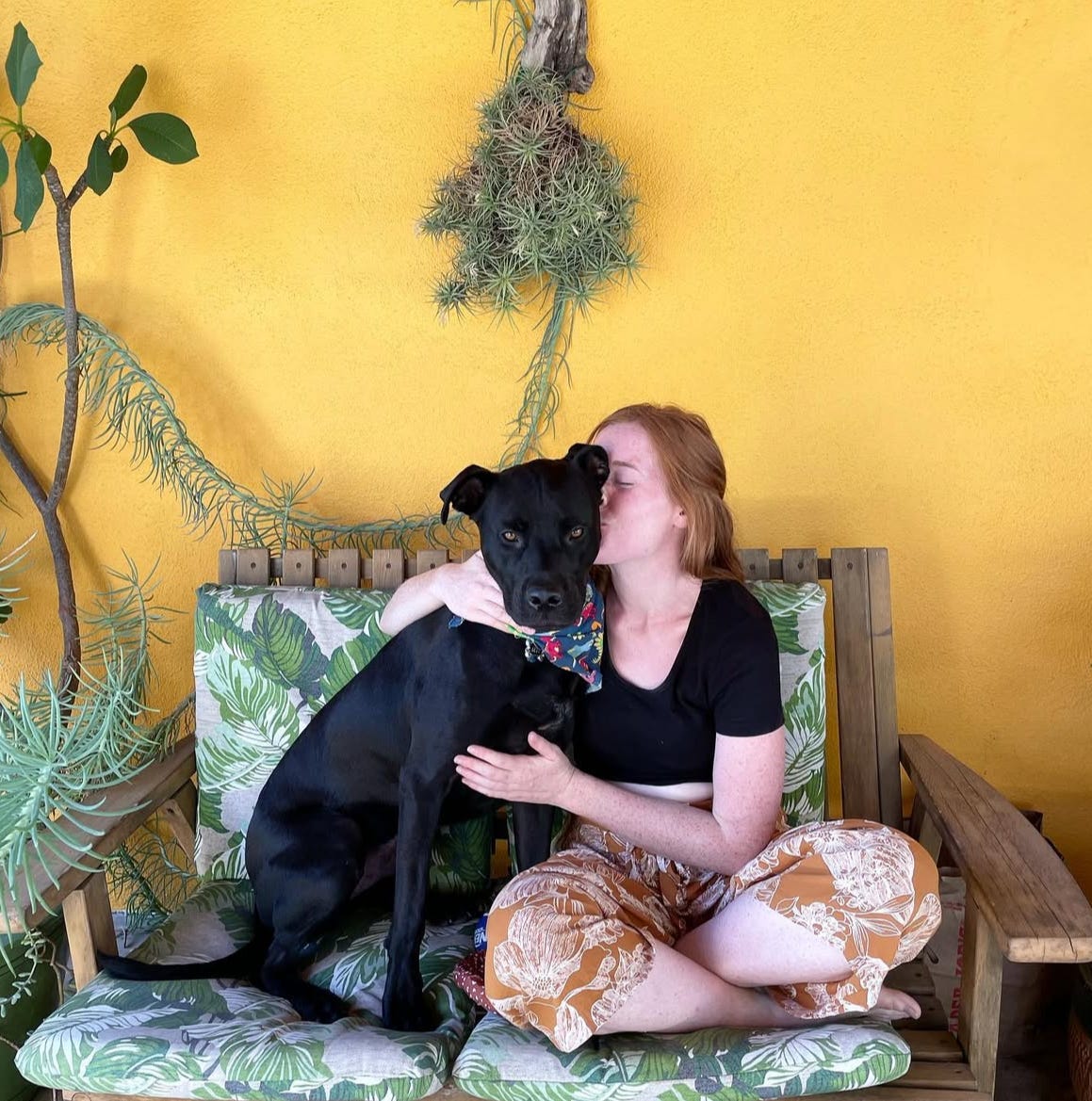
Continued Conversations with Christine Dickinson
Description
Everyone please welcome my friend and fellow actor, writer, producer, Christine Dickinson, to A Broadway Body: Continued Conversations! Christine is an actor, a writer, and a producer, and I met in our acting class at Crash Acting a few years ago. She very recently debuted her one-woman play “Mother” in Los Angeles, CA, and the show was phenomenal. We’d had this conversation before I saw it, and I will say that many topics of convo that Christine brought to the fore were beautifully touched on in her show.
In our conversation, we discuss…
* Breaking the generational trauma cycle (with body image and more broadly)
* The debut of her one-woman, one-act show “Mother” and what inspired her to write the play
* How rehearsing her play brought her body image story front and center
* The conscious permission it takes to write about topics we don’t necessarily feel “qualified enough” to speak on
* The comment her play makes about the impacts of social media on today’s culture
* Navigating our feelings around our bodies
* Her body image story - from being praised for being thin and invalidated in her feelings about her body, to uncovering a body image story through the rehearsal of her play
Christine so openly shared her body image story with me, and her vulnerability to speak on these topics she’s just recently started to face head on is beautiful. Her thoughts on generational trauma and the impacts of social media on our individual body image are powerful, and I cannot wait for you to hear our conversation!
“I think a lot of comparison is what comes up in the play, kind of in a subtle way. But there are a lot of different videos in the video sequences that you see that indicate that my character is doing girlhood or womanhood incorrectly. So you have one person saying, “Hey, if your body is larger, that’s bad, and you should fix that.” And then another person, “If your body is smaller, that’s also bad and you should fix that.” And then, “Oh, you should be dainty and feminine and always keep a groomed appearance.” And then like, “No, fuck that!” And then, you know, all of these different, you know, expectations about what we should and shouldn’t use our bodies for. And yeah, then there’s, you know, the whole topic of what happens to your body during pregnancy. That’s something that’s explored in one of the video series as well.”
- Christine Dickinson
Megan Gill: Hi, Christine! I’m so excited to talk with you, and I’m just so glad that you’re here.
Christine Dickinson: Hi! Thank you so much for having me. I’m very excited. I’m a big fan. I’m a big Megan fan.
Megan Gill: Hey, I’m a big fan of you! Do you wanna just start by introducing yourself and introducing your work in the world?
Christine Dickinson: Yes, I’m Christine Dickinson and I am an actor, playwright, and new producer. And right now, I am producing my first original work called Mother, which will be a workshop production of my one-woman show.
Megan Gill: Which is just so exciting because, at the time of recording this, you are premiering this piece to the world in just a couple of days!
Christine Dickinson: Yep. Yep!
Megan Gill: How do you feel?
Christine Dickinson: I think, more than anything, excited but also terrified. So I would say it’s probably equal parts both. This has been something that’s been marinating for me for a couple of years. A few years ago, I wanted to write a screenplay of this kind of a thing, and now it’s kind of evolved into a play and, you know, that’s a little bit more my realm anyway than film. So I’m definitely excited to share the story in a medium that I have been working in for so long. But scary because I’ve never really put my own voice out there like this before. So I would say it’s a little bit of both.
Megan Gill: Oof, I just got chills. That is so, so totally fair. Okay, so the premise of your story is, “In this comedy thriller play, a daughter faces the cost of being a woman in a modern world where her mother isn’t answering her calls.”
Christine Dickinson: Yes.
Megan Gill: Can you share a bit more about the premise in the story and kind of these themes of what it is to be a young woman today and how those themes are woven into the piece?
Christine Dickinson: Yeah, absolutely. So the play opens when a daughter, my character, comes in from a long-haul flight, and the first call is, you know, just checking in with the mom like, “Hey, I got home,” that kind of thing. And it becomes pretty clear that something happened during the last moments that we saw each other, because I guess the idea is that we live on opposite sides of the country, and I no longer live near my mom. So the phone is really the only way that we can connect. So there’s this idea that something happened, and we’re not quite sure what happened, but there was some sort of tension between daughter and mother that was unresolved before the daughter left to get on a plane to go back home.
So that’s where we start. And throughout the play, without giving too much of it away, we start to see this person’s life shake out kind of maybe how you would imagine it to with a lack of guidance or support. And many of the troubles, again, without getting too much into it, because it’s only 40 minutes. So I’m like, there’s not a ton that I could really tell about the plot that’s not a total spoiler.
Megan Gill: Totally. No spoiler alerts!
Christine Dickinson: I’m like, I just tell you the whole thing right now. “In scene six, this happens.”
Megan Gill: I’m like, “No, I’m seeing the play this weekend!” And I’m so excited. I cannot wait!
Christine Dickinson: Yes. Okay. I won’t spoil it for you. But, you know, it’s everything to do with the things that we have to face, particularly as women in a modern world, everything from pressures of how we look, pressures of how we are coming off (especially to people who have authority over us like employers), pressures of being equal parts girl boss and equal parts dainty, feminine. And then we kind of dive into this whole world of like, whoa, okay, these are modern lenses on these issues, but these are really issues that have existed for centuries.
So we kind of go back and look at some ancestral stuff a little bit and some things that – like what happens when we experience traumatic things and we leave those traumatic things unchecked and we continue to reproduce, especially when it’s a woman giving birth to a daughter, and then she has a daughter, and then she has a daughter. And how those cycles kind of don’t break themselves unless somebody breaks it.
Megan Gill: That is such an important thing to be talking about and something that I very much think our generation is all about looking at and uncovering and trying to get to the bottom of. So I just think it’s really beautiful and also quite relevant to probably what many women are unpacking today.
Christine Dickinson: Hmm. Yeah. Thank you. What’s really interesting about writing this play was that I think we had actually had a conversation years ago because, when I saw your short, A Broadway Body, the screening of that, I felt really inspired. And I was like, “Oh, I’m writing something that’s kind of touching on something similar to this.” And I think we had a conversation about that because I was so inspired. I was like, “How did you sit down and write this?” I kind of felt like I abandoned that project for a while, but then I sat down, I think it was February, and I was, like, “Ooh, I’m really kind of feeling something right now.” And so, I just sat down without thinking of it being a play or anything. I think I just wrote a conversation or a one-ended phone conversation, like a voicemail, like so much of this play is a voicemail series. So I think I just wrote one. From there I was like, “Oh, this is kind of setting something off in me a little bit.” And then I stepped away from it for I think a couple weeks, and then I went back to it and I read it and I was like, “Oh, no, no, no. Something else happens after this.” And it just kind of one thing led to the next, to the next.
I just, over the course of maybe two months, kept walking away and then coming back, and then it was just so abundantly clear what happens next in this person’s story. And I didn’t know how this play was going to end until I sat down and I wrote the final scene. And I think my fiancé, who was literally in the room. He came in, in the middle of me writing it, and he was like, “Hey, how was your –?” And I was like, “No. No, no, no. Hold on, hold on!”
Megan Gill: “Zip it! Not now!”
Christine Dickinson: Hold on one sec. Hold one second. And then da, da, da da, last line of the play. “Okay. Yes, it was fine. Um, take five and I’m gonna read you this.” So yeah, it just – like, I had no idea some elements of it, that were coming in, until literally I was writing it. It was as if something was kind of moving. It sounds silly when I say it, but it’s like something else was moving through me that was not my own narrative anymore, even though it felt like it started off that way.
And even in the rehearsal of it, the reading of it, all of this, we had a dress rehearsal on Sunday, and even in that I’m like, “Oh, there are things that I’m discovering in this text that I was not aware that I was putting into it.” Yeah, so it’s been a really strange experience. So bizarre for me and foreign but co













 United States
