


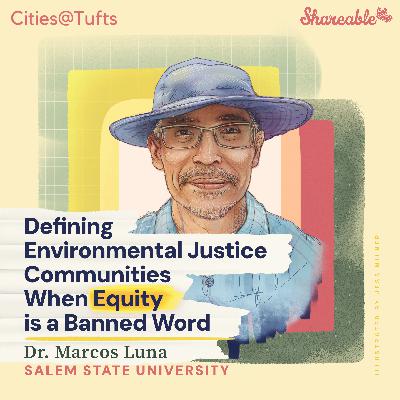
Defining environmental justice communities when 'equity' is a banned word with Marcos Luna
Description
Since the emergence of the Environmental Justice movement, maps have been pivotal tools in revealing patterns of environmental and social inequality, in legitimizing what many communities already knew – that power and oppression shape the landscape of opportunity and risk.
Mapping remains critical to Environmental Justice activism, research, and policy. Maps are often employed as tools of accountability, and as a result, mapping is both a technical and a political act, facing both technical and political challenges.
Within the current political climate, these challenges have been magnified, but they are not new. They are familiar and pernicious obstacles to the larger movement for social justice.
And they share a common root – a resistance to naming and confronting the role of racism and other forms of social and political marginalization that sustain the inequitable landscape of privilege and oppression.
This is a discussion about how that resistance is manifested, how it challenges the task of mapping in environmental justice research and policy, and reflections on what it means to meaningfully engage with environmental justice mapping as a technical and political act.
About the speaker
Professor Marcos Luna joined the Geography and Sustainability Department at Salem State University in 2004. I received my Ph.D. in Urban Affairs and Public Policy with a concentration in Technology, Environment, and Society from the University of Delaware in 2007. I received my M.A. in Geography from California State University, Los Angeles, in 2000. Before coming to Salem State University, I worked as an Environmental Analyst for the Massachusetts Department of Environmental Protection, and before that, as a NASA-funded GIS consultant for Native American tribes in the Southwest and Northwest. I have participated in various health and environmental research and public service projects in Massachusetts, Delaware, and California, as well as at the national level.
Resources
- Cities@Tufts Lectures explores the impact of urban planning on our communities and the opportunities to design for greater equity and justice with professor Julian Agyeman.
- Cities@Tufts Lectures is produced by Tufts University and Shareable.net with support from Barr Foundation,
- Paige Kelly is our co-producer and audio editor. The original portrait of Marcos Luna was illustrated by Jess Milner. The series is co-produced and hosted by Tom Llewellyn.
- "Light Without Dark" by Cultivate Beats is our theme song.











 United States
