


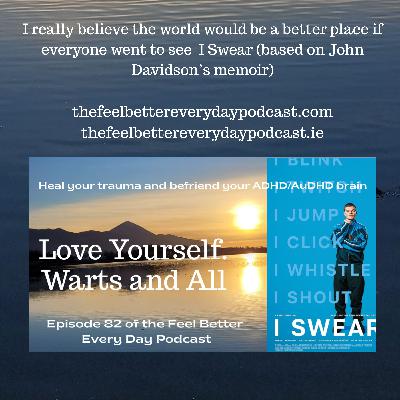
Love Yourself. Warts and All. I Swear Inspired Episode
Description
Inspired by the stunning film “I Swear” about living with Tourette’s, this episode explores why self-compassion is so difficult, especially with trauma, ADHD and AuDHD (autism and ADHD). Discover how acceptance and love can transform shame into advocacy, and learn practical ways to be gentler with yourself.
Using my Feel. Love. Heal framework, I (trauma therapist, ADHDer, only recently recognised AuDHDer - brand new emotional rollercoaster - senior accredited supervisor, Self care coach, author and columnist, Eve Menezes Cunningham) share some self-care ideas the film inspired. You deserve the same compassion you give others.
Is the Feel Better Every Day Podcast helping you? Please leave a ***** rating and review for this and other episodes you’ve enjoyed. Your sharing, subscribing, feedback and support helps me help more people (of all genders) with trauma histories and ADHD or AuDHD (autism and ADHD). You learning to take better care of yourself isn’t just good for you – it creates a ripple effect and helps others. My ultimate dream, in a world in which SO much is coming up for healing and so many people are unsafe, is to do my part to help as many people as possible heal from trauma. To help create a world in which everyone everywhere feels safe, welcome and loved - able to thrive.
CHAPTERS
0:00 Why it’s so hard to have compassion for ourselves
1:10 Understanding ourselves through trauma and neurodivergence
5:11 Using the Feel. Love. Heal. framework
10:25 Learning to help ourselves heal
14:18 Creating a world where everyone feels safe and loved
18:22 Healing through connection and community
21:11 The ripple effect of healing and hope
RESOURCES
Cattitude: Purr! Hiss! Freeze! Episode 48 of The Feel Better Every Day Podcast
Be More Cat: Episode 70 of the Feel Better Every Day Podcast
Shadow Work with Black Cats and Sharks: Episode 71 of the Feel Better Every Day Podcast
https://selfcarecoaching.net/2023/08/07/cattitude-familiars-and-polyvagal-theory/
https://selfcarecoaching.net/2022/10/19/cattitude-life-lessons-from-my-first-9-years-on-earth/
https://selfcarecoaching.net/feline/
https://selfcarecoaching.net/2021/02/17/bring-more-cattitude-to-the-way-you-move/
https://selfcarecoaching.net/2019/09/30/cat-coaching-for-self-care-3-cattitude/
FULL TRANSCRIPT
Why is it so hard to have the kind of compassion and empathy and understanding we so often find so easy to direct towards anyone else, towards ourselves, especially with trauma histories, with ADHD, with ADHD, with autism? Why?
This episode, 82 of the Feel Better Every Day Podcast is inspired by the phenomenal film I Swear, based on John Davidson’s memoir about living with Tourette’s and becoming an advocate. I hope you enjoy it.
Hi, you’re listening to the Feel Better Every Day Podcast.
I’m your host and producer, Eve Menezes Cunningham. I’m a trauma therapist, trauma survivor, ADHDer. Now I’ve heard about the AuDHD, learning more about the autism, that the ADHD medication, it’s a learning curve. It’s a lot. And it’s also helpful, the more we understand ourselves, the better.
I’m a self-care coach, senior accredited supervisor, author, columnist, you can access more information about the Sole to Soul Circle, the book, full show notes and transcripts and links at selfcarecoaching.net and also thefeelbettereverydaypodcast.com. You can listen wherever you get your podcasts.
I release new episodes every Tuesday, helping people with trauma, ADHD and AuDHD, take better care of yourself, create a life you don’t need to retreat from and help create a world in which everyone feels safe, welcome and loved, able to thrive.
And again, back to this amazing film, it’s just so phenomenal. I recognised an enormous, so sorry, I’ve just skipped ahead an enormous amount. I Swear, I’m recording it, it’s out in cinemas at the moment in Ireland. It might be out on one of the streaming services or still in the cinema by the time you see this in a few weeks. His memoir is available, John Davidson.
I sobbed, I howled with laughter, I was shouting at the TV, not the TV, the big screen. It was amazing. I had to leave the cinema at one point and I wanted to leave at other points with the brutality of what he was having to deal with.
And the film shows this young, confident football enthusiast lad starting high school and then developing Tourette’s. So you see him go from confident and like asking a girl out on his first day of school and being like told that a scout is going to watch the football game and then he begins to develop the tics and the outbursts.
I recognised a lot of the impulsivity and self-loathing and also the enormous potential for healing through compassion. But seeing it on the big screen, so visible, so desperate to just give him an enormous hug and move him away from all that pain, that kind of wishing that everyone could see this film and have more compassion for themselves and the differences they struggle with, whether to do with Tourette’s or any kind of physical or mental condition or emotional or any kind of difference.
Like you think about the way people are othering immigrants, refugees, people from other backgrounds, all sorts of gender. It’s incredible how this young man was able to turn so much pain into advocacy for so many people who needed that support and that understanding.
And through doing that, he found more for himself. It’s beautiful, beautiful, beautiful. I wasn’t the only one sobbing in the cinema. And I think it’s, I can’t remember the last time a film ended and everyone just sat there. And one of the people I’ve been telling, watch this film, said, now when you do the podcast, don’t give the ending away, don’t give too much away. So I’m going to try and avoid spoilers.
But it’s based on his true story. We know he survives. We know he wrote a memoir.
We know he told the Queen to fuck off when he got to meet the Queen. They’re not spoilers. They’re all from the very beginning.
Using the Feel. Love. Heal. framework to move through some of the lessons from, I Swear, this gorgeous, gorgeous film. The Feel element of the framework I developed, it’s very much about the active self-care when you have the bandwidth to do things, to help yourself regulate, to help yourself feel better. And he got to the stage where he was able to research Tourette’s as someone with the lived condition.
But it took a long time for him to get there because unfortunately, when the symptoms appeared, his parents were not in a place where they could support him. Instead, they contributed to the shame and the pain and the horror of his young life, which he tried to end at a very early age. And luckily, he survived.
And also, very luckily, when he was a bit older, he meets the friend’s mother, an old school friend’s mother, who they all think is dying and she has six months to live. He kind of has an outburst saying something like, “Ha ha, you’re going to die!” something deeply inappropriate.
It was laugh out loud. It was so funny in parts, and so horrendous, and so relatable in so many ways, because all of us have shame, have fear, have embarrassment, have things we worry about being too much, saying too much, moving weirdly, all sorts of things. He had no control over it. And he learned to live with it.
He learned to advocate for others. But that was through his friend’s mother being the first person really to see him and to accept him and to help him begin to understand himself and come off the horrendous medication and work with life, stop arguing with reality, like kind of they all made mistakes, like everyone’s human. But her attitude, so accepting, so loving, it kind of takes me then to the love element of the framework.
But she was active. It was very active, her inviting this stranger into her home, telling her husband and her son, who was his friend, that she had invited him to stay. She recognised that things were tough for him at his home.
And her argument for doing so much to help him was she only had six months to live. He begins to find acceptance through, for the first time in his life, being accepted, being told to not apologise for anything he can’t help. And he’s had a lifetime of brutal, brutal punishments for things he can’t help, which, of course, we know would trigger a stress response, which would make it much more likely that these outbursts, that these tics would become more amplified, because he’s then terrified.
He’s in a sympathetic survival response, “Hiss!” in terms of the Cattitude [Polyvagal Purrs] way of explaining polyvagal theory. You can find links to the episodes around that in the show notes. It’s so obvious that, had the grown-ups, even not understanding about Tourette’s, just having a bit more care and compassion for a young boy in pain, how different his life could have been, and how he’s able to recognise that he might not have done any differently if he’d been in one of the different positions.
I’m a little bit all over the place. I’ve been so excited about sharing this film rec








 United States
