


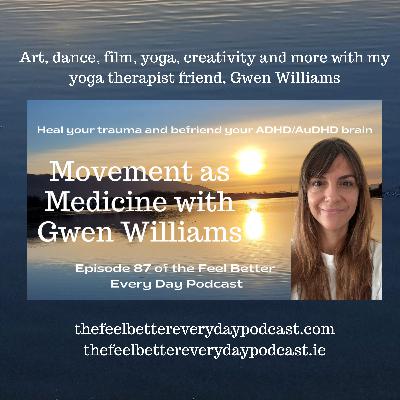
Movement as Medicine with Gwen Williams: Episode 87 of the Feel Better Every Day Podcast
Description
Get your free weekly journal prompts and more here
Watch here or listen here or wherever you get your podcasts
Dance movement psychotherapist Gwen Williams joins me (trauma therapist, AuDHDer, senior accredited supervisor, coach, author and columnist etc, Eve) to discuss how she combines yoga therapy, dance, art, and psychotherapy to help people reconnect with their bodies and heal.
Gwen shares her journey from yoga therapy training (while pregnant!) to completing her MA in dance movement psychotherapy, plus her exhibition “Reclaiming the Wild Body.” She offers practical insights on movement practices for ADHD and neurodivergent brains, explaining why gentle, slow practices work best when your mind moves at a million miles an hour.
Perfect for anyone interested in somatic healing, trauma recovery, creative therapy, or finding movement practices that actually work for neurodivergent nervous systems.
Find Gwen: Website: gwen-williams.com Instagram: @movement_art_therapy
Topics covered: ADHD, dance movement psychotherapy, yoga therapy, somatic practices, neurodiversity, creative healing, embodiment
le grá (with love),
Eve
Chapters
(0:00 ) Introduction to Gwen Williams
(0:53 ) Reconnecting after yoga therapy training 14 years ago
(2:09 ) Gwen’s evolving body-based and creative work
(3:57 ) Reclaiming the Wild Body exhibition
(5:12 ) Neurodiversity, ADHD and creative practice
(7:14 ) Where to find Gwen online
(7:48 ) Exploring Eve’s Feel. Love. Heal. framework
(9:22 ) Gwen’s essential Feel self-care
(11:05 ) Ideal and essential Love Self care
(14:49 ) Designing life around slower somatic practice
(16:22 ) Heal collective care: community, dance and co-regulation
(18:03 ) Reclaiming the Wild Body workshops
(19:20 ) Earth body, social body and transpersonal body
(21:02 ) Vegan chat and episode planning
(22:57 ) Where to find Gwen (recap)
(23:23 ) Closing credits and resources
FULL TRANSCRIPT
Welcome to episode 87 of the Feel Better Every Day Podcast. Today’s guest is the delightful Gwen Williams. We trained together as yoga therapists for mental health and it was so lovely to catch up with her for this episode and reconnect.
She’s since become a psychotherapist and she is combining art and her psychotherapy and yoga and movement and just all around delightfulness. If you’re in Bristol check her out and online obviously also you can gain a lot from her amazing presence in the world. I hope you enjoy the episode and let me know how you get on.
Welcome Gwen, thank you so much for joining me. Thank you for having me Eve, it’s really nice to be here. It’s so funny because I met you like we used to sit together a lot in the yoga therapy training we did with the Minded Institute and you were pregnant at the time and you like I couldn’t believe that I was struggling because it was a lot.
It was amazing but it was a lot and there you were and now finding out how old your son your first son is it’s like wow like you say it’s a huge mark of time but yeah it’s gorgeous seeing what you’ve been doing with the work and how it’s evolved for you and it looks so beautiful in the video. Do you want to say a little bit more about how it has evolved for you, where people can find you?
Yeah thank you, yeah so it’s lovely to reconnect with you and yeah it was it was about it was like 13 or 14 years ago that we were doing that training together. So yeah so that training in yoga therapy with the Minded Institute, yeah so I suppose that’s been part of an ongoing process for me of exploring, training, sharing different body and movement based work.
So after that I did some training in Focusing so we’re kind of bodied, lovely, gorgeous, embodied, practised and in women’s health and then in dance I trained as a dance movement psychotherapist so I did an MA in that which I completed about a year and a bit ago.
Congratulations.
Yeah thank you and that was a very big big chunky training to do so all these things I kind of bring together now in a way of working with people that’s very much focused on the body, focused on movement, focused on the somatic experience of our body, of what’s happening for us in movement and in response to our lives and our emotions and what’s going on in the world.
And I also have been yeah reclaiming my own creative practice because my background years ago was in fine arts and then in cultural and media studies so lots of the work I’ve been doing that was part of my MA and then going forward has been working with creative practice through I suppose what you could broadly call performance art or movement and film based work.
And you had an exhibition? I had an exhibition yes I had so I had an exhibition in January in central Bristol in an amazing gallery called Centre Space Gallery which is a gorgeous place and that was an exhibition that showcased this body of art space research that I’d done I’d been exploring for probably about seven years in different forms and then it became the focus of my final year of my master’s in dance movement psychotherapy where I got to do this piece of art space research which was called Reclaiming the Wild Body and that was heuristic.
It was sort of very much my exploration my own process in this and then I felt like OK I’ve got to bring this work out into a public space so had this exhibition which was an amazing experience and then as part of that had a movement lab with an amazing multi-instrumentalist so we brought other people in I brought other people into it and we explored and now that’s become a piece of workshops that’s happening right now.
Multi-talented, multi-passionate and it’s obvious that you’re waiting for an ADHD diagnosis like kind of with hindsight with what we know.
Yeah yeah yeah so as I was mentioning I’ve been on the waiting list for about four years for an ADHD diagnosis pretty sure I fit that model and often have multiple threads in different things going on that sort of all link together but often doing lots of things at once yeah yeah some diversity in the picture.
And I think that I know for me understanding oh it’s a differently wired brain it really has helped and continues to help me honour that more rather than oh I shouldn’t be or I should be or all of that.
Yeah absolutely yeah I think my own process with understanding neurodiversity and knowing I’ve been dyslexic my whole life and going and doing well actually when I did my degree it felt like quite a big deal when I did my Master’s it felt like quite a big deal and yeah shake off some ideas I had about what I was good at. And I actually did really well, amazingly, in my in the writing aspect which was a surprise because sometimes I’m like a thousand million ideas and I want to get all in and it can end up feeling a bit chaotic but wonderful.
Yeah it’s been really helpful to kind of understand a bit more about ADHD and be like, OK this is just how I this is kind of the way my brain works and there’s not something wrong with me. No what it is what I do but I think that’s what I think is really helpful in this growing interest in neurodiversity and I ADHD brain I’m not sure if you mentioned your website or website or Instagram I did yeah so my website is gwen-williams.com so you can find on there about my work that I do with groups one-to-ones and a little bit about my creative work and then my Instagram is at movement_art_therapy
Wonderful yeah and we were talking a bit about how I’ll be asking about your ideal and actual self-care so I work with the Feel. Love. Heal. framework I developed and the Feel bit is the more regulatory lowercase self-care the Love is the the uppercase s Self-care like connecting with your miraculous highest wisest wildest truest self and remembering that we’re all part of the divine remembering that we’re already whole no matter what we’ve survived whatever challenges we’re facing and then the Heal bit is the collective self-care the co-regulation.
It might be spaces you hold for others but also very much how you allow yourself to be held and to heal. If I start with the feel what would stand out as an ideal self-care and the essential for you?
I love this model. Great. It’s really nice breaking it down into these three parts so I’d say the kind of Feel yeah so the so the kind of yeah as we were saying sort of the I don’t want to call them basic self-care because they can be challenging and different circumstances but for me I guess I’m sort of eating relatively healthy food whilst also not denying myself any particular foods. But healthy foods fairly regularly. Getting hopefully just about enough sleep and having time I’ve got a little pooch who’s just sat here on the sofa next to me so walking out I’m very lucky to live in a city but one where there’s lots of nature around and woods and fields and a river. So being outside for a good part of the day and also just having time with my boys who are now teenage and tween age and maybe even sneaking in some cuddles with them in front of a good tv series we’re all watching and having some walks and time with my family.
Wonderful yeah they make a lot of self-care wonderful and I’m remember




 United States
