



Obesity Causes and Solutions
Description
STORY AT-A-GLANCE
Obesity is not just about eating too much — it develops when your cells cannot burn oxygen and fuel efficiently, leading to fat storage even at normal calorie intake
Polyunsaturated fats in vegetable oils slow down your metabolism, mimic hibernation signals, and make your body store fat instead of using it for energy
Stress hormones like cortisol and estrogen push your body further into fat storage, lowering energy, mood, and reproductive function
Choosing saturated fats, whole-food carbs, and simple movement helps restore your ability to burn both fat and carbohydrates effectively
Cutting vegetable oils and supporting cellular energy gives you a clear path to sustainable weight loss and higher daily energy

Obesity is one of the most visible health crises in the world, and it’s far more than just a cosmetic concern. It’s defined as excessive body fat that raises the risk for Type 2 diabetes, cardiovascular disease, fatty liver disease, sleep apnea, and even certain cancers. Symptoms often include fatigue, shortness of breath, joint pain, and metabolic issues that worsen over time. Left untreated, obesity shortens lifespan and slashes quality of life.
Globally, an estimated 1 billion men and 1.11 billion women were classified as overweight or obese as of 2021, with over 3.8 billion adults projected to be overweight or obese by 2050.1 That makes obesity one of the central drivers of declining life expectancy. Every year, millions of people attempt weight-loss programs built on the idea that eating less and moving more is the simple solution. Yet, long-term data reveal that most regain the lost weight, leaving them discouraged and metabolically worse off.
That failure points to a deeper problem than calorie math. Researchers like Brad Marshall, a molecular biologist known for his work at Fire in a Bottle, and bioenergetic researcher Georgi Dinkov have been arguing that obesity stems from cellular energy imbalances. They focus on reductive stress, a condition in which your mitochondria — the tiny energy factories in your cells — struggle to burn oxygen efficiently.
When your cells cannot fully burn food for energy, the result is fat accumulation, lowered metabolic rate, and widespread dysfunction. Shifting the conversation away from willpower and toward cellular energy offers a different lens on obesity. This perspective suggests that the fats and fuels you eat directly change how your body manages energy and redefines obesity solutions.
Experts Link Obesity to Cellular Energy Failure
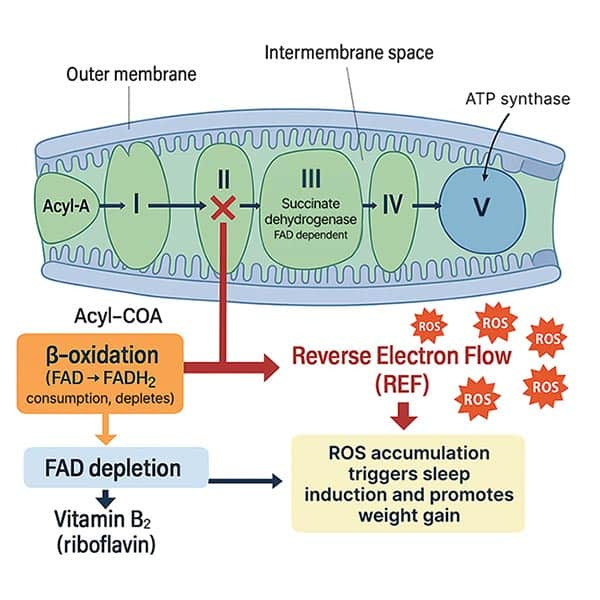
When your cells rely too heavily on burning fat for energy, especially under stress, it backfires. Breaking down fat uses up vitamin B2 (riboflavin), which is needed to keep one of the mitochondria’s key energy complexes (Complex II) running smoothly. Once that helper is depleted, electrons begin flowing backward in a process scientists call “reverse electron flow.” Instead of producing clean energy, this backflow generates a flood of reactive oxygen species (ROS).2
Your body reads the buildup of ROS as a stress signal. To protect itself, it lowers your metabolic rate and shifts into fat-storing mode. In other words, excessive fat burning doesn’t always help you slim down — in some cases it encourages your body to gain weight.
In a video discussion hosted by David Gornoski, Dinkov and Marshall explained why obesity is less about overeating and more about broken energy metabolism.3 They argued that your body stores fat when its cells fail to properly burn oxygen and fuel. This view challenges the standard “calories in, calories out” model that dominates mainstream advice.
The experts drew from personal and professional experience — Marshall explained that his own struggles with weight led him into mitochondrial science and how cells use fuel. Dinkov, with a background in computer science and bioinformatics, became fascinated by biochemistry and metabolism after years of self-directed study. Their conversation aimed to help people understand why conventional approaches like calorie restriction and keto diets often fail long term.
The focus shifted to the role of polyunsaturated fats (PUFs) — According to Marshall, “when you consume PUF [such as linoleic acid (LA) in vegetable oils] ... it doesn’t burn as much oxygen, it doesn’t create as much reactive oxygen species.” In simple terms, PUF-rich vegetable oils such as soybean and canola reduce your cell’s ability to burn fuel efficiently. This incomplete burning leaves a buildup of unused energy, which your body then stores as fat.
How this process creates reductive stress — Reductive stress means your cells have too much stored energy and not enough oxygen use to process it. In this state, certain key enzymes shut down, blocking carbohydrate burning. At the same time, fats are also left partially burned, leaving you stuck in a low-energy, fat-storing mode. Marshall described this as the body’s “switch” that favors fat-making when it senses an energy backlog.
PUF signals mimic hibernation in animals — Dinkov pointed out that squirrels and bears load up on PUF before winter because it lowers body temperature, slows brain and reproductive function, and helps them enter a torpid state, meaning their body slows down into a low-energy, semi-hibernation mode.
<label class="hide-text" contenteditable="false">Text within this block will maintain its original spacing when published</label>Human studies show similar effects: excess PUF lowers metabolic rate, making you tired, cold, and prone to storing fat. As Dinkov explained, “You will actually gain weight because your metabolic rate will drop.”
The hormonal side of the story — Estrogen, usually thought of as a female hormone, is a stress hormone that swells cells with water and


 United States
