


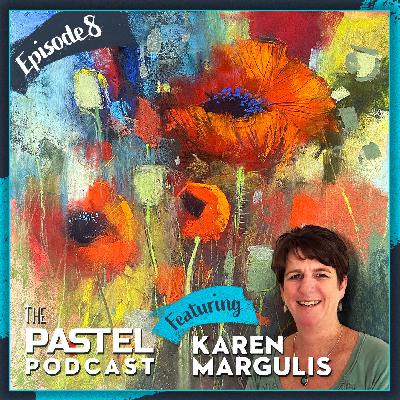
Pastel Podcast Episode 8: Karen Margulis
Description
Pastel Podcast Episode 8: Karen Margulis
Karen Margulis began painting again in her 40s and quickly found her voice in pastel. Two decades later she is a Master Pastelist and an inspiring teacher who simplifies complex ideas into techniques any painter can adopt. Her work is known for bold color, expressive underpaintings, and a balance between delicate layers and confident strokes.
From a one-day workshop to a daily practice
A single pastel workshop changed Karen's direction. After trying watercolor briefly, she fell in love with the tactile immediacy of pastels. Pastel allowed her to paint in short bursts, clean up quickly, and get hands-on without the fuss of brushes and solvents. That accessibility helped make regular practice possible, even around family and other commitments.
Why underpainting matters
Underpainting or block in is central to Karen's process. She begins with the whole composition laid out, using value and sometimes color to establish a foundation. That big-picture approach prevents getting lost in detail too early and keeps the painting painterly and cohesive.
When she discovered alcohol washes, the effect was transformational. An alcohol wash creates a wet underpainting that suggests shapes, values, and unexpected drips to respond to. For Karen it removed the intimidation of a white surface and gave an immediate, engaging base to paint on.
Practical approach to underpaintings
- Start with a value-based block in so the composition reads at a glance.
- Use a deliberate, expressive brush hand when making the underpainting; think of it as a creative layer, not just primer.
- Experiment with color choices. There is no single correct underpainting color; different choices yield different moods and depths.
Texture: how to get physical depth with pastel
Pastel does not naturally give the thick impasto of oils, so Karen uses what is underneath to create texture. Clear gesso adds grit and a sanded surface, perfect when you want physical texture for grasses and rough foregrounds. When painting outdoors, she pares down her kit and adapts materials to the scene at hand.
Tools Karen relies on
- Clear gesso for added tooth and texture
- Bamboo skewers (for scraping, carving, and making thicker marks)
- Palette knife for applying gesso or scraping back
- Pipe insulation for fast, soft block ins
Whispering versus shouting: the right touch
Karen talks about mark making as whispering or shouting. Whispering means a light, feathered touch that leaves layers visible for optical blending. Shouting is pressing hard for a final, bold stroke. Both have their place, but the order matters. Whisper long, then shout when you need clarity and emphasis.
"The light touch is the right touch."
Her rule of thumb is simple: if you can still see the color or paper underneath, you are whispering. If the mark becomes a solid, opaque layer that hides everything beneath, you have shouted. Whispering creates options and helps avoid muddy neutrals.
Optical blending and avoiding mud
Optical blending happens when the eye combines colors placed next to or on top of each other rather than physically mixing them together. Use a light touch and build layers so pigments vibrate together. Pressing too hard blends physically and can neutralize color into mud.
How to practice optical blending
- Lay down two or three light layers of closely related colors without pressing hard.
- Step back and let your eye mix the colors from a small distance.
- Reserve strong, opaque strokes for accents that anchor the composition.
To blend or not to blend
Blending has a place. Karen blends when she wants calm skies or softer transitions, but she blends sparingly and with a light touch. Using fingertips or gentle tools only, she knits layers without flattening pigment luminosity.
Pipe insulation makes an excellent fast blender for initial block ins. Karen uses it for the first layer to quickly push everything out of focus when plein air painting. After multiple layers, however, she sets the tool aside because aggressive blending at that stage tends to muddy the surface.
Plein air packing: less is more
For location work Karen pared down her kit to a compact pochade box and a focused selection of sticks. Her approach when packing for plein air:
- Think value range first: colorful darks, colorful lights, and middle values.
- Bring neutrals and a few vibrant accents rather than trying to bring every color.
- Tweak the selection for the scene. More greens for mountains, more ochres for deserts.
If the value is right you can often make color choices work. Carry fewer sticks and rely on layering and optical mixing to expand your palette on the paper.
Surfaces and papers: match the paper to the job
Different papers behave differently. Sandy papers take many layers and can accept wet underpaintings. Smooth papers need different approaches. Karen recommends giving a new paper more than one trial; explore different techniques before discarding it.
Some practical guidance:
- Use sanded or gritty surfaces for heavy layering and texture.
- Try clear gesso on smoother sheets when you want to add tooth and brushwork texture.
- Test specialty papers, such as iridescent or lightly colored sheets, for one or two paintings to discover their strengths.
Teaching, community, and a practice that sticks
Karen believes teaching and making go hand in hand. She often chooses lesson topics that match what she wants to explore personally, so the work stays fun and meaningful. Sharing discoveries with other artists helps deepen understanding and keeps practice consistent.
Her single best tip for progress is also the simplest: paint often. Even short, timed pieces force decision making and improve skill faster than waiting for the perfect long session.
"Paint as often as you can. Set a timer for 20 minutes and just put pastel to paper."
Quick practice checklist
- Set a daily or weekly small-painting goal, even 20 minutes.
- Start each piece with a whole-surface underpainting or block in.
- Keep a light touch for layers and save strong strokes for final emphasis.
- Experiment with one new paper, tool, or texture method each month.
- Pack a pared-down plein air kit focused on values rather than every hue.
Final thoughts
Pastel painting is equal parts intuition and craft. Develop a reliable underpainting habit, learn the difference between whispering and shouting marks, and make practice non negotiable. Over time those tiny choices add up into bold, luminous work that reads with clarity and heart.
Make a mark, leave a little dust, and enjoy the process of discovering how many voices pastels can have.
Related Links from this episode of the Pastel Podcast:





 United States
