


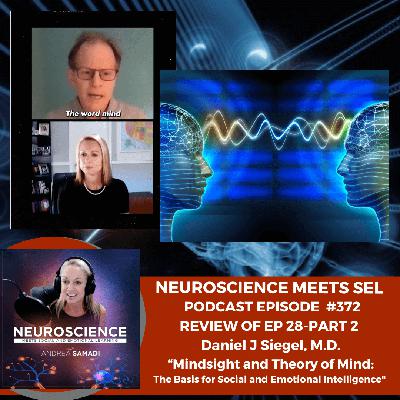
Review of Daniel J Siegel MD's Mindsight PART 1: Become the Captain of Your Own Mind
Description
In this episode Andrea revisits her 2019 conversation with Dr. Daniel J. Siegel to explore Mindsight — his science-based approach to understanding the mind, integrating the brain, and cultivating empathy. Dr. Siegel explains the difference between mind and brain, the benefits of the Wheel of Awareness meditation, and how Mindsight can change brain structure and improve health.
Watch full interview here https://www.youtube.com/watch?v=d7pnea2Vbzc
Practical tips include daily Mindsight practice, naming emotions to build self-awareness, and simple emotional check-ins to make learning and relationships more meaningful.
This week, in our review of EP 28 with Daniel J. Siegel, MD and his book Mindsight, we learned:
✔ The Difference Between the Mind and the Brain.
✔ The Benefits of The Wheel of Awareness Meditation.
✔ How to Understand and Apply Mindsight that gives us insight into ourselves, and empathy for others.
✔ How Mindsight can change brain structure and improve health.
✔ In order to make teaching and learning more meaningful, what we are teaching must have an element of emotion.
Welcome back to SEASON 14 of The Neuroscience Meets Social and Emotional Learning Podcast, where we connect the science-based evidence behind social and emotional learning and emotional intelligence training for improved well-being, achievement, productivity and results—using what I saw as the missing link (since we weren’t taught this when we were growing up in school), the application of practical neuroscience.
I’m Andrea Samadi, and seven years ago, launched this podcast with a question I had never truly asked myself before: (and that is) If productivity and results matter to us—and they do now more than ever—how exactly are we using our brain to make them happen?
Most of us were never taught how to apply neuroscience to improve productivity, results, or well-being. About a decade ago, I became fascinated by the mind-brain-results connection—and how science can be applied to our everyday lives.
That’s why I’ve made it my mission to bring you the world’s top experts—so together, we can explore the intersection of science and social-emotional learning. We’ll break down complex ideas and turn them into practical strategies we can use every day for predictable, science-backed results.
Episode 371:
For today’s Episode 371, we continue our journey into the mind with the next interview review. Just a reminder-this review series began back with Episode 366[i], where in Part 3 we discovered an important lesson: if we don’t like our results—or what we see on the outside—we need to shift our mindset and look within. True change always begins on the inside.
EP 369[ii] we learned how to Rewire our Brain with Dr. Dawson Church and his Bliss Brain Meditations, and then last week, EP 370[iii] with John Medina’s Brain Rules, we reviewed how important this understanding of neuroscience is, especially connected to education, teaching and learning.
Which brings us to today’s review, EP 371, where we revisit a very early episode with clinical professor of psychiatry from UCLA’s School of Medicine, Dr. Daniel J Siegel. He’s from EP 28[iv], that was recorded back in November of 2019. As we take this journey deeper into the mind, Dr. Dan Siegel offers the perfect place to begin, with his ability to bridge cutting-edge neuroscience and practical wisdom.
Dr. Dan Siegel, is well known for his books, trainings and courses that bridge cutting edge neuroscience with mindfulness and therapy. A reminder of his background-he’s a clinical professor of psychiatry at the UCLA School of Medicine and executive director of the Mindsight Institute[v] where you can find his courses, workshops, books and tools to help anyone understand and apply what can sometimes be complicated scientific concepts and make them easy to understand and applicable to our daily lives. At the end of the interview, I let Dr. Siegel know that I had been practicing his Wheel of Awareness Meditation, and ended up reviewing what I learned on EP 60[vi] where we explored the Science Behind a Meditation Practice.
You can watch the whole interview by clicking on the link in the resource section in the show notes, and learn all about Dr. Siegel’s work that encompasses schools, with resiliency, brain science and helping our next generation to understand how to apply these important strategies whether it’s in our classrooms, or workplaces of the future. Today we will continue to explore within, sharpen our mindset, and learn about what Dr. Siegel calls Mindsight.
In Clip 1, Dr. Siegel unpacks the concept of Mindsight and helps clarify the difference between the mind and the brain, when I asked him to explain this distinction. I knew this wasn’t an easy question—as I had already listened to him answer it many times over the years, and still wasn’t sure I fully grasped it. In fact, I even tried to tackle it myself back in Episode 23[vii], Understanding Your Brain and Mind for Increased Results. But revisiting this topic now, I can see this concept requires a much deeper reflection.
So, I asked Dr. Siegel if we could look at his definition of the mind—one he has been studying for years and that many in his scientific and educational circles agree on. He describes the mind as “an embodied and relational process—since it’s in the body and it’s in our relationships with one another—that regulates the flow of energy and information.” I wanted to hear him expand on this again, especially around why relationships are so critical for our health, our well-being, and for creating what he calls an integrated brain—which he equates with a healthy brain.
His answer helped me to understand the importance of implementing Mindsight into our daily life. He said:
“The word mind doesn’t actually have a formal definition—not in education, psychotherapy, or even in fields like psychology that study it directly. But if we look closely, the mind includes your subjective experience—that inner feeling of being alive. It also includes consciousness—the ability to know that you’re having that subjective experience. And beyond that, there’s information processing—which doesn’t always require consciousness and is essentially what school focuses on: learning to process information.
When you understand the mind as a self-organizing process—a complex system that regulates its own becoming—you begin to see the power of teaching about the mind itself. This is what we call Mindsight. And if we could bring this understanding into education, the outcomes for students would be profoundly different.”
Key Tip 1 with Dr. Dan Siegel
Understanding and Applying Mindsight which is “the way we focus our attention on the internal world. It’s how we bring consciousness to our own thoughts and feelings, and then next, how we attune to the inner world of someone else. Mindsight gives us insight into ourselves, and empathy for others.”
💡 If we could bring the concept of Mindsight—focusing attention on the internal world—into education, (or teaching and learning anything) the outcomes for our students would be profoundly different. They would not only learn academic content, (or whatever skill we are teaching) but also how to understand their own subjective experiences and expand their consciousness.
Just as we’ve seen that true change begins by going within, Dr. Siegel shows us that teaching and learning follow the same principle. Mindsight (going within to understand ourselves first, and then extending this understanding to others cultivating empathy) invites us to go deeper with ourselves through self-study, and Dr. Siegel reminds us that clarity emerges when we are willing to take that deeper dive.
He describes Mindsight[viii] as “the way we focus our attention on the internal world. It’s how we bring consciousness to our own thoughts and feelings, and how we attune to the inner world of someone else. Mindsight gives us insight into ourselves, and empathy for others.”
Importantly, Dr. Siegel explains that Mindsight is more than simply observing—it equips us with the tools to monitor our inner world with clarity and depth, and also to modify it with strength and intention. While mindfulness centers on awareness, Mindsight adds an empowering, action-oriented dimension: the ability to change the structure and function of the brain itself.
With Mindsight, we can literally alter the course of our lives by integrating areas of the brain that were previously disconnected. When we monitor our inner world, we can shift it from chaos toward harmony—moving our mind toward health. That’s the true power of Mindsight.
It’s a way of awakening the mind to the fact that you aren’t a PASSIVE participant of life, but you can become the ACTIVE participant, the Captain of your own ship, he says. This way, you become the author of your own story, of your life.
Which brings us back to EP 366, where we looked at the question “What do you REALLY want to do with your life.” Do you REALLY believe what you want is possible? Dan Siegel, with his research grounded in science, would say it most definitely is possible with the use of Mindsight.
I highly recommend Dr




 United States
