


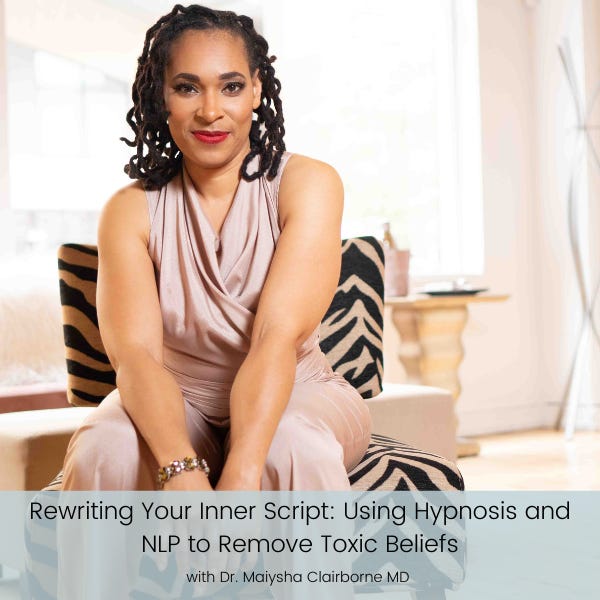
Rewriting Your Inner Script: Using Hypnosis and NLP to Remove Toxic Beliefs | Episode 40
Description
Dr. Maiysha Clairborne is an Integrative Family Physician, Master Practitioner & Trainer of Neurolinguistic Programming (NLP), Hypnosis & Time Line Therapy®, & founder of the Mind Re-Mapping Academy. Through her live trainings, Dr. Clairborne teaches individuals and organizations thought and communication mastery helping leader eliminate negative thinking, faulty beliefs, and emotional trauma, while also teaching them to be trauma responsive in their own communication.
Dr. Maiysha specializes in trauma informed communication teaching her clients the power of word, and how our unconscious thoughts and beliefs have an impact on the reality we create. Her trainings combine the mastery of emotional and communication intelligence, teaching leaders that by mastering their language (both internal and external) they can not only be conscious but also responsible for the impact of their words, actions, and behaviors. This ultimately helps them to communicate in a way that transforms creating new connections and outcomes that positively impact the people, community & organizations around them.
This episode we discuss
❤️🩹Why it’s so difficult to let go of beliefs we picked up early in life
❤️🩹How hypnosis and NLP (Neuro-linguistic programming) can be utilized to shift stubborn beliefs
❤️🩹Creating a sustainable/healthy relationship with anger
Episode Resources
http://www.mindremappingacademy.com
Dr. Clairborne’s Podcast Black Mind Garden
Episode edited and produced by Unapologetic Amplified
This transcript was generated with the help of AI.
Have you ever wondered why almost all the health and wellness information you see out there is so white, cis able-bodied and het? I know I have. And as a queer black registered dietitian, I gotta tell you, I'm not into it. I believe health and happiness should be accessible to everyone. That is precisely why I wrote Decolonizing Wellness: A QTBIPOC-Centered Guide to Escape the Diet Trap, Heal Your Self-Image, and Achieve Body Liberation and why I host Body Liberation for All.
The road to health and happiness has a couple of extra steps for chronically stressed people, like queer folks and folks of color. But don't worry, my guests and I have got you covered. If you're ready to live the most fierce, liberated, and joyful version of your life, you are in the right place.
Body Liberation for All Theme
They might try to put you in a box, tell them that you don't accept when the world is tripping out tell them that you love yourself. Hey, Hey, smile on them. Live your life just like you like it
It’s your party negativity is not invited. For my queer folks, for my trans, people of color, let your voice be heard. Look in the mirror and say that it's time to put me first. You were born to win. Head up high with confidence. This show is for everyone. So, I thank you for tuning in. Let's go.
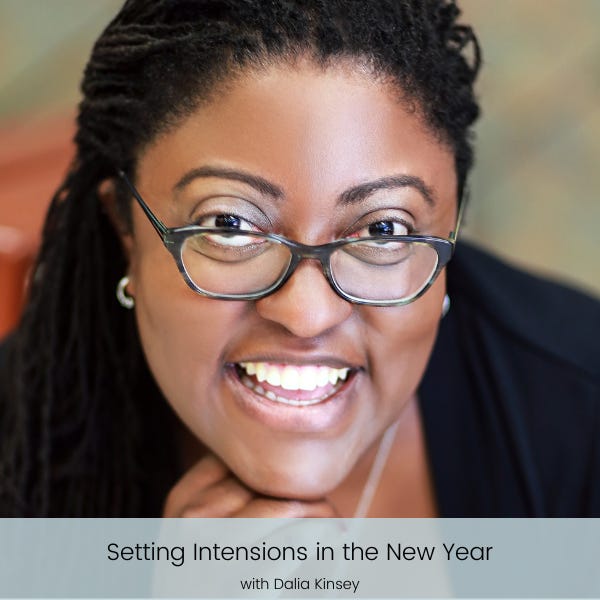
Dalia Kinsey: I am so excited to have you here. Thanks for taking out the time to join us.
Dr. Maiysha Claiborne: I am so excited. We've talked offline. This is a long time coming.
Dalia Kinsey: Yeah. It's no joke where you're trying to navigate multiple commitments, I think this is a fairly universal marginalized experience in the states, we may be out here doing big things, but we're also working, raising kids, doing all the things, taking care of people it can be hard to get things on the calendar. But when it's time, it all falls into place.
Dr. Maiysha Claiborne: It does. Well, thank you so much for having me. I'm excited to be having this conversation with you.
Dalia Kinsey: I really wanted to have you on because of your background as a physician, an MD and as someone who uses hypnotherapy to help people, because I've seen so many things out there that make it look like maybe hypnotherapy is a useful tool, maybe not.
Since it's not regulated in the US it seems like it's one of those things, and I think this happens with anything that's not regulated, unfortunately, sometimes really loud people who use the tool are clearly just kind of bootleg running their operation by the seat of their pants, not really together. And so it makes people perceive the tool itself as less credible.
So to see an MD using hypnotherapy was very interesting to me because we all know if you are a marginalized person, you probably have a lot of deep-seated beliefs that you would like to shake, that you maybe have not been able to figure out how to get rid of so if hypnotherapy is real, we really need to know.
So can you tell us a little bit about what drew you to medicine in the first place, and when you felt interested in bringing in hypnotherapy? How did you realize that it could be useful?
Dr. Maiysha Claiborne: Absolutely. I love that you said we have a lot of deep-seated beliefs. What I'll talk about, you know, at some point is the deep-seated beliefs that we also have about these types of disciplines, the deep-seated beliefs that we have about things like hypnotherapy and NLP and why that's the case. So just about me, there wasn't a sentinel event that drew me to medicine. I just decided one day out of an eighth-grade writing assignment that I was going to medical school and it felt sort of random. Although what I'll say is that my dad isn't a retired OBGYN, my mom is a retired dentist, so probably just kind of went into my DNA a little bit and was modeled to me this sort of like passion for caring for others, right. And I'm the oldest child and so I'm naturally a caretaker. So even though I would like to say that I made the decision of my own accord, most likely it was subconsciously, you know, a conversation for many years.
But I think that it really was a natural part of me to really care for people. What drew me to the type of medicine that I practiced, which when I did came out of residency, I'm a family physician by training. Like that's what I trained in after I went to medical school. But I've always been interested in the integrative, the holistic, like how do we go beyond the Western practices of medicine, and pharmaceuticals in order to, to really heal ourselves? And that really started with wanting to understand the mind-body connection. I grew up in a home of domestic violence, witnessing domestic violence. In retrospect, honestly, I think I was a functionally depressed kid, and so I think that that was sort
Dalia Kinsey: Could you say more about that? Because I don't think I've ever heard that term? Yeah. Functionally depressed. What does that mean?
Dr. Maiysha Claiborne: What that means? Thank you for asking me. A lot of times when we think about depression, especially the stigma of depression, and I think this is a lot of times why we deny the experience as, as people of color, as Black people, is that we see depression as, I can't get out of bed.
I, you know, I'm not motivated to do anything at all. I'm crying all the time. I'm, you know, like that sort of thing. But there are some people who live at this sort of low level of sadness, low level of, you know, I'm, I'm just pushing through every day this experience of feeling depressed. , and it may not be connected emotionally, but feeling like a heaviness, but you can get through the day, right?
Dalia Kinsey: Mm-hmm. , that makes sense. No, I thought that was everybody. Is that not everybody?I think I didn't realize until early adulthood and I finally tried an SSRI that worked and did something for me and started talking with other people about their general vibe every day, and I realized like, oh no, everybody else didn't feel like that. Yeah. It's a problem.
Dr. Maiysha Claiborne: It really wasn't until very recently, I mean, I say recently, probably in the last really five to seven years, that I really began to think like, am I experiencing this sort of functional depression? But when I look back and I, when I thought about that, I start looking back on patterns and I'm, and I really think that, you know, there was a lot of, I, I experienced growing up a lot of sadness, a lot of, you know, inner turmoil and I because it was required, you know, at my age, I'll be 48 in April, so I'm of this generation that was raised by baby boomer parents where there wasn't room for being emotional or anything of that nature, holding space for any emotion. It was just pushed through. And so that's what I did most of my life is pushed through, but there was this part of me having witnessed what I witnessed growing up that really wanted to understand like, why?
Why did this person act this way? Why did this, what made him be this way towards my mom? Right? This was a stepfather. I think that's what drove me to major in psychology in college, you know, I took my first psychology class and I was.
You know, hooked to, oh, there's this, what is, what's up with the mind? I took abnormal psych and I thought psychology, and I thought, oh my gosh, this is it. You kno





 United States
