


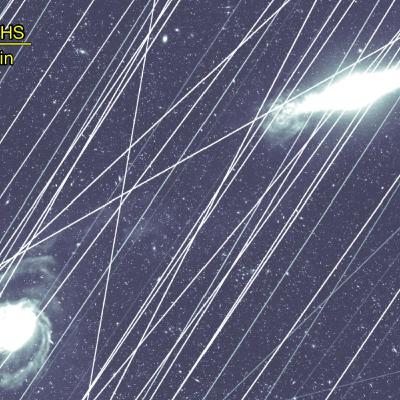
Satellite megaconstellations will threaten space-based astronomy
Description
The rapid expansion of Low Earth Orbit (LEO) satellite megaconstellations is creating a growing threat to space-based astronomy, challenging the long-held perception that space telescopes are immune to light contamination.
If all proposals for new telecommunication satellite launches are fulfilled, projections indicate that Earth could be orbited by **half a million artificial satellites by the end of the 2030s**. Currently, the total number of satellites is only a small fraction (less than 3%) of those planned for the next decade.
This episode delves into a study forecasting the devastating impact of these constellations on vital observatories:
* **Current Impact:** Satellite trails already affect astronomical images across the complete electromagnetic spectrum. A recent study demonstrated that 4.3% of images obtained by the **Hubble Space Telescope** between 2018 and 2021 already contained artificial satellite trails.
* **Future Contamination:** If the planned constellations are completed (approximately 560,000 satellites), light contamination becomes critical for LEO observatories.
* The forecast shows that **more than one-third (39.6% $\pm$ 4.6%) of Hubble Space Telescope images will be contaminated**.
* Newer LEO telescopes, such as the SPHEREx, ARRAKIHS, and Xuntian space telescopes, are predicted to have **more than 96% of their exposures affected**.
* The Xuntian Space Telescope, due to its lower orbit (450 km), will be the most affected, potentially seeing 92 satellite trails per average exposure.
* **Trail Brightness:** Reflections from satellites are extremely bright for professional telescopes. The typical surface brightness of detectable trails is forecasted to range from $\mu = 18$ to $\mu = 23$ mag arcsec⁻². This is orders of magnitude above the detectability limit for these telescopes.
The scientific community is urging action to address this growing threat. Proposed mitigation measures include setting an optimal upper limit for large satellite constellations' orbits, maintaining updated and precise open archives of orbital solutions for active and derelict spacecraft (avoidance), and implementing correction techniques for unwanted light pollution.
***
**Reference to the article discussed:**
Borlaff, A. S., Marcum, P. M. & Howell, S. B. Satellite megaconstellations will threaten space-based astronomy. *Nature*. Published online 3 December 2025.
**DOI:** https://doi.org/10.1038/s41586-025-09759-5
Acknowledements: Podcast prepared with Google/NotebookLM. Illustration credits: Borlaff, A.S., Marcum, P.M. & Howell, S.B., Nature 648, 51–57 (2025)



 United States
