


Strength & Balance in Yoga
Description
Cheryl Gordon: Yoga is supposed to heal you, so why did it hurt me? In this episode, my guest and I reveal the hidden risks of yoga for women over 50, and the essential steps to keep your practice safe, strong, and sustainable for decades to come.
Today, I'm so excited to have a great gab with Gillian Soder of Body Labs Yoga in Edmonton, Canada. Gillian is the creator and primary facilitator for Body Labs classes, workshops, and courses. She's been studying yoga and the human body for over 20 years, spanning a university degree, employment in forensic medicine, and currently as a movement educator.
Her and I today will break down where I, and so many yoga enthusiasts, are at risk for injury. We’ll explain why, and give you the best practices for enjoying decades of yoga safely.
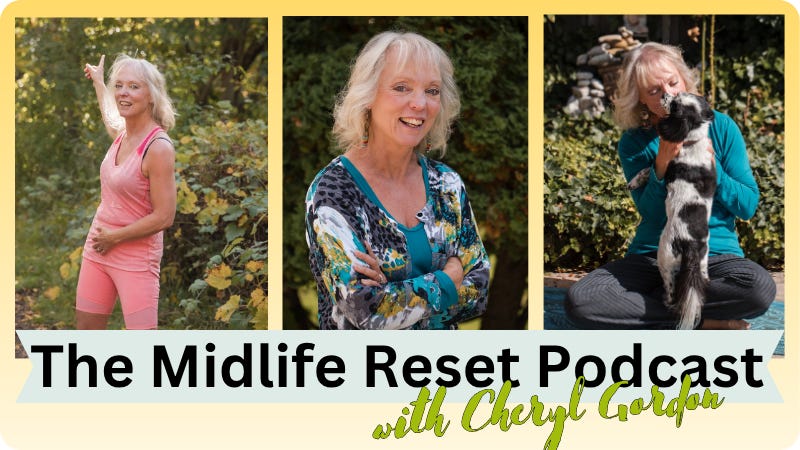
So welcome to episode number 27 of the Midlife Reset Podcast.I'm Cheryl Gordon. I'm a yoga therapist who's very busy these days, doing my best to educate midlife women on feeling stronger, losing weight, and sleeping better using the tools of yoga and mindfulness.
Now, I started teaching yoga with great enthusiasm. I had always loved attending classes, and felt that yoga was just about the best thing that had ever happened to me.
When I got to start leading those classes myself, sharing the teachings, well, you know, I just jumped in, like, 150%. I taught six days a week.Enthusiastically demonstrating poses on one side, but then walking around the room to help my students adjust into their poses. And they would be doing the second side, but I skipped that side, you know, because I was busy teaching. I didn't do any of the preparatory breathing or relaxation stuff that I had my students do. I was guiding others.
And yoga was magic, right? I was totally above worrying about keeping myself safe.And then there was that first injury. Ouch.My psoas, which is a hip flexor muscle, just got fed up with those deep, sexy lunges, and all the lack of counterposing. It got inflamed, angry, painful — I couldn't even walk.Other injuries have followed, each one teaching an essential lesson.
So please welcome my guest today, Gillian Soder. Gillian, I can't wait to mine all your knowledge, so our listeners won't make those same mistakes that I was talking about. So welcome!
Gillian Soder: Thank you for having me! I'm super excited! Let's get into it.
Cheryl Gordon: I want to ask, Gillian, because I was so intrigued: what was your work in forensic medicine? That sounds so intriguing.
Gillian Soder: So, yeah… my degree is actually in forensic anthropology. Bones are my jam — that's why I’ve got all my buddies around me. And so I took my forensic anthropology here at the University of Alberta, and started working at the medical examiner's office, actually before I graduated. So I worked in a forensic setting doing autopsies.Not medical autopsies, but forensic autopsies — those are autopsies on individuals whose death was unexpected, either due to some sort of medical reason, or due to some sort of violent death, be it in a trauma accident, homicide, or something like that.And so we did that for a number of years. I also worked for the transplant program at the University of Alberta Hospital, as a coordinator, speaking with families at time of death about donation of their loved one's tissues.Over the span of 20 years, I actually went back to the medical examiner's office during 2020 as well. So, over the span of about 20 years, I have been in and out of anatomy labs with my hands literally on the tissues of the human body, and it's been such an honor to be able to learn in that way continuously.
Cheryl Gordon: Wow, that's a lot of deep experience, Gillian. So when you talk about the body and how to align ourselves in yoga poses, we're going to play very close attention. So… how did you go from forensic anthropology to yoga?
Gillian Soder: Yeah, it seems like a big leap — and it was. I have two children, and when I had my second child, our work schedules… I was working shift work at the transplant program at the time, and it just didn’t make sense for me to return back to work full-time.So, as a stay-at-home mom, I decided I was going to take my yoga teacher training as kind of my little side gig. Get me out of the house, keep me a little sane, right? Keep me busy.I took my yoga teacher training almost 15 years ago now, and that was a big learning curve — bigger than I thought it was going to be. Because here’s the thing: I had been learning from bodies that were stationary. No feeling, right? They had no opinion on what was happening. I had always worked with deceased bodies. Always.And it was a big shift for me to work with moving, breathing, feeling humans. So, I'm still learning in that transition, 15 years later. But again, it's this beautiful arc of the human experience — between this life that we get to live in these bodies, and understanding how they interact.
Cheryl Gordon: Fascinating. So, can we talk a little bit more about the difference between a dead body and a live body? Beyond the obvious. Now, here’s kind of the reason I’m asking the question, Gillian, and I think it’s going to lead us into the reason that I sustained the injuries that I did in yoga, and it’s got something to do with connective tissue.
Gillian Soder: Yeah, absolutely. So, our connective tissue — everyone’s connective tissue, everyone’s body — is very independent. Everyone has their own kind of build and structure. My buddy over here, just over my left shoulder, he’s named Stan, because he stands around. He goes with me to all of my trainings. He’s kind of the template. But we always have to remember: he’s a template, and that’s it.There is huge variation in the human population. When I was learning at the University of Alberta, we worked with a skeletal collection that wasn’t representative of the bodies we typically see here in Canada. Those skeletons were much smaller than the bodies I see in my classes. Later, when I did some of my training in Eastern Europe, those skeletal bodies were much larger than the ones I had studied here.So, when we’re talking about movement and templates — the kinds of images that Yoga Journal has put out over the years, those beautiful pictures of people practicing — those are just templates. It’s not necessarily how it’s going to look for you, or me, or the next person.It really comes down to how the position feels in your body. Your skeleton is going to interact with those positions in a very different way than someone else’s. That’s why we want to focus on the experience of the soft tissue — the connective tissue around and within the joints — in order to stay within what we might call “safe spaces.”
Cheryl Gordon: Absolutely. And this is something I’ve been trying to communicate, but I just love having someone with your expertise and experience reinforcing the message I’ve been trying so hard to share with midlife women. Because it becomes even more important as we get older. It’s very important when we’re young, but even more so as we age.I remember following some of the work of Tom Myers — you’ve probably heard of him — the “Anatomy Trains.” He and a number of my teachers have mentioned that for many centuries, people were studying autopsies, looking at dead bodies, and basically dismissing fascia and connective tissue. Because the body wasn’t moving, fascia seemed unimportant.It’s only in more recent times, with imaging technology, that we can actually see a moving body from the inside and say, “Oh wow, what’s all that doing?” That must be one of the big differences between working with the dead and the living, right?
Gillian Soder: Absolutely. When I was learning anatomy in the gross anatomy labs at university, fascia was literally the stuff we cut away to get to the “interesting” parts.
Cheryl Gordon: The good stuff, like the nerves and muscles.
Gillian Soder: Exactly. We removed it just to see the rest. And that was only in the early 2000s when I was doing my degree — not that long ago. In the 20 to 25 years since, we’ve realized the nervous system is actually more connected to fascia than to anything else.Don’t quote me on the exact numbers, but I believe it’s almost 100 times more connected to your fascia than to your skin. Which is fascinating.
And that’s something I love about the human body. You’d think after thousands of years of living in these bodies we’d know everything, but we’re still learning. We used to believe the parts weren’t connected — but in reality, they are totally connected.
Cheryl Gordon: Yes, and that brings us back to connective tissue. It’s this continuous weave throughout all of our tissues — through each tiny little muscle spindle, around our organs, even within our bones. It’s all connected.
Gillian Soder: Absolutely.
Cheryl Gordon: So if fascia is so deep, and even more sensitive than our skin, then in a way we’re actually feeling from the inside, right?
Gillian Soder: Yes, absolutely. And especially for yoga teachers, many of whom haven’t studied anatomy since high school, it’s important to remember: the images in textbooks or online are only created because tissue was cut away.
Your body, until a scalpel touches it, is complete and whole. It’s one system. That’s one of the issues I have with Tom Myers’ work. He’s a brilliant anatomist and has great ideas, but we have to remember his “fascial lines” only exist because a scalpel created them.Those fascial lines are interwoven — the anterior line isn’t truly separate




 United States
