


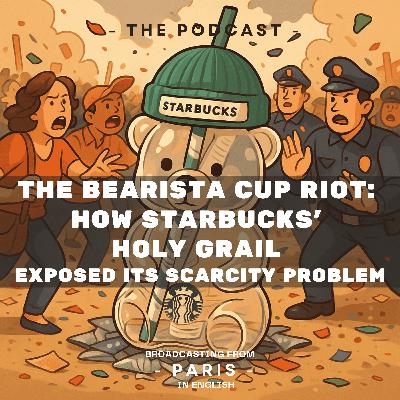
The Bearista Cup Riot: How Starbucks’ Holy Grail Exposed Its Scarcity Problem
Description
A $30 glass teddy bear mug caused riots, police calls, and a secondary market listing cups for up to $50,000. Drawing on Marc Abergel's analysis, we unpack the Starbucks Bearista Cup launch as a live-fire experiment in modern desirability – and how a mass coffee chain accidentally moved like Hermès, then apologized for it.
We show how Starbucks behaves less like a coffee shop and more like a “cultural nation”: 75 million rewards members, seasonal rituals like Pumpkin Spice and Red Cup Day and decades of collectible nostalgia.
We break down the brutal math of the launch – where resellers made more than three times Starbucks’ own revenue – and diagnose the four “sovereignty failures” in access, resale, narrative, and data that turned a coronation into a street fight. Then we flip it: a concrete “desirability playbook” for any brand with a fanbase, from Nike to Trader Joe’s, on how to choreograph access, own the aftermarket, author the story, and reward the people who camp out at 3 a.m. This isn’t just about coffee; it’s about who owns desire in your category.
Top quotes:
- “Starbucks proved they have the cultural power of a luxury brand – they just don’t yet have the infrastructure to steward it.”
- “That 75 million rewards list isn’t a customer file, it’s a constituency.”
- “The people lining up at 3 a.m. didn’t just want the cup – they wanted to be first. Access equals status.”
- “You’ve got a $30 glass bear triggering the same behavior as a multimillion-dollar Birkin at auction; the psychology is identical, the difference is control.”
- “Starbucks did all the work to build the desire, then watched other people walk away with more than three times the profit. That’s the brutal math.”
- “It was a battlefield, not a ceremony – a luxury brand would never treat its inner circle that way.”
- "The narrative of the launch was dictated by the TikTok algorithm, not by the brand.”








 United States
