


The Crucible of Being — Dying to the Old, Rising to the New
Description
Imagine a blacksmith’s forge: heat blazing, sparks flying, metal glowing red as it is hammered into shape. This, Saint Germain tells us, is the final stage of alchemy — not just changing substances, but changing ourselves.
Every alchemist must eventually face the crucible of being — the fire where the “old man” dies, and the “new man” is born.
Welcome to today’s episode of The Fellowship Chronicles. This is Episode 9—the final and climactic episode of Saint Germain’s teaching from his book on Alchemy.
Expanding the Universal Within
In his teaching today, Saint Germain reminds us of our greatest need: to see ourselves not as small, separate egos, but as part of the vast universal consciousness of God.
“The greatest need of mankind today… is the development and nurturing of the sense of the universal as belonging completely to the individual.”
When we feel isolated, life becomes heavy. But when we know we belong to the cosmos, the whole universe becomes our home.
Paul echoed this when he declared: “In him we live, and move, and have our being.” (Acts 17:28 ).
Breaking the Chains of False Identity
Most people, Saint Germain says, live under false identification — as sinners, failures, victims of heredity or circumstance. They accept the accusations of the “accuser of our brethren” (Revelation 12:10 ) and mistake that voice for truth.
But this, he insists, is the greatest illusion. Our first loyalty must not be to these false labels, but to our own God-identity — the Christ within. Paul said it this way: “Put off… the old man, which is corrupt… and put on the new man, which after God is created in righteousness and true holiness.” (Ephesians 4:22 –24).
The Refiner’s Fire
Saint Germain is frank: the crucible burns. Jealousy, fear, pride, and attachment all have to be cast into the flame. But he assures us the fire is not destruction — it is purification.
Like Malachi 3:3 says, God sits as a refiner of silver, skimming away the dross until only pure radiance remains.
The mystics of old called this dying with Christ. Paul wrote, “I am crucified with Christ: nevertheless I live; yet not I, but Christ liveth in me.” (Galatians 2:20 ). To pass through the crucible is to die with Christ — so that we may also rise with him.
Resurrection in the Everyday
But here’s the hope: resurrection doesn’t begin only after death. It begins here, now, each time we choose to rise out of limitation into freedom.
Saint Germain calls this the daily round of victories — each day lived as a chalice of opportunity, each sunrise a new resurrection.
“Your life can become a daily round of victories whereby each step taken aright propels you into an expanding awareness of the beauty and glory of the newness of life.”
This is why Jesus said, “I am come that they might have life, and that they might have it more abundantly.” (John 10:10 ). The crucible doesn’t just burn away — it gives back life in fuller measure.
A New Humanity
Saint Germain offers us a vision: a new kind of man, a New Atlantean clothed with the righteousness of the Sun. This is the Master Alchemist — one who has passed through the fire and emerged radiant, whole, and free.
It’s a call not just to personal transformation, but to collective renewal. The crucible of being doesn’t only change individuals — it has the power to birth a golden age.
The Invitation
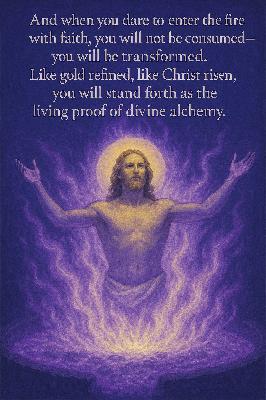
So here is the climactic truth: you are the crucible. Your life is the furnace. Every trial, every sorrow, every moment of fire is an invitation to shed the old and step into the new.
And when you dare to enter the fire with faith, you will not be consumed — you will be transformed. Like gold refined, like Christ risen, you will stand forth as the living proof of divine alchemy.
📚 Excerpt inspired by Studies in Alchemy: The Science of Self-Transformation by Saint Germain, published by the Summit Lighthouse.
This is a public episode. If you'd like to discuss this with other subscribers or get access to bonus episodes, visit thefellowshipchronicles.substack.com/subscribe



















 United States
