


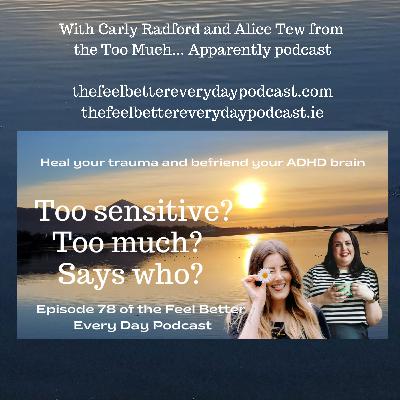
Too Sensitive? Too Much? Says Who? (with special guests Alice Tew and Carly Radford)
Description
Join me (trauma-informed therapist etc, Eve Menezes Cunningham) as I welcome Alice Tew and Carly Radford, hosts of the podcast “Too Much… Apparently.”
We explore sensitivity as a gift rather than a flaw, sharing practical nervous system regulation techniques and the power of radical self-acceptance.
Discover why tiny non-negotiables work better than perfect routines, how the pandemic became a turning point for Carly embracing authenticity, and why building chosen family through friendship can be transformative.
Perfect for highly sensitive people, those with ADHD and autism, trauma survivors, and anyone who’s ever been told they’re “too much.”
You’ll learn about:
· Nervous system awareness
· micro self-care practices
· parts work therapy
· community building
· neurodivergent experiences, and
· moving from self-criticism to self-compassion.
Find Alice at @reparentingwithalice and Carly at @the_sensitivity_therapist
CHAPTERS
(0:00 ) Introduction and podcast context
(1:00 ) Guest introductions
(4:00 ) Sensitivity and self-care
(8:30 ) Nervous system awareness
(12:00 ) Tiny non-negotiables
(15:00 ) Love and acceptance
(19:00 ) The pandemic as a turning point
(22:00 ) Radical self-acceptance
(26:00 ) Collective care and community
(30:00 ) Redefining family and support
(35:00 ) Building community through friendship
FULL TRANSCRIPT
I’m delighted to welcome Alice Tew and Carly Radford, who are here to talk about whatever they want to talk about, but I invited them on because I’ve known their names for a long, long time, but I’ve got to know them better online through a neurodivergent therapy group, and they have a gorgeous new podcast, Too Much… Apparently, and it’s so lovely.
Hi, you’re listening to episode 78 of the Feel Better Every Day Podcast. I’m your host and producer Eve Menezes Cunningham. I’m a trauma-informed therapist, including embodied approaches, energetic approaches. I’m a trauma survivor. I have ADHD and I’m a senior accredited supervisor with BACP and a supervisor with IACP.
I’m also an author and columnist and a self-care coach where I integrate lots of different ways of working for a really embodied approach, but really all my work is about helping you remember that you already know what you need.
I help people with trauma and ADHD to take better care of themselves and their Self, that highest, wisest, truest, most joyful, brilliant, miraculous part of yourself. It really is remembering you are already whole. You’re already complete. You are worthy. You’re lovable. You’re not too much. You are enough.
And with that in mind, I am utterly delighted to be welcoming today’s guests and look forward to hearing what you think of today’s episode. If you haven’t already, do subscribe and I would love to hear from you, either in the comments or you can email eve at selfcarecoaching.net
You can find out more about the book, the podcast, free resources, all sorts of things at selfcarecoaching.net or thefeelbettereverydaypodcast.com.
I’m delighted to welcome Alice Tew and Carly Radford, who are here to talk about whatever they want to talk about, but I invited them on because I’ve known their names for a long, long time, but I’ve got to know them better online through a neurodivergent therapy group and they have a gorgeous new podcast, Too Much… Apparently, and it’s so lovely and I wanted to have them on here.
I’m going to ask Alice and then Carly to introduce yourselves, including any links you want people to go to and they’ll be in the show notes as well.
Welcome, welcome, welcome and thank you.
So shall I start?
Yeah, OK.
I’m Alice Tew. I’m a psychotherapist. I’m based in Cheshire, but I work completely online. I mainly work with people who have kind of harshly critical parents and so kind of dealing with the emotional fallout of that. The best way to find me is on Instagram, where you’ll find me @reparentingwithalice. Yeah, that’s me.
I was admiring earlier your little hello sign because your email is hello at Alice Tew. Do you want to give your website as well?
Yeah, so my website is alicetew.com.
Perfect. Thank you. And Carly?
Yes, hello. My name is Carly Radford. I am a nurse by background before retraining as a psychotherapist and I also work solely online with doing individual therapy and running groups. I specialise in a few areas, but I put those under the theme of sensitivity. I’m known as the sensitivity therapist and I work with either inherent or acquired sensitivity. And essentially what I mean by that is inherent is if you feel you were born a highly sensitive person, neurodivergent, autistic, ADHD. You have always felt like a sensitive person in the world.
And I also work with acquired sensitivity. So if that is through stressful life situations, traumatic events, chronic anxiety, anything that over time has essentially made your nervous system more sensitive and more reactive in the world. That’s ultimately what I specialise in. You can find me on Instagram @the_sensitivity_therapist with underscores between the words. My website is currently being redeveloped, but it will be carlyradford.com. And yeah, email wise, I’m just hello at carlyradford.com.
Thank you so much. I’m going to ask you both about sensitivity because you had a lovely episode about it. And I think it’s so important. I think especially with trauma, with ADHD, we grow up, we get so told, oh, you’re being too sensitive, you’re too.
And we can recognise that it is a gift and we can also internalise shame around it. And I’m nearly 50 and I’m like happier than I’ve ever been, but it’s still like, oh God, I’m crying again. And it’s I’ll cry out of joy as well. It’s like fully emotional landscape. It’s the whole, but I just loved what you were saying.
We’ll start with the Feel part of the Feel. Love. Heal. Framework I created. If you tell me a bit about what you would recommend and what you’ve both done in terms of regulating, in terms of that kind of more active self care around sensitivity, when it all feels too much, if that’s OK.
Yes. Yeah.
Or should I go? Or should you go? When there’s three of you, it’s like, who talks first? Who knows, who knows who to go? No, I’m just nodding and you can’t see who I’m nodding at. Yes. So I, I have always described myself.
Well, I say always more in later years, I’ve always described myself as sensitive, but I now very much realised that I am very sensitive, deep, deep in my bones. And what I mean when I say the word sensitive is I can react quite strongly emotionally to things in the world. And a bit like you said, it’s both in a way that can be challenging and also in a way that can be really lovely and beautiful in terms of those strong emotional reactions.
And I also describe it of having quite a reactive nervous system. So seemingly small things, or that may be small to other people are not small to my nervous system. And ultimately can, well, that can respond in various ways, but I would often say that that can translate to like emotional overwhelm or, or feeling, feeling stressed, feeling like things are a little bit too much.
And it’s only in later years that I’ve come to really recognise that and start to embrace that as that is who I am in the world. So particularly, I’d say particularly over the last five years, I’ve more like radically been moving, been moving towards that acceptance. And you mentioned from the field perspective of the framework that you work with, how I, how I regulate, I think that what you were asking me? Yeah.
I regulate my nervous system through various ways, some of it’s not super conscious, it’s automatic. I will sing throughout the day quite a lot as I’m just going about the day. And I think singing just automatically helps to regulate my nervous system.
And there’s a lot of science behind that, actually, which I didn’t say.
The exhalation, so you’re activating the parasympathetic branch of the nervous system. And you’re also using your voice. So yeah, helping tone the vagus.
Yes, yes, it’s all related to the vagus nerve. And whether that’s the breathing part, really taking control of your breath, slow, really slowing it down and controlling it. And also through the through the vibrations of your vocal cords, and what that is essentially doing from biofeedback to the vagus nerve. So there are various things that influence singing. So I think singing can be good.
Joining a singing group, for example, but also just even if you’re humming to yourself throughout the day. So I’ve learned that there are things that I just do automatically throughout the day that help. So singing, vocalising things.
And I like to just talk out loud to my dogs in various accents and things like that. Just almost using the voice as a form of play, I think really, really helps. And then there are the more active things that help regulate my nervous system.
And they might be things like just curling up on the sofa, blanket wrapped around me, maybe heated blanket, cup of something warm and a good book or something crafty. If I’m really overwhelmed, the crafty thing won’t be too challenging. It could even just be an adult colouring book, something that doesn’t involve much thought, but that’s something that always helps me.
I love it.
And before I ask Alice, I also wanted to applaud your talking about your nervous system. And it sounded like that acceptance. And we all, all mammals have our nervous systems. And with trauma, with ADHD, we grow up, like thinking there’s something wrong with it. Whereas the minute




 United States
