


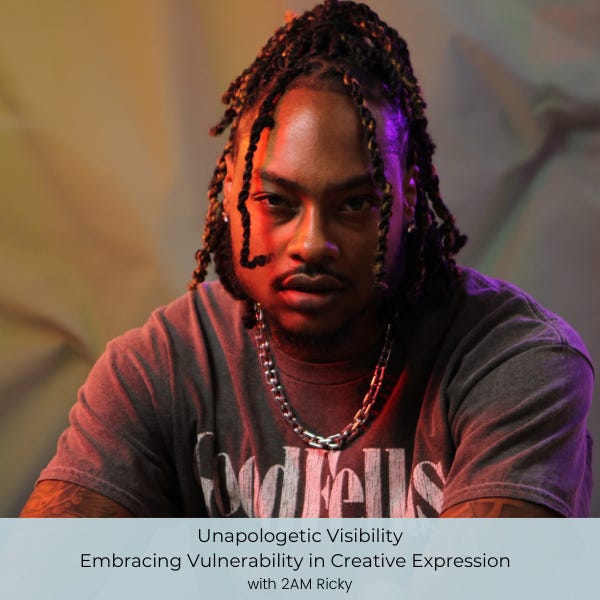
Unapologetic Visibility | Episode 45
Description
Recording artist and songwriter 2AM Ricky is best known for utilizing his platform to bridge the intersection of LGBTQ advocacy and entertainment. He uplifts marginally perceived communities while building trans awareness, one song and conversation at a time.
In 2021, Ricky became the first black transgender male artist to land #1 on any music chart, with his single "Whatchu On (ft. CeCe Peniston)" peaking on the LGBTQ Urban Charts. His extensive portfolio includes several placements with credits including CeCe Peniston, Tyler Perry Studios, Zeus Network and more.
Ricky has helped industry professionals, corporate leaders, and creatives worldwide to develop language and best practices for transgender healthcare and education, intersectionality, inclusive strategies, and mental health. He recently released a new album titled "Listen If You're Lonely", a musical exploration of mental health, relationships, and life from a black masculine perspective.
This episode 2AM shares some of his story with us and we discuss:
🌈 Growing up without LGBTQIA+ representation and becoming a visible member of the community
🌈 Living a blessed life and finding your calling
🌈 Navigating transphobia in reproductive healthcare settings
🌈 Words of wisdom 2AM has for trans and non-binary young folks
Episode Resources
Connect with 2AM Ricky
https://www.instagram.com/2amricky/
Episode edited and produced by Unapologetic Amplified
This transcript was generated with the help of AI. Thank you to our supporting members for helping us improve accessibility and pay equitable wages for things like human transcription.
Have you ever wondered why almost all the health and wellness information you see out there is so white, cis able-bodied and het? I know I have. And as a queer black registered dietitian, I gotta tell you, I'm not into it. I believe health and happiness should be accessible to everyone. That is precisely why I wrote Decolonizing Wellness: A QTBIPOC-Centered Guide to Escape the Diet Trap, Heal Your Self-Image, and Achieve Body Liberation and why I host Body Liberation for All.
The road to health and happiness has a couple of extra steps for chronically stressed people, like queer folks and folks of color. But don't worry, my guests and I have got you covered. If you're ready to live the most fierce, liberated, and joyful version of your life, you are in the right place.
Body Liberation for All Theme
They might try to put you in a box, tell them that you don't accept when the world is tripping out tell them that you love yourself. Hey, Hey, smile on them. Live your life just like you like it
It’s your party negativity is not invited. For my queer folks, for my trans, people of color, let your voice be heard. Look in the mirror and say that it's time to put me first. You were born to win. Head up high with confidence. This show is for everyone. So, I thank you for tuning in. Let's go.
Dalia Kinsey: Thank you so much for coming on the show at 2 AM Ricky and I met recently at a 100 Black Trans Men Event that was focused on reproductive justice. And while I was there listening to your story was so impactful. I already knew, of course, that there are a lot of health disparities throughout the country for black folks, for people that have a womb and for trans folks, like when you're more than one type of marginalized, it really gets more and more difficult to get good access to healthcare.
But just hearing your story, it was so visceral. I really appreciate you putting in that emotional labor to share your story with other people, and to do all the advocacy work that you're doing in addition to being a young person who's making their dreams come true. It seems like a lot to tackle at once.
So, I'm so happy that you're here, and I would love to hear about a little bit of your story that maybe people don't always get a chance to hear. Like, how did you know, as a young person in North Carolina, a young Black person, that all that you're doing right now is possible, and if you didn't know it then, what had to shift for you to be open enough to life to be able to get to where you are right now?
2AM Ricky: First of all, I'm from Winston Salem, North Carolina, so I'm from, I would say, a smaller town. I wouldn't say too small. I've seen smaller cities, but a smallish town. And I grew up in a space that everyone knew my family, everyone knew who we were, the history of them. And so navigating through, coming from a small place that everyone knew who your people were, but you might end up going through certain things and we all know in Black culture, "what happens in this household, supposed to stay in this household" type of thing navigating just trauma overall, and knowing that I needed someone who could be a voice for me, but that was also a situation where I needed a voice, and I knew that I was coming from a place that a lot of people looked at us for the voice, and so it was a very complex situation.
And so I wanted to make sure that no matter what I did and no mattervwhat it was that I became, I just wanted to make sure that I made a great impact.
Dalia Kinsey: Okay. So how old do you think you were when you started realizing you wanted to have reach?
2AM Ricky: I, it's interesting because I actually got into music. My first like real project was called "Hiatus" and it was based around the death of my brother and best friend and he used to always say that like he used to always tell me that I will be doing these things and I will kind of like argue against it.
Oh, not because I didn't think it was possible, but because of the weight that I knew came with it, I, as a young kid was like, even now I'm pretty introverted. So I'm not going to say I'm not a people person, but people like me, and I would rather just watch people.
Dalia Kinsey: Oh, I, I can relate to that so much. So it sounds like you actually got a calling.
I think there's lots of different ways we can decide to live our lives. But some people, you know, have a passion that they want to share with others. Or they have a thirst for fame, but I don't think an introvert has ever thirsted for fame. So you're just tolerating attention that comes with sharing your gift.
2AM Ricky: Basically, God says so. And I feel like when I tell him, no, he kind of bullies me a little bit. So we just gonna flow with what he said.
Dalia Kinsey: Oh, the facts. Yes. If everybody can just. Learn to get out of their own way. When people keep telling you like, Oh, but you're so good at that thing. Or like, Oh, that thing that you did, it's still on my mind.
I really think you should push a little further. It's usually easier for other people to see our potential than for us to see our own potential. But I find that a lot of times, especially for queer folks and trans folks, that because we're being undermined in other ways. That sometimes it's even harder to trust yourself, so you know who you are but being your full self, sometimes people reject it or you see them rejecting other people like you, and that may make you feel like, well, maybe I can't trust my gut.
Did you ever have any, any need for breakthrough around that being trans and from a southern state? I mean, y'all consider your, yeah, yeah, y'all are southerners. Yes. Okay. Just because North was in there for half a second, I questioned myself, but yeah. What was it like? What was the trans acceptance like the LGBTQIA
acceptance in general, like when you were a kiddo in the 90s?
2AM Ricky: I would say, well, I didn't really get exposed to too many queer folk when I was coming up. Like we didn't, I grew up more so in an area that was like more like faith based. Like you didn't really see people if they were LGBTQ, you didn't really see them talking about it.
It wasn't a lot of trans representation. So, even once I did get to the point of like, I started going to like, Black queer community. Cause I graduated high school at like, 16. So, I went to college really early. Oh, yeah. Yeah, I was like sneaking into clubs at like 16, 17, chilling.
Dalia Kinsey: I'm surprised you got in cause you look like you're barely 21 right now.
2AM Ricky: You know what? I don't know how I got in either. They never, like, I don't know how I've done a lot of things in life but I'm here. So, somehow, I was in there, and I was in there faithfully.
Dalia Kinsey: So... I guess they just figured, you know what, he's cool. Maybe.
2AM Ricky: Everyone treated me as such.
I don't know how I got in. Favored. Favored, lets call it that.
Dalia Kinsey: Oh, I like that. Do you feel like in general, despite what other people might see as, oh, it's a difficult identity to be born with, that your life has been blessed?
2AM Ricky: Definitely. I think that my life has been very blessed. I don't at any point think that my





 United States
