


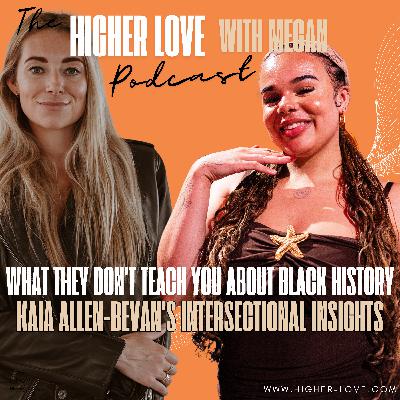
What They Don't Tell You About Black History: Kaia Allen-Bevan's Intersectional Insights
Description
I was joined by the incredible activist, Kaia Allen-Bevan, to discuss the deeply interconnected nature of social justice, education, and wellness. Kaia, who identifies first and foremost as an activist specialising in racial justice and racial equity, shared her insights on how systems of oppression are perpetuated and how we can work towards collective liberation.
We delve into the quietest Black History Month in five years , why activism and social justice cease to be "trendy" and the essential nature of intersectionality when discussing global struggles like those in Congo, Sudan, and Palestine. Kaia powerfully unpacks the colonial structures embedded in the education system , and we discuss how wellness has been co-opted by capitalism and white supremacy6666. Crucially, Kaia highlights the importance of radical hope and community action as tools for genuine resistance against systems designed to foster despair and isolation.
🔑 Key Takeaways
Social Justice is Interconnected: Global struggles for liberation, such as those in Congo, Sudan, and Palestine, are deeply connected by the actions of bigger powers and the global north exploiting the global south.
Education is Not Neutral: Education systems were set up to manufacture compliant workers and uphold a social hierarchy, not necessarily to inspire dreams or critical thinking.
Wellness Must Be Decolonised: Wellness defined by indulgence, consumption, and white, thin bodies is merely capitalism.
Hope is an Act of Resistance: The empire actively tries to shut down hope to make people susceptible to propaganda and opt out of change.
Confronting Fragility is Essential: Progress in social justice requires confronting personal fragility—be it white fragility or discomfort—by sitting with the resulting emotions.
📌 Episode Highlights
03:51 The reason Black History Month felt quietest in five years is because it is "no longer trendy" after the global phenomenon of the BLM movement plateaued.
04:36 Kaia explains how the disconnection from the ongoing picture of revolution and the lack of immediate gratification caused engagement with the movement to drop.
07:44 Discussing the interconnectedness of global struggles: the liberation of Congo and Sudan is linked to the liberation of Palestine.
23:25 Kaia's definition of wellbeing: not looking away from the world's injustices, but being well enough to show up to the fullest and take informed action.
37:05 Challenging the "higher self" or "best version of yourself" narrative, which is often a cog in the wheel of capitalism that creates a sense of inadequacy.
44:59 Kaia defines and discusses the necessity of confronting white fragility to navigate conversations about racial injustice.
👤 About the Guest: Kaia Allen-Bevan
Kaia Allen-Bevan is an activist specialising in racial justice and racial equity, working with schools, youth, and through diversity and inclusion consultancy. She is also a trustee and creative.
Instagram: @kaia.ab
🔗 Episode Links: Resources Mentioned
Fernando Deveras: Educator and advocate
Kimberlé Crenshaw: Coined the term "intersectionality" in 1989
audre Lorde: Writer, activist, and quoted on the importance of self-care and practices as resistance
맺 End Credits
Connect with Megan:
Instagram: @HigherLove_withMegan
Website: www.higher-love.com
This episode was written and recorded by me and produced by Lucy Lucraft (http://lucylucraft.co.uk )
If you enjoyed this episode please leave a 5* rating and review!
Would you like me to find out more about any of the resources or people mentioned in the show notes?



 United States
