


Why RPE Matters Just As Much As Power: Kolie Moore from Empirical Cycling on Training Smarter
Description
What if the most sophisticated training tool you have isn't your power meter, but your ability to feel the difference between sustainable and unsustainable effort? Kolie Moore launched Empirical Cycling in 2015 after noticing a gap in how coaches approached endurance training. With a background in biology, biochemistry, metabolism, and physiology from Boston University, plus his own experience as a national championship medalist in track cycling, Kolie recognized that most coaching focused too much on training plans and not enough on the biological processes actually driving adaptation.
Nearly a decade later, Kolie’s Empirical Cycling Podcast is known for its, uh, thorough explanations of exercise physiology—but also for its human approach to applying that knowledge.
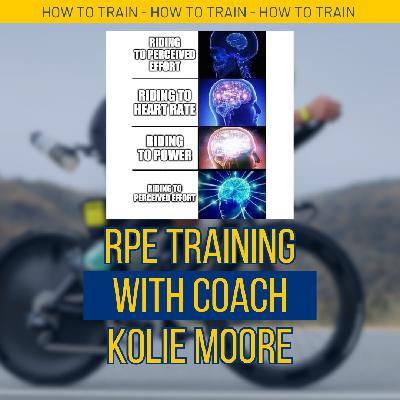
The Expanding Brain Meme: From RPE to Power and Back Again, Kolie's first and favorite meme, illustrates the training evolution most athletes experience. You start by training to RPE because you don't know any better. Then you discover heart rate and power-based training. Finally, if you stick with it long enough and pay attention to what works, you end up training to RPE again—but this time with the wisdom to know why it matters.
The problem isn't that power meters and heart rate monitors aren’t useful. The issue is that athletes get so fixated on hitting prescribed numbers that they ignore what their bodies are telling them. Your brain integrates signals that no device can measure—life stress, environmental conditions, recovery status, total accumulated fatigue. When you override those signals to complete a workout exactly as written, you might be digging yourself into a hole rather than building fitness.
We also talk about the assessment that has become known as the "Kolie Moore FTP Test," although Kolie is somewhat uncomfortable with this title. The test emerged from his realization that WKO5's power duration modeling was excellent at finding inflection points in the 30-80 minute range, and that the best predictor of performance is performance itself. Rather than suffering through a traditional 20-minute all-out effort and applying a mathematical discount, why not just ride at threshold by feel?
We talk about how training plans should be flexible, not rigid, what makes Professional World Tour cyclists different from the rest of us, and our favorite books that have shaped our coaching methods. A HUGE thank you to Kolie for coming on the show—please go and listen to his!
Learn More:
Check out the Empirical Cycling Podcast at https://www.empiricalcycling.com/podcast.html
Follow @empiricalcycling on Instagram for weekend AMAs with shorter answers
Join us at an upcoming Campfire Endurance training camp: https://www.campfireendurance.com/training-camps
Ready to work on your training? Book a consultation: https://app.acuityscheduling.com/schedule/f0ceda55/appointment/63067352/calendar/any?appointmentTypeIds[]=63067352




 United States
