


Technovation with Peter High (CIO, CTO, CDO, CXO Interviews)
Subscribed: 398Played: 22,051
Subscribe


Description
Twice-weekly conversations with top executives and thought leaders at the intersection of business, technology, and innovation. Each episode of Technovation explores the technology trends that are transforming business, and the leaders driving digital change inside their organizations. Produced by Metis Strategy and hosted by firm President Peter High, Technovation is the premier podcast for IT and technology professionals with the largest collection of interviews with elite CIOs, CTOs, and CDOs.
897 Episodes
Reverse
What if claims processing could be 10x faster without sacrificing accuracy?
In this episode of Technovation, Pravina Ladva, Group Chief Digital and Technology Officer at Swiss Re, shares how one of the world’s leading reinsurers is using AI to transform claims processing, unlock insights, and redefine how work gets done across the enterprise.
Key highlights include:
How AI is reducing claims processing time from ~40 days to 4–5 days
Why data ingestion is the biggest unlock for AI in insurance
The importance of building “AI-ready” data foundations
How Swiss Re achieved ~60% enterprise AI adoption
Why AI transformation is more about people and process than technology
Apple’s greatest successes were built on failure.
In this episode of Technovation, Peter High speaks with David Pogue, an Emmy-winning journalist, former New York Times technology columnist, CBS News correspondent and author of Apple: The First 50 Years, about how Apple transformed early product missteps into category-defining innovation.
Drawing on 150 interviews and decades of coverage, Pogue unpacks the hidden lessons behind Apple’s most famous failures—and how they shaped the company’s future.
Key insights include:
Why the Apple III and Lisa failed—and what they enabled
How constraints in the early Mac informed later breakthroughs
The role of leadership in reframing failure as progress
Apple’s near-collapse and improbable turnaround
What today’s executives can learn from Apple’s innovation model
The modern workplace wasn’t designed for today’s leaders, and it’s starting to break under the pressure.
In this episode of Technovation, board director, author and former CIO Lisa Davis joins Peter High to examine why the workplace system, built decades ago, no longer supports the realities of modern careers. Drawing from her leadership experience across government, academia, and the private sector, Davis outlines what must change, and what leaders must do now.
Key insights include:
Why the current workplace model is structurally outdated
How power dynamics shape leadership advancement
The hidden cost of talent loss and system misalignment
Why AI leadership lacks critical representation
What executives must do to redesign work for the future
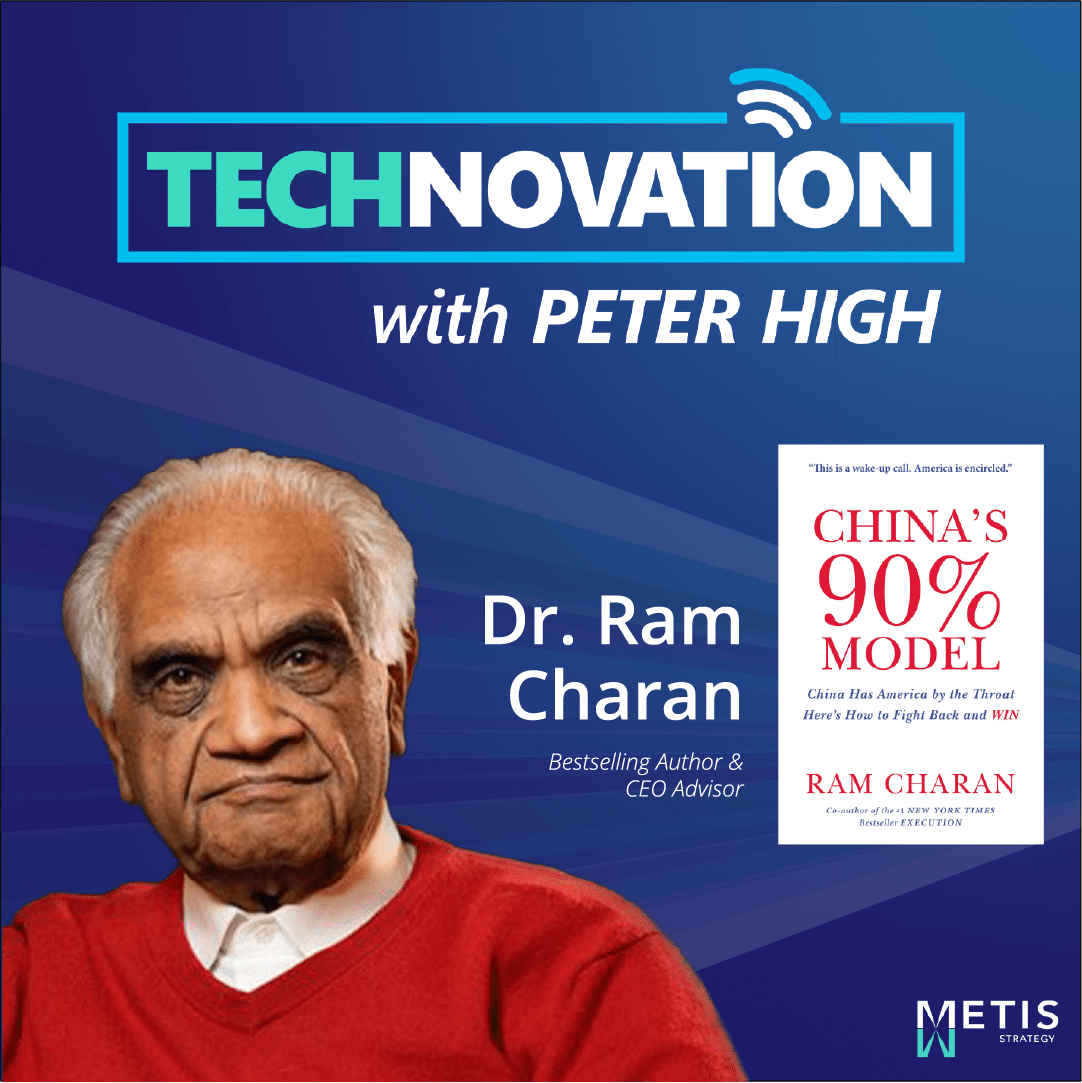
China is competing on control. In this episode, Ram Charan explains the “90% Model,” a strategy designed to dominate global manufacturing through scale, pricing power, and long-term positioning.
Drawing on decades advising CEOs and global leaders, Charan breaks down how this model is reshaping industries—and what it means for business leaders navigating a fragmented, multi-polar world.
Key insights include:
Why China is willing to lose money to gain global dominance
How “asset-light” strategies weakened Western manufacturing
What CEOs must do to redesign supply chains for resilience
Why AI should be treated as a tool—not a strategy
How leadership must evolve in an era of unprecedented scale and speed
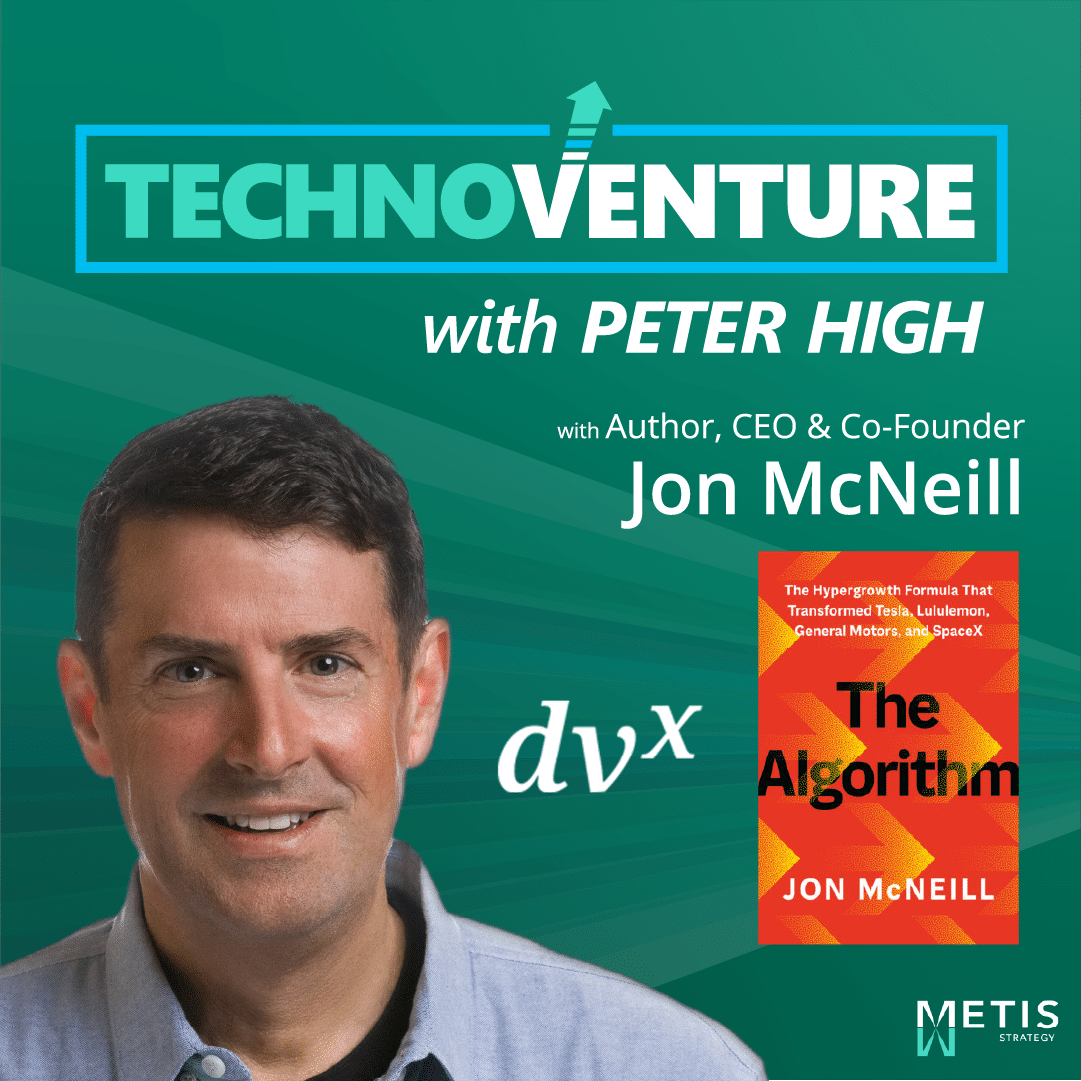
What does it really take to scale a company 10X in just a few years? Jon McNeill argues it’s not genius, it’s a system.
In this episode of Technoventure, Jon McNeill, former President of Tesla and CEO of DVx Ventures, breaks down “The Algorithm,” a five-step framework that powered Tesla’s rise from $2B to $20B in revenue. He shares how questioning assumptions, eliminating friction, and accelerating execution can unlock exponential growth.
Key insights include:
Why hypergrowth is a repeatable operating system—not a one-time event
How Tesla reduced complexity to increase speed and conversion
The role of first-principles thinking in breakthrough innovation
Why cycle time is the ultimate performance metric
How leaders can build cultures that embrace feedback and urgency
Why do most AI initiatives fail to deliver real value? Because they automate broken processes instead of fixing them.
In this episode of Technovation, Peter High speaks with Shobhit Varshney, Global Head of Artificial Intelligence at Citi, about how one of the world’s largest banks is rethinking AI from the ground up. With experience spanning Citi and IBM, Shobhit shares how a value-first, platform-driven approach is enabling AI at scale, while maintaining strong governance and control.
Key highlights include:
Why re-engineering workflows is essential before applying AI
How Citi prioritizes high-value use cases with clear ROI accountability
The role of centralized AI platforms in scaling capabilities
Embedding responsible AI across the enterprise
Building an AI-first culture through training and champions
What happens when IT stops delivering projects—and starts delivering outcomes?
In this episode of Technovation, Peter High speaks with Alex Gutman, CTO of Gilbane, about how a 150-year-old construction leader is transforming its IT operating model around value streams. Gutman shares how aligning technology to client-defined value is driving agility, accountability, and measurable business impact.
Key highlights include:
Transitioning from siloed projects to outcome-driven value streams
Building faster learning loops through cross-functional alignment
Treating data as a trusted asset to enable scalable AI
Applying AI to accelerate RFP responses and field execution
Designing architecture for flexibility, speed, and long-term differentiation
What does it take to scale technology across one of the world’s largest marketing organizations?
In this episode of Technovation, Peter High speaks with Craig Cuyar, Global CIO of Omnicom, about leading technology transformation across a $25B global enterprise.
Craig shares how Omnicom is evolving from a holding company to a more centralized operating model, particularly in the wake of its acquisition of Interpublic Group.
Key topics include:
Managing post-acquisition integration at global scale
Leveraging first-party data and proprietary platforms
Using AI’s predictive models to agentic workflows, to transform marketing
Balancing centralization, outsourcing, and business-aligned IT leadership
Why do so many successful companies eventually lose their way?
In this episode of Technovation, Peter High speaks with Eric Ries, entrepreneur, founder of the Long-Term Stock Exchange, and author of The Lean Startup and his new book Incorruptible: Why Good Companies Go Bad and How Great Companies Stay Great.
Eric argues that corporate corruption rarely begins with bad actors. Instead, it emerges from organizational design—governance structures, incentives, and metrics that gradually push companies away from their original mission.
Key highlights from the episode:
Corporate corruption is often a design problem, not a character problem
Short-term pressure often acts as an “invisible force” inside organizations
Organizations behave like “superorganisms,” developing their own intelligence and moral character
Metrics can distort behavior when companies mistake the measurement for the goal
Is AI evolving beyond software into a new form of digital labor?
In this episode of Technoventure, Peter High speaks with Sandhya Venkatachalam, Co-Founder and General Partner at Axiom Partners, about the next phase of artificial intelligence.
Sandhya argues that AI is moving from a tool that assists humans to systems capable of performing entire jobs, from data science to network engineering. This shift could expand AI’s economic impact far beyond traditional software markets.
Key topics include:
Why AI is transitioning from software tools to digital workers
How Axiom Partners is building an AI-native venture capital firm
Opportunities for AI in industries like construction, legal, and infrastructure
The importance of creating insanely useful and usable products
How founders can build companies serving billions of people globally
Enterprise leaders are investing heavily in AI, but many struggle to generate measurable business value.
In this episode of Technovation, Peter High speaks with Kellie Romack of ServiceNow about how the company is scaling AI across its operations to produce real, quantifiable results.
ServiceNow has already generated $355 million in AI-driven value internally, with automation resolving many service requests instantly and improving operational efficiency across the enterprise.
Key topics include:
How ServiceNow runs its own platform internally as Customer Zero
Examples of AI resolving 90% of some IT service requests on first touch
Why AI governance and oversight are essential at enterprise scale
How automation transforms the workforce rather than replacing it
Lessons for CIOs seeking real ROI from AI investments
Healthcare systems have traditionally been designed around individual encounters, not the patient journey.
In this episode of Technovation, Peter High speaks with Rajan Mohan, Chief Marketing and Digital Experience Officer at Ascension Health, about how digital platforms, marketing strategy, and AI are reshaping how healthcare organizations engage patients.
Drawing from leadership roles at Marriott International and Qatar Airways, Rajan explains how consumer-grade experience design can transform healthcare delivery.
Key highlights include:
Why healthcare must shift from encounters to coordinated patient journeys
How marketing and digital teams can align around shared growth outcomes
The role of AI in expanding healthcare capacity
How personalization removes barriers to accessing care
Why pricing transparency matters more than faster appointments
In this episode of Technovation, Peter High speaks with Stephen Witt, award-winning journalist and author of The Thinking Machine, which has been named Business Book of the Year by Financial Times. Witt writes about Jensen Huang’s improbable journey from near-bankruptcy in the 1990s GPU wars to leading NVIDIA at the center of the AI revolution. Witt unpacks how NVIDIA defeated nearly 70 competitors, why Huang began targeting “zero-billion-dollar markets,” and how CUDA became the backbone of modern AI.
Key highlights from the episode:
How investing in zero-billion-dollar markets created durable platform advantage
The emerging bull and bear cases for NVIDIA in robotics, edge computing, and global competition
The strategic lessons NVIDIA extracted from surviving a 70-competitor GPU market
Why operating with a constant “near-death” mindset shaped long-term execution discipline
What happens when you put revenue and technology under one executive leader?
In this episode of Technovation, Peter High speaks with Drew Pinto, Executive Vice President and Chief Revenue and Technology Officer at Marriott International, a $26 billion hospitality leader approaching its 100-year anniversary. Pinto shares how Marriott is transforming technology from a support function into a strategic growth engine — tightly integrated with capital allocation, AI experimentation, and commercial outcomes.
Key highlights include:
Why Marriott merged revenue and IT under a single executive mandate
How disciplined capital allocation is shaping AI investments
The shift from “tech for tech’s sake” to measurable business impact
Why most “technology problems” are actually data problems
How a new product operating model is breaking down silos
🎧 Listen to learn how modern CIOs can align IT strategy directly to top-line growth.
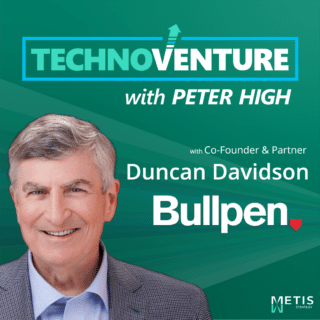
Is AI just another tech bubble or the defining platform shift of this era?
Duncan Davidson, Co-Founder and General Partner at Bullpen Capital, argues that the answer lies in one critical distinction: Is the technology being used for its core purpose? In this episode of Technoventure, Duncan draws on his experience across the PC boom, dot-com era, mobile, and now AI to explain why real adoption signals durability.
He also explores why CIOs can’t afford to sit out a boom, how AI agents may disrupt the SaaS model, and why history suggests productivity revolutions create more opportunity than they destroy. For technology leaders navigating board-level AI pressure, this conversation reframes the question from timing the bubble to strategically participating in the inflection.
Key insights include:
Why core-use adoption determines whether AI is hype or a true platform shift
Why leaders must participate in tech booms rather than try to time the peak
How to distinguish defensible AI innovation from fragile “wrapper” plays
What historical signals indicate when a technology boom is nearing exhaustion
How do you scale AI in a regulated enterprise without risking trust, compliance, or credibility?
In this episode of Technovation, Nick Colisto, CIO of Avery Dennison, and Sathish Muthukrishnan, Chief Information, Data & Digital Officer at Ally Financial, share how they are moving from AI pilots to measurable enterprise impact.
From governance-first implementation inside a federally regulated bank to CFO-grade ROI tracking across a global manufacturing enterprise, this conversation focuses on the discipline required to operationalize AI at scale.
Key highlights include:
Why one AI misstep can set a regulated enterprise back years
How to win over risk, audit, and compliance before scaling
Embedding “human-in-the-loop” safeguards from day one
Measuring AI-enabled initiatives using EBIT and IRR
Taking credit for AI embedded in SaaS platforms
If you’re leading AI in a regulated or board-visible environment, this episode offers a pragmatic blueprint for scaling responsibly.
🎧 Listen to learn how CIOs are turning AI experimentation into enterprise value.
Can trust be engineered into digital systems or is it purely cultural?
In this episode of Technovation, Peter High speaks with Jimmy Wales, co-founder of Wikipedia and author of The Seven Rules of Trust, about designing platforms that scale without sacrificing integrity. From neutrality policies to radical transparency and human-in-the-loop AI governance, Wales shares how trust must be built, not assumed.
Key highlights from the episode:
Why trust operates at a human scale, even inside global platforms
How incentives shape behavior, and why ad-driven models distort integrity
Lessons from Airbnb’s early trust crisis
Managing generative AI with human oversight
Neutrality as a strategic discipline in polarized times
Is AI really eliminating jobs, or is it redefining skills?
In this episode of Technovation, Peter High speaks with Ehren Powell, Chief Digital Officer of Marathon Petroleum Corporation, about leading digital transformation at one of America’s largest and most complex industrial enterprises. Powell shares how he is building a skills-first organization—decomposing roles, augmenting capabilities with AI, and reassembling work around differentiated processes.
Key topics include:
Why AI should be treated as a value multiplier—not a strategy
How data contextualization unlocks massive sensor environments
The creation of data domain ownership across the enterprise
Applying edge technology and AI to improve safety and reliability
Why curiosity and reinvention define the future workforce
You can’t scale AI on fragmented data.
In this episode of Technovation, Peter High speaks with Ogi Redzic, Chief Digital Officer of Caterpillar, about the foundational platform transformation that made rapid AI innovation possible across a $65B industrial enterprise.
Ogi shares how retiring legacy systems, consolidating data into the Helios cloud platform, and establishing trusted data pipelines enabled CAT Digital to launch an enterprise AI assistant in just 10 months.
Key topics include:
Building Helios to process millions of data pipelines daily
Turning unplanned downtime into predictive maintenance at scale
Scaling $5B in industrial e-commerce
Partnering with NVIDIA on edge AI and digital twins
Aligning digital teams to measurable business outcomes

In this episode of Technovation, Peter High speaks with Saam Motamedi, General Partner at Greylock Partners, about the evolving role of artificial intelligence within the enterprise technology stack. They discuss how venture capital approaches enterprise AI companies at an early stage, how large enterprises are evaluating changes to their technology stacks, and what implications AI may have for workforce dynamics.
Saam shares perspectives on how AI may influence infrastructure decisions, application development, and software business models over time.
Key insights include:
Shifts in enterprise infrastructure strategy
Usage- and outcome-based software economics
The future of AI agents
What large enterprises should understand about emerging AI startups

Comments

Download from Google Play

Download from App Store
 United States