


 Claim Ownership
Brain Inspired
Subscribed: 1,580Played: 51,455
Subscribe

© 2019 Brain-Inspired
Description
Neuroscience and artificial intelligence work better together. Brain inspired is a celebration and exploration of the ideas driving our progress to understand intelligence. I interview experts about their work at the interface of neuroscience, artificial intelligence, cognitive science, philosophy, psychology, and more: the symbiosis of these overlapping fields, how they inform each other, where they differ, what the past brought us, and what the future brings. Topics include computational neuroscience, supervised machine learning, unsupervised learning, reinforcement learning, deep learning, convolutional and recurrent neural networks, decision-making science, AI agents, backpropagation, credit assignment, neuroengineering, neuromorphics, emergence, philosophy of mind, consciousness, general AI, spiking neural networks, data science, and a lot more. The podcast is not produced for a general audience. Instead, it aims to educate, challenge, inspire, and hopefully entertain those interested in learning more about neuroscience and AI.
146 Episodes
Reverse
Support the show to get full episodes, full archive, and join the Discord community.
The Transmitter is an online publication that aims to deliver useful information, insights and tools to build bridges across neuroscience and advance research. Visit thetransmitter.org to explore the latest neuroscience news and perspectives, written by journalists and scientists.
Read more about our partnership.
Sign up for Brain Inspired email alerts to be notified every time a new Brain Inspired episode is released.
To explore more neuroscience news and perspectives, visit thetransmitter.org.
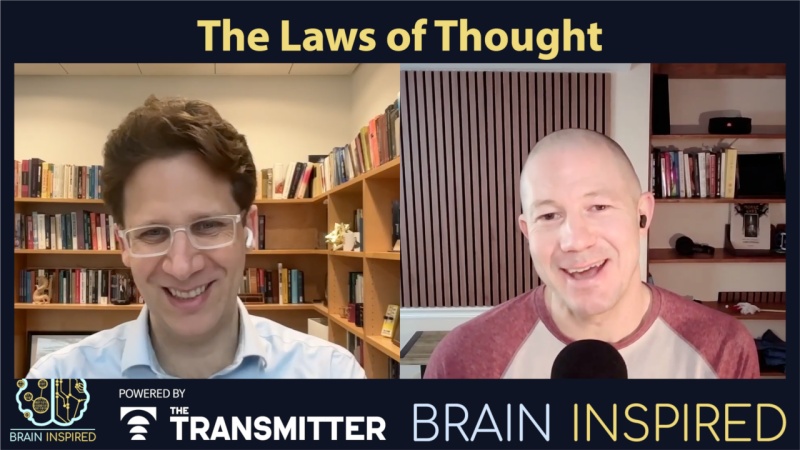
Tom Griffiths directs both the Computational Cognitive Science Lab and the Princeton Laboratory for Artificial Intelligence at Princeton University. He's been on brain inspired before to talk about his previous book Algorithms to Live By: The Computer Science of Human Decisions, which he co-wrote with Brian Christian. Today he's here to talk about his new book, The Laws of Thought: The Quest for a Mathematical Theory of the Mind. In this book, Tom explains how the three pillars of logic, neural networks, and probability theory complement each other to explain cognition, arguing we are on the doorstep to settling what mathematical principles - the so-called "laws of thought" - underly our cognition. So we discuss a little bit about a lot of things, including the concepts themselves, the people who have generated and worked on those concepts. I should also mentioned, Tom recorded a bunch of his interviews with people he writes about, and he's edited and polished those into a podcast called the Cognition Project, which I have enjoyed after reading the book, and I think you'd enjoy it either before or after you read the book.
Computational Cognitive Science Lab
Princeton Laboratory for Artificial Intelligence
Social: @cocosci_lab; @cocoscilab.bsky.social
Book:
The Laws of Thought: The Quest for a Mathematical Theory of the Mind.
Podcast: The Cognition Project
Read the transcript.
0:00 - Intro
3:20 - Tom's approach
7:19 - 3 pillars of the laws of thought
28:24 - Logic and formal systems strip away meaning
39:04 - Nature of thought
50:35 - Kahneman and Tversky
1:015:12 - Enabling constraints and inductive bias
1:12:51 - Hidden layers, probability, and hidden markov models
1:20:47 - Conscious vs nonconscious
1:23:43 - Feelings
1:31:26 - Personal

Support the show to get full episodes, full archive, and join the Discord community.
The Transmitter is an online publication that aims to deliver useful information, insights and tools to build bridges across neuroscience and advance research. Visit thetransmitter.org to explore the latest neuroscience news and perspectives, written by journalists and scientists.
Read more about our partnership.
Sign up for Brain Inspired email alerts to be notified every time a new Brain Inspired episode is released.
To explore more neuroscience news and perspectives, visit thetransmitter.org.
How does brain activity explain your perceptions and your actions? That's what neuroscientists ask. How does the interaction between brain, body, and environment explain your perceptions and actions? That's what ecological psychologists ask… sometimes leaving the brain out of the equation altogether. These different approaches to perception and action come with different terms, concepts, underlying assumptions, and targets of explanations.
So what happens when neuroscientists are inspired by ecological psychology but don't necessarily want take on, or are ignorant of, the fundamental principles underlying ecological psychology?
This happens all the time, like how AI was "inspired" by the most rudimentary understanding of how brains work, and took terms from neuroscience like neuron, neural network, and so on, as stand-ins for their models. This has in some sense re-defined what people mean by neuron, and neural network, and how they function and how we should think of them.
Modern neuroscience, with better data collecting tools, has taken a turn toward more naturalistic experimental paradigms to study how brains operate in more ecologically valid situations than what has mostly been used in the history of neuroscience - highly controlled tasks and experimental setups that arguably have very little to do with how organisms evolved to interact with the world to do cognitive things.
One problem with this turn is that we neuroscientists don't have ready-made theoretical tools to deal with the less constrained massive amounts of data the new approach affords. This has led some neuroscientists to seek those theoretical concepts elsewhere. One of those places that offers those theoretical tools is ecological psychology, developed by James and Eleanor Gibson in the mid-20th century, and continued since then by many adherents of the concepts introduced by ecological psychology. Those concepts are very specific with regard to how and what to explain regarding perception and action.
Matthieu de Wit is an associate professor at Muhlenberg College in Pennsylvania, who runst the ECON Lab, as in Ecological Neuroscience. Luis Favela is an associate professor at Indiana University. He's been on before to talk about his book The Ecological Brain. And Vicente Raja is a research fellow at University of Murcia in Spain, and he's been on before to talk about ecological psychology and neuroscience.
With their deep expertise in ecological psychology, they are keenly interested in how neuroscience write large adopts various facets of ecological psychology. Do neuroscientists have it right? Do they need to have it right? Is there something being lost in translation? How should neuroscientists adopt ecological psychology for an ecological neuroscience? That's what we're discussing today.
More broadly, this is also a story about what it's like doing research that isn't part of the current mainstream approach, in this doing ecological psychology under the long shadow cast by the computational mechanistic neuro-centric dominant paradigm in neuroscience currently.
Matthieu de Wit lab.
@dewitmm.bsky.social
Luis Favela.
The Ecological Brain: Unifying the Sciences of Brain, Body, and Environment
Vicente Raja
@diovicen.bsky.social
MINT Lab.
Ecological psychology
Previous episodes:BI 223 Vicente Raja: Ecological Psychology Motifs in NeuroscienceBI 190 Luis Favela: The Ecological Brain
BI 213 Representations in Minds and Brains
Read the transcript.
0:00 - Intro
8:23 - How Louie, Vicente, and Matthieu know each other
11:16 - Past present and future of relation between neuroscience and ecological psychology
17:02 - Why resistance to integrating neuroscience into ecological psychology?
28:26 - What counts as ecological psychology?
33:32 - Affordances properly understood
40:33 - Ecological information
47:58 - Importance of dynamics
48:59 - What's at stake?
58:27 - Environment intervention
1:16:21 - When ecological neuroscience publishes
1:31:25 - Neuroscientists escape hatch
1:38:04 - Is ecological psychology a theory of everything?

Support the show to get full episodes, full archive, and join the Discord community.
The Transmitter is an online publication that aims to deliver useful information, insights and tools to build bridges across neuroscience and advance research. Visit thetransmitter.org to explore the latest neuroscience news and perspectives, written by journalists and scientists.
Read more about our partnership.
Sign up for Brain Inspired email alerts to be notified every time a new Brain Inspired episode is released.
To explore more neuroscience news and perspectives, visit thetransmitter.org.
Jaan Aru is a co-principal investigator of the Natural and Artificial Intelligence Lab at the University of Tartu in Estonia, where he is an associate professor. Jaan's name has kept popping up on papers I've read over the last few years, sometimes alongside other guests I've had on the podcast, like Matthew Larkum and Mac Shine. With those people and others, he has co-authored papers exploring how some of the pesky biological details of brains might be important for our subjective conscious experience, details like dendritic integration, and loops between the cortex and the thalamus. Turns out a recurring theme in his work is to connect lower-level nitty gritty biological details with higher level cognitive functioning. And he has some thoughts about what that might mean for the prospects of consciousness in artificial systems. And we also touch on his more recent interest in understanding the brain basis of insight and creativity, connecting some of the more mundane kinds of insights during problem solving, for example, with some of the more profound kinds of insights during mystical and psychedelic experiences, for example.
Natural & Artificial Intelligence Lab
Social: @jaanaru.bsky.social
Related papers
The feasibility of artificial consciousness through the lens of neuroscience
On biological and artificial consciousness: A case for biological computationalism
Cellular mechanisms of conscious processing.
Realization experiences: a convergent account of insight and mystical experiences.
0:00 - Intro
4:21 - Jaan's approach
8:51 - Likelihood of machine consciousness
18:58 - Across-levels understanding
30:23 - Intelligence vs consciousness
36:27 - Connecting low-level implementation to cognition
45:42 - Organization and constraints
52:28 - Thalamocortical loops
1:04:18 - Artificial consciousness
1:14:34 - Theories of consciousness
1:23:16 - Creativity and insight
1:37:26 - Science research in Estonia

Support the show to get full episodes, full archive, and join the Discord community.
The Transmitter is an online publication that aims to deliver useful information, insights and tools to build bridges across neuroscience and advance research. Visit thetransmitter.org to explore the latest neuroscience news and perspectives, written by journalists and scientists.
Read more about our partnership.
Sign up for Brain Inspired email alerts to be notified every time a new Brain Inspired episode is released.
To explore more neuroscience news and perspectives, visit thetransmitter.org.
Michael Shadlen is a professor of neuroscience in the Department of Neuroscience at Columbia University, where he's the principle investigator of the Shadlen Lab. If you study the neural basis of decision making, you already know Shadlen's extensive research, because you are constantly referring to it if you're not already in his lab doing the work. The name Shadlen adorns many many papers relating the behavior and neural activity during decision-making to mathematical models in the drift diffusion family of models. That's not the only work he is known for,
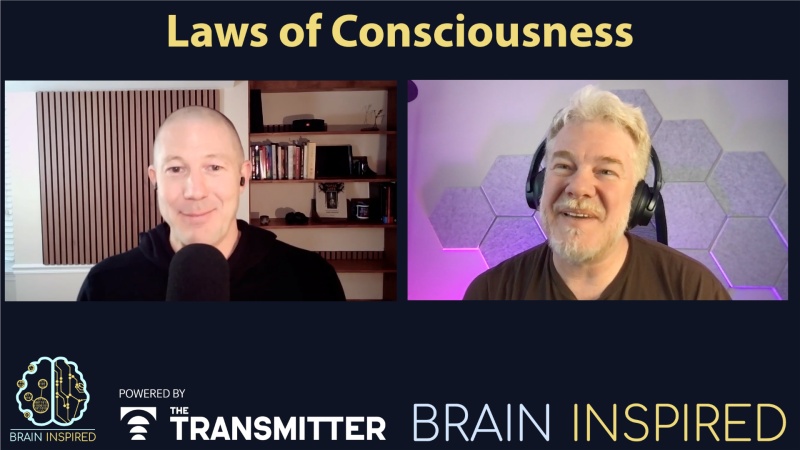
As you may have gleaned from those little intro clips, Michael is with me today to discuss his account of what makes a thought conscious, in the hopes to inspire neuroscience research to eventually tackle the hard problem of consciousness - why and how we have subjective experience.
But Mike's account isn't an account of just consciousness. It's an account of nonconscious thought and conscious thought, and how thoughts go from non-conscious to conscious
His account is inspired by multiple sources and lines of reasoning.
Partly, Shadlen refers to philosophical accounts of cognition by people like Marleau-Ponty and James Gibson, appreciating the embodied and ecological aspects of cognition.
And much of his account derives from his own decades of research studying the neural basis of decision-making mostly using perceptual choice tasks where animals make eye movements to report their decisions.
So we discuss some of that, including what we continue to learn about neurobiological, neurophysiological, and anatomical details of brains, and the possibility of AI consciousness, given Shadlen's account.
Shadlen Lab.
Twitter: @shadlen.
Decision Making and Consciousness (Chapter in upcoming Principles of Neuroscience textbook).
Talk: Decision Making as a Model of thought
Read the transcript.
0:00 - Intro
7:05 - Overview of Mike's account
9:10 - Thought as interrogation
21:03 - Neurons and thoughts
27:05 - Why so many neurons?
36:21 - Evolution of Mike's thinking
39:48 - Marleau-Ponty, cognition, and meaning
44:54 - Naturalistic tasks
51:11 - Consciousness
58:01 - Martin Buber and relational consciousness
1:00:18 - Social and conscious phenomena correlated
1:04:17 - Function vs. nature of consciousness
1:06:05 - Did language evolve because of consciousness?
1:11:11 - Weak phenomenology and long-range feedback
1:22:02 - How does interrogation work in the brain?
1:26:18 - AI consciousness
1:35:49 - The hard problem of consciousness
1:39:34 - Meditation and flow

Support the show to get full episodes, full archive, and join the Discord community.
The Transmitter is an online publication that aims to deliver useful information, insights and tools to build bridges across neuroscience and advance research. Visit thetransmitter.org to explore the latest neuroscience news and perspectives, written by journalists and scientists.
Read more about our partnership.
Sign up for Brain Inspired email alerts to be notified every time a new Brain Inspired episode is released.
To explore more neuroscience news and perspectives, visit thetransmitter.org.
Tomaso Poggio is the Eugene McDermott professor in the Department of Brain and Cognitive Sciences, an investigator at the McGovern Institute for Brain Research, a member of the MIT Computer Science and Artificial Intelligence Laboratory (CSAIL) and director of both the Center for Biological and Computational Learning at MIT and the Center for Brains, Minds, and Machines.
Tomaso believes we are in-between building and understanding useful AI That is, we are in between engineering and theory. He likens this stage to the period after Volta invented the battery and Maxwell developed the equations of electromagnetism. Tomaso has worked for decades on the theory and principles behind intelligence and learning in brains and machines. I first learned of him via his work with David Marr, in which they developed "Marr's levels" of analysis that frame explanation in terms of computation/function, algorithms, and implementation. Since then Tomaso has added "learning" as a crucial fourth level. I will refer to you his autobiography to learn more about the many influential people and projects he has worked with and on, the theorems he and others have proved to discover principles of intelligence, and his broader thoughts and reflections.
Right now, he is focused on the principles of compositional sparsity and genericity to explain how deep learning networks can (computationally) efficiently learn useful representations to solve tasks.
Lab website.
Tomaso's Autobiography
Related papers
Position: A Theory of Deep Learning Must Include Compositional Sparsity
The Levels of Understanding framework, revised
Blog post:
Poggio lab blog.
The Missing Foundations of Intelligence
Read the transcript.
0:00 - Intro
9:04 - Learning as the fourth level of Marr's levels
12:34 - Engineering then theory (Volta to Maxwell)
19:23 - Does AI need theory?
26:29 - Learning as the door to intelligence
38:30 - Learning in the brain vs backpropagation
40:45 - Compositional sparsity
49:57 - Math vs computer science
56:50 - Generalizability
1:04:41 - Sparse compositionality in brains?
1:07:33 - Theory vs experiment
1:09:46 - Who needs deep learning theory?
1:19:51 - Does theory really help? Patreon
1:28:54 - Outlook
Support the show to get full episodes, full archive, and join the Discord community.
The Transmitter is an online publication that aims to deliver useful information, insights and tools to build bridges across neuroscience and advance research. Visit thetransmitter.org to explore the latest neuroscience news and perspectives, written by journalists and scientists.
Read more about our partnership.
Sign up for Brain Inspired email alerts to be notified every time a new Brain Inspired episode is released.
To explore more neuroscience news and perspectives, visit thetransmitter.org.
Alex is an associate professor of psychology at Vanderbilt University where he heads the Maier Lab. His work in neuroscience spans vision, visual perception, and cognition, studying the neurophysiology of cortical columns, and other related topics. Today, he is here to discuss where his focus has shifted over the past few years, the neuroscience of consciousness. I should say shifted back, since that was his original love, which you'll hear about.
I've known Alex since my own time at Vanderbilt, where I was a postdoc and he was a new faculty member, and I remember being impressed with him then. I was at a talk he gave - job talk or early talk - where it was immediately obvious how passionate and articulate he is about what he does, and I remember he even showed off some of his telescope photography - good pictures of the moon, I remember. Anyway, we always had fun interactions, even if sometimes it was a quick hello as he ran up stairs and down hallways to get wherever he was going, always in a hurry.
Today we discuss why Alex sees integration information theory as the most viable current prospect for explaining consciousness. That is mainly because IIT has developed a formalized mathematical account that hopes to do for consciousness what other math has done for physics, that is, give us what we know as laws of nature. So basically our discussion revolves around everything related to that, like philosophy of science, distinguishing mathematics from "the mathematical", some of the tools he is finding valuable, like category theory, and some of his work measuring the level of consciousness IIT says a whole soccer team has, not just the individuals that comprise the team.
Maier Lab
Astonishing Hypothesis (Alex's youtube channel)
Twitter:
Sensation and Perception textbook (in-the-making)
Related papers
Linking the Structure of Neuronal Mechanisms to the Structure of Qualia
Information integration and the latent consciousness of human groups
Neural mechanisms of predictive processing: a collaborative community experiment through the OpenScope program
Various things Alex mentioned:
“An Antiphilosophy of Mathematics,” Peter J. Freyd youtube video about "the mathematical".
David Kaiser's playlist on modern physics.
Here's a link to the Integrated Information Theory Wiki.
Read the transcript.
0:00 - Intro
4:27 - Discovering consciousness science
11:23 - Laws of perception
15:48 - Integrated information theory and mathematical formalism
23:54 - Theories of consciousness without math
28:18 - Computation metaphor
34:44 - Formalized mathematics is the way
36:56 - Category theory
41:42 - Structuralism
51:09 - The mathematical
54:33 - Metaphysics of the mathematical
59:52 - Yoneda Lemma
1:12:05 - What's real
1:26:22 - Measuring consciousness of a soccer team
1:35:03 - Assumptions and approximations of IIT
1:43:13 - Open science
Support the show to get full episodes, full archive, and join the Discord community.
The Transmitter is an online publication that aims to deliver useful information, insights and tools to build bridges across neuroscience and advance research. Visit thetransmitter.org to explore the latest neuroscience news and perspectives, written by journalists and scientists.
Read more about our partnership.
Sign up for Brain Inspired email alerts to be notified every time a new Brain Inspired episode is released.
To explore more neuroscience news and perspectives, visit thetransmitter.org.
Can you look at all the synaptic connections of a brain, and tell me one nontrivial memory from the organism that has that brain? If so, you shall win the $100,000 prize from the Aspirational Neuroscience group.
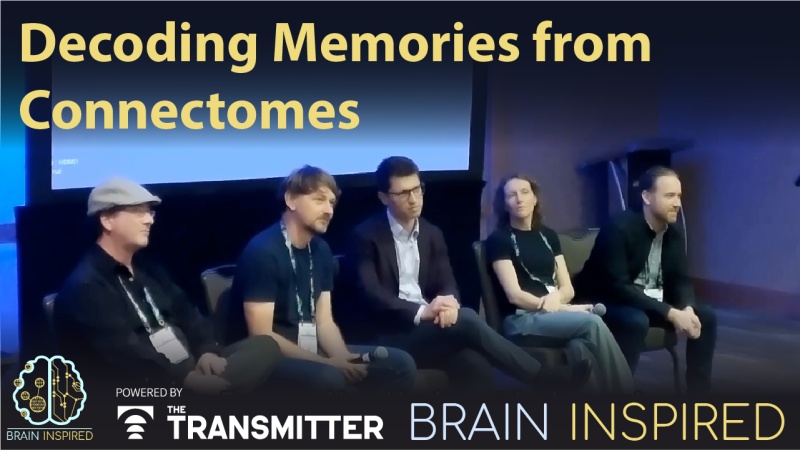
I was recently invited for the second time to chair a panel of experts to discuss that question and all the issues around that question - how to decode a non-trivial memory from a static map of synaptic connectivity.
Before I play that recording, let me set the stage a bit more.
Aspirational Neuroscience is a community of neuroscientists run by Kenneth Hayworth, with the goal, from their website, to "balance aspirational thinking with respect to the long-term implications of a successful neuroscience with practical realism about our current state of ignorance and knowledge." One of those aspirations is to decoding things - memories, learned behaviors, and so on - from static connectomes. They hold satellite events at the SfN conference, and invite experts in connectomics from academia and from industry to share their thoughts and progress that might advance that goal.
In this panel discussion, we touch on multiple relevant topics. One question is what is the right experimental design or designs that would answer whether we are decoding memory - what is a benchmark in various model organisms, and for various theoretical frameworks? We discuss some of the obstacles in the way, both technologically and conceptually. Like the fact that proofreading connectome connections - manually verifying and editing them - is a giant bottleneck, or like the very definition of memory, what counts as a memory, let alone a "nontrivial" memory, and so on. And they take lots of questions from the audience as well.
I apologize the audio is not crystal clear in this recording. I did my best to clean it up, and I take full blame for not setting up my audio recorder to capture the best sound. So, if you are a listener, I'd encourage you to check out the video version, which also has subtitles throughout for when the language isn't clear.
Anyway, this is a fun and smart group of people, and I look forward to another one next year I hope.
The last time I did this was episode 180, BI 180, which I link to in the show notes. Before that I had on Ken Hayworth, whom I mentioned runs Aspirational Neuroscience, and Randal Koene, who is on the panel this time. They were on to talk about the future possibility of uploading minds to computers based on connectomes. That was episode 103.
Aspirational Neuroscience
Panel
Michał Januszewski@michalwj.bsky.social
Research scientist (connectomics) with Google Research, automated neural tracing expert
Sven Dorkenwald
@sdorkenw.bsky.social
Research fellow at the Allen Institute, first-author on first full Drosophila connectome paper
Helene Schmidt@helenelab.bsky.social
Group leader at Ernst Strungmann Institute, hippocampus connectome & EM expert
Andrew Payne
@andrewcpayne.bsky.social
Founder of E11 Bio, expansion microscopy & viral tracing expert
Randal Koene
Founder of the Carboncopies Foundation, computational neuroscientist dedicated to the problem of brain emulation.
Related episodes:
BI 103 Randal Koene and Ken Hayworth: The Road to Mind Uploading
BI 180 Panel Discussion: Long-term Memory Encoding and Connectome Decoding
 1
1Support the show to get full episodes, full archive, and join the Discord community.
The Transmitter is an online publication that aims to deliver useful information, insights and tools to build bridges across neuroscience and advance research. Visit thetransmitter.org to explore the latest neuroscience news and perspectives, written by journalists and scientists.
Read more about our partnership.
Sign up for Brain Inspired email alerts to be notified every time a new Brain Inspired episode is released.
To explore more neuroscience news and perspectives, visit thetransmitter.org.
Tatiana Engel runs the Engel lab at Princeton University in the Princeton Neuroscience Institute. She's also part of the International Brain Laboratory, a massive across-lab, across-world, collaboration which you'll hear more about. My main impetus for inviting Tatiana was to talk about two projects she's been working on. One of those is connecting the functional dynamics of cognition with the connectivity of the underlying neural networks on which those dynamics unfold. We know the brain is high-dimensional - it has lots of interacting connections, we know the activity of those networks can often be described by lower-dimensional entities called manifolds, and Tatiana and her lab work to connect those two processes with something they call latent circuits. So you'll hear about that, you'll also hear about how the timescales of neurons across the brain are different but the same, why this is cool and surprising, and we discuss many topics around those main topics.
Engel Lab.
@engeltatiana.bsky.social.
International Brain Laboratory.
Related papers:
Latent circuit inference from heterogeneous neural responses during cognitive tasks
The dynamics and geometry of choice in the premotor cortex.
A unifying perspective on neural manifolds and circuits for cognition
Brain-wide organization of intrinsic timescales at single-neuron resolution
Single-unit activations confer inductive biases for emergent circuit solutions to cognitive tasks.
0:00 - Intro
3:03 - No central executive
5:01 - International brain lab
15:57 - Tatiana's background
24:49 - Dynamical systems
17:48 - Manifolds
33:10 - Latent task circuits
47:01 - Mixed selectivity
1:00:21 - Internal and external dynamics
1:03:47 - Modern vs classical modeling
1:14:30 - Intrinsic timescales
1:26:05 - Single trial dynamics
1:29:59 - Future of manifolds

Support the show to get full episodes, full archive, and join the Discord community.
The Transmitter is an online publication that aims to deliver useful information, insights and tools to build bridges across neuroscience and advance research. Visit thetransmitter.org to explore the latest neuroscience news and perspectives, written by journalists and scientists.
Read more about our partnership.
Sign up for Brain Inspired email alerts to be notified every time a new Brain Inspired episode is released.
To explore more neuroscience news and perspectives, visit thetransmitter.org.
Henk de Regt is a professor of Philosophy of Science and the director of the Institute for Science in Society at Radboud University. Henk wrote the book on Understanding. Literally, he wrote what has become a classic in philosophy of science, Understanding Scientific Understanding.
Henks' account of understanding goes roughly like this, but you can learn more in his book and other writings. To claim you understand something in science requires that you can produce a theory-based explanation of whatever you claim to understand, and it depends on you having the right scientific skills to be able to work productively with that theory - for example, making qualitative predictions about it without performing calculations. So understanding is contextual and depends on the skills of the understander.
There's more nuance to it, so like I said you should read the book, but this account of understanding distinguishes it from explanation itself, and distinguishes it from other accounts of understanding, which take understanding to be either a personal subjective sense - that feeling of something clicking in your mind - or simply the addition of more facts about something.
In this conversation, we revisit Henk's work on understanding, and how it touches on many other topics, like realism, the use of metaphors, how public understanding differs from expert understanding, idealization and abstraction in science, and so on.
And, because Henk's kind of understanding doesn't depend on subjective awareness or things being true, he and his cohorts have begun working on whether there could be a benchmark for degrees of understanding, to possibly asses whether AI demonstrates understanding, and to use as a common benchmark for humans and machines.
Google Scholar page
Social: @henkderegt.bsky.social;
Book:
Understanding Scientific Understanding.
Related papers
Towards a benchmark for scientific understanding in humans and machines
Metaphors as tools for understanding in science communication among experts and to the public
Two scientific perspectives on nerve signal propagation: how incompatible approaches jointly promote progress in explanatory understanding
0:00 - Intro
10:13 - Philosophy of explanation vs understanding
14:32 - Different accounts of understanding
20:29 - Henk's account of understanding
26:47 - What counts as intelligible?
34:09 - Hodgkin and Huxley alternative
37:54 - Familiarity vs understanding
44:42 - Measuring understanding
1:02:53 - Machine understanding
1:16:39 - Non-factive understanding
1:23:34 - Abstraction vs understanding
1:31:07 - Public understanding of science
1:41:35 - Reflections on the book

Support the show to get full episodes, full archive, and join the Discord community.
The Transmitter is an online publication that aims to deliver useful information, insights and tools to build bridges across neuroscience and advance research. Visit thetransmitter.org to explore the latest neuroscience news and perspectives, written by journalists and scientists.
Read more about our partnership.
Sign up for Brain Inspired email alerts to be notified every time a new Brain Inspired episode is released.
To explore more neuroscience news and perspectives, visit thetransmitter.org.
My guest today is Dan Nicholson, Assistant Professor of Philosophy at George Mason University, here to talk about his little book, What Is Life? Revisited. Erwin Schrödinger's What Is Life is a famous book that people point to as having predicted DNA and influenced and inspired many well-known biologists ushering in the molecular biology revolution. But Schrödinger was a physicist, not a biologist, and he spent very little time and effort toward understanding biology.
What was he up to, why did he write this "famous little book"? Schrödinger had an agenda, a physics agenda. He wanted to save the older deterministic version of quantum physics from the new indeterministic version. When Dan was on the podcast a few years ago, we talked about the machine view of biological systems, how everything has become a "mechanism", and how that view fails to capture what modern science is actually telling us, that organisms are unlike machines in important ways. That work of Dan's led him down this path to Schrödinger's What Is Life, which he argues was a major contributor to that machine metaphor so ubiquitous today in biology. One of the reasons I'm interested in this kind of work is because the cognitive sciences, including neuroscience and artificial intelligence, inherited this mechanistic perspective, and swallowed it so hard that if you don't include the word "mechanism" in your research paper, you're vastly decreasing your chances of getting your work published, when in fact the mechanistic perspective is one super useful perspective among many.
Dan’s website. Google Scholar.
Social: @NicholsonHPBio; @djnicholson.bsky.social
What Is Life? Revisited
Previous episode:
BI 150 Dan Nicholson: Machines, Organisms, Processes
Read the transcript.
0:00 - Intro
7:27 - Why Schrodinger wrote What is Life
15:13 - Aperiodic crystal and the meaning of code
21:39 - Order-from-order, order-from-disorder
28:32 - Appeal to authority
37:48 - Cell as machine
39:33 - Relation between DNA and organism (development)
44:44 - Negentropy
53:54 - Original contributions
58:54 - Mechanistic metaphor in neuroscience
1:16:05 - What's the lesson?
1:28:06 - Historical sleuthing
1:39:49 - Modern philosophy of biology
Support the show to get full episodes, full archive, and join the Discord community.
Vicente Raja is a research fellow at University of Murcia in Spain, where he is also part of the Minimal Intelligence Lab run by Paco Cavo, where they study plant behavior, and he is external affiliate faculty of the Rotman Institute of Philosophy at Western University. He is a philosopher, and he is a cognitive scientist, and he specializes in applying concepts from ecological psychology to understand how brains, and organisms, including plants, get about in the world.
We talk about many facets of his research, both philosophical and scientific, and maybe the best way to describe the conversation is a tour among many of the concepts in ecological psychology - like affordances, ecological information, direct perception, and resonance, and how those concepts do and don't, and should or shouldn’t, contribute to our understanding of brains and minds.
We also discuss Vicente's use of the term motif to describe scientific concepts that allow different researches to study roughly the same things even though they have different definitions for those things, and toward the end we touch on his work studying plant behavior.
MINT Lab.
Book: Ecological psychology
Social: @diovicen.bsky.social
Related papers
In search for an alternative to the computer metaphor of the mind and brain
Embodiment and cognitive neuroscience: the forgotten tales.
The motifs of radical embodied neuroscience
The Dynamics of Plant Nutation
Ecological Resonance Is Reflected in Human Brain Activity
Affordances are for life (and not just for maximizing reproductive fitness)
Two species of realism
Lots of previous guests and topics mentioned:
BI 152 Michael L. Anderson: After Phrenology: Neural Reuse
BI 190 Luis Favela: The Ecological Brain
BI 191 Damian Kelty-Stephen: Fractal Turbulent Cascading Intelligence
Read the transcript.
0:00 - Intro
4:55 - Affordances and neuroscience
13:46 - Motifs
39:41- Reconciling neuroscience and ecological psychology
1:07:55 - Predictive processing
1:15:32 - Resonance
1:23:00 - Biggest holes in ecological psychology
1:29:50 - Plant cognition
Support the show to get full episodes, full archive, and join the Discord community.
The Transmitter is an online publication that aims to deliver useful information, insights and tools to build bridges across neuroscience and advance research. Visit thetransmitter.org to explore the latest neuroscience news and perspectives, written by journalists and scientists.
Read more about our partnership.
Sign up for Brain Inspired email alerts to be notified every time a new Brain Inspired episode is released.
To explore more neuroscience news and perspectives, visit thetransmitter.org.
Nikolay Kukushkin is an associate professor at New York University, and a senior scientist at Thomas Carew’s laboratory at the Center for Neural Science. He describes himself as a "molecular philosopher", owing to his day job as a molecular biologist and his broad perspective on how it "hangs together", in the words of Wilfrid Sellers, who in 1962 wrote, “The aim of philosophy, abstractly formulated, is to understand how things in the broadest possible sense of the term hang together in the broadest possible sense of the term”.
That is what Niko does in his book One Hand Clapping: Unraveling the Mystery of the Human Mind.
This book is about essences across spatial scales in nature. More precisely, it's about giving names to what is fundamental, or essential, to how things and processes function in nature. Niko argues those essences are where meaning resides. That's very abstract, and we'll spell it out more during the discussion. But as an example at the small scale, the essences of carbon and oxygen, respectively, are creation and destruction, which allows metabolism to occur in biological organisms. Moving way up the scale, following this essence perspective leads Niko to the conclusion that there is no separation between our minds and the world, and that instead we should embrace the relational aspect of mind and world as a unifying principle. On the way, via evolution, we discuss many more examples, plus some of his own work studying how memory works in individual cells, not just neurons or populations of neurons in brains.
Niko's website.
Twitter: @niko_kukushkin.
Book:
One Hand Clapping: Unraveling the Mystery of the Human Mind
Read the transcript.
0:00 - Intro
9:28 - Studying memory in cells
10:14 - Who the book is for
17:57 - Studying memory in cells
21:53 - What is memory?
29:49 - Book
29:52 - How the book came about
37:56 - Central message of the book
44:07 - Meaning in nature
49:09 - Meaning and essence
51:55 - Multicellularity and ant colonies
57:43 - Eukaryotes and complexification
1:03:38 - Why do we have brains?
1:06:17 - Emergence
1:10:58 - Language
1:12:41 - Human evolution
1:14:41 - Artificial intelligence, meaning and essences
1:25:49 - Consciousness
Support the show to get full episodes, full archive, and join the Discord community.
Ann Kennedy is Associate Professor at Scripps Research Institute and runs the Laboratory for Theoretical Neuroscience and Behavior.
Among other things, Ann has been studying how processes important in life, like survival, threat response, motivation, and pain, are mediated through subcortical brain areas like the hypothalamus. She also pays attention to the time course those life processes require, which has led her to consider how the expression of things like proteins help shape neural processes throughout the brain, so we can behave appropriately in those different contexts.
You'll hear us talk about how this is still a pretty open field in theoretical neuroscience, unlike the historically heavy use of theory in popular brain areas throughout the cortex, and the historically narrow focus on spikes or action potentials as the only game in town when it comes to neural computation. We discuss that and I link in the show notes to a commentary piece Ann wrote, in which she argues for both top-down and bottom-up theoretical approaches.
I also link to her papers about the early evolution of nervous systems, how heterogeneity or diversity of neurons is an advantage for neural computations, and we discuss a kaggle competition she developed to benchmark automated behavioral labels of behaving organisms, so that despite different researchers using different recording systems and setups, analyzing those data will produce consistent labels to better compare across labs and aggregated bigger and better data sets.
Laboratory for Theoretical Neuroscience and Behavior.
Social:
@antihebbiann.bsky.social
@Antihebbiann
The Kaggle competition Ann developed to generalize behavior categorization.
Related papersDynamics of neural activity in early nervous system evolution.Theoretical neuroscience has room to grow.
Neural heterogeneity controls computations in spiking neural networks.
A parabrachial hub for the prioritization of survival behavior.
An approximate line attractor in the hypothalamus encodes an aggressive state.
Read the transcript.
0:00 - Intro
3:36 - Why study subcortical areas?
13:30 - Evolution
15:06 - Dynamical systems and time scales
21:32 - NeuroAI
28:37 - Before there were brains
33:11 - Endogenous spontaneous activity
40:09 - Natural vs artificial
43:09 - Different is more - heterogeneity
45:32 - Neuromodulators and neuropeptide functions
55:47 - Heterogeneity: manifolds, subspaces, and gain
1:02:43 - Control knobs
1:09:45 - Theoretical neuroscience has room to grow
1:19:59 - Hypothalamus
1:20:57 - Subcortical vs "higher" cognition
1:24:53 - 4E cognition
1:26:56 - Behavior benchmarking
1:37:26 - Current challenges
1:39:46 - Advice to young researchers

Support the show to get full episodes, full archive, and join the Discord community.
The Transmitter is an online publication that aims to deliver useful information, insights and tools to build bridges across neuroscience and advance research. Visit thetransmitter.org to explore the latest neuroscience news and perspectives, written by journalists and scientists.
Read more about our partnership: https://www.thetransmitter.org/partners/
Sign up for the “Brain Inspired” email alerts to be notified every time a new “Brain Inspired” episode is released: https://www.thetransmitter.org/newsletters/
To explore more neuroscience news and perspectives, visit thetransmitter.org.
What changes and what stays the same as you scale from single neurons up to local populations of neurons up to whole brains? How tuning parameters like the gain in some neural populations affects the dynamical and computational properties of the rest of the system.
Those are the main questions my guests today discuss. Michael Breakspear is a professor of Systems Neuroscience and runs the Systems Neuroscience Group at the University of Newcastle in Australia. Mac Shine is back, he was here a few years ago. Mac runs the Shine Lab at the University of Sidney in Australia.
Michael and Mac have been collaborating on the questions I mentioned above, using a systems approach to studying brains and cognition. The short summary of what they discovered in their first collaboration is that turning up or down the gain across broad networks of neurons in the brain affects integration - working together - and segregation - working apart. They map this gain modulation on to the ascending arousal pathway, in which the locus coeruleus projects widely throughout the brain distributing noradrenaline. At a certain sweet spot of gain, integration and segregation are balanced near a bifurcation point, near criticality, which maximizes properties that are good for cognition.
In their recent collaboration, they used a coarse graining procedure inspired by physics to study the collective dynamics of various sizes of neural populations, going from single neurons to large populations of neurons. Here they found that despite different coding properties at different scales, there are also scale-free properties that suggest neural populations of all sizes, from single neurons to brains, can do cognitive stuff useful for the organism. And they found this is a conserved property across many different species, suggesting it's a universal principle of brain dynamics in general.
So we discuss all that, but to get there we talk about what a systems approach to neuroscience is, how systems neuroscience has changed over the years, and how it has inspired the questions Michael and Mac ask.
Breakspear: Systems Neuroscience Group.
@DrBreaky.
Shine: Shine Lab.
@jmacshine.
Related papers
Dynamic models of large-scale brain activity
Metastable brain waves
The modulation of neural gain facilitates a transition between functional segregation and integration in the brain
Multiscale Organization of Neuronal Activity Unifies Scale-Dependent Theories of Brain Function.
The brain that controls itself.
Metastability demystified — the foundational past, the pragmatic present and the promising future.
Generation of surrogate brain maps preserving spatial autocorrelation through random rotation of geometric eigenmodes.
Related episodes
BI 212 John Beggs: Why Brains Seek the Edge of Chaos
BI 216 Woodrow Shew and Keith Hengen: The Nature of Brain Criticality
BI 121 Mac Shine: Systems Neurobiology
Read the transcript.
0:00 - Intro
4:28 - Neuroscience vs neurobiology
8:01 - Systems approach
26:52 - Physics for neuroscience
33:15 - Gain and bifurcation: earliest collaboration
55:32 - Multiscale organization
1:17:54 - Roadblocks

Support the show to get full episodes, full archive, and join the Discord community.
The Transmitter is an online publication that aims to deliver useful information, insights and tools to build bridges across neuroscience and advance research. Visit thetransmitter.org to explore the latest neuroscience news and perspectives, written by journalists and scientists.
Read more about our partnership.
Sign up for Brain Inspired email alerts to be notified every time a new Brain Inspired episode is released.
To explore more neuroscience news and perspectives, visit thetransmitter.org.
Xaq Pitkow runs the Lab for the Algorithmic Brain at Carnegie Mellon University. The main theme of our discussion is how Xaq approaches his research into cognition by way of principles, from which his questions and models and methods spring forth. We discuss those principles, and In that light, we discuss some of his specific lines of work and ideas on the theoretical side of trying understand and explain a slew of cognitive processes. A few of the specifics we discuss are:
How when we present tasks for organisms to solve, they use strategies that are suboptimal relative to the task, but nearly optimal relative to their beliefs about what they need to do - something Xaq calls inverse rational control.
Probabilistic graph networks.
How brains use probabilities to compute.
A new ecological neuroscience project Xaq has started with multiple collaborators.
LAB: Lab for the Algorithmic Brain.
Related papers
How does the brain compute with probabilities?
Rational thoughts in neural codes.
Control when confidence is costly
Generalization of graph network inferences in higher-order graphical models.
Attention when you need.
Read the transcript.
0:00 - Intro
3:57 - Xaq's approach
8:28 - Inverse rational control
19:19 - Space of input-output functions
24:48 - Cognition for cognition
27:35 - Theory vs. experiment
40:32 - How does the brain compute with probabilities?
1:03:57 - Normative vs kludge
1:07:44 - Ecological neuroscience
1:20:47 - Representations
1:29:34 - Current projects
1:36:04 - Need a synaptome
1:42:20 - Across scales

Support the show to get full episodes, full archive, and join the Discord community.
We are in an exciting time in the cross-fertilization of the neurotech industry and the cognitive sciences. My guest today is Chris Rozell, who sits in that space that connects neurotech and brain research. Chris runs the Structured Information for Precision Neuroengineering Lab at Georgia Tech University, and he was just named the inaugural director of Georgia Tech’s Institute for Neuroscience, Neurotechnology, and Society. I think this is the first time on brain inspired we've discussed stimulating brains to treat mental disorders. I think. Today we talk about Chris's work establishing a biomarker from brain recordings of patients with treatment resistant depression, a specific form of depression. These are patients who have deep brain stimulation electrodes implanted in an effort to treat their depression. Chris and his team used that stimulation in conjunction with brain recordings and machine learning tools to predict how effective the treatment will be under what circumstances, and so on, to help psychiatrists better treat their patients. We'll get into the details and surrounding issues. Toward the end we also talk about Chris's unique background and path and approach, and why he thinks interdisciplinary research is so important. He's one of the most genuinely well intentioned people I've met, and I hope you're inspired by his research and his story.
Structured Information for Precision Neuroengineering Lab.
Twitter: @crozSciTech.
Related papers
Cingulate dynamics track depression recovery with deep brain stimulation.
Story Collider: Wired Lives
0:00 - Intro
3:20 - Overview of the study
17:11 - Closed and open loop stimulation
19:34 - Predicting recovery
28:45 - Control knob for treatment
39:04 - Historical and modern brain stimulation
49:07 - Treatment resistant depression
53:44 - Control nodes complex systems
1:01:06 - Explainable generative AI for a biomarker
1:16:40 - Where are we and what are the obstacles?
1:21:32 - Interface Neuro
1:24:55 - Why Chris cares
Read the transcript.

Support the show to get full episodes, full archive, and join the Discord community.
The Transmitter is an online publication that aims to deliver useful information, insights and tools to build bridges across neuroscience and advance research. Visit thetransmitter.org to explore the latest neuroscience news and perspectives, written by journalists and scientists.
Read more about our partnership.
Sign up for Brain Inspired email alerts to be notified every time a new Brain Inspired episode is released.
To explore more neuroscience news and perspectives, visit thetransmitter.org.
Do AI engineers need to emulate some processes and features found only in living organisms at the moment, like how brains are inextricably integrated with bodies? Is consciousness necessary for AI entities if we want them to play nice with us? Is quantum physics part of that story, or a key part, or the key part? Jennifer Prendki believes if we continue to scale AI, it will get us more of the same of what we have today, and that we should look to biology, life, and possibly consciousness to enhance AI. Jennifer is a former particle physicist turned entrepreneur and AI expert, focusing on curating the right kinds and forms of data to train AI, and in that vein she led those efforts at Deepmind on the foundation models ubiquitous in our lives now.
I was curious why someone with that background would come to the conclusion that AI needs inspiration from life, biology, and consciousness to move forward gracefully, and that it would be useful to better understand those processes in ourselves before trying to build what some people call AGI, whatever that is. Her perspective is a rarity among her cohorts, which we also discuss. And get this: she's interested in these topics because she cares about what happens to the planet and to us as a species. Perhaps also a rarity among those charging ahead to dominate profits and win the race
Jennifer's website: Quantum of Data.
The blog posts we discuss:
The Myth of Emergence
Embodiment & Sentience: Why the Body still Matters
The Architecture of Synthetic Consciousness
On Time and Consciousness
Superalignment and the Question of AI Personhood.
Read the transcript.
0:00 - Intro
3:25 - Jennifer's background
13:10 - Consciousness
16:38 - Life and consciousness
23:16 - Superalignment
40:11 - Quantum
1:04:45 - Wetware and biological mimicry
1:15:03 - Neural interfaces
1:16:48 - AI ethics
1:2:35 - AI models are not models
1:27:13 - What scaling will get us
1:39:53 - Current roadblocks
1:43:19 - Philosophy

Support the show to get full episodes, full archive, and join the Discord community.
The Transmitter is an online publication that aims to deliver useful information, insights and tools to build bridges across neuroscience and advance research. Visit thetransmitter.org to explore the latest neuroscience news and perspectives, written by journalists and scientists.
Read more about our partnership.
Sign up for Brain Inspired email alerts to be notified every time a new Brain Inspired episode is released.
To explore more neuroscience news and perspectives, visit thetransmitter.org.
A few episodes ago, episode 212, I conversed with John Beggs about how criticality might be an important dynamic regime of brain function to optimize our cognition and behavior. Today we continue and extend that exploration with a few other folks in the criticality world.
Woodrow Shew is a professor and runs the Shew Lab at the University of Arkansas. Keith Hengen is an associate professor and runs the Hengen Lab at Washington University in St. Louis Missouri. Together, they are Hengen and Shew on a recent review paper in Neuron, titled Is criticality a unified setpoint of brain function? In the review they argue that criticality is a kind of homeostatic goal of neural activity, describing multiple properties and signatures of criticality, they discuss multiple testable predictions of their thesis, and they address the historical and current controversies surrounding criticality in the brain, surveying what Woody thinks is all the past studies on criticality, which is over 300. And they offer a account of why many of these past studies did not find criticality, but looking through a modern lens they most likely would. We discuss some of the topics in their paper, but we also dance around their current thoughts about things like the nature and implications of being nearer and farther from critical dynamics, the relation between criticality and neural manifolds, and a lot more. You get to experience Woody and Keith thinking in real time about these things, which I hope you appreciate.
Shew Lab. @ShewLab
Hengen Lab.
Is criticality a unified setpoint of brain function?
Read the transcript.
0:00 - Intro
3:41 - Collaborating
6:22 - Criticality community
14:47 - Tasks vs. Naturalistic
20:50 - Nature of criticality
25:47 - Deviating from criticality
33:45 - Sleep for criticality
38:41 - Neuromodulation for criticality
40:45 - Criticality Definition part 1: scale invariance
43:14 - Criticality Definition part 2: At a boundary
51:56 - New method to assess criticality
56:12 - Types of criticality
1:02:23 - Value of criticality versus other metrics
1:15:21 - Manifolds and criticality
1:26:06 - Current challenges
Support the show to get full episodes, full archive, and join the Discord community.
The Transmitter is an online publication that aims to deliver useful information, insights and tools to build bridges across neuroscience and advance research. Visit thetransmitter.org to explore the latest neuroscience news and perspectives, written by journalists and scientists.
Read more about our partnership.
Sign up for Brain Inspired email alerts to be notified every time a new Brain Inspired episode is released.
To explore more neuroscience news and perspectives, visit thetransmitter.org.
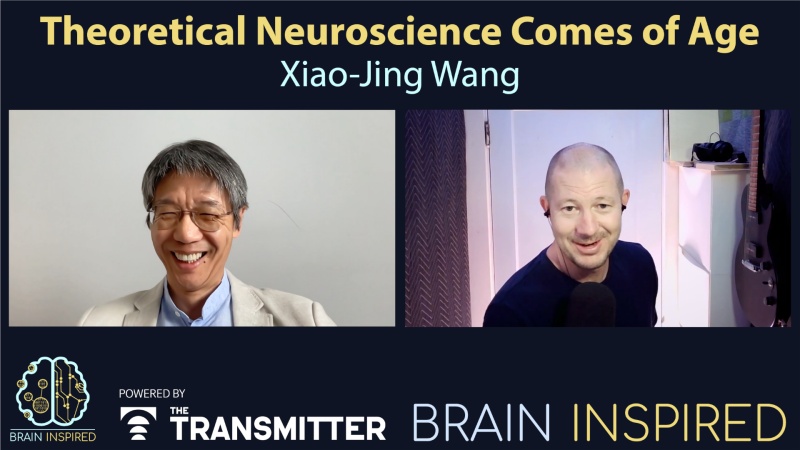
Xiao-Jing Wang is a Distinguished Global Professor of Neuroscience at NYU
Xiao-Jing was born and grew up in China, spent 8 years in Belgium studying theoretical physics like nonlinear dynamical systems and deterministic chaos. And as he says it, he arrived from Brussels to California as a postdoc, and in one day switched from French to English, from European to American culture, and physics to neuroscience. I know Xiao-Jing as a legend in non-human primate neurophysiology and modeling, paving the way for the rest of us to study brain activity related cognitive functions like working memory and decision-making.
He has just released his new textbook, Theoretical Neuroscience: Understanding Cognition, which covers the history and current research on modeling cognitive functions from the very simple to the very cognitive. The book is also somewhat philosophical, arguing that we need to update our approach to explaining how brains function, to go beyond Marr's levels and enter a cross-level mechanistic explanatory pursuit, which we discuss. I just learned he even cites my own PhD research, studying metacognition in nonhuman primates - so you know it's a great book. Learn more about Xiao-Jing and the book in the show notes. It was fun having one of my heroes on the podcast, and I hope you enjoy our discussion.
Computational Laboratory of Cortical Dynamics
Book: Theoretical Neuroscience: Understanding Cognition.
Related papers
Division of labor among distinct subtypes of inhibitory neurons in a cortical microcircuit of working memory.
Macroscopic gradients of synaptic excitation and inhibition across the neocortex.
Theory of the multiregional neocortex: large-scale neural dynamics and distributed cognition.
0:00 - Intro
3:08 - Why the book now?
11:00 - Modularity in neuro vs AI
14:01 - Working memory and modularity
22:37 - Canonical cortical microcircuits
25:53 - Gradient of inhibitory neurons
27:47 - Comp neuro then and now
45:35 - Cross-level mechanistic understanding
1:13:38 - Bifurcation
1:24:51 - Bifurcation and degeneracy
1:34:02 - Control theory
1:35:41 - Psychiatric disorders
1:39:14 - Beyond dynamical systems
1:43:447 - Mouse as a model
1:48:11 - AI needs a PFC

Support the show to get full episodes, full archive, and join the Discord community.
The Transmitter is an online publication that aims to deliver useful information, insights and tools to build bridges across neuroscience and advance research. Visit thetransmitter.org to explore the latest neuroscience news and perspectives, written by journalists and scientists.
Read more about our partnership.
Check out this story:
What, if anything, makes mood fundamentally different from memory?
Sign up for Brain Inspired email alerts to be notified every time a new Brain Inspired episode is released.
To explore more neuroscience news and perspectives, visit thetransmitter.org.
Elusive Cures: Why Neuroscience Hasn’t Solved Brain Disorders―and How We Can Change That. Nicole Rust runs the Visual Memory laboratory at the University of Pennsylvania. Her interests have expanded now to include mood and feelings, as you'll hear. And she wrote this book, which contains a plethora of ideas about how we can pave a way forward in neuroscience to help treat mental and brain disorders. We talk about a small plethora of those ideas from her book. which also contains the story partially which will hear of her own journey in thinking about these things from working early on in visual neuroscience to where she is now.
Nicole's website.
Elusive Cures: Why Neuroscience Hasn’t Solved Brain Disorders―and How We Can Change That.
0:00 - Intro
6:12 - Nicole's path
19:25 - The grand plan
25:18 - Robustness and fragility
39:15 - Mood
49:25 - Model everything!
56:26 - Epistemic iteration
1:06:50 - Can we standardize mood?
1:10:36 - Perspective neuroscience
1:20:12 - William Wimsatt
1:25:40 - Consciousness


Download from Google Play

Download from App Store
 United States
Fantastic Podcast - Goes into a fair amount of detail, whilst retaining a broad perspective on the context and potential of specific cutting-edge research - highly entertaining!