


 Claim Ownership
 Future IQ
Future IQSubscribed: 2Played: 87
Subscribe

© Videoschool Media
Description
It contains a nuanced and factual description and objective analysis of some of the most influential scientific, psychological, and philosophical principles that dictate an individual’s lifespan. Get ready to get your mind blown with this fact-based, conversation-style podcast show intended to inform and entertain you in equal parts.
150 Episodes
Reverse
What if the secret to using ChatGPT wasn’t about coding, but about psychology? In this episode of FutureIQ, we explore the strange truth: large language models don’t behave like traditional software, they behave like people. Sometimes they’re brilliant, sometimes they get lazy, sometimes they even “cheat.” And just like humans, they respond to pressure, persuasion, and coaching.You’ll see how tricks from psychology from Cialdini’s persuasion principles to classic “System 1 vs System 2” thinking can dramatically improve the way you work with AI. Researchers are even experimenting with cognitive-behavioral therapy (CBT) prompts for chatbots, while companies like Anthropic are quietly building “AI psychiatry” teams to deal with pathological cases.Why does this matter? Because the way you talk to an AI shapes the way it thinks. A vague prompt like “Think step by step” works better than complex coding, because it nudges the model from instinct to reasoning. A firm nudge like “do better” can turn generic answers into expert insights. And pairing the right kind of human with the right kind of AI “personality” can change measurable outcomes like click-through rates or image quality.The story is bigger than chatbots, it’s about us. The same psychological patterns we apply to manage, persuade, or coach people now apply to our machines. Which raises a provocative question: are you still treating ChatGPT like a piece of software… or like a team of interns waiting for a demanding boss?
How to become an expert? Who wins between talent and hard work? How many
hours does it take to be an expert to be successful in life? We have
discussed a very interesting concept of "Effort Shock" in this episode,
which explains how to excel in life with less effort. Just like
Bollywood songs where the lead becomes a super lead in a miraculous
song.
Check out this video, that explains whether you can become an expert
fast?
Hope you enjoyed FutureIQ by Navin Kabra and Shrikant Joshi. Do hit us
up on Twitter:
@ngkabra http://twitter.com/ngkabra
@shrikant https://twitter.com/shrikant
Listen it on the podcast provider of your choice: https://tapthe.link/FutureIQRSS
Watch other episodes of The FutureIQ podcast: https://www.youtube.com/playlist?list=PLAppTB0r5_TaYueZ0adD42Wiw5X-wTE4v
#futureiq #effortshock

The “boiling frog” idea appears in many fields under different names but the core insight is the same when change happens slowly enough, we stop noticing it. What would have shocked us yesterday becomes normal today.If you look around, you can see this pattern everywhere. Many things that would have been completely unacceptable to the Indian middle class thirty years ago are now routine. Television news has slowly shifted from being serious and restrained to becoming a loud spectacle. Working 70 hour weeks for a salaried job is often treated as normal ambition. Apps like Zomato, Swiggy, and Blinkit gradually turned the gig economy from an oddity into something that feels like the default. Even major political movements, like Anna Hazare’s India Against Corruption, seemed unstoppable at one point yet slowly faded away.Across psychology, politics, economics, and business, this gradual change shows up again and again. Political scientists call it the Overton Window, organizations experience it as normalization of deviance, salespeople use it through the foot in the door technique, and behavioral economists study it through nudges. Different names, different contexts but the same underlying mechanism small shifts, repeated over time, quietly reshape what people accept as normal.But this idea isn’t only something that happens to us. It’s also something we can deliberately use. Instead of relying on dramatic New Year’s resolutions that collapse within weeks, real progress often comes from tiny improvements repeated consistently. Reduce the sugar in your tea a little every month. Wake up a few minutes earlier each week. Improve by just 1% at a time. Over months and years, these nearly invisible steps can quietly compound into massive change.In this episode of Future IQ, we explore how this “boiling frog” principle shapes society, organizations, and our daily habits and how the same framework can help you climb your own Mount Everest, one small step at a time.

Why do loud, bright colours feel “cheap” to some people… and full of life to others? And why does beige suddenly become sophisticated the moment wealth enters the room?It’s easy to turn this into a joke. The poor love shiny gold and bright pink. The rich debate between ivory, cream, eggshell and “not quite off white.” But beneath the humour lies something far more interesting because this isn’t really about colour at all. Children naturally gravitate toward bold, primary colours. No one trains them to do that. Yet as people grow older, something shifts. Preferences become subtler. Muted tones begin to feel elegant. What once seemed exciting starts to feel loud. What once looked plain starts to look refined. That shift isn’t random. The brain adapts to whatever it repeatedly experiences. The more time spent noticing subtle differences in colours, music, writing, wine, design, even chai, the sharper perception becomes. If someone lives in an environment where fine distinctions matter, the brain reorganizes itself to detect those distinctions. If not, those subtleties barely register. It’s not a moral difference. It’s training.But perception is only half the story.Taste also functions as a social signal. Groups unconsciously develop preferences that are difficult to imitate without effort. Subtlety becomes a marker of belonging. Loud becomes “unsophisticated.” Minimal becomes “classy.” And when subtlety becomes too extreme, it flips into “pretentious.” At any given point, people tend to see those slightly behind them as lacking taste, those slightly ahead as aspirational, and those far ahead as absurd. It’s a quiet status game rarely intentional, almost always subconscious. So when the question arises “Why do poor people like loud colours?” a deeper question sits underneath: what environments train people to appreciate subtlety, and what environments reward visibility? Because in the end, colour preference is rarely about colour. It’s about exposure, identity, belonging, and the invisible hierarchies shaping perception. And once that pattern is seen, it appears everywhere.

Should you delete Instagram or learn how to use it better?The debate around Instagram has become intense. Rising teen anxiety, sleep disruption, body image pressures, addictive doomscrolling, and the sharp spike in mental health issues since 2012 have led many to call it toxic. Some even argue it should be banned in schools. But that’s only one side of the story.For millions of young people, Instagram is where friendships deepen, creativity flourishes, communities form, and careers quietly begin. It’s a portfolio, a classroom, a networking platform, and sometimes even a launchpad all in one app. So what’s really happening? Is Instagram the problem? Or is unmindful use the real issue? This conversation moves beyond outrage and defensiveness. It explores data, psychology, parental fears, teenage realities, algorithm control, doomscrolling vs connection, and what responsible use actually looks like.Because maybe the real question isn’t “Delete Instagram?”It’s “Are we mature enough to handle it?”
The Economic Survey of India 2025 - 2026 has taken a serious look at a question many people casually debate. Why do Indians behave abroad but not in India? Why is the metro clean and disciplined while city buses in the same city feel chaotic often used by the same people?Does this mean the issue will finally be resolved?According to the Survey, the problem is not awareness. Swachh Bharat had sustained communication, funding support and public participation. The problem is not values either. Indians are deeply committed to cleanliness inside their homes. In fact, the gap between private cleanliness and public disorder may be among the highest anywhere.The real issue, the Survey argues, is inconsistent enforcement, unclear penalties and weak institutional design.Using concepts from behavioral economics, coordination failures, Schelling Points and the Prisoner’s Dilemma, this episode explains why metro systems create disciplined behavior while bus systems struggle. It is not about culture. It is about credible enforcement, system reliability, identity formation and governance capacity.
What if Raam is actually your ancestor but you don’t have a single gene from him? What if a mother can fail her own child’s DNA test, identical twins don’t have perfectly identical DNA, and your family tree explodes to the size of the entire world in just a few dozen generations?This episode dives into the deeply unintuitive world of DNA, ancestry, and heredity where math breaks our common sense and biology refuses to behave the way we expect. We explore real court cases where women were accused of fraud because genetics said they weren’t their own children’s mothers, the strange reality of chimeras, and why being someone’s ancestor doesn’t guarantee you inherit anything from them.And yes we directly tackle the big question:Was Raam really your ancestor?Not as a matter of faith or belief, but using population mathematics, genetic inheritance, and historical constraints. By the end, you’ll know what science can (and cannot) say about that claim and why the answer is far more subtle than a simple yes or no.Along the way, we bust popular myths about ancestry tests, explain why family trees collapse into each other over time, and show how identity, heritage, and genetics are far more complicated than “who your genes came from.” This isn’t about proving mythology right or wrong. It’s about understanding how science reframes ancient questions and why intuition often gets it wrong.

Can an atheist defend religion without believing in God?That’s exactly what we’re doing in this episode.A FutureIQ viewer asked a sharp question: If you’re an atheist, why do you still talk about the Bhagavad Gita and religious teachings? This episode is our honest answer.We start by doing something unusual listing all the strongest problems with religion, exactly as a typical atheist would see them. False claims. Conflicting beliefs. Violence, guilt, fear, generational clashes, and misuse by power. No sugarcoating.Then comes the twist.Instead of asking “Is religion true?” we ask a more uncomfortable question:What has religion actually done to human behavior, cooperation, and society?From rituals and community bonding to coordination, shared meaning, and stability during chaos we explore why religion may have survived for thousands of years despite its flaws, and why removing it entirely may not solve the problems people think it will.This is not a defense of blind belief, and it’s not an attack on atheism.It’s a first-principles look at what religion gets wrong, what it accidentally gets right, and how to take the good without swallowing the bad.If you enjoy thoughtful debates, uncomfortable questions, and ideas that don’t fit neatly into ideological boxes this episode is for you.

For most of us, the word ritual instantly points to religion. Something sacred, inherited, and rarely questioned. You either follow rituals because you were taught to or you reject them entirely, believing that thinking people shouldn’t need them. Both reactions miss something important.Look closely at your own life. The way your day begins. That first cup of tea or coffee. The same route you walk when you’re stressed. The weekly call that somehow keeps a relationship alive. None of this is religious and yet it brings structure, calm, and predictability. These are rituals too. Quiet, secular ones that shape how you think and feel without asking for your belief.This episode explores what rituals really are: repeated actions loaded with meaning that slowly influence behavior, identity, and emotions. We look at how personal rituals reduce anxiety, automate good habits, and give stability during chaos and why shared rituals create trust, cooperation, and a sense of “we” in groups.But power cuts both ways. The very mechanism that builds habits and bonds can also be weaponized. When rituals become compulsory, sacred, and unquestionable, they stop being tools and start becoming instruments of control. History, politics, and even workplaces are full of examples where rituals are used to test obedience, suppress dissent, and fuse identity so tightly with a group that independent thought feels like betrayal.Rituals aren’t dangerous because they’re irrational. They’re dangerous because they work. And once you understand how they work, you gain a rare advantage: the ability to design good rituals for yourself while recognizing and resisting the bad ones when they’re used against you.
Why do some ideas feel negotiable, while others feel untouchable? You can debate movies, food, or even money but the moment someone insults a god, a nation, a hero, or a principle, people are willing to fight, cancel, or die.In this episode of Future IQ, we explore the hidden psychological force that decides which beliefs we protect with logic and which we protect with rage. It’s not just religion. The same force quietly governs nationalism, free speech, science, sports fandom, and even “rational” ideologies that claim to reject faith altogether.We look at how ordinary ideas turn into identity, how disagreement becomes betrayal, and why humans instinctively divide the world into “us” and “them.” Most importantly, we ask a dangerous question: is this force the root cause of humanity’s worst conflicts or the only reason large scale cooperation ever worked?Once you understand this mechanism, you’ll start seeing why some arguments are impossible to win, why compromise feels like treason, and why every society protects a few ideas at all costs even when it claims to be logical.This episode isn’t about taking sides. It’s about seeing the invisible rules that decide which beliefs rule us.
Why does Makar Sankranti fall on almost the same date every year, while most Indian festivals keep shifting? And if Uttarayan actually begins in December, why do we celebrate it in mid January? This episode breaks a very common assumption about the Indian calendar and reveals the elegant astronomical logic behind Sankranti.We explore what Sankranti really means, why there are 12 of them every year, and why only Makar Sankranti became culturally significant. From zodiac transitions and solar calendars to leap years and Earth’s slow cosmic wobble, this story connects ancient Indian astronomy with modern science in a surprisingly simple way.If you’ve ever wondered why Sankranti is sometimes on the 14th and sometimes on the 15th, or how calendars, equinoxes, and traditions like Uttarayan fit together, this episode will completely change how you look at Indian festivals and time itself.
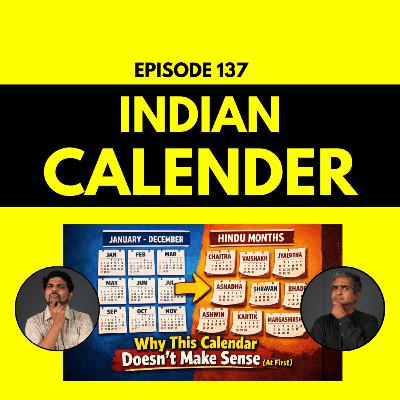
Why did the Hindu calendar in 2025 have two different days for Diwali? Why do Hindu festivals keep shifting days every year? Hindu festivals in fact, have a mathematically accurate system and thus the argument of "shifting days" becomes redundant. In this episode, we delve into the logic of the Hindu calendar, also popularly known as the Indian calendar. This calendar is not simply based on the lunar cycle, but it derives it's logic from precise mathematical calculations of the positions of the solar system. We breakdown every single concept in depth. What Tithi is in Astrology, how is a day in Hindu calendar different from a day in the Gregorian calendar, what is a Poornimanta system & what is a Amanta system within the Hindu calendar itself, how do the Zodiacs fit into this, and many more related concepts.
A coordination failure happens when there exists a better outcome that everyone would prefer, but no one can move to it alone, so society stays stuck in a worse system. In this episode of Future IQ, we break down what coordination failure really means and why it shows up everywhere around us.Using real world examples like traffic chaos, the 70 hour work week, education rankings, medical appointments, scientific research, corruption, and insurance driven healthcare, we show how rational people responding to incentives unintentionally create outcomes that are worse for everyone. We connect these patterns to ideas like the Prisoner’s Dilemma, multipolar traps, the Tragedy of the Commons, and Goodhart’s Law.The episode also explores why coordination failures are so hard to fix, how they slowly emerge without being designed, and why simply “being a good person” is not enough. Finally, we discuss when coordination does work—vaccinations, ozone protection, functioning governments and the four ingredients required to make coordination possible, along with the danger of coordinating for the wrong goal.If you’ve ever wondered why everyone agrees something is broken but nothing changes, this episode gives you the mental model you’ve been missing.
Why do some choices feel obvious even when no one explicitly chose them? Why does one leader emerge over others, why does 50–50 feel “fair,” and why is it sometimes easier to quit something completely than to do it in moderation? In this episode, we explore Schelling Points, a powerful idea from game theory that explains how people coordinate their behavior without communication, negotiation, or agreement. When there are many possible options, the human brain naturally gravitates toward what feels most salient, familiar, or expected.Using examples from Indian politics, leadership succession, border and property rights, marketing, traditions, and everyday social norms, we show how these invisible defaults quietly shape outcomes in the real world. From why Rahul Gandhi remains the leader of Congress, to why brands like Colgate dominate shelves, to why social norms persist long after they stop making sense.We’ll also look at how Schelling points create groups, echo chambers, and divisions, how beliefs and identities cluster into “Schelling sorts,” sometimes producing stability and sometimes producing deep and lasting conflict. Finally, we bring the idea back to your own life. You’ll learn how Schelling points can be used deliberately to create bright-line rules, break bad habits, simplify decisions, and notice where defaults were set for you without your conscious consent.This episode isn’t about how the world should work. It’s about how it actually works, and why changing it is so hard.
Why do “WhatsApp Uncles” exist? Why do they send endless Good Morning images, emotional stories, and “forwarded as received” messages that are often… not true? In this episode, we go far beyond the jokes and memes to uncover the real psychological and social forces shaping this behavior.You’ll discover how older Indians went from living in tight-knit communities joint families, neighbors, colleagues, constant social contact, to a world of loneliness, nuclear families, and shrinking offline connections. And how WhatsApp quietly stepped in to become Tribe as a Service and Status as a Service for millions of people who suddenly had no tribe and no place to feel important.We’ll explore why Good Morning messages became a billion dollar industry, how political groups learned to weaponize these behaviors, why echo chambers grow louder, and why directly correcting misinformation often backfires. Most importantly, we’ll discuss what you can do: how to protect your relationships, when to push back, how to gently guide people toward better thinking, and when to simply let go.This episode is not just about WhatsApp Uncles it’s about the unseen effects of technology on human psychology, and what it reveals about the modern world we’re all struggling to adapt to.
The world isn’t just changing, it’s rewriting the rules. What made you successful 10 or 20 years ago may not help you tomorrow, yet most of us continue to rely on old habits, outdated systems, and the advice of experts who mastered a world that no longer exists. We repeat familiar strategies because they feel safe, even when the environment around us has already changed.Like chess players still using classical openings in a format where those strategies no longer apply, or cricketers bringing Test match logic into a fast paced T20 world, we often cling to what once worked instead of adapting to what now matters. Our brains are wired for comfort and repetition, not reinvention.But the future demands a different approach. It doesn’t reward prediction, it rewards awareness. It doesn’t favour certainty. It favours experimentation. And it doesn’t need rigid beliefs, it needs open, adaptable thinking. In a rapidly shifting world shaped by AI, unconventional careers, evolving education systems, and constant technological disruptions, the real skill is learning how to learn and just as importantly, learning how to unlearn.This episode explores how to stay mentally flexible, how to identify outdated mental models before they hold you back, and how to cultivate a mindset that stays curious instead of defensive. Because the people who thrive in the future won’t be the ones with the most knowledge but the ones who can update their thinking the fastest.
We often imagine CEOs as people who know exactly how their companies run. Every workflow, every decision, every system. But research on large companies shows something surprising! even top leaders don’t fully understand how their own organizations function. Big companies aren’t clean, perfectly planned structures. They’re messy, constantly changing systems with undocumented processes, hidden ways of getting things done, and decisions shaped by many people and not just the person at the top.Studies in organizational theory, behavioral economics, and political science all point to the same conclusion. Large systems function through emergent behavior, informal routines, and negotiated power not clear top down control. Decisions often form through chaos, incentives, miscommunication, and politics, rather than rational planning.This episode breaks the illusion of perfect leadership and explores why real institutions resemble “organized anarchies,” why confidence doesn’t equal clarity, and why no one no matter how high up has a complete map of what’s going on.By the end, you’ll see companies, governments, and leadership in a very different way and you’ll understand why embracing uncertainty may be the most powerful strategy in a complex world.

Gold prices are hitting all-time highs, up 30% in just two months and yet India is buying more of it than ever. What makes gold so irresistible, even when logic says demand should fall? In this episode of Future IQ, we dig into the unique mix of economics, psychology, culture, and history that makes gold the world’s most evergreen asset.From ancient coins and royal treasuries to modern ETFs and gold bonds, we explore why gold became humanity’s favorite form of money, why it still beats almost every asset on trust and longevity, and why its appeal goes far beyond investment returns. Gold is durable, portable, divisible, culturally precious, emotionally charged, and the one thing people turn to when everything else feels uncertain.But if gold is so perfect, why do we use paper money today? And do digital forms of gold really give you the best of both worlds, or do they sacrifice the qualities that made gold special in the first place? This episode cuts through myths, hype, and tradition to explain why gold has lasted 6000 years and why it still matters today.
Everyone has that one uncle who swears life was perfect “back in the day.” Appliances never broke, marriages never failed, music was pure magic, food was straight from nature, teachers were gods, and doctors knew everything. Sounds amazing… except it’s mostly nonsense. In this episode of FutureIQ, we travel back in time not to the fantasy version, but the real one. A world where life expectancy crawled at 32, half of all children didn’t survive, famines were normal, and your ‘durable’ fridge cost you half a year’s salary. We remember the hits, forget the misery, and call it nostalgia.So why does the past look golden while the present feels chaotic? Why does every generation believe the world is falling apart, even when things are getting undeniably better? And why do our parents’ memories sound like a fairy tale that somehow skips all the poverty, danger, and randomness of life back then?Join us as we unpack the myths, the selective memories, the psychological tricks, and the strange reason why progress often feels like decline. By the end of this episode, you might just realize one shocking truth: the world today isn’t perfect but the past sucked way more.
What happens when tradition collides with change? When Amitabh’s Parampara, Pratishtha, Anushasan meets Shah Rukh’s rebellious romance in Mohabbatein who’s actually right? In this episode of Future IQ, we explore the eternal tension between modern culture and traditional values between the fast and the slow. Why does every civilization need both? Why does friction between the two create progress, not chaos? Through Stewart Brand’s idea of Pace Layers, we’ll uncover how every new idea from fashion trends to GPS technology travels through multiple layers of society before it becomes “normal.” You’ll see why fast-moving innovation keeps us alive, but slow-moving wisdom keeps us stable. So the real question isn’t whether to change it’s how fast to change. Watch till the end to find out why we need both SRK and Amitabh in our heads all the time.

Comments

Download from Google Play

Download from App Store
 United States