


 Claim Ownership
The Fink Tank
Subscribed: 2Played: 84
Subscribe

© Cam and Col Fink
Description
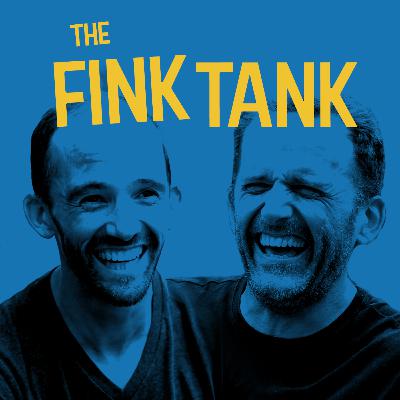
A podcast for people dealing with the weirdness of running their own small business. Brothers Cam and Col Fink chat about work, life, and the confounding idiocy of themselves and others.
They've been brothers for 45 years. You get to pick who's older.
Col helps people run successful small practices, and is an expert public speaker and trainer.
Cam is an event producer and freelance videographer, and loves helping people bring their best selves to video.
They've been brothers for 45 years. You get to pick who's older.
Col helps people run successful small practices, and is an expert public speaker and trainer.
Cam is an event producer and freelance videographer, and loves helping people bring their best selves to video.
118 Episodes
Reverse
Who cares most about my expanding bald patch?Me. Nobody else gives a shit.Except it’s kinda news to me. Some recent video footage really tells it like it is! When else do I see the back of my own head?Video shows us as we truly are, not as we imagine ourselves. One of my jobs is helping people get comfortable with how they show up on camera. It's tricky territory, and most people find this confronting to the point they'll often choose total avoidance.Nearly everyone has a complex about some aspect of their appearance.But that thing you’re self-conscious about? There’s a good chance everyone else has either a) not noticed, or b) accepted it without judgement.They’re too worried about their own shit to care about yours.YES I REALISE I AM IN DANGEROUS TERRITORY HERE. PLEASE ACCEPT THIS HUGE CAVEAT FOR PATRIARCHY AND MISOGYNY BIAS, ABLEISM AND PRIVILEGE AND ALL OF THE THINGS.Those factors are real and true and I’m not here to judge your experience. These barriers can be hard to overcome.But Col and I both work with people who are the face of their business. And typically, the more comfortable you are with yourself, the more successful you’ll be.Your hair, face, weight, voice, teeth, mannerisms - ALL OF IT - is already what people see every day. Show up anyway. It’s better for your business and your soul.
“Mate, I’m not here to be f*cken reasonable!”- Some well-dressed guy at the football.Being a parochial sports fan is one thing. Objecting to basic facts is another. The guy next to us was so one-eyed I eventually said something. His response was perfect.Because in that moment he wasn’t trying to be fair. Or even coherent. He was being a rabid sports fan, and he was in exactly the right place. In his eyes, I was the unreasonable one. And he had a point!We get to choose who we are depending on the context.If we’re grounded in our values, we can match our behaviour to the moment.You don’t need to be the same person everywhere. You just need to not be a fraud anywhere.As Walt Whitman put it:“I contain multitudes.”PS. The guy at the end commentating on my shithouse plays is Dom Bareford. He’s a decent frisbee player and a LITERAL WORLD CHAMPION HOT AIR BALLOON PILOT.
“Cam, you’re smart enough to always be ‘right’, and I can’t be bothered anymore.”Oof.In our twenties, Col stopped talking to me for a few years. Fair enough.Smart people aren’t less biased. They’re just better at explaining why they’re “right”. That was me, and I was insufferable. There’s a poster of fallacies and biases in Col’s toilet, and it prompted some terrible jokes and useful reflection:If you’re always right, you’re definitely not.
I expressed my exasperation to Col’s 6-year-old son Deakin. His response was so funny it completely dissolved the tension.Being funny is a great quality. Even if you’re not exactly sure what’s funny or why. In this Fink Tank, Col and I laugh about the nature of humour and why it matters in life and work.Being stand-up-comedian level funny is beyond most people, for effort and talent reasons. But we think everyone is capable of adding a bit of humour to their repertoire.Skip to 6:25 for some terrible jokes. Better yet, put your shit go-to jokes in the comments!
When I was 15, I stole an esky full of drinks from a random campsite. Not exactly the heist of the century, but it felt huge in the context of my teenage attempts at rebellion. I was fingered as the perp the next morning. I feared the worst, but the poor bastard whose beers I nicked had other ideas.In this Friday Fink Tank I share a story Col had never heard. I definitely never told mum or dad!My selfish teenage idiocy had wronged a good man. I was expecting humiliation and punishment. Instead, he chose grace and forgiveness. I don’t even know his name, but I’ve never forgotten him.
I came home to human poo in the driveway. Our fridge broke the same day.Life will always have problems. Are they actually problems though?In this Fink Tank Col Fink and I laugh about the human audacity to complain about things that were luxuries unavailable to even kings or queens only a hundred years ago.In a great 2024 article about the quality of problems, Alicia McKay wrote:Most of the problems I complain about are:a) Entirely the result of my own choicesb) Actually a sign of progress and privilege.Yours probably are too.If you don't like your problems, get better ones.If you already have good ones, but you forgot, this is your gentle reminder.Well said Alicia, as usual.What’s the poo in your driveway right now??
I rented an e-bike and shot myself in the foot.By making life “easier” I accidentally made it less rewarding.If you run a business, it’s quite likely you love some parts more than others. In this Friday Fink tank Col Fink and I talk about the bits we love in our work, and the bits we like considerably less. And the difficulty of maintaining touch with the parts that light you up.We admire the audacity of successful operators like Dr. Jason Fox (wizard) 𓃦, who stopped doing email, and Alicia McKay, who stopped taking meetings.How's the balance in your work?
Did it hurt?When you read something so profound it left you reeling. A book that laid your soul bare. An article that prised open your brain. A quote distilling the human condition to its essence. An idea so poignant it simply MUST be shared with your bestie. You buy them the book. You email the article. You forward the meme.You anticipate deep connection, gratitude, shared metamorphosis. Instead you get… meh.Yeah. That hurt. Sometimes the meh person is yourself, a few days or months later.The Fink Tank is back! And we’re here to see the world not as it is, but as we transiently foolishly are.
Col’s four year old daughter Darwin rode a pedal bike for the first time last week. If it weren’t for the Fink Tank, I would have missed it.In our final episode for this year, we reflect on the surprising longevity of the project, and the multiple ways it has brought joy to our lives.Since June 2023, we’ve dropped 114 episodes in 130 weeks. Apart from season breaks, we’ve only missed one Friday publishing deadline. For anyone who knows the Finks, that is ASTONISHING.We love the conversations and connections the Fink Tank brings. To all you beautiful people who’ve joined in the fun, THANK YOU. You’re the reason Col and I keep playing in this magnificent sandpit. See you next year!
If you’re a member of the Dead Parent Club, today’s Fink Tank is for you.Our dad Tony died 27 years ago. On his anniversary yesterday we honoured him in Col’s shed. I’m now about the same age as Dad was as I remember him. When I was younger all I could see were the differences. As I’ve aged, I’ve been quietly chuffed to grow into the similarities. I love seeing echos of his character in Col.We’re all a reflection of our parents, for better or worse. Tony was a wonderful dad, so most similarities are for better. Apart from Col inheriting a filthy smoking habit for a decade. And my penchant for leaving things to the absolute last minute*. If you’ve lost a parent, we’d love to hear from you.
People warned us about going to the United States. With alarming news at saturation point, we had doubts ourselves. Here’s what happened:Everything was fine.In Florida, people warned us about going to New Orleans.New Orleans was amazing. We went to a Halloween street party in the suburbs, and it was pure delight. But the people there warned us about going to downtown New Orleans.Downtown New Orleans is fantastic. We took the kids for a sunset walk on Bourbon Street, and they loved it.The news paints a distorted picture of the world, where danger and catastrophe lurk at every corner.The world is mostly great. But that doesn’t make the news, because reality is boring. Yes we’re privileged, and there’s a lot of real suffering in the world. The news machine knows we feel guilty about our comparative ease, and exploits our empathy.You already know that just being “aware” of the world’s atrocities doesn’t help. What actually helps is money.So, Col Fink and I wonder, should you stop watching the news?
If you’re hurtling toward Christmas in a hectic hot mess, here’s the good news:That’s fine. It’s what November is for.If things are STILL chaotic in February, we might have issues. Our great mate and friend of the show Digby Scott writes an annual “Christmas won’t fix it” newsletter. In the spirit of nuanced debate for which social media is revered, The Fink Tank offers this response:He’s wrong.Christmas WILL fix it. Life and work come in cycles. There's an end-of-year frenzy, then we chill out for a while. Feeling frazzled isn't ideal, but Col thinks it might be a sign your business is... businessing.Here are two Fink Tank approved suggestions for the end-of-year rush:1. Suck it up for a couple more weeks then enjoy your break.2. Cross some things off your to-do list without doing them.And yes, Digby's right about avoiding toxic cycles and the dangers of running on empty. You can read his excellent newsletter here (and follow him if you don’t already) https://www.linkedin.com/pulse/christmas-wont-fix-digby-scott-tuxpc/We’ll leave you with this quote, which I stole from his newsletter:"Almost everything will work again if you unplug it for a few minutes, including you." - Anne Lamott
Cars are singularly amazing, and a collective pain in the arse.In this (mercifully short) Fink Tank rant, Col and I bemoan the loss of amenity in cities designed entirely around cars.It points to a frequently occurring tension in modern individualistic life:Things that make MY day easier often make EVERYONE’S day worse. Including mine.(Ha! I toyed with writing “make ONE’S day easier” for the inclusive feel, but it looks archaic. However I did just realise referring to oneself as “one” makes more sense when one considers the word “everyone”. Language eh?)Anyway, this cost/benefit tension applies to lots of modern innovation. Smartphones, AI, capitalism. The satirical American newspaper The Onion summed it up brilliantly in the year 2000: 98 Percent Of U.S. Commuters Favor Public Transportation For Others.
Is it just us, or is everyone else already bored with AI generated stuff?The explosion of prompt-generated videos WITH OUR OWN FACES in fantastical scenarios is astonishing. And also dull. It’s eye-catching, but devoid of any substance. There’s zero emotional investment.Video calls with 10-year-old Harriet often involve her head turning into a skull with rainbows pouring out of its ears, or a cute giraffe in a sombrero. The software tracks her facial expressions, and the cartoon head mimics her eyebrows and mouth movements with incredible accuracy. And it’s awful.These technological advancements are exciting and interesting for a short burst, and then…. we’re bored.Is AI generated art destined to live out its days in the Metaverse? Ha! Remember the Metaverse???Col Fink and I are probably already behind on the hype cycle conversation. There’s plenty of talk about the AI financial bubble, and when it might pop.In the meantime, keep being you. Do the work, write your newsletter, record your videos. The need for genuine humanity isn’t going anywhere. The fear of obsolescence in a world of AI hopefully is.PS. Would AI generate face shadows on Col's head and terrible lighting in the opening frame of this video?? No, you need a real human videographer for that!!
Without vision correction, I truly cannot see how many finger’s you’re holding up. I can barely see how many fingers I’M holding up.But I almost exclusively wear contact lenses, so even people who know me well are sometimes surprised to find out I'm short-sighted at all.Glasses are an indicator of the problem AND the solution. Contact lenses quietly solve the problem without anybody knowing you even have one.There's a big difference between visible and invisible help.Following the wonderful reaction to our “I think I have ADHD” episode a couple of weeks ago, Col and I chat about the changing landscape around neurodiversity, and how bringing visibility Shame stops many of us from sharing our differences and burdens. The more we see others share safely, without judgement, the easier it becomes.If you can, be the glasses of your coping strategies, not the contact lenses.
My Airbnb roommate was a Hollywood movie star. I had no idea. I was at the Toronto Greek Film Festival for Ange & The Boss, and the organiser said, “You’ve got a roommate tonight. You’ll like him.”Five minutes later, he’s pointing at me going, “Wait… you’re the guy who made that Ange Postecoglou film?”Turns out he knew half the people in it. He’d actually PLAYED with them in the 1980s.His name was Costas Mandylor. When injury cut his football career short, he pursued acting. Quite successfully, it turned out!You’ve probably seen him without realising. Picket Fences. The SAW movies. Cameos in shows like Sex & the City.For the next two days, I got a quiet masterclass in confidence. Not arrogance, just ease. Costas was affable, generous, memorable, magnetic.It got me thinking: was his charisma a reflection of his stardom… or the reason he became a star?In this week’s Fink Tank, Col and I dig into conviction and success, and where it comes from.Also, you should see his film The Aegean. He's the lead actor, he barely says a word in the entire film, and his performance is mesmerising.
Hands up all our favourite “I think I might have ADHD” people This week’s Fink Tank kicks off with Col “diagnosing” both of us, before comparing ADHD to being left-handed. Something that only showed up in the stats once it became socially acceptable to admit it.We dig into the blurry line between explanation and excuse.When does understanding yourself help you grow, and when does it just become a way to justify bad behaviour? At what point does “this is how my brain works” turn into “if you can’t handle me at my worst, you don’t deserve me at my best” (Ugh).A slightly longer episode today, befitting the subject matter.
Ever meet someone’s family and think, ah, that explains everything?Mum, Col, and his eldest son Deakin came to visit us in Wellington. Our collective Fink quirks, gathered in the McKay family home (portmanteau options include FcKay or McKink, pronounced with relish), were suddenly much more visible to me than usual.We like to imagine we’re all unique, self-made individuals. But truthfully, most of us are just slightly modified versions of our parents. Flawed apples rolling a short distance from the tree.Meeting the tree, as it were, can be enlightening.Annoying traits become more forgivable when you see them in siblings and parents. At least that’s what I hoped as I watched Col unknowingly commit Finkish faux pas I’ve spent years trying to adjust in myself.That doesn’t excuse any of us from doing the work. From knowing ourselves and taking what friend of the show Di Foster calls radical responsibility. I love that phrase.But we’re all deeply flawed humans, requiring constant forgiveness. David Whyte’s poem on friendship might be the best articulation ever written of what enduring relationships truly demand.At the very least, if you find someone a bit annoying but want to keep liking them, meet their family.
Ever noticed that the less you care about something, the easier it is?Everyone wants to grow. Almost universally, we want to improve and upskill, we want to look back on our journey and see how far we’ve come.And yet, we’ll reliably prevent ourselves from improving by locking ourselves away, playing small, and avoiding risks.I have no particular interest in getting good at disc golf, but funnily enough the very fact that I don’t really care about the outcome means that yesterday, given a chance to play with Col and his son Deakin, I just gave it a crack. It went pretty well*.Had it been something that feels more significant to my career and identity, I’m as guilty as the rest of us at protecting myself from feelings of inadequacy and shame.It’s strange how, despite living with our brains our whole lives, we’re still terrible at managing them.In this Fink Tank, Col and I talk about better ways of getting better at things; selfie videos, public speaking, anything that matters to your life and your work.*My round ended one hole early when I threw Col’s favourite disc across a stiff Wellington breeze and it skewed 50 metres into impenetrable scrub. You've gotta spend money to make money.
Do I want to eat more Twisties?If they’re within arms reach, apparently yes. But actually, no. We’re on the way to pick up a planishing hammer (bonus points if you have any idea what a planishing hammer is. I didn’t), and Col has a huge open packet of Twisties in the centre console.After a few mouthfuls I’ve had enough sickly orange grubs, yet I lack the self-control to stop shovelling them into my face. So I give the packet to Col to stash in his car door.Why?I have total agency no matter where the Twisties packet is. Yet I need to introduce a hurdle to change my behaviour. It’s stupid and irrational. And very human.Moving the packet changes what economist Richard Thaler calls my “choice architecture”. Choice architecture plays a huge role in determining whether our behaviour aligns with our goals. Best intentions usually aren’t enough. Whether it’s resisting Twisties, keeping an exercise routine, staying in contact with friends, or getting to bed on time. Or posting videos. I was utterly stuck at the start of 2020. I flogged myself trying to establish a video presence, but couldn’t post a thing. After weeks of floundering, Alicia McKay and Peter Cook flipped my approach. They held me to account to ditch my perfectionism and post weekly phone videos for a month. I was up and running.Sometimes small shifts lead to huge results.In this weeks Fink Tank, Col and I talk about choice architecture experiments, and how to get the best out of ourselves.

Comments

Download from Google Play

Download from App Store
 United States