


 Claim Ownership
Lessons from Learning Leaders
Subscribed: 0Played: 2
Subscribe

© Duane Lester
Description
Continuing the legacy of his partner, Bob Pike, Duane Lester talks with leaders in the performance improvement industry about lessons they learned in decades of training.
lessonsfromlearningleaders.substack.com
lessonsfromlearningleaders.substack.com
40 Episodes
Reverse
In this episode of Lessons from Learning Leaders, we chat with Katrina Kennedy—consultant, facilitator, and author of the new book, Learning That Lasts: Reflection Activities for Trainers and Designers.Katrina shares her accidental start in L&D, which began when her manager at the District Attorney’s office needed someone to train new staff for a reorganization: “Katrina, you can talk,” she was told. Over the past 28 years on her own, she discovered her passion for helping new trainers and subject matter experts (SMEs) design and facilitate powerful learning experiences.The Monumental Shift: It’s Not About YouKatrina reflects on her journey from unknowingly “telling” to intentionally facilitating. Like many trainers, she initially had the mindset of an empty vessel ready to be filled. The monumental shift came during a conference session where she witnessed participants deeply interacting. She realized, “This is about them”.She reinforces that the number one rule of training is “It’s not about you”. This realization is freeing for SMEs, reducing their nervousness because they know the focus isn’t entirely on their performance. Instead, the goal is to impress the participants with their own discoveries.The Critical Failure Point: Learning TransferKatrina joins the host in preaching the absolute importance of learning transfer. The host notes that training often fails after the classroom because the trainer considers their job done, and the manager assumes the training worked. If the training isn’t transferred to the field, performance isn’t improved.Katrina emphasizes that transfer success begins before the training, by ensuring the learning is aligned with organizational needs and securing buy-in from managers and participants.Common Transfer Failures:* Running Out of Time: Trainers pack too much content and neglect the vital time needed for reflection.* No Support: Pushing people out the door without follow-up, supportive nudges, or an accountability partner.The Phlebotomist Test: Practice Over ContentTo shake the mental model that training is only about the transfer of information, Katrina uses a memorable story:If you are going to have blood drawn, do you want the phlebotomist to have a lot of content knowledge, or do you want them to have practiced and reflected on what they’re doing?The clear answer (practice!) reinforces the need to give people time to practice and receive feedback.Katrina’s book, Learning That Lasts, is a practical reference guide with research-backed reflection activities that help ensure learning transfers to the workplace.Key Takeaways* Rule #1: It’s not about you: The most profound shift for a trainer is realizing the job is to facilitate their learning, not show off your knowledge.* Transfer is a Trainer’s Responsibility: If you slack on the transfer strategy, the entire training fails because you haven’t improved performance.* Reflection is Not an Afterthought: Time must be intentionally designed into the session for practice and reflection.* Practice is Paramount: Use the phlebotomist test to prove that practice and reflection are superior to content volume.Katrina Kennedy’s Book and Contact:* Book: Learning That Lasts: Reflection Activities for Trainers and Designers* Contact: Connect on LinkedIn or visit katrinakennedy.com. Get full access to Lessons from Learning Leaders at lessonsfromlearningleaders.substack.com/subscribe
A Note from the Host: Please accept my sincere apology for the audio quality on my end of this recording. Despite buying new equipment to improve the audio quality, I made a rookie mistake. I didn’t look at my own audio levels before recording and didn’t notice my four-year-old maxed out the volume on my mixer. Despite my best efforts to fix it in post-production, my audio is unfortunately quite distorted. Justin Hunsaker’s audio is perfect, and that is where the real value lies. I ask you to forgive my technical error and embrace the fantastic communication insights Justin shares. The lesson he delivers on clarity and audience focus is one I clearly need to re-learn!The Expert Trap: How Your Knowledge Can Sabotage Your TrainingHow do you go from being a software engineer to an executive communication coach? For Justin Hunsaker, it was realizing that the through-line of all success is communication.Justin, the author of Presentation Pitfalls, joins us to discuss his upcoming presentation at the Training Conference and Expo: “The expert trap: how knowing too much can sabotage your training and presentations”.The “expert trap” is defined as when presenters focus on their expertise rather than what their audience needs to learn, resulting in a message that never completely gets conveyed. Justin emphasizes that in communication, your audience comes first.Spock vs. Kirk: The Emotional vs. Logical VoiceJustin suggests everyone has two voices in their head: the Mr. Spock (logical, sequential, data-oriented) and the Captain Kirk (emotional, storytelling). The expert trap is relying solely on Mr. Spock.To avoid this, Justin recommends:* Start with a story to get emotional engagement (Captain Kirk).* Introduce facts and logic (Mr. Spock) to provide credibility and confidence that you’ve done the expertise work.* End with the story.This approach works because people buy with emotion and justify with logic. Storytelling is much more primal to the human experience than a sequence of facts, making information stickier.The Signal to Noise Ratio: Cutting the FatExperts often feel everything they know is important and needs to be included, but this creates noise that distracts the audience from the three most important facts they should remember.Justin and his partner’s four-part presentation framework includes Reduce Noise. If an expert can’t explain when a piece of information will be valuable to the learner, it becomes noise that should be put in a handout or an appendix. He advises using the military’s BLUF (Bottom Line Up Front) framework to flip a history-lesson approach upside down and lead with the most important answer.Tools for the Modern CommunicatorJustin is excited about how AI (Large Language Models) can help experts communicate better. He suggests asking a large language model to generate 10 analogies for a complex topic, allowing the expert to quickly select the most resonant one for their audience.The Platinum Rule of PresentationsJustin teaches that presentation design is a function of your audience, your purpose, and your setting—the presenter is not included. This reinforces the number one rule of training: It’s not about you.The 3F Framework for Instant PresenceAs a final tip, Justin shares the 3F Framework for leveling up your communication in just three minutes before any important conversation:* Facts: Write down the three facts you want your audience to remember.* Feelings: Write down the feelings you and your audience have going into the conversation.* Follow-ups: Write down what you promise to do after the conversation, and what you want your audience to promise to do.Key Takeaways* Audience First: The expert trap is focusing on what you know instead of what the audience needs to learn. The design of your training should focus on the audience, purpose, and setting—not the presenter.* Embrace Emotion: People make decisions based on emotion and justify them with logic. Start with a story (emotion/Captain Kirk) before providing data (logic/Mr. Spock).* Reduce Noise: Cut extraneous information that is only a “history lesson” of your journey. Use the BLUF (Bottom Line Up Front) approach to prioritize the most important answer.* The 3F Level Up: Spend three minutes before any meeting writing down the three desired Facts, the related Feelings, and the planned Follow-ups to increase your leadership presence.Justin Hunsaker’s Book and Contact:* Book: Presentation Pitfalls* Contact: Find Justin on LinkedIn (he’s the one with the book in the background!). Get full access to Lessons from Learning Leaders at lessonsfromlearningleaders.substack.com/subscribe
What if the most annoying part of a long hike—a pebble in your shoe—was actually your greatest asset as a trainer?On this episode of Lessons from Learning Leaders, we welcome Jeff Weaver—director of training at J.J. Taylor Companies for 15 years and now founder of A Pebble in Your Shoe Consulting. Jeff is sharing his philosophy (and presentation title) that challenges how we think about behavior change and learning.Jeff’s journey started at Polk County schools and took him through Disney and Target, experiences that shaped his unique approach to L&D. He argues that to get people to change their behavior, you need a catalyst for change—something that can’t be ignored. That, he explains, is the gift of the pebble.Tune in to discover:* The Power of Pleasant Uncomfortableness: How to intentionally design moments that force learners to stop and fix a problem.* The Disney First Impression: Jeff shares a brilliant training technique he learned at Disney that uses a seemingly unprepared start to create a lasting, emotional lesson on preparation.* Marketing Your Learning: Why L&D professionals should think of training like product marketers, using branding and jingles to create cultural touchstones that stick.* The CEO Question: Are you worried about being “too silly” in front of executives? Jeff has a perfect answer for why you should facilitate for fun and effectiveness, no matter who’s in the room.Don’t miss Jeff’s session, “The gift of the pebble in your shoe,” at the 2026 Training Conference and Expo, where he’ll also be running the Podcasting Lab.Key Takeaways* Pebble = Catalyst: A “pebble in your shoe” is a metaphor for a necessary, uncomfortable catalyst that forces behavior change.* Emotion Drives Memory: Memorable training is often emotional and action-oriented, hitting a place beyond just logic.* Branding Works: Use advertising and marketing techniques—like jingles and catchphrases—to make core concepts un-ignorable cultural touchstones that stick long after training ends.* Challenge Traditional L&D: Broaden your view of training beyond traditional adult learning theories to incorporate the powerful tools of entertainment and marketing.Jeff Weaver’s Consulting:* A Pebble in Your Shoe Consulting Get full access to Lessons from Learning Leaders at lessonsfromlearningleaders.substack.com/subscribe
Join us on the latest episode of the Lessons from Learning Leaders podcast as we welcome back the master facilitator himself, Sardek Love! Sardek, author of Presentation Essentials and Speak for a Living, sits down to discuss the fascinating intersection of neuroscience and effective training.Sardek is presenting a standalone session at the Training Magazine conference and expo called “The science of designing ridiculously engaging learning experiences,” which is also known as “The science of engagement”. His recent focus has pivoted to looking at the neuroscience and psychology behind the things trainers do, noting that while many training techniques have roots in these fields, most trainers are unaware of it. He highlights that many techniques taught by Bob Pike, which he and the host use, are backed by deep data from a neuroscience perspective.In this conversation, Sardek dives deep into techniques that leverage brain science for better engagement and learning:* The Engagement Loop: Sardek’s framework, created based on neuroscience, has three phases:* Grab people’s attention by doing something novel.* Create connection or allow participants to connect with each other, building trust. The neuroscience suggests allowing participants to connect with each other first before moving to large group discussion.* Create interaction, which is essentially experiential learning or training activities.* Overcoming Silence with Escalating Mutual Disclosure: Sardek discusses how most trainers are met with “bone crushing, mind numbing silence” when they ask a question because participants are cautious and fearful of being judged. The solution, a neuroscience technique called escalating mutual disclosure , involves repeatedly asking questions and having participants respond at the table group level (pair shares, triads, quads) in the beginning of a course. The questions should gradually increase the amount of vulnerability demonstrated.* The Benjamin Franklin Effect: Sardek explains that when participants share their tips or “edify each other” at the table group level, it creates the Benjamin Franklin effect. This means doing a favor for someone actually makes a person neurologically like the recipient, reducing cognitive dissonance and automatically building trust.* The Peak-End Theory in Experiential Learning: Sardek uses Daniel Kahneman’s peak-end theory to design impactful experiential activities. People judge an experience based on the most intense moment and the very end of that experience. Sardek’s approach involves agitating a known problem, putting people into an experiential activity that simulates the problem and its emotions, and then providing the solution at the end. He uses his “taste of change” activity with Warheads candy as an example, where the intense sourness represents the fear and resistance of change, and the eventual sweetness represents the metaphor for change.He also touches on the fact that current instructional design principles may be outdated, and as we learn more about the brain and how habits are changing (especially after the pandemic), refinement of adult learning principles will be necessary. He suggests focusing on the three most relevant of Gagne’s nine events of instruction rather than covering all nine in live instruction.Key Takeaways* Neuroscience is the foundation for effective engagement: Many successful training techniques are rooted in brain science, even if the trainer is unaware of it.* Build trust before large group discussion: Start with activities that allow participants to connect and build trust in small groups (pair shares, triads) to overcome the fear of being judged and the resulting “mind numbing silence”.* Use Escalating Mutual Disclosure: Gradually increase the vulnerability of questions asked in small groups to build trust and connection.* Leverage the Peak-End Theory in Design: Make the experiential learning’s most intense moment and its conclusion memorable to shape how people judge the entire experience. Get full access to Lessons from Learning Leaders at lessonsfromlearningleaders.substack.com/subscribe
In this conversation, Duane Lester interviews Lenn Millbower, who shares his extensive background in entertainment and training, particularly at Disney. They discuss the importance of blending emotion and logic in training, innovative techniques used at Disney, and the principles of engaging learning environments. Millbower emphasizes the significance of storytelling, humor, and professionalism in training, while also introducing his LearnerTainment principles that enhance the learning experience.You can buy Lenn’s new book The Santa System: Ten Leader Lessons from the North Pole here.Key Takeaways* Emotion and logic must be balanced in training.* Engaging training requires innovative techniques.* Storytelling is crucial for connecting with learners.* The environment should be controlled to enhance learning.* Humor can create a positive atmosphere in training.* Professionalism in delivery leads to better outcomes.* Training should focus on what’s in it for the learners.* Using props and visuals aids retention.* Creating a magical learning experience is essential.* Rudolph’s story illustrates the importance of creativity in training. Get full access to Lessons from Learning Leaders at lessonsfromlearningleaders.substack.com/subscribe
What happens when you realize great training isn’t enough?That’s the question Jess Almlie faced when she left the corporate world to build her own business and began discovering the limits of traditional learning and development. In this conversation, she shares the highs and lows of being self-employed, the lessons behind her new book L&D Order Taker No More, and why too many trainers set themselves up for failure by treating every problem as a “training problem.”Jess explains how she learned the hard way that even the best-designed programs can fall flat if they’re not addressing the real issue. Misaligned systems, unclear expectations, or poor management habits can’t be fixed by a course or a workshop. Her solution: stop acting like helpers and start showing up as strategic partners. That means slowing down, asking sharper questions, and resisting the urge to plug in training as the default answer.We also talk about the process of writing a book—how years of blogging, experimenting, and testing ideas gradually turned into a practical handbook that every learning leader wishes they had when moving from order taker to business partner. Jess pulls back the curtain on how she made that transition and what it takes to create lasting impact inside organizations.If you’ve ever wondered how to stop spinning out content that doesn’t move the needle—or if you’ve thought about writing your own book—this episode will resonate. Get full access to Lessons from Learning Leaders at lessonsfromlearningleaders.substack.com/subscribe
In this conversation, LaNiqua McCloud shares her journey as a mother of a gifted child and her evolution into an advocate for parents navigating the challenges of the education system. She discusses the importance of empowerment, the process of writing her book ‘Birth of an Advocate’, and the lessons learned through her experiences in training and education. LaNiqua emphasizes the need for individualized approaches in both parenting and training, and she expresses her desire to coach other parents in their advocacy journeys.Get a copy of LaNiqua’s book, “Birth of an Advocate” here. Get full access to Lessons from Learning Leaders at lessonsfromlearningleaders.substack.com/subscribe
Organizations are built on trust, and trust is built on communication and mutual understanding.It’s not enough to know your own strengths, work style, and values. Leaders must also learn the strengths, work styles, and values of the people they depend on. Performance depends on it.Trust grows when we build on each other’s strengths, respect each other’s ways of working, and share what others can count on from us. Clarity creates trust, and trust creates results.Here’s your challenge: Make a list of the people who depend on you, and those you depend on. Write down what each person needs from you, and what you need from them. Then share it.Listen to the full episode here: []How do you build trust in your work relationships?Lead with purpose. Get full access to Lessons from Learning Leaders at lessonsfromlearningleaders.substack.com/subscribe
When tragedy strikes a nation, the role of a leader comes into sharp focus. People don’t just look for direction. They look for clarity, values, and a sense of contribution.Clarity matters because uncertainty breeds fear. Leaders must speak truthfully about what is known, what is not, and what matters most in the moment.Values matter because culture is tested in crisis. If you’ve said compassion, respect, or dignity are central, this is the time to show them in action.Contribution matters because people want to help. Effective leaders channel grief and anxiety into meaningful action, whether that means serving the community, supporting one another, or simply keeping the mission moving with care.Tragedy will come. The question for every leader is: Will you be ready to provide clarity, model values, and offer contribution when your people need it most?Lead with purpose. Get full access to Lessons from Learning Leaders at lessonsfromlearningleaders.substack.com/subscribe
A paycheck isn’t enough.Every leader develops people. The question is—are you helping them grow, or holding them back?Too often, leaders focus on fixing weaknesses. It feels helpful, but it drains energy and rarely creates lasting progress. The truth is simple: people grow faster when they build on what they already do best. And when their values align with the organization’s mission, performance and fulfillment reinforce each other.Here’s how you can recalibrate: look at your calendar. Highlight the tasks that actually use your best strengths—and circle the ones that don’t. Then decide: what can you delegate, what can you drop, and where should you double down?This week’s challenge: have one strengths-focused conversation with someone on your team. Ask, “What do you do best—and how can we raise the bar there?” You’ll be surprised at how energizing that simple shift can be.How are you helping your people grow by focusing on their strengths? I’d love to hear your thoughts.Let’s keep learning together—and let’s lead with purpose. Get full access to Lessons from Learning Leaders at lessonsfromlearningleaders.substack.com/subscribe
Every leader develops people. The only question is—are you helping them grow, or stunting them?Too many leaders make the mistake of trying to “fix” weaknesses. But weaknesses rarely become strengths. Focusing there drains energy without creating real growth.The best leaders flip the script. They build on strengths, challenge people to stretch further, and set expectations that make growth inevitable.Here’s my challenge for you: This week, sit down with one person on your team and ask, “What do you do best—and how can we raise the bar there?”That one conversation can shift someone’s career—and your team’s results.What strengths will you develop on your team this week? Get full access to Lessons from Learning Leaders at lessonsfromlearningleaders.substack.com/subscribe
Are you measuring success by how much you do — or by the impact you actually create?In today’s episode, I share why the most effective leaders stop asking, “What do I get?” and start asking, “What can I contribute?” This simple shift changes everything. It moves you from busyness to true impact and forces you to connect your work to the bigger mission of your organization.Here’s my challenge for you: Pick one project this week and ask yourself, “If I nail this, how does it contribute to the bigger mission?” If you can’t answer clearly, it may be time to rethink the project — or your approach.Listen in, then let me know: What project are you working on right now that makes the biggest contribution? Get full access to Lessons from Learning Leaders at lessonsfromlearningleaders.substack.com/subscribe
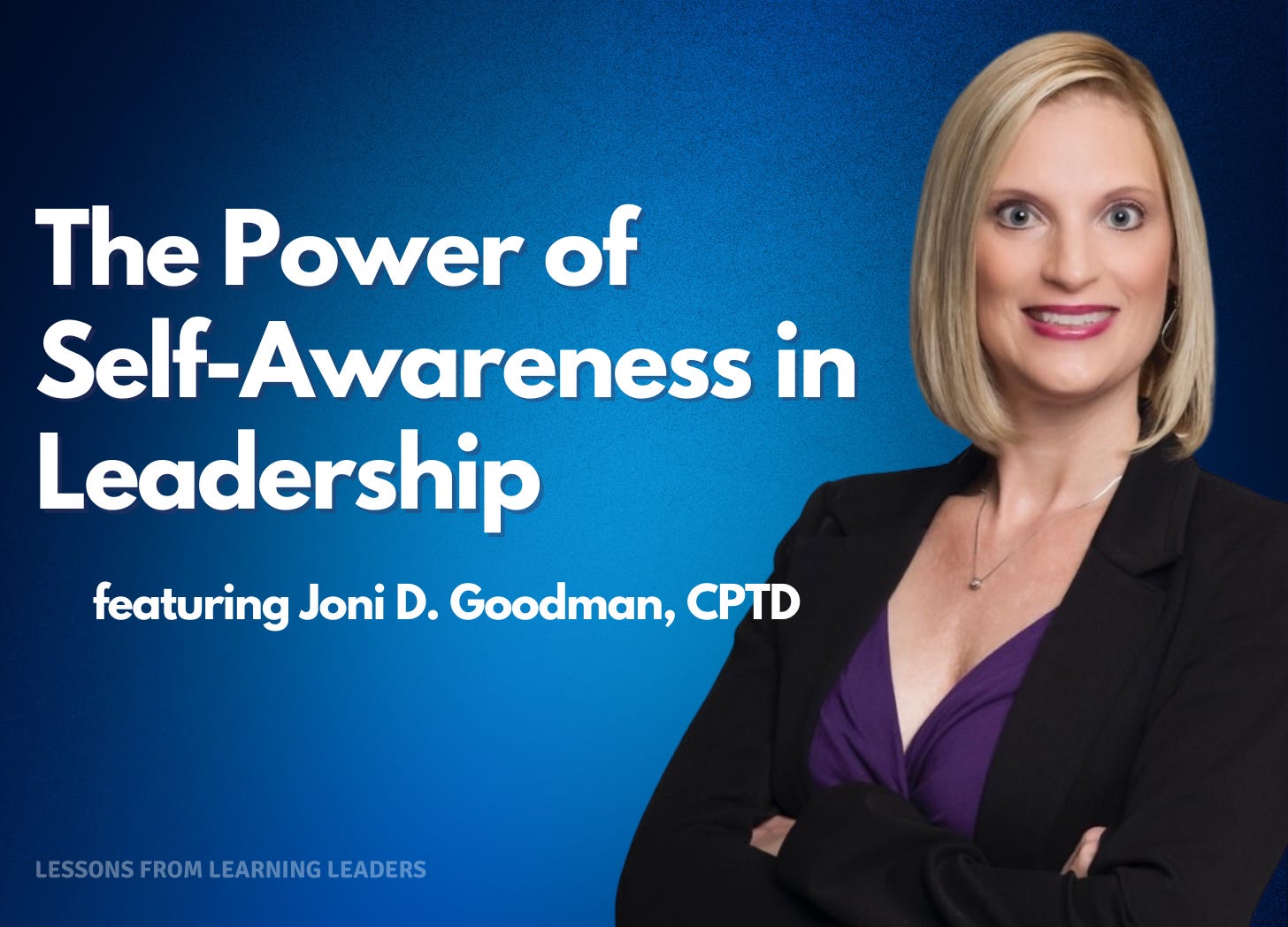
SummaryIn this conversation, Joni Goodman shares her journey from being a biochemist to becoming a master trainer and entrepreneur. She discusses the importance of self-awareness in leadership, the significance of creating safe spaces for vulnerability, and her experiences in coaching, particularly for women in STEM. Joni emphasizes the continuous nature of personal and professional growth and introduces her upcoming book that aims to support individuals in their development journey.Takeaways* Joni transitioned from biochemistry to training and development.* Self-awareness is crucial for effective leadership.* Creating safe spaces fosters vulnerability and growth.* Continuous growth is a lifelong journey.* Joni's coaching focuses on women in STEM.* Discomfort is essential for personal development.* Assessments can enhance self-awareness.* Building trust is key in leadership.* Joni's upcoming book will provide practical insights.* Community support is vital for personal growth.Joni’s LinksWebsite: https://www.jdgadvisors.com/Encounter You: https://www.encounteryou.org/LinkedIn: https://www.linkedin.com/in/jonidgoodman/Facebook: https://www.facebook.com/jdgadvisorsInstagram: https://www.instagram.com/jonidgoodman/?igsh=NHAyZjlvNnlocTZv&utm_source=qr#YouTube: https://www.youtube.com/channel/UCqEymnYdumpHbOk1de2QOOwLinktree: https://linktr.ee/jonidgoodman Get full access to Lessons from Learning Leaders at lessonsfromlearningleaders.substack.com/subscribe
SummaryCassie Leishman, a learning and development manager, shares her approach to creating engaging and interactive training sessions. She emphasizes the importance of incorporating fun and gamification into adult learning, using activities like escape rooms and scavenger hunts. Cassie also discusses the challenges of transitioning from teaching children to training adults and the need to make training efficient and relevant. She highlights the value of focusing on the participants and their needs, building relationships, and being flexible in delivering training. Overall, Cassie's approach aims to make compliance training enjoyable and effective.Takeaways* Incorporating fun and gamification into adult learning can make training more engaging and effective.* Transitioning from teaching children to training adults requires adapting teaching methods and considering the time constraints of adult learners.* Making training efficient and relevant is crucial for adult learners who have limited time and specific job responsibilities.* Focusing on the participants, building relationships, and being flexible in delivering training are key to successful learning experiences. Get full access to Lessons from Learning Leaders at lessonsfromlearningleaders.substack.com/subscribe
SummaryIn this conversation, Duane Lester interviews Carmen Simon, a cognitive neuroscientist specializing in memory. They discuss the importance of memory in business and learning, and how memory is not just about remembering the past, but also about remembering the future. They explore the concept of prospective memory and how it relates to decision-making in business. Carmen shares practical guidelines for improving memory, including the use of repetition, visual elements, and creating associations. They also discuss the limitations of working memory and the need to balance abstract and concrete information. Overall, the conversation emphasizes the importance of controlling the 10% of information that people remember.Takeaways* Memory is not just about remembering the past, but also about remembering the future.* Prospective memory, or remembering intentions set for the future, is crucial in business and decision-making.* Repetition is key to improving memory and ensuring that important information is remembered.* Visual elements and associations can enhance memory retention.* Working memory has limitations, so it's important to be mindful of the amount of information presented at once.* Balancing abstract and concrete information can help improve memory recall.* Controlling the 10% of information that people remember is crucial in business and learning. Get full access to Lessons from Learning Leaders at lessonsfromlearningleaders.substack.com/subscribe
SummaryIn this conversation, Duane Lester interviews Joe Urbanski about transforming training culture and creating a learning culture. They discuss the importance of making training a want to, not a have to, and how to create a culture that supports learning and growth. Joe shares his personal journey and emphasizes the importance of having fun in all aspects of life. They also explore the challenges of changing a resistant culture and the need to let go of people who are not willing to grow. Joe provides insights on creating a safe and brave space for open and honest conversations, and the role of facilitators in making learning easy and engaging.Takeaways* Transforming training culture involves making training a want to, not a have to.* Creating a learning culture requires aligning the organizational culture with the training culture.* Changing a resistant culture requires having tough conversations and being willing to let go of people who are not willing to grow.* Creating a safe and brave space is essential for open and honest conversations.* Facilitators should focus on making learning easy and engaging, and allow participants to contribute their knowledge and experiences.* Taking 100% responsibility as a leader is crucial for driving change and creating a positive culture.Follow Joe on LinkedIn. He’s always sharing powerful and insightful content.And check out Total Solutions Group (TSG), where Joe is the COO. Get full access to Lessons from Learning Leaders at lessonsfromlearningleaders.substack.com/subscribe
SummaryJess Almlie, M.S., a learning and development consultant, discusses the importance of measurement in the L&D field. She highlights the trend of L&D professionals viewing measurement as a burden and explains why this mindset is flawed. Jess emphasizes the need for L&D to shift their thinking and approach measurement from a strategic perspective. She suggests focusing on three types of measures: activity measures, effectiveness measures, and outcome measures. Jess also talks about her podcast and newsletter, L&D Must Change, which aims to shift the L&D industry's mindset.Takeaways* Measurement is essential in the learning and development field to demonstrate the value and impact of L&D initiatives.* L&D professionals should shift their mindset and view measurement as a strategic tool for making informed business decisions.* Measurement should focus on three types of measures: activity measures, effectiveness measures, and outcome measures.* L&D professionals should align their measurement efforts with the strategic initiatives of the business.* Jess Almlie hosts the L&D Must Change podcast and newsletter, which aim to shift the mindset of the L&D industry.Follow Jess on LinkedIn.Subscribe to her newsletter and her podcast! Get full access to Lessons from Learning Leaders at lessonsfromlearningleaders.substack.com/subscribe
SummaryDeb Arnold, a marketing communications expert, discusses the importance of winning awards, speaking at conferences, and publishing thought leadership in order to achieve recognition in your field. She explains how these three elements can be interconnected but are not necessarily dependent on each other. Deb shares her experience of helping companies win learning awards and highlights the benefits of winning, including corporate and employer brand building, team credibility, and individual career advancement. She also provides insights on how to choose the right award to apply for and emphasizes the value of the award application process in improving training programs.Takeaways* Winning awards, speaking at conferences, and publishing thought leadership are key elements in achieving recognition in your field.* These three elements can be interconnected but are not necessarily dependent on each other.* Winning awards can benefit the corporate brand, employer brand, team credibility, and individual career advancement.* Choosing the right award to apply for involves considering your strengths, the company you keep, your image, leadership priorities, and how you can leverage the win.* The award application process can lead to the improvement of training programs and provide valuable insights and learning opportunities.Deb’s website Get full access to Lessons from Learning Leaders at lessonsfromlearningleaders.substack.com/subscribe
SummaryTony Sanders shares his journey from being a salesperson to starting his own training company. He emphasizes the importance of mindset and overcoming mental blocks when considering entrepreneurship. Tony also discusses the value of focusing on the needs of the people you're training and the importance of selling ideas and concepts. He shares his experience of building training processes and the impact it had on revenue. Tony encourages others to take the leap and start their own businesses, reminding them that failure is a valuable learning opportunity. He also offers a free video training for those interested in starting a training company.Takeaways* Overcoming mental blocks and having the right mindset is crucial when considering entrepreneurship.* Focusing on the needs of the people you're training and selling ideas and concepts are key in the training industry.* Building effective training processes can have a significant impact on revenue.* Failure is a valuable learning opportunity in business.* Tony Sanders offers a free video training for those interested in starting a training company. Get full access to Lessons from Learning Leaders at lessonsfromlearningleaders.substack.com/subscribe
SummaryIn this insightful episode of "Lessons from Learning Leaders," host Duane Lester sits down with seasoned talent development innovator Jonathan Halls to explore the evolving world of training and development. Jonathan shares his extensive experience and innovative approaches to creating impactful training videos using modern technologies. He discusses the transition from traditional training methodologies to dynamic, cognitive-based learning that harnesses the power of digital media. The episode delves deep into the strategies for producing professional-quality training videos with just a smartphone, emphasizing the importance of planning, scripting, and adapting to the visual learning modalities that keep learners engaged.Takeaways* The Shift in Training Paradigms: Training has moved from classroom settings to flexible, digital formats that focus on enhancing job performance across various industries.* Essentials of Effective Video Training: Jonathan underscores the significance of planning and structuring content before production to ensure videos are educational and engaging.* Practical Tips for Using Smartphones: Detailed advice on using smartphones for creating high-quality training content, highlighting the unnecessary nature of high-end professional cameras for effective learning videos.* Cognitive Psychology in Learning: An exploration of how understanding cognitive psychology enhances the learning experience, making training more relevant and retention-focused.* Upcoming Trends in Talent Development: Insights into the latest trends and future directions in talent development, with a particular focus on adapting to technological advances and organizational needs.This episode is a must-listen for anyone involved in education, training, or looking to enhance their instructional techniques using modern technology.And while you’re at it, buy Jonathan’s NEW BOOK. Get full access to Lessons from Learning Leaders at lessonsfromlearningleaders.substack.com/subscribe

Comments

Download from Google Play

Download from App Store
 United States