


 Claim Ownership
Head2Head
Subscribed: 2Played: 126
Subscribe

© Bryan Bruce
Description
An Aotearoa New Zealand based podcast series featuring interviews with community leaders and influencers about the big issues facing us today and what we could do to solve them and create a better tomorrow.
bryanbruce.substack.com
bryanbruce.substack.com
71 Episodes
Reverse
Yesterday I featured a documentary I made twenty-six years ago about how the State promised that people with mental disabilities would not be sent indefinitely to institutions but would be cared for in the community.Today, at least 65 mentally disabled New Zealanders are currently denied that right.Instead, they are detained in institutions and, as a recent Supreme Court case revealed, some of them are effectively doing life sentences.Why?Because they committed a crime which carried a jail sentence, but instead of being sent to prison the presiding Judge decided that because of their mental disability, the defendant would go into a care facility before being released back into society.The problem is that some of these people are not being released for reasons that are not allowed to be made public.In short there are people In our country who are being detained indefinitely for reasons that are kept secret from the public which, it seems to me, flies in the face of the principle of open justice.The ProblemLet me be clear. These are difficult cases involving difficult defendants who, because of their mental disability (not mental illness), are deemed by the Judge at their trial to be a danger to themselves or to others, and who need specialised professional help before they can return to the community.The legislation that allows all this to happen is The Intellectual Disability (Compulsory Care and Rehabilitation) Act 2003, and a section of which (S85) allows the usual 3 year maximum term for a Compulsory Care Order to be rolled over.The application of Section 85 was recently successfully challenged in case of “J, “ Compulsory Care Recipient v Attorney‑General“J” is a man with an intellectual disability (and autism) who has been detained under the IDCCR Act since 2006, on a secure compulsory-care order. His order has been repeatedly extended because his behaviour has not been deemed to have improved and so, at the time of the Supreme Court hearing this year, he had been in detention for almost 20 yearsThe Supreme Court was asked to review whether the legal test being applied to extend his compulsory care orders under s 85 of the IDCCR Act was been correctly administered — and whether J’s long detention breached his rights under the New Zealand Bill of Rights Act 1990 (e.g. right to liberty, freedom from arbitrary detention and non-discrimination).Last August the Court allowed the appeal in part, finding that the legal test lower courts had been using to decide whether to extend a compulsory care order was wrong.The Court of Appeal for example had previously found that extending a compulsory care order only required evidence of some risk. Instead the Supreme Court ruled that the right to liberty should be the starting point for a Judge’s decision to release a person under a Compulsory Care Order or not, and that the time such a person is detained should not be disproportionate to the offence they originally committed.In J’s case he had carried an axe onto a neighbour’s property and used it to break windows — including a garage and van.The offence was Wilful Damage, and if J had been deemed fit to plead he would have faced a maximum sentence of 3 months in prison.But J has been detained in secure care for nearly 20 years which raised serious proportionality and rights concerns around arbitrary detention.Frankly, I know of convicted murderers and rapists who have been freed before 20 years.The Secrecy IssueIt is in the Family Court, presided over by a Judge, that the decision to release or roll over a person’s detention is made, and the problem I have ( or any journalist has) in reporting on such a case is that it is a closed court.Unlike a Parole Board hearing, for example, where journalists can apply to observe proceedings, Family Court hearings are secret – and that very fact is, in my view, contrary to the principle of open justice.The reason I have been looking into this issue is that I recently interviewed the well-known author Anne Hunt for an episode of my podcast series Head2Head. Her grandson – Daniel - is one of the 65 people who is subject to a compulsory care order because , like J, he has a mental disability, committed some property damage and is currently now being indefinitely detained.During the interview ( which you can watch here) Anne raised a number of concerns about Daniel’s treatment and human rights abuse. So, in fairness, I decided to hold off publishing the interview until I had contacted his care provider and ask about some of the issues Anne had raised with me – such as she was not allowed to communicate with him to even wish him a happy 30 th birthday.So I emailed the management of IDEA Services, the facility where Daniel is being detained, and asked four questions1. Is it correct that Anne has been denied access to Daniel? If so, why?2. She says she understands from others that Daniel is regressing? Is this so? If so, what treatment strategy is he on and why is it not working ?3. Would you consider an online interview with me about Daniel’s case ?4. May I visit Daniel if he requests it? If not ,why not?Their response was they were not willing to comment and referred me to the Ministry of Health.OpinionI will of course be doing that because Daniel has rights which, at face value, seem to me to be being denied. But of course I can’t report to you on that one way or the other, because what is happening to him is being kept secret the from public.As difficult as people like Daniel can be, and as difficult as it must be to decide what is best for their own safety and public safety – never- the- less it seems to me that the secrecy that surrounds the treatment of people like Daniel and J speaks of an 1825 attitude to mental disabilities, not a 2025 one.This public journalism interview has been made free to listen to thanks to the support of my paid subscribers.For $10 a month including GST ( less than a cup of coffee a week) you can not only gain full access to all my paywalled fourth estate articles,dpcumentaries and podcasts, but you will get to comment in a chatroom of thoughtful Kiwis who care about our country and where it is going, in a troll- free social media environment This is a public episode. If you'd like to discuss this with other subscribers or get access to bonus episodes, visit bryanbruce.substack.com/subscribe

The Wellbeing Economic Alliance Aotearoa (WEAll Aotearoa) isn’t a political party. It’s an independent “think and do” tank driven by the belief our economy should exist for the wellbeing of our people and the planet, and is working to make that happen.They take an evidence approach towards solving the economic issues that face us in order develop practical, long-term solutions for the public good.WEAll Aotearoa is a registered charity, funded through philanthropic grants and donations and Sally is their Knowledge and Engagement lead.If you find yourself feeling a bit down about the self- centred neoliberal track we’ve been headed down - have a listen to Sally. We can have a more caring economy ….if we want to.You can find out more about The Wellbeing Economic Alliance Aotearoa here:https://www.weall.org.nzThis public journalism interview has been made free to listen to thanks to the support of my paid subscribers.For $10 a month including GST ( less than a cup of coffee a week) you can not only gain full access to all my paywalled fourth estate articles,dpcumentaries and podcasts, but you will get to comment in a chatroom of thoughtful Kiwis who care about our country and where it is going, in a troll- free social media environment. This is a public episode. If you'd like to discuss this with other subscribers or get access to bonus episodes, visit bryanbruce.substack.com/subscribe
November is Diabetes Awareness Action Month in which Diabetes New Zealand is calling attention to the rise in Diabetes amongst young people.You can find out more here:https://www.diabetesactionmonth.org.nz This is a public episode. If you'd like to discuss this with other subscribers or get access to bonus episodes, visit bryanbruce.substack.com/subscribe
In this episode I catch up with Dr Bryan Betty who is the Chair of General Practice New Zealand and is also a practicing GP in Cannons Creek Porirua, to discuss issues of concern to General Practitioners and Labour’s recent primary health proposals.This public journalism interview has been made free to listen to thanks to the support of my paid subscribers.For $10 a month including GST ( less than a cup of coffee a week) you can not only gain full access to all my paywalled fourth estate articles,dpcumentaries and podcasts, but you will get to comment in a chatroom of thoughtful Kiwis who care about our country and where it is going, in a troll- free social media environment. This is a public episode. If you'd like to discuss this with other subscribers or get access to bonus episodes, visit bryanbruce.substack.com/subscribe
As part of my Head2Head series I have been interviewing politicians to find out a little about who they are and what they believe. Kieran McAnulty was a minister in the Ardern led government and is currently Labour’s Shadow Leader of The House and spokesperson for Housing, Infrastructure and Public Investment.In this wide- ranging interview we discuss the legacy of the introduction of neoliberal economics by the Fourth Labour government, how he sees Labour has changed since the Lange/ Douglas days, the role of government in relation to the marketplace, their policy on Crown ownership of assets today, the economic relationship between town and country (why does the food we produce cost us so much?) as well as Labour’s latest Health policy.Little wonder then that, at 45 minutes in duration, this is the longest interview in Head2Head series to date, but I hope you find it informative and I look forward to reading your comments.PS If you would rather read the interview rather than watch it just click on the Transcribe button.This public jounalism interview has been made free to listen to thanks to the support of my paid subscribers.For $10 a month including GST ( less than a cup of coffee a week) you can not only gain full access to all my paywalled fourth estate articles and podcasts, but you will get to comment in a chatroom of thoughtful Kiwis who care about our country and where it is going, in a troll- free social media environment. This is a public episode. If you'd like to discuss this with other subscribers or get access to bonus episodes, visit bryanbruce.substack.com/subscribe
In this interview I talk with two of the organisers of Rā Whakamana, an event happening next Tuesday the 28th of October 2025. It is a national day of solidarity between Māori, the Unions and Tangata Tiriti allies which coincides withe the 190th anniversary of He Whakaputanga o te Rangatiratanga o Nu Tireni (1835 Declaration of Independence)It is not a strike or protest, but a tikanga-led action that centres on Māori wellbeing, cultural identity, and mana motuhake throughout the motu.Rā Whakamana is also a response.directly to the intensifying political, legal, and cultural attacks on Māori being driven by the current coalition government.You can find out more about the Rā Whakamana event on their Facebook by clicking on the following link.https://www.facebook.com/search/top/?q=Ra%20WhakamanaAnd on the Together.org.nz website here :https://www.together.org.nz/ra_whakamanaYou can support this day of solidarity by attending at the following times and locations28 October 2025Waitangi: 10am, Te Tii MaraeTāmaki Makaurau | Auckland Central: 12pm, Okahu BayTāmaki Makaurau | South Auckland: 12pm, Māngere Bridge (meeting at corner of Waterfront Rd & Coronation Rd)Thames: 11.00am, Te Whariki Mana Wahine o HaurakiTauranga: 11.30am, Marine ParkRotorua: 12pm, LakefrontWhanganui: 12pm, PakaitoreTe Whanganui-a-tara | Wellington: 12pm, Midland ParkŌtepoti | Dunedin: 12pm, Queens GardensMy public journalism work is made possible because of the generosity of my paid subscribers. If you are receiving this post as a free subscriber please consider upgrading. I post something to read, listen to, or watch every day, so right now you are probably seeing 1 item out of 9 that I produce.For $10 a month you will not only get access to my fourth rstate writing, podcasts and documentaries, you will be able to comment and join our vibrant chat room in which New Zealanders from all walks of life intelligently discuss the issues we are facing as a nation in a environment safe from trolls. This is a public episode. If you'd like to discuss this with other subscribers or get access to bonus episodes, visit bryanbruce.substack.com/subscribe
.Catherine Murupaenga-Ikenn (Ngāti Kuri, Te Rarawa) was part of protest group Te Waka Hourua, who defaced (she says “redacted” ) Te Papa’s large wooden display panel of the English version of the Treaty of Waitangi in 2023 for which she was recently fined $1500.In this interview Catherine talks candidly about why she was one of those who did it - and what you hear isn’t the senseless ramblings of a vandal, but words of intelligence and reason spoken by a wahine toa.Head2Head interviews are free to view and listen too thanks to the generosity of my paid subscribers.If you are receiving this post as a free subscriber please consider upgrading. I post something to read, listen to, or watch every day, so right now you are probably seeing one item out of 12 that I produce.For $10 a month you will not only get access to my fourth rstate writing, podcasts and documentaries, you will be able to join our vibrant chat room in which New Zealanders from all walks of life intelligently discuss the issues we are facing as a nation in a environment safe from trolls.Please restack and share any posts you find useful. This is a public episode. If you'd like to discuss this with other subscribers or get access to bonus episodes, visit bryanbruce.substack.com/subscribe
I recently caught up with Dr Ganesh Rajaram Ahirao who was formerly the Research Director at BERL and Chair of the now disestablished Productivity Commission ,who has been analyzing data from Stats NZ on wealth distribution in our country - and what he has uncovered is truly alarming.You can find his research on his Substack here:However I have copied his research post below in case you can’t access it and you want to read his disturbing analysis as he talks to me about what it means._______________________________________________________________In 2024 Aotearoa wealth ranged between* an average net debt of $298,000 for each of 19,9401 households* an average net wealth of $9.2 million for each of another 19,940 households.Alternatively,* 19,940 households shared total net debt of $5.9 billion* another 19,940 households shared total net wealth of $183.8 billion.The picture below illustrates the net wealth per household - across the total spectrum of the wealth distribution - with each vertical bar representing 19,940 households.2The right-hand end of the spectrum illustrates that, while relatively small in number, the net wealth of the uber-wealthy was visibly well above those only a few bars towards their left. For example, the 19,940 households in the 95th percentile (the 6th bar from the right) each with $4.1 million of net wealth is less than half that of the $9.2 million for each of those households in the 100th percentile.Adding up the ten bars at the right-hand end of this spectrum, (together representing 199,400 households), results in a combined $1,006.9 billion in net wealth. Each household in this group possesses net wealth of at least $2.5 million, with many having visibly more.However, wealth at the left-hand end of this spectrum is close to invisible. The widespread prevalence of household’s either in net debt, or possessing relatively negligible levels of net wealth, is saddeningly stark.The left-hand 50 vertical bars in the picture - together representing the net wealth of 997,000 households (that is, half of all households) - barely register any visible wealth.The following picture magnifies the previous chart, allowing the left-hand 50 vertical bars to become visible. Note, critically, that the vertical axis depicts a considerably smaller range of wealth (in $thousands and not $millions) than in the previous chart. However, each vertical bar still represents 19,940 households - with the 50 bars together totalling half of all households in Aotearoa in 2024.The numbers are sobering, if bland* the half of all households illustrated here together recorded net wealth totalling $138.2 billion* that means half of all households in Aotearoa possessed 6.7% of the total net wealth of all households* consequently, the other half of households in Aotearoa possessed 93.3% of the total net wealth of all households.I urge you to see past the blandness of the numbers and remind yourself that behind each of the 19,940 households represented by each of those vertical bars lie individuals, families, whānau, hapū, and community hopes and aspirations.The numbers in the latter chart include many people and communities still awaiting - in vain - for the hope and opportunities to be accrued from the much-promised trickle down.The chasm opensThose unfortunate to be amongst those households towards the left-hand end of this spectrum have seen their wealth struggle to register any significant improvements over the 9 years to 2024. Worse, many have seen their debts noticeably increase.What was a divide, has become a chasm.The combined total debt of the least-wealthy 10% of all households (that is, 199,400 households, being the ten bars at the left-hand end of the spectrum in the pictures above) last year totalled $8.0 billion. In 2015, that debt totalled $1.7 billion.In contrast, the combined wealth of the most-wealthy 10% (the ten bars at the right-hand end of the first picture) rose from $551.5 billion in 2015 to the aforementioned $1,006.9 billion.Yes, the nine years to 2024 saw the least-wealthy households in Aotearoa subjected to an ever worsening debt picture - with their total debt rising by $6.3 billion.That is, an average $31,640 worsening for each household.Over the same period, the most-wealthy households in Aotearoa enjoyed an increase in their total wealth of $455.3 billion.That is, an average $2.3 million improvement for each household.I know it is a cliche to talk about the rich getting richer, while the poor get poorer. But, what I do not know is when (or how) we - as a nation - have seemingly become so immune to this utter failure of our economy and the consequent dereliction of our duty to our people and communities.Many prognoses, advice, and policies centre on education as the key out of poverty. I share such a view. And, yes, I wholeheartedly encourage further education and training as this data (discussed below) provides evidence of a better wealth outcome for those with further qualifications.But, as the least-wealthy sought further education over the years to 2024, in a perversity that I can only describe as incredulously cruel, a noticeable component of the loss of wealth of the least-wealthy was a disproportionate increase in student debt.The hurdles and barriers facing many in navigating across the chasm appear increasingly insurmountable.The above chart illustrates - through standard headline statistical indicators of inequality - the nature of the gap that has now widened to a stark chasm.The P90/P10 indicator is defined as the net wealth of the household at the 90th percentile compared to the net wealth of the household at the 10th percentile. The relative closeness (or not) of these two measures reflects the relative equality (or inequality) of the underlying distribution. When stated as a ratio (as depicted), the higher the indicator the higher the relative inequality. And similarly, using the stated respective percentiles, for the P80/P20 and P70/P30 indicators.The chart shows that, in particular, the P90/P10 indicator has dramatically increased over the 9 year period - from a ratio of 50 to be a ratio of 73 in 2024.This dramatic shift - accompanied by the relative stability of the other two indicators of inequality - confirm the changes in wealth are relatively concentrated at either ends of the spectrum. In contrast, the ‘middle’ appears to have held relatively stable - likely underpinned largely by the increasing skew towards housing-related wealth.The throw-away quip could be that this data does not tell us anything we didn’t know already. I would counter that, yes, the data is bland (and blind); but the people and their communities are real, as are their opportunities, aspirations, and hopes.Whether we knew already is not the issue; it is whether we continue to remain immune to the failure of the economy that we have designed.A peek under the hoodHouses, financials, non-financials, and student debtI follow with an outline of some of the detail of the changes in the distribution of wealth. However, to ensure data comparability I am limited to looking at totals and averages for each quintile group; noting each quintile group of households represent a fifth (or 20%) of all the households in Aotearoa (that is, 399,800 households in each quintile in 2024).The picture below, again, illustrates a comparatively microscopic change for the least-wealthy households (at the left-hand end of the spectrum - labelled Q1). Similarly, the numbers for the second quintile (labelled Q2) are also barely visible.Closer inspection of the numbers for quintile Q1 reveal* total net wealth worsened by $2.7 billion over the nine years (or $6,720 per household), comprising* a $4.8 billion increase in other financial wealth* a $2.0 billion increase in education debt (student loans)* a $4.7 billion increase in other non-financial wealth* a $9.3 billion reduction in net equity in their own houses.The comparable numbers for quintile Q5 (as visibly illustrated) are* total net wealth improved by $650.2 billion (or $1.6 million per household) over the nine years, comprising* a $297.8 billion increase in other financial wealth* a $0.6 billion increase in education debt (student loans)* a $119.5 billion increase in other non-financial wealth* a $233.6 billion increase in net equity in their own houses.Outside of the total quantum and different direction of the changes over the 9 years recorded by the two quintiles, points to note include* an improvement in the net equity in own houses for quintile 5 contrasted with the reduction for quintile 1* undoubtedly related to the reduction in home ownership opportunities, and consequent shift to renting, for households at the left-hand end of the wealth spectrum.* the improvement in other non-financial wealth for quintile 5 households includes a significant increase of $80 billion in other real estate assets (net of loans on such assets)* undoubtedly reflecting the attractiveness of holding assets in houses other than one’s own* but this was an opportunity well out of reach for quintile 1 households. In this case the $4.7 billion improvement in other non-financial wealth included a reduction in the loans (net debt) owing on other real estate assets* in addition, an improvement in wealth was recorded for both quintile groups through collections of household contents and equipment, furnishings, cars and other consumer durables.* the improvement in other financial wealth enjoyed by both groups reflected savings (including KiwiSaver and other pension funds and stock holdings) alongside cash holdings, but also netting out debt to other lenders* the improvement for the quintile 5 households were concentrated in a $245 billion wealth increase in bonds, stocks, securities, equities and other items within the savings sub-category* the improvement for the quintile 1 households were more noticeable in cash holdings but also balanced by an unwelcome increase in debt to other lenders - like
Is the Israeli government committing genocide in Gaza? What should we be doing to assist Ukraine? What’s gone wrong with the New Zealand- Cook Islands relatiomship ? Should we be a neutral country? And what do we need to know about Pacific politics and environmental issues?In this wide ranging and engaging conversation Green Party Foreign Affairs spokesperson Teanau Tuiono, speaks candidly about these issues and more.He is the Greens first Pasifika MP, who also holds their portfolios for Defence and Disarmament,National Security and Intelligence, Oceans and Fisheries, Pacific Peoples, Space,Veterans and Workplace Relations and Safety.You can find out more about Teanau Tuiono and his political views here:https://www.greens.org.nz/teanau_tuionoPlease consider supporting my public journalism work.$10 a month ( incl gst) gives you full access to all my posts, podcasts and documentaries. Plus you get to join a great chatroom with intelligent New Zealanders who are concerned about our country and where it is going. . This is a public episode. If you'd like to discuss this with other subscribers or get access to bonus episodes, visit bryanbruce.substack.com/subscribe
Last Friday I had the pleasure of talking with Sir Graeme Dingle and Lady Dingle - Jo-anne Wilkinson (pictured) who started the Graeme Dingle Foundation 30 years ago with the aim of improving the lives of young New Zealanders and helping them realise their full potential. The Foundation works with Aotearoa New Zealand’s tamariki and rangatahi at different life stages through schools and communities, delivering life enhancing programmes that have now involved over 30,000 young people in 10 regions across the country.One of the things that makes the Graeme Dingle Foundation special is their focus on being the fence at the top of the cliff, not the ambulance waiting at the bottom. They believe that prevention is better than cure, and their programmes are designed to empower youth to make positive choices and develop healthy habits early on in life.While we talk about the work of the foundation in this podcast, much of our conversation is about a rugged 1200 km journey Sir Graeme undertook with six violent offenders back in 1988 and Jo- anne and Graeme’s views about how military-style Boot camps are not the way to help young people develop the resilience they need to turn their lives around.You can find out more about the inspiring work of The Graeme Dingle Foundation here:https://dinglefoundation.org.nzSir Graeme Dingle is a New Zealand outdoor adventurer and mountaineer. In 1968, Dingle and Murray Jones were the first to climb all six major European north faces and the Bonati pillar, including Eiger and Matterhorn in one season.He has achieved over 200 mountaineering and adventure firsts worldwide, including first ascents of mountains and faces in the Himalayas, the Andes, and in New Zealand.Dingle made the first traverse of the Himalayas, a distance of some 5000 km, in 265 days. He has made a 28,000 km traverse of the Arctic, the first winter traverse of the Southern Alps taking 100 days, and the first transit of the Northwest Passage by snow machine.This interview has been made free to listen to thanks to the generosity of my paid subscribers who support my independent public journalism.For $10 a month including GST ( less than a cup of coffee a week) you can not only gain full access to all my paywalled fourth estate articles and podcasts, but get to comment in a chatroom full of thoughtful Kiwis who care about our country and where it is going.I post something everyday and all subscriptions go to meet production costs . This is a public episode. If you'd like to discuss this with other subscribers or get access to bonus episodes, visit bryanbruce.substack.com/subscribe
Monday Is Hope DayDo you think everyone should be able to access free dental care?I do. It has always seemed ridiculous to me that if something goes wrong with any other part of your body you can get help through our public health system - but not teeth.Well, this week’s Monday Is Hope Day story is about Action Station’s campaign to do something about the bad teeth situation and are calling on the Government to bring universal dental care into the public healthcare system to make it free for all.For a start they are close to getting their target of 20,000 signature on their petition which you can sign here :https://our.actionstation.org.nz/petitions/make-dental-care-free-for-all-nzBut wait! There’s more!Last Friday I spoke with Hana Pilkinton- Ching who is one of the campaign organisers and starting next Monday they are taking Dental Care For All on the road.They will be heading all over the motu from August to October this year to hold dozens of Dental for All community events. From panel discussions, to market stalls, to free dental days and more. You can find the details on their website:https://www.dentalforall.nzTheir first roadshow trip is in August, heading up the West Coast of the North Island from Te Whanganui a Tara and wrapping up with events in Kirkiriroa and Rotorua. Check out the Dental for All Roadshow calendar (or Facebook events) for event details. It would be great if you could tell them if you’re planning to attend.To keep in the loop about their second and third roadshow trips, make sure you’re signed up for updates — because more info coming soon!People like Hana and organisations like Action Station remind me that despite the self centred policies coming out of the Beehive , there are lots of good people in our country doing good things to make life better for all of us - and in that, there is hope!This interview has been made free to listen to thanks to the generosity of my paid subscribers who support my independent public journalism.For $10 a month including GST ( less than a cup of coffee a week) you can not only gain full access to all my paywalled fourth estate articles and podcasts, but get to comment in a chatroom full of thoughtful Kiwis who care about our country and where it is going.I post something everyday and all subscriptions go to meet production costs . This is a public episode. If you'd like to discuss this with other subscribers or get access to bonus episodes, visit bryanbruce.substack.com/subscribe
The Sunday Long Read and ListenI had the very enjoyable experience of interviewing Chlöe Swarbrick last Thursday. I’d never met or spoken with Chlöe before and I was taken by how the MP for Central Auckland and Co-Leader of the Greens, has carefully thought through in detail big issues such as What is the role of government in the economy? and How can we pay for better housing, healthcare, education and all the other things people in our society need ?Authenticity comes from knowing who you are and what you believe. Authenticity comes from walking the talk.And authenticity, born of social conscience, is as freshing as it is inspiring.So, if you are in need of a little hope for the future,you might like to find 25 minutes today to listen to the very authentic Chlöe Swarbrick.Or, you may prefer to read the transcription. Please share and restack posts you find useful. Thank you This interview has been made free to listen to thanks to the generosity of my paid subscribers who support my independent public journalism.For $10 a month including GST ( less than a cup of coffee a week) you can not only gain full access to all my paywalled fourth estate articles and podcasts, but get to comment in a chatroom full of thoughtful Kiwis who care about our country and where it is going.I post something everyday and all subscriptions go to meet production costs .TRANSCRIPTIONHello, I'm Bryan Bruce and welcome to Head to HeadMy guest today is the co-leader of the Green Party and MP for Auckland Central, Chloe Swalbrick.Kia ora, Chloe.Chlöe :Kia ora, thank you for having me.Bryan :You've been an MP for nine years now, is it? Since 2017?Chlöe : Nearly nine years.Bryan: A lot of people will know your name, but not much about your background.Just fill me in a little bit about where you grew up, how you got interested in politics.Chlöe : Yeah, how long have we got? (laughs) So I grew up all over kind of central, south central Taumaki Makaurau, Auckland. So me and my little sister were trying to count up the number of rental properties that we lived in the other day, but couldn't, a few dozen. But long story short, you know,I spent a lot of time with my dad and in those conversations, what some would call arguments as I was growing up. I learned a lot about how you can flesh out your worldview by trying your best to understand other people and their perspectives. As my old man used to always say, different people see different things differently.I later went to uni, did one of my undergrad degrees in philosophy and realized my old man was not Socrates, did not come up with the idea of subjectivity. ( laughs)But, you know, in doing so, I guess that's part of the intellectual framework or ideological framework that I approach things with, where I'm just, obviously very clear about where my views and values have landed, but I'm fundamentally interested in understanding other people's points of view, because otherwise you can't move forward.So yeah, I then went on to study my law degree. While I was at university, I spent about four and a half years at 95 BFM, number one alternative radio station in Auckland, where I thought that I might actually eventually become a journalist because I was really interested in, again, trying to understand the shape of the world, the motivations of different players and that. And I was consistently interviewing these community leaders and researchers and people who had dedicated their lives to solving and understanding these problems…and then the politicians!!And I did not understand that the massive gap between the reality of what people were saying on the ground and then what the politicians were coming to the table with, let alone the gap between what politicians said and what they did. So all of that was bubbling away in the background as I also got involved in running a few different small businesses with my former partner- Alex.We were involved in producing menswear clothing for a little while, we ran a bunch of events,particularly in arts and culture and nightlife across Tamaki Makaurau,particularly in the central city.And up until the point that I was elected, I was running a little art gallery, coffee and donut shop on Mount Eden Road next to the Crystal Palace.So that's, I guess, a bit of a grab bag of all the things that I'd been doing,How I got involved in politics is I was interviewing the kind of top four candidates as prescribed by the mainstream media for the Auckland Mayoralty in 2016, and I was just really frustrated by the fact that I didn't feel as though they were addressing issues that mattered to me or to my community or to my friends.At the same time, we were sitting in the context of the brain drain, you know, with the former national government, and I was watching a bunch of my mates who are incredibly talented all go offshore for a lower cost of living and a higher quality of life, and I just kind of had to go and say, stay and fight, you cowards. You know, I love this city and I love this country and nothing changes if nothing changes!So, yeah, I was complaining about this to my producer at the time and she said,just shut up while we go and do something about it.So I Googled how to become the mayor of Auckland. And it turns out there's three barriers.You need $200 for administrative fees.You need two people to nominate you, which I'm not sure if you're familiar with local government elections -t here's some interesting characters, but those two nominators are probably the sanity bar.And you had to be over the age of 18.And I was 22 at the time, which became kind of my defining feature.But I just, was really conscious of how I wanted to try and model the kind of politics that I felt was missing.So I never pretended to have all of the answers. Obviously, I was 22 years old. But also I think any politician who stands in front of people and says that they know everything is either lying to people or completely lacking self-awareness, and I'm not sure which is worse.Which brings me back to the point that I was making earlier about the approach that I take to trying to solve problems, which is understanding how we got here and how everybody thinks about the issue.Bryan : Let's get on to politics and economics.I mean, I grew up in what I call the We Society. I was a poor kid. I got a free education right up to and including university and I'm able to talk to you today because, you know, I got the break.And then in 1984, I think about 10 years before you were even born, we switched to what I call the Me society with neoliberalism - the idea that government ought not to be involved in the marketplace.Whereas in the society I grew up in, we understood that the The State meant all of us and that the government really ought to be involved in the marketplace.What do you think is the role that government should play in the marketplace.Chlöe: I think that if we take a step back and ask ourselves what the government is and what parliament is and what it's supposed to be, then we actually get a far better insight.So I think part of the problem is that right now we tend to conceptualise of government as a sector, like business or like civil society, as opposed to what I believe it's supposed to be as far as the democratic ideal goes, which is simply the manifestation of the will of the people, of all of us.And if we take that really pure version of democracy about how we allocate our resources,which, again, is actually a point that I often kind of try and unpack for people because there's a tendency to present politics as though it's really complicated but, you know, sure,it's imbued in jargon and all of this other gatekeeping terminology, but at the end of the day,all politics really is, it's about power, it's about resources, and it's about who gets to make decisions that saturate and shape our daily lives.So when we understand that context, to your question of what the role is that the government or the state should play in the economy per se, well,I'd say that it should ensure that everybody has their basic needs met so that they are able to participate in this thing that we call democracy.Otherwise, we experience the decline of said democracy like we are at the moment.And to give some colour to that statement, you know, we've experienced not just,you know, obviously the last 40 years or the last four decades of kind of trickle-down economics, and I think very much Margaret Thatcher encapsulated it best in terms of that project when she said that there is no such thing as society, there is nearly individual men and women. by which I think she lifted the lid on the fact that the neoliberal economic project, which individuated people and forced them into competition for basic needs and basic survival, was very much not only an economic project, but one that had substantive cultural ramifications.So, you know, this is where when we think about how at hyperspeed over the last 18 months as this government has been demonstrating what cronyism looks like in practice,setting up not only a two-track economy where they preach growth, growth, growth, but that growth seems to only be in the form of profits for the supermarket banking and electricity sector while regular people are suffering because that profit is the cost of living for regular people.We're now also seeing that manifest in a two-track democracy because those who canafford it get special access, whereas regular people are now also explicitly, as of this last week, going to have their voting rights suppressed. So I think it's impossible to see the economy as this kind of walled-off, pseudo-natural thing, which obviously more right-wing economists want us to see it as,it's simply an area of public policy and that's where,as we've released our green budget and fiscal strategy, and we've been touring around the country trying to unpack these seemingly mystical concepts for regular New Zealanders for whom we think th
As part of my Head2Head series I have been interviewing politicians to find out a little about who they are,why thet got into politics, and what they believe.In this episode I meet Vanushi Walters who is Labour’s Shadow Attorney- General and an Associate Spokesperon on Foreign Affairs .We discuss the threats to our rule of law and our democracy by legislation that has been brought before the House in recent times, and what New Zealand could be doing about the terrible events in Gaza and Ukraine.This interview has been made free to view thanks to the generosity of my paid subscribers who support my independent public journalism.For $10 a month including GST ( less than a cup of coffee a week) you can not only gain full access to all my paywalled fourth estate articles and podcasts, but get to comment in a chatroom of thoughtful Kiwis who care about our country and where it is going.I post something everyday and all subscriptions go to meet production costs . This is a public episode. If you'd like to discuss this with other subscribers or get access to bonus episodes, visit bryanbruce.substack.com/subscribe
Bryan Bruce catches up with Dr Ganesh Ahirao, former BERL Research Director and Chair of the now disestablished Productivity Commission , to talk about the direction and purpose of our Economy, privatisation concerns for our Public Health System and why Early Childhood Education is much more than baby sitting.This interview has been made free to listen to thanks to the generosity of my paid subscribers who support my independent public journalism.For $10 a month including GST ( less than a cup of coffee a week) you can not only gain full access to all my paywalled fourth estate articles and podcasts, but get to comment in a chatroom of thoughtful Kiwis who care about our country and where it is going. Please restack and share posts you think are worthwhile as it all helps to build readership. This is a public episode. If you'd like to discuss this with other subscribers or get access to bonus episodes, visit bryanbruce.substack.com/subscribe
The Sunday Long Read gives way this week to a Sunday Long Watch and Long Listen.Last week I had the privilege of interviewing two Jesus and 1st Century historians – Professors Joan Taylor, currently in Wellington, and Prof. Helen Bond at the University of Edinburgh, who jointly authored and presented the BBC Channel 4 documentary Jesus’ Female Disciples and the book Women Remembered about Jesus’ Female Disciples.Because the history of Christianity was written by men, the two scholars argue, the importance and contribution of the women to the spread of the Jesus message has been largely overlooked - women who preached, healed, baptised and even bankrolled the movement.You can find their documentary JESUS’ FEMALE DISCIPLES here:The Head2Head series is made possible and freely available thanks to the generosity of my paid subscribers. Please consider supporting my public journalism work by becoming one of them. I publish something everyday mostly on social, political, climate and life challenging issues. For $10 a month (including GST) you can gain access to all premium posts and comment in the chat room.. This is a public episode. If you'd like to discuss this with other subscribers or get access to bonus episodes, visit bryanbruce.substack.com/subscribe
Today I am catching up with Blake Forbes and Paul Barlow Blake has a disability. He has spastic cerebral palsy with mild autism and ADHD, but that hasn’t stopped him running a very effective interview podcast called BFG (short for Blake Forbes Gentle) which he produces with co-host Paul Barlow .Paul has a media background and, in addition to working with Blake, runs his own podcast show entitled Paul The Other One.Blake has become an effective advocate for people with disabilities and at the moment is rightly concerned about the loss of respite funding for care givers.And Paul is into anyalizing the Local Body elections.Kia kaha Blake and Paul .Thank you for a very enjoyable and informative conversation.If you want to check out Blake’s Channel you can find it here:https://www.youtube.com/@thebfgpodcastPaul’s personal channel Paul The Other One is here:https://www.youtube.com/@Paul...theotheronePaul is a former political commentator with a background in media studies and pop culture, and has over 35000 followers of his content from across Aotearoa.This content is also available in video formats on Tik Tok, YouTube, Facebook and Instagram as well as audio versions from wherever you get your Podcasts.Thanks to the generosity of my paid subscribers who help fund my Head2Head interviews are free to access. Please consider supporting my public journalism work by becoming a paid subscriber for $10 a month (including GST) as only paid subscribers can comment in the chat room. This is a public episode. If you'd like to discuss this with other subscribers or get access to bonus episodes, visit bryanbruce.substack.com/subscribe
Part of my job as a public interest journalist and documentary maker is to give a voice to people in our community who find it difficult to be heard.Disability access to houses and public buildings is one of those issues that doesn’t get enough attention in Aotearoa New Zealand, and as advocate Nick Ruane points out in today’s interview, any of us can find ourselves having to use a wheel chair as a result of an accident or illness or simply because of mobility problems associated with aging.Accessing public spaces is something we recognise by law as a right everyone should have - a right that is embedded, for example, in The New Zealand Building Code.These regulations, however, don’t apply to the buildings we inhabit most each day - our private homes or rental accommodation. This is a much greyer area where voluntary accessibility is encouraged and, in some cases, incentivised, but not compulsory.Private landlords, for example, are not legally required to provide no-step entries, wide doors, accessible bathrooms or even lever handles instead of knobs.There is however government support for modifying existing homes to accommodate people with disabilities, including the Ministry of Health’s Housing Modification Service, which provides funding for necessary changes such as ramps, stair lifts, and accessible bathrooms.You can find out about what is available and may be possible here:https://www.govt.nz/browse/health/help-in-your-home/modifying-your-house/#825Head2Head is made possible thanks to the generosity of my paid subscribers. If you are receiving this post for free,please consider becoming one of them.For $10 a month (including GST ) - less a cup of coffee each week- you can help to have more issues investigated, give a voice to those not being heard and call government to account.You will not only get access to my documentaries, interviews and premium posts, you will also be able to join a group of New Zealanders in our chatroom who comment on posts and discuss the issues that are important to all us who want to live in a fairer, more democratic society.All subscription money goes on production. This is a public episode. If you'd like to discuss this with other subscribers or get access to bonus episodes, visit bryanbruce.substack.com/subscribe
As regular readers will know, Monday on my Susbstack is Hope day, and for over 30 years Child Poverty Action Group (CPAG) has been bringing hope to children living in our most deprived homes, by fighting for their rights to food, housing, health and education.They are an independent, registered charity, that since its inception has been working to eliminate child poverty in Aotearoa New Zealand through research, education and advocacy Here’s their website.https://www.cpag.org.nzAs their name suggests CPAG has been a driving force in getting the idea that there is such a thing as child poverty accepted, to the point where in 2018 The Child Poverty Reduction Act was passed, which set up a framework for measuring and reporting on it.So when CPAG’s Executive Officer Sarita Divis received an invitation to a Child Poverty Reduction Summit, hosted by Ministry Of Social Development at Parliament Buildings. she was looking forward to hearing what initiatives the National/ACT/NZ First coalition government were going to announce.In this episode of Head2Head Sarita not only describes her disappointment after attending the event - in which the assembled charities were told the onus would be on communities to look after the vulnerable - but points up some solutions we need to put in place at government level to ensure the well-being of all our children.Recording interviews like this one is made possible by the generosity of my paid subscribers. If you are receiving this post for free, please consider supporting my public journalism by upgrading to paid status.For $9 a month (less than a cup of coffee each week) will not only give you access to my documentaries and premium posts, you will also get to join a group of New Zealanders in our chatroom who comment on posts and discuss the issues that are important to all us who want to live in a fairer,more democratic society.All subscriptions go to meet production costs.Please share and restack posts you find useful as it all helps to build readership.Thank you. This is a public episode. If you'd like to discuss this with other subscribers or get access to bonus episodes, visit bryanbruce.substack.com/subscribe
The dull sounding Regulatory Standards Bill presents one of the gravest threats to our democratic way of life to ever come before our parliament. It is a Trogan Horse bill that pretends to be about transparency, but is in fact a power grab on behalf of David Setmours Corporate masters, and if passed, will achieve what he and his ACT party failed to foist on us with his defeated Treaty Principles Bill.In this episode of Head2Head Greens Co-Leader Marama Davidson explains why it is such a dangerous piece of proposed legislation and what we can do to stop it.It is important to deluge the Select Committee with submissions which close in just 3 days time at 1pm on the 23rd of June . Here is the link:https://www.parliament.nz/en/pb/sc/make-a-submission/document/54SCFIN_SCF_E22299B3-B67B-4F74-023D-08DD9688D2C5/regulatory-standards-billIf you are thinking about how and what to write, please refer to my Long Read of last Sunday and you will get lots of information there is you scroll down to the bottom. (Just click on the link below) Please share and restack this post with friends and whanau. It is very important that we kill this bill. Thank you.Recording interviews like this one is made possible by the generosity of my paid subscribers. If you are receiving this post for free, please consider supporting my public journalism by upgrading to paid status.For $9 a month (less than a cup of coffee each week) will not only give you access to my documentaries and premium posts, you will also get to join a group of New Zealanders in our chatroom who comment on posts and discuss the issues that are important to all us who want to live in a fairer,more democratic society.All subscriptions go to meet production costs.Please share and restack posts you find useful as it all helps to build readership.Thank you. This is a public episode. If you'd like to discuss this with other subscribers or get access to bonus episodes, visit bryanbruce.substack.com/subscribe
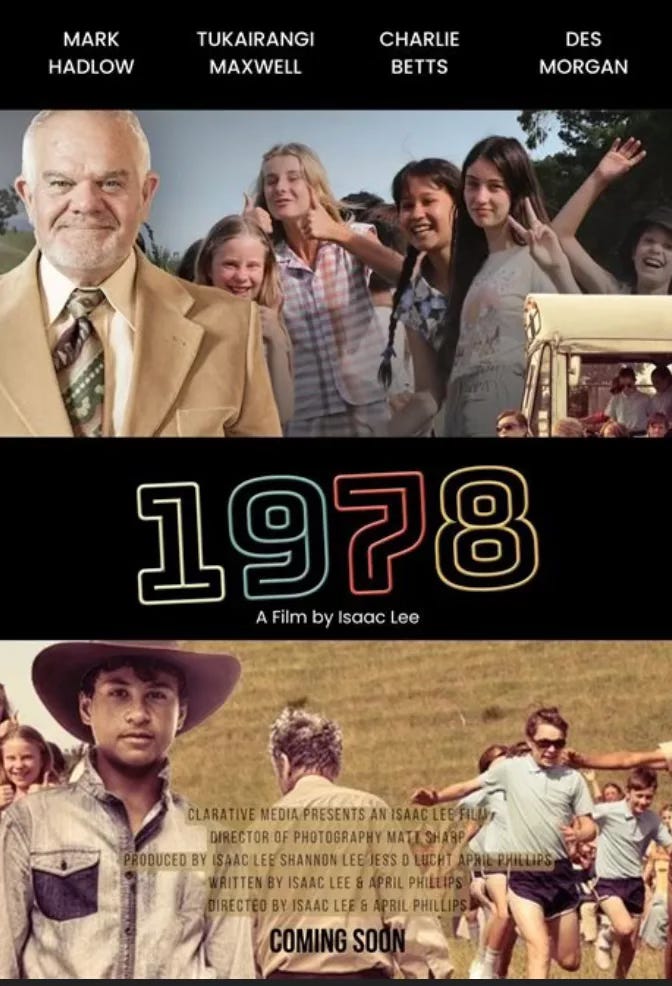
Last Monday I wrote a Hope post about two independent film makers who are trying to crowd fund the money to finish their self- funded feature film 1978 .They need $15,000 to do the post production and finish their film so it can be shown in cinemas up and down the country. As I write they have reached $10,834 on the Arts Foundation Boosted site. If they reach their target in the next 7 days they get the money. If they don’t they get nothing.Cruel, I reckon.But there it is.Yesterday I spoke with Director Isaac Lee and Co -Director April Phillips about their quintessential Kiwi film - where the idea came from, the struggles they have had to shoot their feature length film which has now been edited and just needs some post production polishing before it gets released for the big screens around our country.Do have a listen to the interview and if you can afford something to help them out please do. Every bit helps.Thank you to everyone who has chipped in so far.As you will hear in the interview they really appreciate your support.Here’s the linkhttps://www.thearts.co.nz/boosted/projects/post-production-1978Here is their websitehttps://www.1978.co.nzAnd their Facebook pagehttps://www.facebook.com/1978NZLet’s help make their inspiring 1978 film happen!ThanksBryan Please share this post with whanau and friends. This is a public episode. If you'd like to discuss this with other subscribers or get access to bonus episodes, visit bryanbruce.substack.com/subscribe

Comments

Download from Google Play

Download from App Store
 United States