


 Claim Ownership
Sunny Side Up Nutrition
Subscribed: 43Played: 764
Subscribe

© Sunny Side Up Nutrition
Description
A series of conversations about all things nutrition-related for parents or caregivers of toddlers, teens and everyone in between.
snutrition.substack.com
snutrition.substack.com
111 Episodes
Reverse

In this episode: Anna and Elizabeth unpack one of the most common parent worries, how much kids eat. We explore how diet culture fuels fear, why restriction and pressure backfire, and how to use structure (not restriction or control) to support kids’ self-regulation. We discuss:* Why social media “perfect plates” and lunchboxes fuel worry and fear* The research on restriction* Providing structure without micromanaging your child’s eating* Tweens/teens still need support (even if they look independent)* When appetites fluctuate * Special considerations for ADHD meds and ARFID Links & Resources* Division of Responsibility (sDOR) — Ellyn Satter Institute * Podcast with Naureen Hunani on prioritizing felt safety in feeding. Sunny Side Up posts to support this episode* Sunny Side Up Feeding Framework* Tips for Serving Dessert with Dinner * Handling Halloween Candy: A Step-by-Step Parent Guide * A Simple Guide to Eliminate Diet Culture from Halloween Other links* Caffè Panna: the ice cream Elizabeth ordered.* Pinney Davenport Nutrition, PLLC* Lutz, Alexander & Associates Nutrition Therapy* Photo by Angela Mulligan on UnsplashShare this episode with a friend who’s navigating mealtime worries.TranscriptElizabeth Davenport (00:01)Welcome back to Sunny Side Up Nutrition. Hi, Anna. Today we’re going to talk about a really common worry parents bring up: What if my child eats too much or too little?Anna Lutz (00:04)Hi, Elizabeth.Right, I feel like this is a universal concern. Parents are always worrying about how much their child is eating. Sometimes they’re worried they’re eating too much. Sometimes they’re worried they’re eating too little. I feel it’s never just right—thinking about Goldilocks. That’s what parents do best, including myself—worry. But we all want our kids to grow up, grow well, and be healthy, of course.Elizabeth Davenport (00:31)Yeah.Anna Lutz (00:35)I think what we really want to talk about today is how diet culture sends so many confusing messages to parents and kind of fuels that worry—fuels the worry of parents—so that they focus a ton on what their child should eat, how much their child should eat, etc.Elizabeth Davenport (00:56)Yeah, exactly. And so we’re going to talk about where those worries come from and why restriction and pressure to eat certain foods—more food, less food—backfire, and what parents can do instead to support their child’s relationship with food. Let’s jump in. Yes.Anna Lutz (01:15)That’s right. I’m really excited—I’m excited about this episode because I think most parents can relate to this.Elizabeth Davenport (01:19)Me too. Yes, I mean, we both can, right?Anna Lutz (01:25)Of course—100%, 100%. And it can change day to day. It almost can be humorous—how you’re worrying about one thing one day and then the next day you’re worrying about the opposite. Yeah. So yeah, let’s jump in. Why do parents’ worries about their child eating either “too much” or “too little”—those are in quotes—usually come from?Elizabeth Davenport (01:36)Exactly.I mean, as you said in the beginning, diet culture really has such a strong influence over everything that we believe about food. And social media—I mean, it’s all over social media: how much kids should be eating, what they should be eating. And it’s confusing even because it’s visual, and parents may see pictures of lunchboxes or plates and think, “My gosh, wait, I’m feeding my kid too much,” or “My gosh, I’m not feeding my kid enough or enough of the right foods.” And so I think one: I’ll caution, right? For parents, it’s so easy to compare what we’re doing to what’s out there. And really we have to do what we know is best, and it’s impossible to fully know how much is in those pictures when people show how much they’re feeding their kids.Other places that parents get these messages are from conversations with well-meaning pediatricians or other healthcare providers—also well-meaning family members, certainly grandparents. No hate—Anna Lutz (02:41)Very true.Elizabeth Davenport (02:59)—grandparents here because they can be really awesome, but they also sometimes forget what their role is, or it’s unclear what their role is. Right? And yeah—just, overarching, it comes from diet culture messaging.Anna Lutz (03:07)True. True.And often it’s linked—not always, but often—it’s linked to the child’s body size. Don’t you think? So if someone—whether it’s a pediatrician or family member or parent—is worried that the child is, “too big,” they’re focusing on, “Well, they must eat too much.” And then conversely, if there are worries about a child being “too small,” that kind of fuels the worry of, “My gosh, my child’s not eating enough.”Elizabeth Davenport (03:22)Yes.Anna Lutz (03:44)So that’s where that diet culture and weight bias really can make an impact and then translate to how we feed our children.Elizabeth Davenport (03:54)Exactly.And because there’s so much information available to us now, parents are just bombarded with this. Even if they’re not on social media, they’re bombarded with this kind of information.Anna Lutz (04:07)It’s so true—it’s so true. And I feel like it’s important to really note that when we see those images on social media that you mentioned—or someone says, “This is how much someone should eat”—there are so many more factors. Even us as dietitians, we would never be able to tell a parent, “This is exactly how much this child should eat at this meal.”Elizabeth Davenport (04:30)Exactly.Anna Lutz (04:31)Because they’re growing, their activity levels—Elizabeth Davenport (04:31)It’s a great point.Anna Lutz (04:34)— are different. It depends what they ate earlier in the day; it depends what they didn’t eat earlier in the day or last week. And so there’s not some magic amount that if we just knew what it was—because even as pediatric dietitians, it’s not something that is definable.Elizabeth Davenport (04:39)Yeah. Exactly. Exactly. So this is a nice segue into why it’s so hard to really trust children to self-regulate their food intake.Anna Lutz (05:05)That’s such a good question because it’s kind of at the heart of it. I think because diet culture has so heavily influenced parenting and our medical system—and a big role of diet culture is to evoke fear—it tells us we can’t trust bodies.Elizabeth Davenport (05:29)Right.Anna Lutz (05:30)Right—we need to control bodies.And so instead of really telling parents, “You know what? Children’s bodies are wise, and your job is to support them in eating and, over time, developing their eating skills,” instead we’re told, “You need to make sure your child doesn’t eat too much of this, and you need to make sure your child eats enough of this.” These messages to parents are: don’t trust your child. And often parents aren’t trusting their own bodies, so then it’s a leap—Elizabeth Davenport (06:02)Exactly.Anna Lutz (06:03)—to then trust your child’s body.I think a few things to highlight here—and you probably have some ideas about this too—we’ve got research that really backs this up. One thing that comes to mind is research showing that when parents restrict their children’s eating— they might be worried their child’s eating too much and they restrict——then what we actually see is increased eating and sneak eating as a result. And so it doesn’t “work.” If the goal is for the child to eat less, it doesn’t work for a parent to restrict their eating. What is some other—Elizabeth Davenport (06:34)Exactly.Anna Lutz (06:46)—research we should highlight?Elizabeth Davenport (06:51)Oh my gosh, that’s a good question. And I’ll be honest here—that is not one of my strengths, remembering the research.Anna Lutz (06:57)Well, I was thinking about how we know that pressure doesn’t help either. So, the opposite: if we’re worried a child isn’t eating enough and we start to say, “You have to eat this much,” that does not lead to an increase in intake. So again, it’s not working. And then there’s this study that I know we’ve mentioned many times on the podcast, but we’ll bring it up here: when parents—Elizabeth Davenport (07:03)Thanks.No. It does not.Anna Lutz (07:21)—restrict “highly palatable foods,” which probably was the old name for highly processed foods, then when children who were not allowed access to those foods in their home were exposed to those foods, they ate a whole lot more. Again, that kind of restriction didn’t lead to self-regulation.Elizabeth Davenport (07:24)Right. Right.Yeah. Yeah. Exactly.I thought you were asking me to name a research study. I definitely cannot do that—except for maybe that one where they feed kids lunch—both kids who’ve been restricted and kids who haven’t been restricted the highly palatable foods—and then they’reAnna Lutz (07:51)Oh, sorry—I was not putting you on the spot. Elizabeth Davenport (08:12)—sent into a room with toys and with free access to all of those foods. And yes—even when they’ve eaten all their lunch—those kids who are from restricted families go and eat more of those highly palatable foods than the kids who are used to having them. I mean, I’ve seen it in my own home. Anytime there’s a kid who’s been restricted those highly palatable foods, often—what I’ve seen—they are going to eat those foods first on a plate. Always. And that’s okay. That’s okay. You can tell when kids are sitting together at a tableAnna Lutz (08:54)Great. Makes sense.Right.Elizabeth Davenport (09:04)with lots of different foods that include something highly palatable—like, I don’t know, Goldfish crackers or Cheez-Its—the ones who don’t have them on a regular basis or feel restricted are the kids who really have a hard time self-regulating.Anna Lutz (09:17)Right, right. That’s true. Elizabeth Davenport (09:29)I just got us way off the topic, I think.And I want to make sure here that we also bring up our Sunny Side Up Feeding Framework, and step three of that framework is: trust your child to eat and grow.Anna Lutz (09:44)Which is—it’s so amazing that in our culture, that’s such a big lif

In our latest podcast episode, Anna and I talk about how parents can navigate a conversation, when a child says, “I’m fat.” In Episode 109, we unpack why this moment feels so charged, and how to respond with curiosity and care.We talk about the baggage our culture places on the word “fat,” why a one-size-fits-all script doesn’t exist, and how parents can validate their child’s feelings. You’ll hear what not to say, what to try instead and when to consider seeing additional support. We also share practical ideas for building body respect at home and how to circle back if your first response didn’t go the way you hoped.* Hit play for language you can use today plus encouragement for staying grounded.Do you have questions or a topic you’d like us to cover on the podcast? You can also email us at hello@sunnysideupnutrition.com or DM us on Instagram at @sunnysideupnutrition.Links* More-love.org, Ginny Jones * The Truth Behind Your Tween Daughter Calling Herself Fat, Ginny jones* Parenting Without Diet Culture, Oona Hanson* Pinney Davenport Nutrition, PLLC* Lutz, Alexander & Associates Nutrition Therapy* Photo by Juliane Liebermann on UnsplashTranscriptElizabeth Davenport, MPH, RD (00:00.524)Okay. Hi, Anna. How are you?Anna Lutz, MPH, RD (00:02.761)Hey Elizabeth, how are you?Elizabeth Davenport, MPH, RD (00:06.52)Good, I’m good. It’s good to see you. So today we are talking about what to do when your child says, I’m fat. This can be such a tough moment for parents. It’s layered with so many of our own experiences with cultural weight bias and with assumptions that we might make about what our child is feeling. And kids are all different sizes and may mean totally different things when they use the word “fat”. There isn’t, and it’s important to know that there isn’t one right response, but our hope is that today’s conversation gives you tools and ideas for how to respond if this comes up in your home. And it has certainly come up in my home for sure. So, and it is really tough to know how to respond. Parents often panic when their child says I’m fat. So let’s talk about why this comment feels so alarming. And really it leaves parents almost feeling kind of like they’re on their back, back foot.Anna Lutz, MPH, RD (01:29.215) That’s so true. I mean, I think what it comes down to is that our culture has equated the word fat with bad.Like everywhere we look, we’re getting these messages that fat is bad. know, many of us grew up that that word was an insult. And as parents, of course, we want our kids to be happy and safe and accepted. And so hearing this word that we have been, you know, “cultureized” or taught that it is bad or as an insult, can really hit a nerve as a parent. And so, you know, we’re a product of all that. It’s not anyone’s fault. It’s just, it just is. I do think it’s important for us to talk a little bit about this word “fat,” because you might even notice as Elizabeth and I saying that you’re having a reaction to it that would be normal again because of our culture. But it’s also important to know that some people are reclaiming it as a neutral descriptor. So some people are really saying, you know what, all it is, is a descriptor. Some people are thin, some people are fat, some people are tall, some people are short. It’s a descriptor. And they’re using the word fat to describe their own bodies and not in a mean or disparaging way. And so, of course, we want to teach our kids that insulting people or commenting on people’s body is never okay, but you know at the same time to know that some people use the word fat in a neutral way and that’s and that’s great. And so this is where this conversation can get a little sticky.Elizabeth Davenport, MPH, RD (03:15.132)Exactly, exactly. And the challenge, as you said, is that we live in a society where fat is often used as an insult. And even if you’re raising your child with body respect values, they’re still getting these negative messages from peers, from the media, and just our culture overall and school as well. I guess that’s peers and our culture. So how can we acknowledge that reality, affirm biodiversity, and stay curious about what our child means and communicate that changing their body isn’t the solution.Anna Lutz, MPH, RD (03:58.175)It’s such an important and good question. And I feel like it’s a lot for us parents to balance, especially in the midst of us having our own reaction, right? We might be having our own reaction to it, but we’re trying to balance like, but we’re a body positive home and that’s a descriptive word, but are they insulting themselves? And did someone make fun of them? Right? Like all of this could be swirling in our head and it’s just so much to balance. Elizabeth Davenport, MPH, RD (04:25.693)It is, it is. And if the, you know, the child may be upset also, and it’s going to be maybe just hard for them to take in much of anything. so, but, but first, before I get ahead of ourselves, let’s start with what not to say when a child says I’m fat.Anna Lutz, MPH, RD (04:43.849)Yeah, I love that question because it’s a good place to start, right? Because there’s so much nuance here, but let’s, let’s really, I love that. Let’s dive into what not to say. So I think both of us really would recommend that you not say, “No, you’re not,” right? Because then you’re reinforcing that fat is this bad, bad, bad thing. And like, “goodness gracious, no, you’re not”. Because they might be fat, right? Your child might be in a larger body. And you’re also, again, don’t want to be reinforce this idea that it’s inherently bad. You don’t want to say, “Well, I’ll help you lose weight”. Let’s do X, Y, Z. Let’s change your food in some way. You don’t want to say that. you know, is, again, reinforcing that your child’s body is the problem and that there’s some kind of “solution,” to the problem.Elizabeth Davenport, MPH, RD (05:35.978)Right? And that they need to change their body. Yeah.Anna Lutz, MPH, RD (05:37.983)Exactly, exactly. And then the other one that comes to my mind is don’t say, “oh, don’t worry, you’ll grow out of it.” Right? Because again, first of all you don’t know that. Second of all, you’re reinforcing the idea that something’s bad and wrong that needs to change.Elizabeth Davenport, MPH, RD (05:56.203)Yeah, yeah, I know when we were when when I certainly when I was a kid What you often heard people say is it’s baby fat and you’ll grow out of it Yeah, which is just not that means there’s it’s something that needs to change which is not the case.Anna Lutz, MPH, RD (06:14.015)Exactly. And I think, of course, these are well-meaning responses. know, of course, as parents, we just want the best for our kids. They’re well-meaning, but like, as we mentioned, they can reinforce these harmful ideas. So instead, right, I know something you and I really talk about, instead of jumping in with the answers, like these things that we just named of what not to say, instead we want to pause.Anna Lutz, MPH, RD (06:43.377)And be curious with our child. So that can be hard for me sometimes, Elizabeth, for me to bite my tongue and to pause. So I’m partly saying this to myself. I need to pause and be curious.Elizabeth Davenport, MPH, RD (06:55.848)Yes, exactly. I have the difficult time with it as well. Yeah, because we just want to help our kids really. And so, but yes, because when a child, one of the reasons that we want to kind of slow down and be curious is also because when a child says, I’m fat, they may not literally be talking about their body size.As we know, kids and adults are often expressing that they feel badly. And part of that is because the term fat is viewed as primarily as negative, but they could be expressing some kind of some other kind of discomfort, loneliness, frustration, anger, feeling left out and just any kind of they could be tired. So and the other thing is they could also be comparing themselves to others or just expressing some kind of awareness of their body. Right. So how can, yes, yes. So many things that can be going on. so how can parents gently explore what their child really means? I mean, I know we said initially pause, take a deep breath.Anna Lutz, MPH, RD (08:05.949)Absolutely. Absolutely. There’s so much going on, right?Right.So I think the thing is to ask open-ended questions. And I know this is something I have to actively practice when I’m having an emotional reaction to anything. My child might say, this is my default is to be like, let’s ask some questions instead of going into fix it mode. So you might ask questions and this curiosity may sound like, “well, what do you mean by that?” Or “tell me more about that.” It opens that door to understanding what your child is really feeling rather than making assumptions, assuming that they’re feeling what you’re feeling. So once we’ve paused, taken a deep breath, maybe asked them open ended questions…what are some supportive responses that we could say instead of that kind of reassurance that we said not to say, reassurance about their appearance? What could we say that would be supportive?Elizabeth Davenport, MPH, RD (10:05.426)So there are a number of responses that we recommend. And of course, this is going to vary based on your child’s age and just your child’s personality in general. You know what your child is going to respond well to and what they’re not going to respond well to. you know, parents can acknowledge and validate the underlying feelings, right? Maybe it’s as we said, could be loneliness, frustration, comparing themselves to other people.One thing you might say is it really sounds like you feel left out. That never feels good. Or you might just affirm, not just, but you might affirm that again, that bodies come in all different sizes and that all bodies deserve respect. And then if your child’s being teased, be clear that it’s with your child, which you know, if they’re being raised, they probably, you probably have been clear with them that thi

We have another episode for you where I’m joined by Anna Mackay, an original co-host of the podcast with Anna Lutz and me. Anna lives on the other side of the world these days, but she and I were able to catch up and record a few episodes this summer while she was visiting the US. I’m sure you’ll enjoy this episode as much as I enjoyed talking with Anna Mackay!Podcast Episode 108: Nourishing Teen Athletes with Anna Mackay In this conversation, Elizabeth and Anna Mackay discuss the unique nutritional needs of teen athletes, emphasizing the importance of fueling for growth and performance. They explore tips for building healthy relationships with food, the role of parents in supporting their teens, and practical strategies for fueling teen athletes in a number of different scenarios. The discussion also highlights the signs of under-fueling and provides resources for parents and teens to navigate nutrition effectively.Key takeaways* The unique nutritional needs of teen athletes.* The importance of food for growth and performance.* The roles parents play in fueling their teen athlete.* The importance of meal planning and preparation.* Suggestions for navigating teen athletes who don’t want to eat breakfast and those who are picky eaters. Links to resources* Podcast Ep. 69: Getting Diet Culture Out of Sports Culture with Rachel Manor* Podcast Ep. 25: Sports Nutrition for Kids and Teens with Leslie Schilling* Leslie Schilling’s Dietitian Development Hub * Podcast Ep. 28: Nourishing a Dancers Mind & Body with Monika Saigal* Podcast Ep. 59: Eating Disorders and Athletes with Shane Jeffery* Hydration Essentials: All Fluids Fit* Opal Podcast: The Appetite* Pinney Davenport Nutrition, PLLC* Lutz, Alexander & Associates Nutrition TherapyDid you miss my previous conversation with Anna Mackay? We chatted about meal planning for college and boarding students. * Episode 104: MealPlanning for College Students TranscriptI am so excited to say to our listeners that I am here with Anna Mackay, who, as those of you who've been with us for a long time know, Anna is really the impetus for starting the podcast during COVID. So Anna, I'm so excited you're here. Welcome, welcome.Anna Mackay (00:20)I am equally excited to be here and in the same time zone. Elizabeth (00:26)Yes, yeah.That's why we haven't been recording with Anna, because Anna's been in a very different time zone and busy ⁓ becoming a registered dietitian, which she is now officially a registered dietitian. yes, yay. And Anna is also a certified personal trainer. And so we thought she would be a great person to chat with.Elizabeth (00:51)Fueling teen athletes. So we'll jump in and let's just talk for a minute to let our listeners know kind of what you would say are the nutritional, you know, what makes the nutritional needs of teens, ⁓ teen athletes rather unique.Anna Mackay (01:06)Thanks.So I really like this question because I don't think it's something we think about. You sort of just, think often it's approached as like a one size fits all. But the main reason that teen nutritional needs are unique is because teens are still growing and developing, right? Their bones, muscles, their brains, their hormones are still maturing. And then you add training into the mix.And it doesn't matter what type of training, we could be talking about football, dancing, gymnastics, any type of training that is physically taxing to the body. And their nutritional needs are going to go way up. Food isn't just fuel for sport either. It's the raw material needed for building a strong, healthy body for life. And so that is what I think makes the nutritional needs for teens specifically unique. I'll also add that where adult athletes would be primarily focused on performance maintenance, teens are still in a phase of physical development and need food to support both their growth and performance. So they are going to need more energy in the form of calories, more protein, potentially more fluids, and more micronutrients like calcium and iron, for example, because of that growth and training.Elizabeth (02:31)So they have to pay, they and their parents really have to pay closer attention to their needs without creating an issue, right? Without it becoming a struggle. Well, so how can parents support teen athletes in building flexible, trusting relationships with food and really support them in.Also, this is really more than one question, support them in meeting their needs.Anna Mackay (02:59)So to answer, think the building of flexible and trusting relationship with food first. I would be interested actually Elizabeth in hearing what you think about this. For me, the first thing that comes to mind is never ever ever tying food to appearance. And for teen athletes, this is going to be very particularly important for the athletes who are in your very, what I would call body conscious sports, gymnastics, swimming, diving, also the sports where they are still, I think, at the elite level, weights are still being taken, wrestling and rowing, it is still happening. Maybe forgetting a sport where that happens, maybe boxing. Because as soon as a kid starts tying their food to how they look, it's impossible to have a flexible relationship with food because they're going to always have that little voice in their head saying, are you sure you want to eat that? It'll make them second guess their intuition. And so instead we can focus on how food helps them to perform by saying things like, this is going to help you recover faster, or this will give you more energy at practice.Keep conversations about weight or size out of it. And I'll just add to that, that it's really important for parents to also model this - modeling body respect yourself.Elizabeth (04:21)Yes, that's a huge one. I'm sitting here nodding and our listeners can't see me nodding. But yes, that's such a valuable point. Even if parents aren't saying anything, just watching, just the teens seeing how the parents are eating and seeing their relationship with food and physical activity. And the earlier that starts, the more solid a foundation the teens will have.Anna Mackay (04:45)Yeah, and one more thing I would add to that is we really, really need to get away from this idea that carbs are bad - absolutely essential. They are an essential component of good nutrition, both generally for every day for all of us, but particularly for athletic performance. Elizabeth (04:53)I'm so YeaAnna Mackay (05:07)You know, and I live on the other side of the world now, and I hear this all the time, and I'm sure in the States this is still a big thing where everyone's kind of... carbs are bad, reduce your carbs and protein’s king. We need both. We do. So, and you know, this belief that sort of looking a certain way is a part of athletic success is also incredibly harmful. I think the bottom line is that under fueling hurts performance, it slows recovery and it increases the risk of injury and burnout. And carbs are a really important part of that fueling.Elizabeth (05:39)Do you want to talk kind of high level on why carbs are so important?Anna Mackay (05:44)Well, it might be over-complicating things to go into the sort of biochemistry of it, but I think we can explain that, or it might be helpful to explain that carbs, when we ingest them, are converted into glucose. And glucose is how our bodies get energy. It is our brain's preferred source of energy. It is also your muscles' preferred source of energy. So that's where all your energy comes from. And the protein is the building block that helps provide the muscles with it's muscle building block, I think. Is that how you would explain it?Elizabeth (06:19)Yeah, 100%, 100%. And I think one thing that just popped into my mind when you were talking about this is, you know, parents are, you know, even if parents are modeling at home and really have laid a foundation for a positive relationship with food, it can still be so difficult because the parents are up against, and the teens, and the coaches are up against all the messaging that's out there in the media. And so that adds another layer to really making sure that teen athletes are fueled adequately.How can parents support teens to fuel eating for performance and recovery after practices and games? You really, do you feel like you said that? Anna Mackay (07:08)I mean, we could talk about packing snacks and sort of planning, being prepared. I think where people can get caught out in the planning for, or not planning, being able to support themselves adequately for performance and recovery when it comes to their practice schedules is in being under prepared or not being prepared at all. So if parents can help out with planning ahead so that your busy team, because these team athletes are so busy, they are, you know, you've got rowers getting up at 4:00 in the morning to hit the river at whatever time.If they already have packed in their sports bag, you know, their water, their whatever snack bars they like, or maybe it's a Tupperware with apples with another Tupperware that's got their peanut butter in it, whatever it is, if it's already in the bag, then it's going to go to practice with them. And the same way, you know, whether that's morning or afternoon, right? So you don't get caught with nothing to eat.And then making sure that you've got things available like the jar of peanut butter, the oats, the hard boiled eggs, the bars, whatever it is. And you're not going for perfection, right? You're going for consistency, variety, and just making sure that you're not skipping snacks or meals.Elizabeth (08:38)And the part about not going for perfection is so important. So let's just talk for a few minutes about how parents can help their teens recognize that there isn't a perfect way to eat for additional performance. How can parents ensure that eating remains a positive experience rather than this anxiety ridden exercise.Anna Mackay (09:03)Yes, there is no su

We’re back with our latest episode of the Sunny Side Up Nutrition Podcast. In this week’s episode of the podcast Anna and I dive into the roles parents don’t need to take on (like controlling weight or forcing kids to clean their plates) and the roles that necessary for raising confident eaters. We talk about Ellyn Satter’s Division of Responsibility, how to adapt it with responsive feeding, and our own Sunny Side Up feeding framework that helps parents understand and succeed in their roles in the feeding relationship.What’s in the episode* Parents are bombarded with messages about controlling their child's eating.* It's not a parent's job to control a child's weight or eating habits.* The Division of Responsibility in Feeding outlines clear roles for parents and children.* Responsive feeding tailors the feeding approach to each child's needs.* Creating a positive mealtime environment is crucial for healthy eating.* Parents should focus on their own stress levels to improve feeding dynamics.* Modeling healthy eating behaviors is essential for children.* There is no one-size-fits-all approach to feeding children.* Parents should avoid the pitfalls of being too permissive or too restrictive.* The Sunny Side Up framework helps simplify feeding responsibilities for parents.Relevant links* Virginia Sole-Smith: The Eating Instinct and Burnt Toast Newsletter* Picky Eating article by VSS* Ellyn Satter Institute: Division of Responsibility in Feeding* Learn more about our membership: Take the Frenzy Out of Feeding* Pinney Davenport NutritionTranscript This is a public episode. If you would like to discuss this with other subscribers or get access to bonus episodes, visit snutrition.substack.com
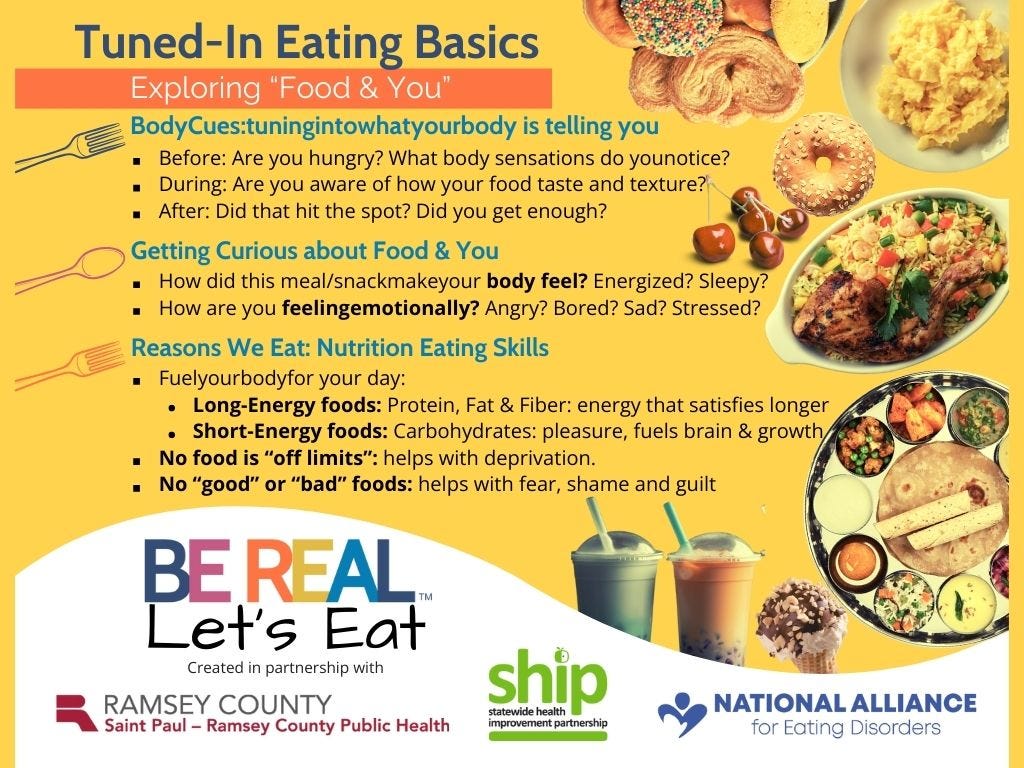
Greetings!You’re likely in the thick of it with back-to-school activities. But back-to-school isn’t just about packing lunches and adjusting to new schedules. It’s also a time when kids begin to hear harmful messages about food and bodies. In this episode of Sunny Side Up Nutrition Podcast, we’re joined by Denise Hamburger, JD, founder and executive director of BE REAL USA, and Selena Salfen, MPH, RD, a public health dietitian working to shift systems toward size-inclusive, weight-neutral models of care. Together, they share insights on BE REAL’s Let’s Eat curriculum, a nutrition program for middle and high school students that focuses on tuned-in eating teaching students to consider their body cues, nutritional needs, food preferences, and past eating experiences. The lessons are designed to be inclusive across cultures, neurodiverse learners, and varying economic backgrounds.Click here to visit BE REAL USA, Let’s EatKey Takeaways * Let's Eat is a new curriculum aimed at teaching nutrition without the influence of diet culture.* The curriculum is free and accessible to all students and educators. * Let's Eat encourages students to trust their bodies and make informed food choices.* The curriculum includes cultural sensitivity and celebrates diverse food practices.* A panel of 42 experts contributed to the development of Let's Eat.* Educators can access Let's Eat through professional development training.* BE REAL USA has ambassadors who are trained to deliver th.e curriculum* Denise and Selena chat about their favorite foods.Links to Resources Mentioned:* BE REAL’s Let’s Eat Middle and High School Nutrition Curriculum* BE REAL’s Body Kind High School Body Image Curriculum* BE REAL’s Ambassador Program* BE REAL’s Body Kind Peer-Led College Body Confidence Seminar* National Alliance for Eating Disorders* Lutz, Alexander & Associates Nutrition Therapy* Pinney Davenport Nutrition, PLLCMore about Denise and SelenaDenise Hamburger, JDDenise Hamburger, JD, is the founder and executive director of BE REAL USA, a nonprofit that imagines a world where every child can grow up with a healthy relationship to food and their body. In 2016, Denise created a professional development workshop for teachers called Body Confident Schools and has delivered this training to over 10,000 educators around the world. With over 250 conference, keynote, and school presentations, Denise has presented at the Harvard T.H. Chan School of Public Health to the National Association of School Psychologists; at the Center for Disease Control to their Healthy Schools Division; at the United States Department of Agriculture to their Food and Nutrition Services Group; and to Amazon’s Body Positive Peers Employee Resource Group.Denise co-developed Be Real’s BodyKind high school, body image curriculum with a team of international body image academics, psychologists and teachers. BodyKind is the first body image curriculum developed for all students. It includes the body image experiences of people of different races, ethnicities, sexualities, gender identities, physical and mental abilities, and body sizes. BodyKind was tested in an 1150-student Randomized Control Trial in Ireland in 2024, and the program has proven to increase to student Body Appreciation, Self-Compassion and Body Appreciation. These aspects are associated with better self-esteem and better mental health.In 2025, Denise--with Ramsey County, MN Public Health--co-developed and launched a weight-neutral nutrition curriculum called Be Real’s Let’s Eat for middle school and high school students. Let’s Eat focuses on Tuned-in Eating, which teaches students to integrate their own body cues, day’s nutritional needs, food preferences and eating experiences into their eating patterns. Let’s Eat lessons are relevant across cultures, neurodiversity, and economic status.Denise has a Juris Doctor degree from the University of Michigan Law School and was an environmental attorney in her first career. She co-wrote the legal treatise Pollution in the United Kingdom. Denise is an Anti-Bias, Antiracist Certified curriculum writer. She has spent the last 25 years involved in education nonprofits, including Chicago’s After School Matters.Instagram: @berealusaWebsite: www.berealusa.orgSelena Salfen, MPH, RDSelena Salfen, MPH, RD (she/her) works on chronic disease prevention in local public health, focusing on sustainable policy, systems and environmental change. Much of her work involves transitioning public health and healthcare systems from weight-focused to size inclusive, weight neutral models of practice. She also presents to educators and school-based health clinics on why weight neutral, eating disorder-aware education is vital to improving and protecting student health.TranscriptElizabeth: Welcome to Sunny Side Up Nutrition, a podcast created by three moms striving to bring you evidence-based information to help support you and the children in your life.Your hosts are Anna Lutz and me, Elizabeth Davenport, both registered dietitians, and Anna McKay, a dietitian-to-be and certified personal trainer.Anna Lutz co-owns Lutz Alexander and Associates Nutrition Therapy in Raleigh, North Carolina, and I co-own Pinney Davenport Nutrition in the D.C. metro area. And Anna McKay is in the process of completing her dietetic internship.Just a note that this podcast is for informational and educational purposes only. Thanks for being here.In this episode, we're joined by two of the co-creators of the Be Real Let’s Eat curriculum: Denise Hamburger and Selena Salfen.Elizabeth: Denise Hamburger, JD, is the founder and executive director of Be Real USA, a nonprofit that imagines a world where every child can grow up with a healthy relationship to food and their body.In 2025, Denise—with Ramsey County, Minnesota Public Health—co-developed and launched a weight-neutral curriculum called Be Real’s Let’s Eat for middle school and high school students.Elizabeth: Selena Salfen, MPH, RD (she/her), is a registered dietitian in public health. Much of her work involves transitioning public health and healthcare systems from weight-focused to size-inclusive, weight-neutral models of practice.Denise and Selena are two of the many experts who came together to create the curriculum. It focuses on Tuned-in Eating, which teaches students to integrate their own body cues, nutritional needs, food preferences, and eating experiences into their eating patterns. Lessons are relevant across cultures, neurodiversity, and economic status.Anna: Denise and Selena, we are so happy you're here. Welcome.Multiple speakers: Great to be here. Thank you, thank you.Anna: Let's jump in. To start us off, can you each tell us a bit about yourself and the work you do?Denise: Thank you. I guess I'll start. I'm Denise Hamburger. I'm the founder and executive director of Be Real USA, a nonprofit that focuses on providing the highest quality resources on body image and eating disorder prevention for schools.I've been talking to educators and parents for almost ten years now about how to create body-confident environments in schools and in homes. We have a presentation I've been giving for ten years called Body Confident Schools, which helps the adults in young people’s lives develop language and understanding that supports raising kids with body confidence.This language and understanding is very different from what we get in diet culture. In the last five years, Be Real added a new piece to its mission: curriculum development. Teachers had been asking us for better resources on body image and nutrition, and we felt compelled to develop them ourselves.Our high school body image curriculum, BodyKind, was developed by a team of academics and tested in schools. We’ve tested it three times, and we’ve had four published papers on its feasibility, accessibility, and effectiveness.We’re starting that same kind of testing now with our new curriculum, Let’s Eat. We also have 150 ambassadors across the country who present our workshops and share our curriculum.Anna: Wow. We certainly need new curricula, so we’re so glad you’re doing this work and that you’re in this space.Elizabeth: I want to hear more about the ambassadors, but we’ll leave that for later.Selena: I’m Selena Salfen. I’m a registered dietitian, but I work in public health, so I don’t see clients one-on-one. I focus more on macro-level policy, systems, and environmental change.I work on a chronic disease prevention grant, where we support schools in areas like food access, nutrition, and mental health. That’s how I ended up working on Let’s Eat.I’m also very committed to bringing size-inclusive, weight-neutral work into public health and undoing some of the harm done since the 1990s, when public health began to hyper-focus on weight, weight control, and BMI.I’ve done a lot of work with WIC, integrating weight-inclusive practices, and expanded that work into other community-based health programs.I’m also a parent to a child with sensory needs around food, which shapes my perspective. And I’m a Be Real ambassador—that’s how Denise and I met.Anna: That’s wonderful. I really appreciate the work you’re doing. I imagine it sometimes feels like swimming upstream in public health.Selena: You know what? It’s been better than I expected—and actually really exciting.Elizabeth: That’s great to hear.Anna: We’re recording this episode just as school is starting across the country, and we’re excited to talk about this new curriculum. Denise, can you tell us more about Let’s Eat and what inspired you to create it?Denise: Sure. I mentioned earlier that I’ve been speaking with teachers for the last ten years. They’d often ask me what curriculum they should be using—specifically one that doesn’t harm students’ body image.We know from research that what’s typically being taught reflects diet culture and can be harmful. For example, a few studies have asked eating disorder patients what triggered their eating disorder, and

Hi Friends, It’s that time of year again - Back to School! We’ll be sharing plenty of back-to-school content over the coming weeks to help you feel ready to start the school year. If you’re dreading school lunch packing, then this podcast episode is for you. Anna and I offer realistic advice to simplify packing lunches. Key Points * Why lunch packing feels overwhelming* The pros and cons of bento-style lunch boxes* Easy, practical ways to streamline lunch packing* How to deal with uneaten lunches* Ideas for lunches to packResources* Simple Black Beans and Rice Recipe* Easy Black Beans, Corn & Tomatoes* Sunny Side Up Nutrition: Lunch Packing Ebook* Pottery Barn Bento Lunch Boxes * Pinney Davenport Nutrition, PLLC* Lutz, Alexander & Associates Nutrition TherapyTranscriptEp. 105 – Back-to-School Lunch Packing TipsAnna: Alright. We're back. We're back. Elizabeth, this is so much fun. I'm excited to talk to you about lunch packing. Woohoo! Elizabeth: And guess what? I'll start the episode by saying I am finished packing lunches.Anna: Oh, I'm so jealous.Elizabeth: because my youngest is about to go off to college.Anna: Wow.Elizabeth: So I'm a little sad because it's been a big—it's been a job that I've always done.Anna: Yes.Elizabeth: Not in the summers. They do their own lunches in the summers, but during the school year...Anna: Well, you have a lot of wisdom to pass on. And I'm so jealous. I have another nine years of lunch packing. That's all. No big deal. Well, school is about to start for us, I guess at the end of the month. End of August here.Elizabeth: Yeah, it starts, I guess, mid-August here. It starts August nineteenth, I think. Here.Anna: Wow. Wow.Elizabeth: In Alexandria City. I don't know about the rest of the DC metro area, but yeah, it's coming up. Summer has flown. Anna: And I know when school starts approaching for me, I start to think, oh gosh, we've got to get back to lunch packing. My child's at a camp this week that they don't have to pack lunch, and it was like celebration time.Why do you think it's so dreaded? Why do you think packing lunches is such a dreaded thing for so many parents?Elizabeth: I think, in part, because you have to come up with ideas for what to pack. So it's one more thing you have to think about and manage as part of the mental load. Often we do it in the morning, and mornings for many people tend to be rushed. And I think other reasons that make it dreaded is it's just kind of a boring task and you do it over and over. I mean, if you think about the number of years your kids go to school, that's a lot of lunches.Anna: Yes - so true. Elizabeth: And as I always share, I opted—and I'm not saying people have to do this—but I opted to pack my kids' lunches all the way through high school. I felt like that was a job I could do. And in my mind, they were still learning what goes into lunch, because they would see what I packed.But back to what you think people dread about it... I also think kids have different likes and dislikes. And if you have multiple kids and you're trying to keep things simple and pack the same things, that can be tough.Anna: Can be, can be. You need to have the items on hand, right? There are all these steps: the items on hand, the proper packing stuff, the containers or lunchboxes—whatever that looks like. If there's utensils involved, there's just... there's a lot.Elizabeth: And I'm going to say this—I don't know if I'm jumping ahead—but one of the things I’ll say is about the lunch packing supplies, the lunch boxes and bags. I think the bento boxes are great. I use a couple different ones for my younger daughter. However, I almost always have to pack something outside that bento-style box. It's very hard to give kids enough in those, and I'm not criticizing them. I'm just saying this because we see them so often on social media. Every time I see them, I think, oh, that can't be enough for a child. Maybe it's just the way it looks on the screen.Anna: Right. Right.Elizabeth: Again, they're great because young kids can open them up and see everything—they don't have to open a bunch of containers. So there are some real benefits. But you also have to think: what’s going to fit in there? Sometimes I have to change what I'm using because it didn’t fit.Anna: Oh, totally.Elizabeth: I'm like, what of this is going in there?One piece of advice is to have a number of different things that you use so you’re not just restricted to one type of container.Anna: Right. I agree. I think that makes total sense.And, you know, of course we're talking today about school-aged children. So that could be anyone from age three—if they go to preschool or daycare—up to eighteen. And so, of course, there are different needs and different size containers.But I'm with you. Some of those bento-style boxes are not enough for my older children. I do use—and we've written about this—the Pottery Barn ones for my younger child.Elizabeth: Yes.Anna: They're a little deeper, I think, than some of the others. But there are lots of lunches that don't work in that.Elizabeth: Right? Can you still buy those? We'll look and see if we can link to them in the show notes.Anna: I just bought our new Pottery Barn lunch box. We buy them because they have a strap, and she needs one she can throw across her body. And then the bento boxes they sell fit in there.Anna: But again, we don’t work with Pottery Barn.Elizabeth: Yeah. Not sponsored by Pottery Barn. Just sharing helpful information.Anna: Yes.Elizabeth: We keep this ad-free for you all.Anna: Alright, so I'm kind of curious. Do you feel like there are some main pitfalls that make packing lunches harder for people than it needs to be? What are the things you commonly see when you work with parents?Elizabeth: I mean, I’ve seen so many different things. Let me think of a good example. I've seen parents come in who are packing their child the same thing every day, and they're worried about doing that. And I think that's okay.School cafeterias typically are very busy, noisy places. They have a short time to eat lunch. It’s not like a calm, pleasing environment. So just send what they'll eat.I think parents also may feel pressure to pack some sort of perfect lunch. You see these on social media. And if that brings you joy, that’s great. It’s okay if it brings you joy to cut the veggies into little shapes and stars.But in my mind, for some people, that’s a form of pressure for the kid to eat the food.Anyway, I’m getting off topic again.I just think parents are under so much pressure—to be perfect, to plan something different every single day—and it’s just not realistic.Anna: That’s right.Elizabeth: We're all about simplifying things.Anna: Right. But I think you’re exactly right—that pressure of “It needs to be this. It needs to be this. It needs to be this…” It doesn’t. I think that’s the biggest pitfall: succumbing to that pressure.Elizabeth: I think you’re right. And if your kid likes the school lunch? That is great. We're not saying in this episode that parents have to pack their kids’ lunches.Anna: That’s right.Elizabeth: We are big fans of school lunches.Anna: Absolutely. I’m very excited when my child wants to buy the school lunch. Unfortunately, they prefer packed lunch.Elizabeth: In some schools—honestly, like in my kids’ schools—the schools were just too big. I mean, the high school had 4,500 students. There’s not enough time to get in line, get lunch, eat, and get back to class. So it’s really hard to make that happen. Even in elementary school.Anna: Yeah, that makes sense. I’m going to circle back to something you said a few minutes ago because I think it’s important: you said you packed your children’s lunches all the way through, which is great. Like you said, it was modeling, and they could focus on other things. And some parents do it differently.So I’ll share what we’ve done. When they’ve gotten to a certain age—upper middle school, maybe—I might have them help me. I’d say, “I’m going to make the sandwich. Why don’t you grab a fruit and some chips?” So we’d do it together.But what I’ve also noticed is that as my oldest child got busier and busier, I went back to packing her lunch.Just to give you a picture—there’s no wrong or right. We get asked so often, “At what age should you stop packing your child’s lunch?”Elizabeth: Exactly. And there’s no right answer.Anna: Involving them in an age-appropriate way is fine. You doing it so they can focus on other things is great, too. There’s no wrong or right when it comes to that.Now, I will say, something you and I have both seen is when a child is given these responsibilities too early—like making their own lunch or dinner—and they might not have the skills to do that, they still need their parents’ care when they’re young.Elizabeth: Yes, there is such a thing as “too young.” The scaffolding is removed, the support is taken away too early—and that’s what we see in our office when we see clients, for sure.In high school, I really think it’s one of the reasons I kept packing their lunches—because of the work I’ve done over these years. We see kids in our offices who need their parents to go back to packing their lunches.As you said, high schoolers get busier. They still need a lot of sleep. Packing lunch is their last priority. It’s unlikely they’re going to pack enough or even remember to pack it. They may just leave with no lunch if they’re really busy.If you have kids entering high school—or even middle school, as they start getting busier—that’s something to be mindful of.Anna: I wanted to mention—we have an ebook on our website that’s about lunch packing. It’s called Reboot Your Lunch Packing... or Take the Stress Out of Lunch Packing. I can’t remember the exact name right now. But it has great resources, including items to purchase and steps to make lunch packing simpler.Elizabeth: Yeah, if you want to do a deeper dive—ask questions, share things you're making for lunch, or get ideas—that’s a gr

HI Friends, Elizabeth here. I was so excited to have a chance to chat with Anna Mackay for our latest Sunny Side Up Nutrition Podcast Episode. In this episode, we offer supportive, non-diet guidance for students transitioning to college life or boarding school. Our conversation draws from both personal and clinical experience working with teens about to leave home. Transitioning from home to college (or boarding school) is a major life transition. And navigating food is a big part of that. How can students navigate dining halls, class schedules, and making sure they’re meeting their nutritional needs?In our latest podcast episode, I’m joined by Anna Mackay, our 3rd host, to dive into simple, easy meal planning strategies designed specifically for college students on a meal plan. We chat about * How students can maintain regular meals amidst their new lives as college students* Easy snack ideas to keep in their dorm rooms* Simple meals students can cook in a dorm kitchen* How to confidently handle diet culture messages they’ll inevitably encounterTune in to get practical advice that supports a realistic and flexible approach to nutrition for students living away from home.TranscriptElizabeth: Hi, Anna. I'm here with Anna Mackay. If you're a longtime listener of ours, you know that Anna was really the person who started the Sunny Side Up Nutrition podcast as part of a project when she was in grad school. She's a certified personal trainer and recently earned her RD degree in Australia. So I'm so excited to have you here, Anna.Elizabeth: We never record together anymore because Anna's been very, very busy and lives truly on the other side of the world from us, so it's hard to coordinate. We're excited that she's back here on the East Coast for a little bit.Anna: Yeah, that 14-hour time difference really complicates podcast scheduling. Today we’re talking about teens, kids, and young adults who are moving away from home and might need support navigating nutrition and meal planning. This episode focuses primarily on those using a meal plan—college students and, less commonly, kids at boarding school. I have two kids in boarding school, so this is definitely relevant to me. We'll explore how parents can support kids who rely on a meal plan for most of their meals and snacks.Anna: So, Elizabeth, what do you think are some of the biggest food-related challenges these students face when living away from home for the first time?Elizabeth: It's a major transition, and I think we forget that sometimes. We often assume they'll automatically know how to navigate dining halls. One big challenge is managing their schedules and making sure they eat regularly—it's hard to catch up if they skip meals. Many students are still growing, especially younger teens in boarding school. Another issue is missing familiar foods from home, which makes it hard to find things they like. Scheduling also plays a role—sometimes students need to eat when they aren’t hungry just because that’s when they have time. And at home, parents typically handle the shopping and cooking, so students may be unprepared for that shift. Thankfully, a dining hall can ease that transition.Elizabeth: Also, sleep often gets disrupted, which impacts eating habits too.Anna: That's a really good point. And the food familiarity is something we might overlook—it’s not just about the food itself but the whole environment. Students go from the comfort of eating at home to a bustling dining hall, which can be overwhelming, especially if they’re sensitive to noise or smells.Elizabeth: Yes, and if a student has a hard time with that, they can often work with the university to arrange accommodations.Anna: What suggestions do you have for students when it comes to class schedules and planning meals and snacks?Elizabeth: When we talk about meal planning as non-diet dietitians, we mean flexible planning that sets people up for success—not rigid or prescriptive plans aimed at eating less or being "super healthy." I suggest looking at the student’s class schedule and identifying times and places they can eat. If there are multiple dining options, figure out which ones they'll use. If they can’t get to a dining hall, maybe they bring a sandwich, fruit, and chips. It’s also important to think about weekends, when dining hall hours might be different. If the hall doesn’t open until noon, early risers need something on hand. Parents can casually ask about this, like, "What’s your schedule like? Where do you think you’ll eat lunch or dinner?"Elizabeth: I also always remind students to have snacks available for late-night studying. Many are up until midnight or later, and if dinner was at 5:30, that’s a long time to go without eating.Anna: That’s a great point. What’s your advice for students who want to plan meals and snacks without becoming rigid?Elizabeth: Remind them the plan is just a guide—it's meant to reduce decision fatigue, not dictate everything. Having things noted in a phone or calendar can help. But if they don’t follow it exactly, that’s OK. Plans can and should change.Anna: What staples can they keep in their rooms for quick meals and snacks?Elizabeth: Ask them what they want to keep stocked before they move in. Mac and cheese cups, ramen, snack bars, dry cereal, peanut butter, crackers, nuts, dried fruit, and yogurt are great options. If they have a fridge, even more is possible—cheese, fruit, hummus packs, etc. Just be mindful of any roommate allergies.Anna: Totally. I love those little Sabra hummus packs with pretzels. And classic granola bars—those Nature Valley ones in the green wrapper are great with peanut butter.Elizabeth: Yes! Peanut butter is an easy staple.Anna: What about small meals students can prepare themselves?Elizabeth: Quesadillas with canned beans and pre-cooked chicken, grilled cheese, boxed mac and cheese with frozen peas, toaster waffles, bagels, scrambled eggs, toast with fruit—all simple and doable. With a shared kitchen or microwave, they can also heat up frozen ravioli and toss it with sauce.Anna: Some students might not know how to do that. Should parents help with that ahead of time?Elizabeth: Absolutely. It’s helpful if kids leave home knowing how to cook a few basics, but if they don’t, that’s not a failure. They can call home or look up cooking videos online. My kids still call me with questions, and that’s totally normal.Anna: Cooking is a lifelong learning process—there’s always something new to learn.Elizabeth: Definitely. That’s what makes it so rewarding.Anna: Let’s shift to the diet culture messaging students are bombarded with—on TikTok, Instagram, and even in the dining halls where calories are posted. What advice do you have for students and their parents?Elizabeth: Nearly all dining halls post calorie counts now, but I encourage students to ignore them. They’re often inaccurate and distract from more important cues like hunger and satisfaction. Focus on what you’re hungry for and what feels good in your body.Anna: That applies to diet content on social media too. Just tune it out.Elizabeth: Exactly. And regarding comments about weight gain—it’s normal for bodies to change during transitions. Gaining weight is not a moral failing. It doesn’t make someone less worthy.Anna: Students may not hear comments directed at them, but diet talk is still common. What should they say or do?Elizabeth: First, it’s OK if you don’t say anything. You can change the subject, say you’d rather not talk about dieting, or explain your perspective kindly. "We have different views—can we talk about something else?" can be effective. If said non-judgmentally, people are usually more receptive.Anna: My niece is confident, but I imagine she’d be more comfortable changing the subject, and that’s perfectly fine. It’s a great strategy.Elizabeth: Definitely. It works.Anna: What can students do if they’re struggling with food or body image? And what can parents say if they notice something’s off?Elizabeth: Point them toward resources—student health centers and counseling centers often have great support. I recommend walking them by those offices during orientation and making sure they know how to schedule appointments. They might roll their eyes, but it ensures they know where to go if needed.Anna: What’s one thing you wish every student heading into a dining hall knew?Elizabeth: That sleep and regular meals are foundational. Think ahead about your schedule and plan some easy go-to meals and snacks for when you don’t want to think about it. Put those ideas in your notes app or somewhere handy.Anna: It’s not about perfect meals—it’s about feeding yourself consistently.Elizabeth: Exactly.Anna: Before we go, want to share what foods you’re enjoying lately?Elizabeth: Ice cream and pie—especially coconut cream and strawberry rhubarb. We visited a favorite pie shop on vacation recently, and it was amazing.Anna: Americans really do pies well. I’m currently loving pavlova—especially with berries and lemon curd. There are so many creative versions in Australia now, and I haven’t had a bad one yet.Elizabeth: Pavlova is so satisfying to make, too. I love it.Anna: I made it once and found it so much work—but maybe I just need better kitchen tools!Elizabeth: A good mixer helps. Definitely one of the first things to invest in.Anna: Thanks so much for this conversation, Elizabeth.Elizabeth: Thank you, Anna. I loved talking with you.Links & Resources Mentioned in This Episode:* Pinney Davenport Nutrition, PLLC* Lutz, Alexander & Associates Nutrition Therapy* Sunny Side Up Nutrition This is a public episode. If you would like to discuss this with other subscribers or get access to bonus episodes, visit snutrition.substack.com

Hi Friends,In our latest podcast episode, we’re doing something we don’t often do. We’re actually talking about nutrition. We’re dietitians after all and we do enjoy the science of nutrition, but we also know that the child nutrition information out there can be overwhelming and stressful for parents. So, we’re all about keeping nutrition information simple.If you’ve ever found yourself worrying (or wondering) whether or not your child is getting enough of the nutrients they need, this episode is for you. In this episode, we chat about:* A simple formula for putting together meals and snacks that will include the nutrients your child needs.* What to do if your child won’t eat any fruits or vegetables* Why parents don’t need to give children nutrition information* The importance of empowering kids around foodMentioned in this episode* Our membership: Take the Frenzy Out of Feeding* Blog post: The Berry’s Journey: Learning Where Food Comes From* Instagram post by The Curious Nutritionist * Pinney Davenport Nutrition, PLLC* Lutz Alexander & Associates Nutrition TherapyWarmly,Elizabeth & AnnaWhat do you worry about when it comes to your child’s nutrition?TranscriptEpisode 103: Nutrition Made SimpleElizabeth: Hi, Anna.Anna: Hi, Elizabeth. It's good to see you.Elizabeth: Good to see you, too. I'm excited to talk about nutrition today. We're dietitians—let’s actually talk about nutrition for once!Anna: I know, imagine that! So often we’re talking about parenting and how to approach food, but today we're going to dive a little deeper into nutrition. But our goal is to keep it simple.Elizabeth: Exactly. And as a reminder to our listeners, what we’ve been doing in our latest episodes is highlighting topics from each of the 12 modules in our membership, Take the Frenzy Out of Feeding. We’re giving people a sneak peek and hopefully sharing some helpful info along the way.Anna: Yes! There’s so much nutrition information out there for parents—so much parenting advice about nutrition. What do you think are the pros and cons of focusing on the nutritional content of food when preparing meals?Elizabeth: I’ll agree that there’s just an overwhelming amount of information. And we create content for parents, right? But ours is designed to challenge a lot of that confusing, or honestly, often incorrect info. We want to help parents feel less stressed, not more.Anna: Totally. That’s what we do with Sunny Side Up and in our practices. So, for the pros: focusing on nutrition can help kids get the nutrients they need. I hesitate to use the word “balanced,” but yes, balanced meals that meet their needs.Elizabeth: Right, but not balanced in a diet culture sense—just well-rounded. The downside is that it can feel overwhelming for parents. Worrying about every meal, every snack, every bite—too much of one thing, not enough of another—it creates a lot of stress.And kids pick up on that stress, which affects the feeding dynamic. I remember when my kids were babies, I stressed over giving them only organic food and making as much of it myself as I could, especially with my first. I got over that with my second.Anna: Exactly. So yes, it’s good to be mindful of nutrition, but not to the point where it causes stress or anxiety. Totally agree. So let’s talk strategies—how can we simplify nutrition in a way that’s empowering instead of fear-based?Elizabeth: What we teach in our membership and what we teach clients is to build meals with three simple components: a protein, a carbohydrate, and a produce. That’s it. Keep it simple. An example could be eggs, toast with butter, and fruit. Or BBQ chicken, sweet potatoes, and broccoli. This is directly from our meal and snack formula in the membership.Anna: Yes, and once you offer those components, your job is done. It’s not your job to make sure it all goes into your child’s body. Over time, kids will get what they need. And of course, there are exceptions—like ARFID or other issues—and that’s when individual support from a dietitian can help.Elizabeth: But for most families, zooming out and thinking about nutrition over the course of a week—rather than each meal—is a game changer. Like one day they eat a ton of broccoli, and then they don’t touch another veggie for three days. That’s totally normal. Nutrients are found in a wide range of foods, not just one.Anna: The nutrients in broccoli are in lots of other foods Elizabeth: Yes! Like Vitamin C —it’s in fruit, veggies, and even some grains. That’s the complexity of nutrition we’re trying to simplify and decrease stress.Anna: We also use a snack formula: two items—usually a protein or dairy, and a carb or produce. Examples: cheese and crackers, yogurt and fruit, cookies and milk.Elizabeth: And we often say, think of snacks as mini meals. That mindset really helps parents simplify things.Anna: If you’re offering meals with 3 components and snacks with 2, think of how many opportunities your child has to be exposed to different foods in a week, even if they don’t eat them every time.Elizabeth: Right. Exposure is key. If a child doesn’t eat any veggies but does eat fruit, they’re still getting a lot of those nutrients. Just keep offering and modeling.Anna: If a parents says, “but what if my child eats no fruits or vegetables?”Elizabeth: If that’s truly the case, than offer a multivitamin. To the parent whose child eats fruits and not vegetables, I would say there are a lot of the same nutrients in fruits and vegetables. And to keep offering the vegetables. And look for low-pressure exposures. Like the blog post you wrote about berry picking. Take them to the farmer’s market, let them help wash greens, unpack groceries, or taste samples. No pressure—just presence.Elizabeth: My younger daughter didn’t eat green beans for years. Now she does. It takes time, and that’s normal. Some kids need professional support, but many just need time.Anna: Absolutely. We often see kids labeled as “picky” who naturally grow out of it as they hit middle school or high school.Elizabeth: Let’s shift gears. When we talk about nutrition, it’s easy to fall into labeling foods as “good” or “bad,” “healthy” or “unhealthy.” And now we’ve got euphemisms like “red light/green light” foods. Why do we avoid that?Anna: Because it’s confusing to kids and moralizes food. And every family defines “healthy” differently. Plus, kids are concrete thinkers. Even teens can get stuck in all-or-nothing thinking.Elizabeth: Yes! A kid hears “cake is bad” and wonders why you’re serving it. “Am I bad for liking this?” It’s not helpful—it creates shame and confusion.Anna: And even “nutrient education” can be unhelpful if it’s not developmentally appropriate. I remember being terrified as a kid that if I didn’t eat carrots, my eyesight would suffer. That’s not empowerment. That’s fear.Elizabeth: Exactly. The best way to teach kids is by modeling—offering a variety of foods consistently over time. They learn through what we do, not what we say.Anna: And when kids hit the independence stage—high school, college—they’ll explore food in their own way. You can still model, offer, and support, but they’ll find their own path.Elizabeth: That brings us to a great post I saw recently—something like: “Empower, don’t shame. Teach, don’t terrify.” That’s it.Anna: Yes! I think it was from The Curious Nutritionist. We’ll link to it. It perfectly captures our philosophy.Elizabeth: Empowering kids around food is eating disorder prevention. It’s helping them trust their bodies and navigate the world confidently.Anna: That word—empower—is everything. If a child feels secure and confident around food, they’ll be able to handle any situation. No fear, no shame.Elizabeth: It’s what we want for the parents, too, to feel confident and calm. And if today’s episode was just a taste, pun intended, there’s more in our membership. The Nutrition Made Simple module goes deeper with the goal of empowering—not overwhelming—you.Anna: So good to chat, Elizabeth.Elizabeth: Same here, Anna. Until next time! This is a public episode. If you would like to discuss this with other subscribers or get access to bonus episodes, visit snutrition.substack.com

Hi Friends,In our latest episode, Anna and I get into a topic that brings up a lot of emotions for parents: How to navigate sweets with kids?We talk about into: * Why sugar has been demonized in our culture.* Diet culture and beliefs about sugar and “good parenting.”* What sugar is and why our bodies need it.* Myths about sugar.* The link between restriction and kids’ interest in sweets.* Realistic advice on how to create structure around sweets.* How we talk about sweets matters. Anna and I also share personal examples from our own homes — plus our favorite sweets right now!Mentioned in this episode:* Let’s Talk About Sugar(blog post)* Take the Frenzy Out of Feeding Membership* Ellen Satter’s Division of Responsibility* Leann Birch Research* Pinney Davenport Nutrition* Lutz, Alexander & Associates, Nutrition TherapyWe’d love to hear from you!Have a question about sweets or a myth you want us to bust? You can listen to the Sunny Side Up Nutrition Podcast on Substack, Apple Podcasts, Spotify, or wherever you get your podcasts.Podcast TranscriptElizabeth:Hi, Anna. It's great to see you.Anna:Hi, Elizabeth. I'm so excited to see you and talk about this topic.Elizabeth:Yeah! Today we’re diving into a topic that brings up a lot of feelings for parents: sugar.We often get questions like:Should I limit sweets?How do I navigate sweets in my house?What do I do if my kids are asking for dessert all the time?If that’s you—you’re not alone. Let’s jump in and chat about sweets and how to navigate them.Anna:Great! Sounds good to me. Elizabeth: So why do you think sugar has become such a villain, especially when it comes to parenting and feeding kids?Anna:I think as a society, we like to put things into categories—good or bad—and the nuance gets lost. That’s gotten even more heightened with social media and how we consume information.It’s easier to say, “These foods have lots of nutrition” and “These foods don’t, so they must be bad.” But the truth is, food is way more complicated.Putting foods in these categories isn’t scientifically accurate, and it doesn’t reflect how we feel about food, who we eat with, our culture—there’s so much more to health than just nutrients.Elizabeth::I couldn’t agree more. Social media really impacts how people think about food. Quick soundbites don’t leave room for nuance, and people click on sensational posts, not on ones that say, “Well, it’s complicated…”Anna:Exactly.Elizabeth:How would you say diet culture has shaped our beliefs about sugar and what it means to be a “good parent”?Anna:Diet culture touches every part of our society—including parenting. There’s this idea that to be a “good parent” your child should eat certain foods, not eat others, and be a certain size.But what I’d love the message to be is: as parents, we can strive to help our kids eat all kinds of foods, enjoy celebrations, and navigate different situations.Elizabeth:Yes! It’s sad that it’s become so black and white when food is wonderful and fun—and sweets taste awesome. Sugar is necessary! Let’s talk about what sugar really is from a nutrition science perspective.Anna:Great. We have a blog post on the science of sugar we can link to!There are three macronutrients: carbohydrates, protein, and fat. Sugar is a type of carbohydrate. Our brains and muscles run on glucose, which comes from carbohydrates.When people talk about sugar, they usually mean simple carbohydrates—1 or 2 glucose molecules linked together. These digest faster than complex carbohydrates (starches), which are lots of glucose molecules linked together.Elizabeth:Exactly. Simple carbs give quick energy—which we need! And at the end of the day, all carbs break down into glucose.Elizabeth:What’s a myth you hear most often?Anna:That sugar makes kids hyper. The research doesn’t support that!Kids might get quick energy from sugar alone, but it doesn’t cause hyperactivity. Often it’s the excitement of the setting—like a party—that’s at play.Elizabeth:Right. And when sugar is eaten with protein or fat—like in cake or ice cream—it digests more slowly.Anna:Another myth is that sugar has no nutritional value.Elizabeth:Yes! Sugar gives us energy. And it’s usually in foods that contain other nutrients, like fruit (fiber, vitamins, minerals). Let’s touch on sugar “addiction.”Anna:We need food to survive. We don’t say people are addicted to oxygen, right?When people restrict sugar, it tastes especially good when they finally have it. That’s our body’s survival mechanism.Anna:Yes. And brain scans showing activity when we eat sugar just show that food is rewarding—which it has to be, because we need it!Elizabeth:Let’s talk about restriction and how it increases kids’ interest in sweets.Anna:Restriction can mean not allowing sweets in the house or even commenting negatively when they’re eaten. Psychological restriction counts too—like, “You can’t have dessert until you eat your broccoli.”And even things like putting just two tiny candies in a lunchbox can be a form of restriction that sends a message of scarcity.Elizabeth:Exactly. We know from research that restriction makes kids want those foods more, and they may eat past fullness when they do get access.Anna:Right. Instead, we can offer sweets in a structured way. For example:* A small sweet in lunches* A sweet after dinner most nights* Occasionally offering sweets as a snack and letting kids eat until they’re fullThe key is to help sweets be just one part of what they eat—not the forbidden prize.Elizabeth:Why do we avoid demonizing language about sugar?Anna:It confuses kids: If this is so bad, why does my parent give it to me?It also can create shame. Kids think, I like this—am I bad for liking it?Elizabeth:If a parent’s child is constantly asking for sweets, what’s one thing they could try today?Anna:Offer sweets proactively—before your child asks. Maybe serve a small dessert with dinner. It helps shift away from the battle and reassures your child that sweets are available.Elizabeth:And let your kids see you enjoying sweets too. That modeling matters!So before we wrap up: what’s your favorite sweet right now?Anna:Chocolate-covered cherries from Trader Joe’s—and I recently discovered seven-layer bars at Whole Foods! I also love baking pies in summer.Elizabeth:Ice cream—especially Tillamook Malted Moo.If you’d like to dive deeper into this topic and join a community focused on raising kids with a healthy relationship with food, check out our Sunny Side Up membership.Thanks for listening!Resources Mentioned:* Let’s Talk About Sugar(blog post)* Take the Frenzy Out of Feeding Membership* Ellen Satter’s Division of Responsibility* Leann Birch Research* Pinney Davenport Nutrition* Lutz, Alexander & Associates, Nutrition Therapy This is a public episode. If you would like to discuss this with other subscribers or get access to bonus episodes, visit snutrition.substack.com
Hi friends,If restocking your pantry feels overwhelming, or it’s something you just don’t like doing, you’re not alone.In our latest podcast episode, Anna and I chat about what it means to stock your pantry in a way that supports you and your family, without the pressure for a picture perfect pantry. Photo by Annie Spratt on UnsplashWe chat about:* Why restocking your pantry matters (and how it helps reduce stress).* A few of our favorite convenience foods. * What to do if you only have five minutes today to think about restocking your pantry.Plus, we share the idea behind our No Recipe Required ebook and how it can help you simplify feeding your family. We hope you find one helpful nugget in this week’s episode and that it leaves you feeling a little less pressure to do it all perfectly. We’d love for you to share some of your favorite pantry or freezer staples in the comment section below. In the episode we also mention:* Take the Frenzy Out of Feeding Membership* Pinney Davenport Nutrition (DC Area)* Lutz, Alexander & Associates Nutrition Therapy (Raleigh, NC)TranscriptEpisode 101: Stocking Your PantryElizabeth:Hi, Elizabeth. I'm so excited to talk with you today.Anna:Yes, I’m excited to talk to you! Let’s jump in.Today we’re talking about stocking your pantry—something that can feel either fun or kind of boring, depending on your perspective. We’re going to make it fun! I think for a lot of people it can feel overwhelming, like, “Whoa, stocking my pantry?! That feels like a big task.” Why do you think this is such an important topic?Elizabeth:I agree—it can feel like a lot, and maybe even a little boring. But like you said, we’ll make it fun! I think the overwhelm comes from all the suggestions out there—so many different people telling you different things. Whose advice are you supposed to follow?And then there’s the idea that stocking your pantry means spending thousands of dollars on matching containers and making it all look perfect. I’m a little envious of those pantries! I’ve even started trying to do that before getting sidetracked, asking myself, “Wait, why am I spending all this money?”It’s absolutely fine if you like having a super-organized pantry and you’re able to keep it that way. But a lot of people just don’t know where to begin. They hear “stock your pantry” and wonder, “Do I need to go out and buy everything on some giant list?”That’s not what we’re talking about. We're here to share suggestions that can help simplify your pantry—and reduce the overwhelm.Anna:Exactly. And today, we’ll share a few ideas for how to stock your pantry. I also want to mention that in our Take the Frenzy Out of Feeding membership, we offer tools and templates that can help with this process. So if you’re listening and feeling overwhelmed or want more support, those resources are there for you.Elizabeth:Yes! We’ve got our favorite frozen and convenience foods lists in there—really everything we use to stock our own pantries. Not to overwhelm, but to offer inspiration.Another thing to remember is that keeping your pantry stocked can help reduce chaos. Fewer last-minute grocery trips!Anna:Right. If you listened to our last episode, this is part of supporting yourself—building in a little structure so you’re not constantly wondering, “Do I have this ingredient?” The food is right there.Elizabeth:Exactly. And when we think about stocking the pantry, something we always think about is having the ingredients on hand for your go-to meals.We talked about that in our last episode, but could you give everyone a quick refresher, Anna?Anna:Sure. A go-to meal is really anything that makes your life easier. Something you can put together quickly with ingredients you usually have on hand—maybe in 15 minutes, maybe 30, depending on your household. There’s no right or wrong here.Elizabeth:Yes! Personally, I keep a running list in the Notes app on my phone. When I run out of something, I add it to the list right away. Before we had phones, I used post-its or scrap paper… but I always lost them!Now, I look at my go-to meals list, decide what I want to make that week, and check what ingredients I need. I go through my fridge, freezer, and pantry and see what’s missing. I usually still forget something, but maybe only one thing.Anna:You talked about that in our last episode, too. I think I’m a little less organized than you. I’ll take a few minutes to scan my pantry, fridge, and freezer. We’ve suggested before that once you have your list of go-to meals, you can create a pantry ingredients list from that. It’s a quick way to check whether you’ve got the basics before you head to the store.But there are different levels of organization, and it’s about figuring out what works for you.Elizabeth:Totally. And the simplest thing really is just taking a moment during meal planning to look through what you already have. Sometimes I think I have something and skip checking, then later realize I don’t.Anna:Been there!So, can you walk us through your steps for keeping your kitchen stocked—maybe a recap?Elizabeth:Sure! It’s mostly just that I add things to my Notes app whenever I run out. That way, when I’m making my grocery list or placing an order, I can just check that one list.Anna:We use a small whiteboard inside our pantry for that. My husband and I both write on it, but I have to remember to look at it! Your system is more streamlined.Elizabeth:Yeah, my kids are 17 and 21, so they both have phones. I tell everyone to either tell me what we’re out of or text it to me so I can add it to my Notes app. It really helps to have one place to look.Anna:That’s so smart. It’s always that mental checklist—“What am I forgetting?”—and this simplifies it.You’re a big fan of convenience foods, and I’d love to hear about your go-to items. What makes cooking easier at your house?Elizabeth:Definitely Rao’s Marinara. We buy it in a three-pack from Costco. Chad, my husband, keeps our Costco list. We use Rao’s for your spinach lasagna, pasta nights, pizzas—so many things!We also love the Just Bare chicken nuggets. Before that, we were really into the Trader Joe’s Mandarin Chicken.Frozen waffles, frozen dumplings, boxed mac and cheese—those are weekend lunch staples or quick dinners for the kids. And I love store-bought pesto for tossing with pasta and peas.Oh, and Lundberg shelf-stable precooked rice is a big favorite. Also, frozen tortellini, pre-chopped broccoli, bagged salad, microwave green beans…Anna:Yes! And single-serve hummus, little egg bites from Costco or Trader Joe’s, and toaster oven snacks like pizza bites. Cereal too—convenience foods aren’t just dinner-specific!Elizabeth:Exactly. It’s okay—actually, it’s necessary—to use convenience foods. Life is full. Cooking from scratch every night just isn’t realistic for most people.Anna:Yes! And we’d love to hear from listeners—what are your favorite convenience foods? Email us or leave a comment on this Substack post.Elizabeth:Yes, please share! I also wanted to mention our No Recipe Required e-book that’s on our website. Can you tell everyone how that came to be and how it ties into pantry stocking?Anna:Sure! We wanted to offer more than just a list—we created a book that walks people through our absolute easiest meals. You don’t need a recipe—just simple instructions.It’s a reminder that not everything has to be made from scratch. We’re bombarded with messages telling us we should be baking our own crackers and growing our own veggies. And hey, if I had space, I’d totally have chickens! But that’s not realistic for everyone.So this book offers real-life meal ideas—simple, doable, low-pressure.Elizabeth:And the meals in it are mostly things you can make with a well-stocked pantry. Think: spaghetti and meatballs with broccoli. Pasta, jarred sauce, frozen meatballs, and a veggie—done.It doesn’t have to be a gourmet salad. It can be sliced cucumbers in a bowl.We want to model for our kids the kind of cooking they can do when they’re on their own.Anna:Yes! Okay, I’m putting you on the spot again. Let’s say someone just listened to this episode and they have five minutes. What’s one thing they can do today to support their pantry?Elizabeth:If they’ve made their go-to meals list, they could write down the ingredients needed for each one. Or simply peek in their pantry and see what they’re out of.Anna:Yes, and sometimes the idea of shopping for a whole week feels overwhelming. You can just grab a few things. You don’t need a full grocery trip—just get what you need to feel more supported today.Elizabeth:Totally. It takes some experimenting, but finding a system that works for you is the goal.Anna:Exactly. We hope you’re leaving today with one small idea that feels helpful!Elizabeth:Thanks for listening, and we’ll see you in a couple of weeks. This is a public episode. If you would like to discuss this with other subscribers or get access to bonus episodes, visit snutrition.substack.com

Episode 100: Reboot Your Meal PlanningWe made it to 100 episodes! Wow!! We’re grateful to you all for being here and supporting our work to challenge diet culture and make family nutrition less stressful.In our latest episode, we’re celebrating with a topic that comes up a lot—meal planning. But not the Pinterest-perfect kind (no judgement here if you love that kind of meal planning). Anna and I are talking about realistic, flexible planning that supports you instead of stresses you out.We share our personal routines, what “go-to meals” mean in our homes, and how diet culture can sneak into the way we think about food and planning. Whether you’re a an avid list-maker or more spontaneous, there’s something in here for you.What are your “go-to meals”? If you’re interested in a deeper dive into all the aspects of feeding your family, from navigating sweets, meal planning, assessing your child’s growth, to supporting your picky eater, join the Sunny Side Up Nutrition Membership: Take the Frenzy Out of Feeding. Links we mention in this episode:* Our Feeding Framework* Easy Black Beans and Rice* Spinach Lasagna* Sweet Potato and Black Bean Tacos* White Bean, Sausage & Kale Soup* Black Beans, Corn, and Tomatoes —A 15 minute recipe 7 different ways* Pinney Davenport Nutrition (DC Area)* Lutz, Alexander & Associates Nutrition Therapy (Raleigh, NC)* Photo by Gabrielle Henderson on UnsplashTranscriptElizabeth: Hi, Anna. So welcome, everyone. We are here today to chat about rebooting your meal planning. So, Anna, I'm just going to jump right in with the first question slash topic.Elizabeth: Feeding Framework Step #1 is to provide structure, not perfection. In our previous podcast episode, we talked about the feeding framework—and we'll link to it in the show notes in case you didn’t have a chance to listen. How does that connect with our meal planning philosophy? And how does diet culture interfere with meal planning?Anna: That’s two really important questions! I think a lot of people hear “meal planning” and immediately think it has to look a certain way. Like there’s a right way to plan and a right way to follow the plan. A lot of folks also associate meal plans with dieting. But the way you and I think about meal planning is more about support. It’s a structure that helps feeding ourselves and our families feel less chaotic.Elizabeth: Yes—exactly. I always regret it when I skip meal planning. Everything feels more chaotic.Anna: Totally. But diet culture can really mess with how we think about meal planning. On social media, you see these perfect plans that take forever to make, or these rigid schedules where every meal is pre-determined. There’s this assumption that you have unlimited time and resources. But that’s not how we define it. Everyone’s meal plan will look different.Elizabeth: Absolutely. I mean, almost every week I end up making something different than I planned. Life happens.Anna: Yes! And one more thing—we share meal ideas every week in our Substack newsletter. Five lunches, five dinners, three breakfasts. The goal isn’t to be perfect or different every day. It’s to make life easier.Elizabeth: Right, we don’t make seven different breakfasts every week! That sounds exhausting.Anna: We also say all the time: meal planning only needs to take 10–15 minutes. Let me walk you through what I do.Anna: I start by looking at our evening activities for the week—soccer practice, concerts, things like that. Then I plan about four dinners. I don’t usually assign them to specific nights, but I try to think ahead to busy nights and plan something easy.Anna: Next, I make a list of the ingredients I need and then check the fridge, pantry, and freezer for staples—like milk, bread, eggs, lunch stuff. Then I place a grocery order online, usually on Sunday.Elizabeth: My method isn’t as structured! I go to the store more often and I’m lucky to have a farmer’s market nearby. I get meat, fish, and produce there in the warmer months. I also enjoy trying new recipes, so sometimes planning takes longer because I want to cook something new.Anna: That’s what works for you! I’ll also do a Costco or Trader Joe’s run once a month. It’s a big day when I do both. I joke that I’ve been hunting and gathering all day!Elizabeth: I feel that. And having frozen or prepared foods from those stores makes weeknights easier. I also plan four dinners and rely on my go-to meals to fill in the rest. Speaking of which—let’s talk about go-to meals.Anna: A go-to meal, for me, is something I usually have the ingredients for and can make in 15–20 minutes. One of mine is Black Beans and Rice—it’s super simple. We’ve made it for years. You use canned beans, cumin, salsa or tomatoes, and rice. Great for leftovers too.Elizabeth: Yes, for me it’s similar—easy ingredients I have on hand. Everyone’s go-to meals will look different. The key is they shouldn’t stress you out.Anna: Exactly. We also both rely on the “cook once, eat twice” idea. If I’m making a bigger dinner on Monday, I want it to be something we can use for another night or lunches. Spinach lasagna is one—great for lunchboxes. Or grilled chicken becomes BBQ chicken salad or pizza. Everyone can build their own bowl.Elizabeth: I do something similar with black beans and corn and tomatoes. It turns into burritos, rice bowls, even a topping for chicken. We also do Sweet Potato and Black Bean Tacos—I double the batch and use the extras for bowls with pre-cooked rice.Anna: Love that. Soups and pasta dishes work well too. I like anything that helps with lunches.Elizabeth: If someone only has five minutes, what’s one thing they can do this week to feel less stressed about meal planning?Anna: Make a list of your go-to meals. Just write them down—stream of consciousness. Then you can build from there and even make a list of pantry staples to keep on hand.Elizabeth: Yes! I always check my go-to list when I feel stuck. Anything else we should add?Anna: Just remember: there’s no right way to do this. You don’t have to make black beans and rice. Find what’s easy and accessible for you.Elizabeth: So true. What are you making tonight?Anna: Actually, we have a school dinner event. But next time I cook, it’ll probably be tacos. Always a favorite in my house.Elizabeth: I’m making coconut rice with roasted chicken thighs, carrots, purple broccoli from the farmers market, and a peanut sesame sauce. It’s a few components, but not a ton of work. The Lundberg coconut rice is already cooked and microwaveable. (not sponsored)Anna: That sounds amazing.Elizabeth: Let us know what you’re cooking! You can comment on Substack, DM us on Instagram, or email us at hello@sunnysideupnutrition.com.Both: Happy meal planning! Bye! This is a public episode. If you would like to discuss this with other subscribers or get access to bonus episodes, visit snutrition.substack.com

Diet culture loves to tell parents exactly how to and how not to feed their kids. What happens often is well-intentioned parents abandon their parenting style(s) and find themselves swinging on a pendulum between permissive feeding practices and urging their kids to “take 3 more bites, or no dessert”! In this latest podcast episode, Anna and I explain how feeding is parenting, how diet-culture creates misalignment, and simple shifts you can make to create calm mealtimes.Takeaways* Consistency is key: Kids do well when the support and boundaries they experience at bedtime and homework time are also part of mealtimes.* Authoritative feeding vs. short order cooking — Learn how you can shift away from short order cooking. * Learning doesn’t happen all at once- Gradually give tweens and teens planning, prepping, and packing instead of handing over all the responsibilities all at once. * Notice the mismatch — If your food rules feel more harsh, or you find you’ve abandoned any structure, that may be a clue to experiment with a small shift toward a more supportive parenting style. Resources & Links* Take the Frenzy Out of Feeding – Our 12-module membership that walks you through stress-free family feeding step-by-step.* Instagram – DM us your questions: @sunnysideupnutritionists* Email the show: hello@sunnysideupnutrition.comFull TranscriptElizabeth:Welcome to Sunny Side Up Nutrition a podcast created by three moms striving to bring you evidence-based information to help support you and the children in your life. Your hosts are Anna Lutz and me Elizabeth Davenport, both registered dietitians, and Anna Mackay, a dietitian-to-be and certified personal trainer. Anna Lutz co-owns Lutz, Alexander & Associates Nutrition Therapy in Raleigh, North Carolina, and I co-own Pinney Davenport Nutrition in the D.C. metro area. Anna Mackay is in the process of completing her dietetic internship. Just a note that this podcast is for informational and educational purposes only. Thanks for being here.Elizabeth: Hi, Anna. It's so exciting to be here again recording our now third episode back into podcasting.Anna:Yeah.Elizabeth: So, today we are going to talk about what we mean when we say feeding is parenting. It's easy to think of mealtime struggles as separate from how we parent, but the truth is they're very interconnected. Diet culture often pulls us out of alignment with the kind of parents we want to be, so today Anna and I are going to chat about how to identify what's working, what's not, and what small shifts you can make to reduce the stress around feeding as parenting.Anna: Absolutely—that was great!Anna:One of the things we say a lot is feeding is parenting. So let's unpack that, because listeners may be thinking, what in the world are you talking about? We can also share examples of how diet culture interferes in parenting.Anna:In the introduction you said it so well: the messages parents get about how to feed children can push us to feed in a way that’s completely different from the style of parenting we use for everything else. Someone who’s normally supportive and structured—bedtime, homework, learning new skills—might suddenly feed in an authoritarian way because diet culture is very good/bad, right/wrong. That misalignment creates anxiety.Elizabeth:Yes! The parent might wonder, Wait, this isn’t what I believe—why am I doing this around food? And all the online feeding advice may not align with how they actually parent, so they’re left questioning whether they’re doing a good job. It’s a lot to navigate.Anna:Exactly. For example, telling a child, “You must eat all your broccoli before dessert.” That’s an authoritarian rule. Yet in other areas this same parent may be collaborative and supportive—like helping a shy child ease into a birthday party instead of forcing them inside. If we step back and apply that supportive style to food, we’d offer the broccoli, let the child decide to smell it, taste it, or not, and trust that over time they’ll learn to eat it without the hammer coming down.Elizabeth:Makes total sense. Listeners, send us questions if anything feels unclear! Another place diet culture collides with parenting is the pressure to give tweens and teens full responsibility for their food—packing lunches, making dinner—without any structure. Kids are still growing and busy; they need scaffolding.Tweens, Teens, and ScaffoldingAnna:Feeding oneself is a developmental task. We want kids to leave home able to feed themselves well, but we can’t yank away all support in fifth or sixth grade. Instead we build autonomy gradually:* Elementary: You plate the snack, or give two choices.* Middle school: They prepare the snack; you nudge balance (“grab a fruit with that granola bar”).* High school: They pack their own food, but you ask, “What’s your plan for snack before soccer?” and check that they actually have one.Elizabeth: And every child develops at their own pace. Some high-school seniors still benefit from a packed lunch. I make my senior’s lunch because her schedule is packed. She sees what I pack, makes her own lunches on weekends, and will be fine in college.Anna: Exactly. Bottom line: “no lunch” isn’t an option. If the parent truly can’t help in the morning, brainstorm a Plan B—school lunch, or pre-packed foods like Uncrustables, chips, fruit, yogurt—so a balanced meal is always there.Short-Order Cooking & Parenting StylesElizabeth: Another common pitfall is short-order cooking—making a separate meal when a child refuses dinner.Anna: Right. That’s permissive feeding. The child misses exposure to new foods and struggles later at a friend’s house or the college dining hall.Anna:Think of the parenting-style continuum:* Authoritarian: “Clean your plate or no dessert.”* Permissive: “Fine, I’ll make mac & cheese instead.”* Authoritative (goal): Structure and flexibility—serve one family meal with at least one familiar food, no pressure to clean plates.Ask yourself: Where am I now? What small step nudges me toward authoritative? Maybe you stop short-order cooking by ensuring a preferred side dish is on the table; over time you can phase that backup out.Elizabeth: And sometimes you will make the alternate meal—life happens—just aim for the overall pattern to support skill-building.Wrapping UpAnna: Notice any misalignment between your overall parenting style and feeding approach, then take one small step toward alignment. We’d love your questions—DM us on Instagram, comment on Substack, or email hello@sunnysideupnutrition.com.Elizabeth: Thanks for listening, and until next time!Anna: Bye.Anna: Thank you for listening. If you enjoyed this episode, please rate it and write us a review wherever you listen. Go to Sunny Side Up Nutrition Podcast in your podcast app and scroll down to the stars. Also, we’d love for you to join our 12-module membership Take the Frenzy Out of Feeding. Visit sunnysideupnutrition.com and look for the Membership tab to join today. This is a public episode. If you would like to discuss this with other subscribers or get access to bonus episodes, visit snutrition.substack.com

Anna and I are back with Podcast Episode 98! In this latest episode, we share our Sunny Side Up Nutrition Feeding Framework—our five-pillar framework at the heart of feeling more confident about feeding your kids. You’ll walk away with actionable steps you can take today to stress less about meal times. * Support Yourself: Simple ways to reduce your own mealtime stress.* Foster a Positive Environment: Practical tips to destress meal times. * Trust: Trust your child to eat and grow. * Respond: Why we encourage tuning out diet-culture and tuning into and responding to your kid’s cues. * Model Behavior: How your own beliefs about food impact your child’s relationship with food.Resources & Links* Take the Frenzy Out of Feeding Membership:Get full access to all 12 modules, power tools, scripts, and more * Feeding Framework Blog Post:Want to read more about our feeding framework?* Pinney Davenport Nutrition, PLLC* Lutz, Alexander & Associates Nutrition TherapyJoin the conversation—leave a question or comment below.Thanks for listening! Be sure to share this episode with friends, family, and colleagues. Podcast Transcript[00:00:43] Host: Hi, Elizabeth. Hi, Anna. I’m excited to be here.Elizabeth: I am too. I’m so excited.Anna: Today we’re talking about our Sunny Side Up Nutrition Feeding Framework. As a reminder, we took a little hiatus from recording the podcast, and now we’re back—starting off with a sneak-peek at some of the topics in our Take the Frenzy Out of Feeding membership. One of our modules covers this framework, so I wanted to ask you, Elizabeth: why did we develop it in the first place?Elizabeth: I love it because it organizes everything we teach—both for parents and for us as providers—into five simple keywords. With so much noise out there about how you “should” feed your kids, this gives a quick go-to list moms and dads can pull up on their phone: Support, Foster, Trust, Respond, Model.Anna: Exactly. We actually discovered these five themes while writing our modules—each one wove through every lesson. And if parents ever feel overwhelmed, they can just pick one keyword to focus on at a time.1. Support YourselfAnna: This one feels like the foundation. If feeding your family feels stressful to you, it’s going to feel stressful to them. You don’t have to tackle all five elements at once—just start by thinking, “What do I need to make meals less overwhelming?”2. Foster a Positive Mealtime EnvironmentElizabeth: Think about what makes mealtimes pleasant for everyone. Maybe one child needs to stand or fidget quietly. Maybe you set a 15- to 20-minute timer so they don’t feel stuck at the table forever. Avoid tense topics or food commentary while you eat—especially with selective eaters.Anna: Ask your kids what helps them feel safe: a favorite toy, a weighted lap blanket, even a quiet corner if smells are hard for them. Mealtime doesn’t have to be a picture-perfect family dinner—it can be breakfast, a snack, or even a sandwich on your lap.3. Trust Yourself & Your ChildAnna: We’re bombarded with messages that we’re responsible for our kids’ weight or that picky eating never ends. But most children instinctively eat what they need to grow—if we can tune out the outside noise and trust both ourselves and them, feeding gets easier.4. Respond to CuesElizabeth: Every child has their own eating style. Some have big appetites; some hardly notice food. Respond by offering what they need: more structure for one kid, more freedom for another. Just like you’d accommodate a sensory-sensitive child at a loud party, you can make simple tweaks at the table to help them succeed.5. Model a Positive Relationship with Food & BodyAnna: Kids learn by watching us. If we label carbs “bad” or obsess over diets, they will too. Showing a balanced, flexible attitude about food and bodies teaches them to respect theirs.Elizabeth: You might notice that none of these pillars actually say what to serve—that’s intentional. What matters most is how we feed, not just what we feed. The right environment and mindset will naturally support kids in trying more foods and eating enough.Anna: Parents who use this framework often tell us mealtimes feel calmer, fights about food happen less, and picky kids expand their plates—without any extra pressure from mom or dad.Elizabeth: That’s exactly why we started Sunny Side Up Nutrition—to cut through diet-culture stress and help families trust themselves and their kids again. If you want to dive deeper, check out our Take the Frenzy Out of Feeding membership—twelve modules packed with tools, scripts, and power tools to help you feel truly supported.Anna: Thanks so much for listening!Elizabeth: Thanks, Anna—this was fun. Bye, everyone! This is a public episode. If you would like to discuss this with other subscribers or get access to bonus episodes, visit snutrition.substack.com

Episode 97: Understanding Your Child’s GrowthWe're back! After a year-long break, Anna Lutz, MPH, RD/LDN, CEDRD-S, and Elizabeth Davenport, MPH, RD, LD, return to the Sunny Side Up Nutrition Podcast with an important conversation about how to support your child’s growth in a body-positive, evidence-based way.In this episode, we talk about:Tips to prepare for pediatrician visits and advocate for your child.Why the 50th percentile is not the “ideal” plot point on a growth chart.What does it mean when your child crosses percentiles?The importance of focusing on each child’s own, individual growth history.How body diversity plays a role in interpreting growth.Why height and weight data on growth charts are just information.Resources and Links: Sample letters to pediatricians (developed with Dr. Katja Rowell)Our 12-module membership course: Take the Frenzy Out of FeedingBlog Post: Understanding Your Child’s Growth and What to Ask of Your PediatricianPinney Davenport Nutrition, PLLCLutz and Alexander & Associates Nutrition Therapy This is a public episode. If you would like to discuss this with other subscribers or get access to bonus episodes, visit snutrition.substack.com

Anna, Anna, and Elizabeth discuss how setting a positive example of a healthy and balanced relationship with food can have a huge impact on our children’s body image and relationship with food, and helps prevent the development of eating disorders. We talk through some specific steps someone can take towards shifting behaviors when it comes to food, the way we view bodies, and the way we talk about food and bodies. This episode marks the end of season 4, and the beginning of a short break from podcasting. We will be around mid-2024 with fresh new episodes! We would be very grateful if you could leave a rating and a review. Thanks for listening! Links: Virginia Sole-Smith’s book Fat Talk Virginia Sole-Smith’s Article The People Who are Afraid of Food Maintenance Phase podcast Christy Harrison’s book The Wellness Trap Laura Thomas’s Can I have Another Snack substack Regan Chastain’s Weight and Healthcare substack Sunny Side Up Nutrition Podcast Lutz, Alexander & Associates Nutrition Therapy Pinney Davenport Nutrition https://thirdwheeled.com/ https://m8.design/ https://www.sonics.io/ This is a public episode. If you would like to discuss this with other subscribers or get access to bonus episodes, visit snutrition.substack.com

Anna Lutz chats with Livia Sara, an autism eating disorder recovery coach. They discuss why we often see people with autistic traits develop disordered eating behaviors, and why the way in which we talk about food is especially important among people with autism. They also discuss protective ways parents and teachers can talk to all children about food. Links: Livia’s Website Livia's Books Website Livia’s Instagram Livia’s Podcast Sunny Side Up Nutrition Podcast Lutz, Alexander & Associates Nutrition Therapy Pinney Davenport Nutrition https://thirdwheeled.com/ https://m8.design/ https://www.sonics.io/ Livia is an autism advocate and eating disorder survivor that now helps others overcome their own mental barriers through her courses, coaching programs, and books. She is the creator behind the blog livlabelfree.com and the host of The Liv Label Free Podcast. This is a public episode. If you would like to discuss this with other subscribers or get access to bonus episodes, visit snutrition.substack.com

Anna L. and Elizabeth chat with Marsha Dunn Klein, a Pediatric Occupational Therapist and expert in the field of feeding children. They discuss how pressure and other factors such as the sensory aspects of eating affect our children's relationship and connection to food. They explore strategies parents and caregivers can use to feel supported in their efforts to feed their children, and ways to help children feel safe and regulated at mealtimes. Links: Get Permission Institute Sunny Side Up Nutrition Podcast Lutz, Alexander & Associates Nutrition Therapy Pinney Davenport Nutrition https://thirdwheeled.com/ https://m8.design/ https://www.sonics.io/ Marsha Dunn Klein is a pediatric occupational therapist with over 53 years of experience. She has been a clinician, an author, an inventor and an educator. She co-authored the first pediatric feeding book, PreFeedingSkills in 1986 with Suzanne Evans Morris. They revised that book in 2000 and also co-authored Mealtime Participation Guide and Homemade Blended Formula Handbook. She co-authored Feeding and Nutrition for the child with Special Needs with Tracy Delaney. Her most current book is Anxious Eaters, Anxious Mealtimes: Practical and Compassionate Strategies for Mealtime Peace. Marsha designed the TeetherHeart and Duospoon, both available through Special Supplies. (Use code marsha20 for a 20% discount). Marsha co-founded the Get Permission Institute as an online teaching platform with courses for professionals and parents. Check out "Dear Parent", a free class for parents of picky eaters! Currently Marsha presents nationally and internationally on feeding challenges with children. She loves to cook, eat and travel, all the while, celebrating food! This is a public episode. If you would like to discuss this with other subscribers or get access to bonus episodes, visit snutrition.substack.com

Anna L. and Elizabeth chat with Jenna Werner, a Registered Dietitian (RD), who runs a virtual nutrition coaching practice. They discuss the diet culture-fueled experiences people often face during the holidays, and tips for navigating these moments. They also explore some advice specifically for parents to help navigate scenarios such as feeling guilty about the foods we eat instead of focusing on enjoying them, and how to handle other adults who make negative comments about food and weight within earshot of children. Links: Happy Strong Healthy RD What the Actual Fork Podcast Sunny Side Up Nutrition Podcast Lutz, Alexander & Associates Nutrition Therapy Pinney Davenport Nutrition https://thirdwheeled.com/ https://m8.design/ https://www.sonics.io/ About Jenna: I am a food-loving, diet-hating, Registered Dietitian, online nutrition coach and mama. Happy Strong Healthy™ is not your average virtual nutrition coaching practice. It’s built on the foundation that nutrition should not be a source of stress in your life. Food should make you feel good. Eating should be fun. And learning how to nourish your body with a “forever” mindset should be on your to-do list. My life’s purpose is to help you quit dieting and fall in love with the way food makes you feel. Other than my 15 years of experience as a Registered Dietitian, I’m qualified to help you because I was you. I obsessed over “wellness” and tried every diet. I worked out for hours on end. I hated my body. Until I learned to eat to nourish my body, not to make myself smaller. And to love myself in that process. It’s possible for you too. That’s why we’re here — to help you become your happiest, healthiest, and strongest self! This is a public episode. If you would like to discuss this with other subscribers or get access to bonus episodes, visit snutrition.substack.com

Anna L. and Elizabeth chat with Sammy Previte, a Registered Dietitian (RD), Certified Intuitive Eating Counselor, Certified Personal Trainer, and the Founder of Find Food Freedom®. Find Food Freedom® is a virtual private practice where Sammy and her team are dedicated to their mission of helping humans make peace with food and their body. They discuss why Halloween can feel so stressful to parents, some of the common pitfalls, and share some advice for parents as they navigate Halloween this year.Links: Find Food FreedomWhat the Actual Fork Podcast Sunny Side Up Nutrition Podcast Lutz, Alexander & Associates Nutrition TherapyPinney Davenport NutritionSammy Previte is a Registered Dietitian (RD), Certified Intuitive Eating Counselor, Certified Personal Trainer, and the Founder of Find Food Freedom®. She is also lover of all things media, hosting the Find Food Freedom® Podcast, co-hosting of the What The Actual Fork™ Podcast. and featuring in many segments including CBS Mornings & The Drew Barrymore Show! She earned her Bachelor’s of Science at Penn State University and then went to Adagio Health in Pittsburgh, PA to earn her RD credential. After completing traditional schooling, she went on to gain additional certifications in Intuitive Eating & Body Image which is where she found her true passion and Find Food Freedom® was born. Find Food Freedom® is a virtual private practice made up of a team of Intuitive Eating Professionals dedicated to their mission of helping humans make peace with food and their body. Find Food Freedom® is a fierce team of women who are committed to bettering the lives of everyone they reach. The Find Food Freedom® team:Believes that food was made to provide our bodies with nourishment and pleasure.Treats each client with individualized care based on their specific needs.Does not support the $72 billion diet industry.Is rooted in Intuitive Eating and Health at Every Size (HAES).Believes that all humans deserve fair, unbiased health care regardless of the size of their body. This is a public episode. If you would like to discuss this with other subscribers or get access to bonus episodes, visit snutrition.substack.com

Anna M. and Elizabeth chat with Dr. Mary Himmelstein a professor and researcher in psychological sciences at Kent State University. Mary is the director of the SWAG Lab, a social and health psychology lab where she examines biopsychosocial mechanisms which influence health and disease processes, and conducts research broadly on identity, stress, and coping processes in weight stigma and masculinity. They discuss: Weight stigma and the different ways people can experience it. How negative body-related feelings affect our perspectives and the way we move through the world, and how this also affects the way we parent. The kinds of conversations parents should be having with their children about weight stigma and masculinity, and some helpful ways to frame the way we talk about body size and social identities. Research findings from the SWAG Lab work on masculinity, social identities and barriers to health. Links: About Dr. Himmelstein Dr. Himmelstein’s SWAG Lab Sunny Side Up Nutrition Podcast Lutz, Alexander & Associates Nutrition Therapy Pinney Davenport Nutrition https://thirdwheeled.com/ https://m8.design/ https://www.sonics.io/ Dr. Mary Himmelstein earned her PhD in social psychology and intradisciplinary health psychology from Rutgers, New Brunswick in 2016. She is currently an Assistant Professor of Psychological Sciences at Kent State University. She has published over 50 peer reviewed papers primarily on weight stigma or masculinity as they relate to health. This is a public episode. If you would like to discuss this with other subscribers or get access to bonus episodes, visit snutrition.substack.com

Comments

Download from Google Play

Download from App Store
 United States