


 Claim Ownership
Horse Geeks
Subscribed: 9Played: 58
Subscribe

© Kirsten Nelsen
Description
222 Episodes
Reverse
Our bodies are mass with weight. How we distribute our body weight internally and how we use muscular contractions generate invisible forces that always have an impact on a horse's movement. When we ride or drive, our balance or imbalance in the saddle or cart has a direct impact on a horse's ability to balance coordination or resort into dysfunctional coordination because of us. We are never neutral to a horse. How we use our bodies can guide a horse's coordination into a better, balanced, healthy use becoming a primary aid before, during and after using our leg and rein aids. How we use our bodies can also contribute to a dysfunctional coordination already adopted by a horse and can even cause dysfunctional coordination in horses. If we are riding to please a judge or adopting postures that look the part for our sport, then we may not be aware of how we are influencing our horse's movement as soon as we get in the saddle or cart. When our horse has problems, looking at our own balance as a contributing factor is just not on our radar - but perhaps it should be. Guest: Deb Romero, Certified Alexander Technique Insturctor www.optimalposture.orgHost: Kirsten Nelsen, professional horse trainer developer of Training for Optimal Balancekirstenwexfordtraining.mvsite.app This is a public episode. If you would like to discuss this with other subscribers or get access to bonus episodes, visit kirstennelsen.substack.com
The skeletal design of the female body is different than the skeleton of a male body, mostly through the shape of the pelvis and lumbar portion of the spine. Can't reference where I learned it, but I remember reading that the female body also has roughly 20% more connective tissue than males. Our traditional riding instruction works well for male riders but the same instructions actually have the opposite effect on female riders. In order to stabilize our seat as female riders we can begin with heels flat, not down, and shoulders down, not back. In order to learn the muscle use needed to coordinate stability through the lumbar and pelvis, the seat, slumping is a girl's best friend! Guest: Deb Romero, Certified Alexander Technique Instructorwww.optimalposture.orgHost: Kirsten Nelsen, professional horse trainer developer of Training for Optimal Balance kirstenwexfordtraining.mvsite.app This is a public episode. If you would like to discuss this with other subscribers or get access to bonus episodes, visit kirstennelsen.substack.com
As riders we have to improve our riding skills in order to improve our horse's balance. Our weight and mass has a constant, dynamic influence on a horse's movement whether we are aware of it or not. We tend to focus on our aids with no thought to how we are distributing our body weight while riding. But our weight has a greater impact than any aid can, even with leverage. Improving our riding skills is often the last thing we consider, if at all, as a solution to health issues or chronic discomfort. But how we coordinate the conformation we have can have a huge impact, positive or negative. Improving riding skills means balancing our body over gravity, which is something we all have to learn and practice. Changing habits of coordination is a big ass deal - for us and for horses. The process is disorienting and disconcerting because we are literally altering our relationship to space and gravity. This can be a challenging process if we are attached to all of our traditional instruction, but if we have problems, then improving our own riding skills can often become the solution. Guest: Deb Romero, Certified Alexander Technique Instructorwww.optimalposture.orgHost: Kirsten Nelsen, professional horse trainerdeveloper of Training for Optimal Balance www.kirstennelsen.com check out my offers at kirstenwexfordtraining.mvsite.app This is a public episode. If you would like to discuss this with other subscribers or get access to bonus episodes, visit kirstennelsen.substack.com
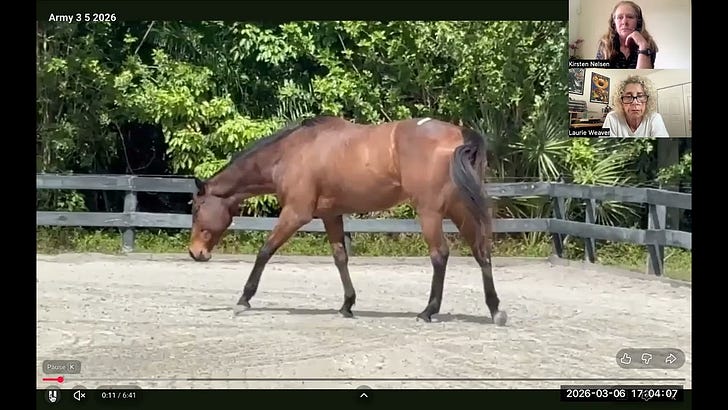
Not physical therapy type tape - just plain old masking tape, painters tape or maybe even duct tape if not pressed too hard. When we place tape on our horse's hindquarters, straight across or point to point on the pelvis, the tape helps us see what is already happening that we might not be aware of yet. Pelvic movement in horses is subtle, the tape helps the habitual use of the pelvis be more obvious. The lesson link below is an example of using a single strip of tape across the top of the horse's hindquarters in order to develop a better eye for how the horse coordinates movement, while loose and while doing a groundwork exercise. Laurie's lesson on youtube: Guest: Deb Romero, Certified Alexander Technique Instructorwww.optimalposture.orgHost: Kirsten Nelsen, professional horse trainer developer of Training for Optimal Balance www.kirstennelsen.com This is a public episode. If you would like to discuss this with other subscribers or get access to bonus episodes, visit kirstennelsen.substack.com
We all hold visions in our heads, the image of what we think things should be like, look like or feel like. Then the gravitational force of reality suddenly invades our image. This is the rub. The rub is that uncomfortable feeling when things are not going as planned, when our horse is not performing or acting the way we want or even when life throws us an unexpected change that we did not see coming. That moment in the rub is really uncomfortable, it is a stress trigger for our fight or flight nervous to kick in gear. If we can pause and just sit with the discomfort for a minute or two, allowing the emotions to quiet down a little, then that reality that suddenly disrupted images in our heads might hold a very personal and important lesson for us. We have all felt the rub, many times. We all tend to respond to it by trying to gain more control, distract ourselves or push away anything that challenges our inner image. What we are all capable of doing is using our conscious awareness of the rub and pausing instead of acting or reacting. Pausing long enough to feel authentically curious about what a sudden dose of reality might be trying to show us. Guest: Deb Romero, Certified Alexander Technique Instructor www.optimalposture.orgHost: Kirsten Nelsen, professional horse trainer developer of Training for Optimal Balance www.kirstennelsen.com This is a public episode. If you would like to discuss this with other subscribers or get access to bonus episodes, visit kirstennelsen.substack.com
Once again... it depends I guess. Deb and I discuss what this horse training strategy entails and the drawbacks we have seen from experience. At the end of the day this strategy comes from observation of horses, but fails to explain that horses approach and retreat from triggers as long as their safety is questioned. When we use the approach and retreat strategy we are mimicking a stress response in horses. Is that really what we want to do? The strategy Deb and I have found far more useful is "Pause & Wait" rather than taking any action at all. We discuss what is happening in the nervous system during the pause and wait, which is what makes it more useful to gaining a relaxation response instead of feeding the stress response. Guest: Deb Romero, Certified Alexander Technique Instructor www.optimalposture.orgHost: Kirsten Nelsen, professional horse trainerdeveloper of Training for Optimal Balance www.wexfordfarm.com This is a public episode. If you would like to discuss this with other subscribers or get access to bonus episodes, visit kirstennelsen.substack.com
For all living bodies the perception of feeling entirely safe, stable and essentially comfortable doing anything is a primary need, not optional. If we consider that feeling unsafe, unstable or uncomfortable might be the deepest root cause of the problem we are having, then we begin to look at the problems we have or problems our horse has through a very different lens. Feeling safe, stable and comfortable is how we shift from sympathetic nervous system dominance into nervous system regulation, or cohesion, or dominance of the parasympathetic nervous system that navigates long term survival. The multiple choice question can also have a fourth option, all of the above, or a fifth option, two out of three. But in order to gain cooperation, authentically bond with our horse or improve athletic abilities, those three magical ingredients must be in the mix, felt inside by every living creature. Guest: Deb Romero, Certified Alexander Technique Instructorwww.optimalposture.orgHost: Kirsten Nelsen, professional horse trainerdeveloper of Training for Optimal Balancewww.kirstennelsen.com This is a public episode. If you would like to discuss this with other subscribers or get access to bonus episodes, visit kirstennelsen.substack.com
Understanding what makes horses tick is complicated and requires an education to some degree. But once we have more depth for understanding horses, then we work in very simple, practical ways. When we try to make things too simple, so simple that we lack understanding, then we typically have problems with horses. When we make things too complex we suffer from analysis paralysis or can't see the issue right in front of us. Both complex explanations and simple observations compliment each other and help us understand horses in ways that make training safer, more predictable and more effective for long term changes that stick. Guest: Deb Romero, Certified Alexander Technique Instructorwww.optimalposture.orgHost: Kirsten Nelsen, professional horse trainerdeveloper of Training for Optimal Balance www.kirstennelsen.com This is a public episode. If you would like to discuss this with other subscribers or get access to bonus episodes, visit kirstennelsen.substack.com
This discussion starts with an email I received from the Heart Math Institute that shows the effects on heart rate, heart coherence, between a boy and his dog when conscious thoughts and feelings of love are held in our heart. Horses are incredibly sensitive to our energy and what can feel like a woo-woo connection with horses is now being explained and shown through the research done at the Heart Math Institute. Whether just for our own well being or for bonding with our horses, the information, techniques and tools offered by the Heart Math Institute are worth looking into! The Heart Math Institute www.heartmath.org831-338-850014700 West Park Ave Boulder Creek, CA 95006Guest: Deb Romero, Certified Alexander Technique Instructorwww.optimalposture.orgHost: Kirsten Nelsen, professional horse trainerdeveloper of Training for Optimal Balancewww.kirstennelsen.com This is a public episode. If you would like to discuss this with other subscribers or get access to bonus episodes, visit kirstennelsen.substack.com
Stephanie Carter, NTP, owner of Indigo Ancestral Health, joins me in this episode to discuss functional nutrition for horses, what that means and why it might be important for your horse's health. Our conversation takes many turns but as promised, I will include the basic ingredients for a forage based diet and the ingredients to avoid that tend to cause inflammatory responses. Also included is Stephanie's contact info in case you would like to set up a personalized remote consultation for your horse or barn. Basic Forage Based Diet IngredientsHay pellets or cubes as base of "AM and PM meals" Meals include a fat supplement and vitamin/mineral mix. Check ingredients closely to make sure hay, fat and vit/min mix are free from inflammatory inducing ingredients listed below. Inflammatory Inducing Ingredients - What to Eliminate or Avoid Entirely Soy and soy products, with exception of heat extruded soy beansWheat and wheat products Corn and corn products Canola Oil Molasses Zinc Sulfate Guest: Stephanie Carter, NTP, Indigo Ancestral Health www.StephanieCarterNTP.com stephaniecarterntp@gmail.com 540-422-0994Host: Kirsten Nelsen, professional horse trainerdeveloper of Training for Optimal Balancewww.kirstennelsen.com This is a public episode. If you would like to discuss this with other subscribers or get access to bonus episodes, visit kirstennelsen.substack.com
We can only feel bored if we feel safe. Feeling unsafe is never boring, but we think we need to push through feeling unsafe in order to grow and progress. Yes... but.... how much stress in the nervous system constitutes a healthy level that is beneficial and how much constitutes an unhealthy level that is detrimental? The answer to that question is different for every person and every horse, and the answer changes over time for the very same person or horse. When we start to "brace for impact" or feel our horse brace, then we have wandered into a negative amount of stress for the situation. Seeking ways to reduce stimulation, slow down, take little breaks or do something so easy that it is boring are the fastest ways to restore cohesion of the nervous system. Slowing down is often what we need to do in order to advance rapidly. Boring is a welcome relief from intense or chronic stress. Guest: Deb Romero, Certified Alexander Technique Instructorwww.optimalposture.orgHost: Kirsten Nelsen, professional horse trainerdeveloper of Training for Optimal Balancewww.kirstennelsen.com This is a public episode. If you would like to discuss this with other subscribers or get access to bonus episodes, visit kirstennelsen.substack.com
Horses test our patience a lot. Most horse owners are very aware of how often it is difficult to be patient with all the challenges offered by their horses and how frustration quickly surfaces. If we consider patience is just listening, actively observing whatever a horse is communicating, then patience transitions from anxious passivity into a quiet activity. Feeling passive, waiting for a horse to figure something out or change can increase our anxiety or tension. Feeling active helps us remain calm, we are actually doing something even though listening is sort of a non-doing. Once we realize that we need the listening time, awareness or observations of horses in order to know what to do next, then we no longer struggle to be patient, we just are. Guest: Deb Romero, Certified Alexander Technique Instructor www.optimalposture.orgHost: Kirsten Nelsen, professional horse trainerdeveloper of Training for Optimal Balancewww.kirstennelsen.com This is a public episode. If you would like to discuss this with other subscribers or get access to bonus episodes, visit kirstennelsen.substack.com
What we see on the outside - good posture, elegant movement, radiant health - are all the final result of changes that start on the inside. Making a horse look right or being able to do various tasks or maneuvers does not mean that the horse has a healthy coordination on the inside. Just like plastic surgery can make people appear to be healthy, restricting horses into frames or headsets only gives an outward appearance of good coordination. When we focus more on what our horse looks like rather than how our horse feels during a ride, then we allow dysfunctional coordination to take its toll over time, resulting in lameness or behavior issues. The feel of smooth gaits, easy transitions and ease of steering are the result of helping horses balance their coordination. A horse that struggles in performance, struggles to do tasks or is not easy to ride is a horse telling us that the coordination inside is not what it could be or should be for healthy movement. Guest: Deb Romero, Certified Alexander Technique Instructorwww.optimalposture.orgHost: Kirsten Nelsen, professional horse trainerdeveloper of Training for Optimal Balancewww.kirstennelsen.com This is a public episode. If you would like to discuss this with other subscribers or get access to bonus episodes, visit kirstennelsen.substack.com
Internal rhythm, just like internal straightness, is a term I came up with to help simplify the vertical and horizontal aspects of balance in both horses and people. Internal rhythm, as a specific use of the spine and pelvis as well as specific weight distribution, is a learned coordination for all horses and all people. This aspect of balancing a three dimensional body is related to rhythmic motion and all speed adjustments. The result of habituating internal rhythm as a coordination is ease of motion in all gaits and during speed adjustments up or down. It must be coordinated with internal straightness in order to bring the body into three dimensional balance. I use these terms because they are different and people have no preconceived ideas of what I mean. But internal rhythm is the same ideal as impulsion, lifting the back, engaging the hindquarters, rounding, collecting, framing or just a good rider on a good mover. I don't use the typical words because the meaning of them is so different to different people. Hope you find this podcast helpful. Host: Kirsten Nelsen, professional horse trainerdeveloper of Training for Optimal Balance www.kirstennelsen.com This is a public episode. If you would like to discuss this with other subscribers or get access to bonus episodes, visit kirstennelsen.substack.com
What it means for horses to find balance left to right involves two different spinal functions that affect each other. The function of spinal alignment, reducing all lateral bending, is how horses begin to stabilize the midline and make lifting the back or engaging the hindquarters much easier for them. The function of spinal rotation is the least understood function of horse's spines in the horse world. Rotation of the spine is what makes a horse's barrel roll side to side, why the saddle slips to one side and why the hindquarters tilt on a turn or during lateral work. Unstable rotation in a horse's spine also causes weight to shift left to right, making a horse heavy on the forehand and often heaviest on one front leg, which can lead to a lot of lameness issues. Conversely, when we understand what internal straightness means in horses and help them develop that coordination, then suppleness through the muscles and ease of steering on any path of travel is the result we feel. Internal straightness is an important part of horse balance that relates to the left and right sides of the body. Guest: Deb Romero, Certified Alexander Technique Instructor www.optimalposture.orgHost: Kirsten Nelsen, professional horse trainerdeveloper of Training for Optimal Balance www.kirstennelsen.com This is a public episode. If you would like to discuss this with other subscribers or get access to bonus episodes, visit kirstennelsen.substack.com
It depends... what is the mindset behind the actual dressage training? I share a really great article about the need to change the current mindset around competitive dressage that I tend to agree with, a lot. I explain the different factions of dressage and how confusing that can be, especially in America. Finally I talk about the essence of dressage and how dressage fundamentals are exactly the same as working on balance or doing rehab work with horses, even though it looks pretty darn different from what people expect. Host: Kirsten Nelsen, professional horse trainerdeveloper of Training for Optimal Balance www.kirstennelsen.com This is a public episode. If you would like to discuss this with other subscribers or get access to bonus episodes, visit kirstennelsen.substack.com
Choosing the right saddle has two sides to it - the fit for the horse and the fit for the rider. Finding a saddle that both horse and rider agree upon is important for success with any horse. Having a good saddle fitter can be incredibly helpful in the process, and preferably not a saddle fitter that only sells one brand of saddle unless you have done saddle research on your own. With good balance as a rider we can adapt to saddles far easier than horses can. When it comes right down to it, the comfort and stability of the saddle for the horse is what really makes the difference between ease of riding or not. Guest: Deb Romero, Certified Alexander Technique Instructorwww.optimalposture.orgHost: Kirsten Nelsen, professional horse trainerdeveloper of Training for Optimal Balance www.kirstennelsen.com This is a public episode. If you would like to discuss this with other subscribers or get access to bonus episodes, visit kirstennelsen.substack.com
Perceptions are personal, for people and horses. It is the perception of things that affect us, that motivate different responses. It is perceptions, more than actual events, that shape how we organize our lives and how we feel most of the time. With horses and people, the key to overcoming fear or even things that stress us out, is changing the perception we have of it. This is a process that cannot be forced but can be achieved. Changing a perception of something requires gentleness, kindness and patience. We have to prove to the body and mind that something perceived as unsafe can transition into something that feels safe. This requires delicate repetition, not force, and respecting thresholds instead of trying to blast through them. The question, “how good can it get?” is a way to help us focus on what we want, instead of what we don’t want, and opens us up to a change in perception. Guest: Deb Romero, certified Alexander Technique Instructorwww.optimalposture.orgHost: Kirsten Nelsen, professional horse trainerdeveloper of Training for Optimal Balancewww.kirstennelsen.com This is a public episode. If you would like to discuss this with other subscribers or get access to bonus episodes, visit kirstennelsen.substack.com
Horses ripping the reins from our hands, snatching the bit or just leaning on our arms all drive us crazy, but it is not a behavior issue and it is not personal. When horses lose control of their own body weight distribution during motion then too much weight passes through the barrel and lands on the forehand. While this does not cause horses to actually fall most of the time, it is a landslide of weight that they cannot control and we feel this weight distribution change in our reins the most. The problem is not really in our hands, that is just the final result. The problem is that the horse cannot control weight distribution during motion. This means that no amount of leverage or clever tricks with reins or bits are going to resolve the underlying issue. We have to look at this problem back to front, not front to back. Guest: Deb Romero, Certified Alexander Technique Instructorwww.optimalposture.orgHost: Kirsten Nelsen, professional horse trainerdeveloper of Training for Optimal Balancewww.kirstennelsen.com This is a public episode. If you would like to discuss this with other subscribers or get access to bonus episodes, visit kirstennelsen.substack.com
We often get caught up in horse sales videos - looking at all the cool things that a horse can do. But it can be a different story when the horse arrives at the new home with a new owner. Deb and I share some tips for picking out the right horse for you, what to look for, what to check and how to have a realistic view of getting a new horse settled in. It helps to let your heart lead the way. Guest: Deb Romero, Certified Alexander Technique Instructor www.optimalposture.org Host: Kirsten Nelsen, professional horse trainer developer of Training for Optimal Balance www.kirstennelsen.com This is a public episode. If you would like to discuss this with other subscribers or get access to bonus episodes, visit kirstennelsen.substack.com

Comments

Download from Google Play

Download from App Store
 United States