


 Claim Ownership
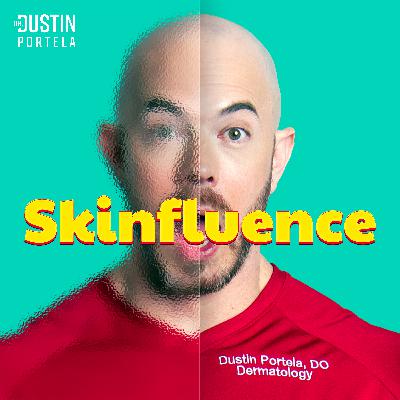
Skinfluence with Dr. Dustin Portela
Subscribed: 33Played: 903
Subscribe

© Copyright 2020 MD Consulting LLC
Description
Skinfluence is a podcast dedicated to helping you understand and take control of your skin health. Hosted by board-certified dermatologist Dr. Dustin Portela and Physician Assistant Austin Lee, each episode blends expert insights with practical advice to guide you through the world of skincare. From treating common concerns like acne and eczema to exploring the latest innovations in cosmetic dermatology, Skinfluence offers trustworthy information you can use—whether you're a skincare beginner or looking to take your routine to the next level. Tune in weekly for science-backed tips, patient stories, and honest conversations about what really works.
Tag: 868329
Tag: 868329
79 Episodes
Reverse
Part one was the absurd and the unexpected. Part two is the stuff that keeps clinicians up at night. Dr. Dustin Portela and Austin Lee go somewhere more vulnerable in this episode, sharing the near misses, the misdiagnoses, and the moments that quietly but permanently changed how they practice. The cases are real. The self-reflection is genuine. And the honesty about what it actually feels like to carry those moments forward is something you won't often hear from medical professionals willing to say it out loud. Austin walks through a case that should be familiar to anyone who has ever been treated for something that kept getting worse: a patient whose scaly rash had been treated as eczema for years before a biopsy revealed it was cutaneous T-cell lymphoma, a skin-confined lymphoma that takes an average of seven to eight years to diagnose. Dr. Portela follows with a drug interaction he prescribed that almost cost a patient her life, a known but poorly documented risk between tetracycline antibiotics and myasthenia gravis that neither he nor his attending had ever heard of. She survived. He has never prescribed it the same way since. The conversation on near misses is candid in a way that matters for patients too. Both hosts have caught melanomas on their way out the door, in lighting that was just slightly different, because something made them turn around. Austin recounts missing a nodular melanoma on a patient's scalp during a thorough skin check, only for the patient to find it herself. That case changed how he examines hair permanently. The did-you-know this week covers amelanotic melanoma, the pink or flesh-colored variant that doesn't follow the classic ABCDE rules and that even experienced clinicians can mistake for something benign. It's one of the more important two minutes in this series. The episode ends where it probably should: a reminder that patients who advocate for themselves, point out the spot the doctor glossed over, or simply say they don't feel right about something, are not being difficult. They are part of the process. Product of the Week CurrentBody LED Hair Growth Helmet A multi-wavelength red light therapy helmet with built-in Bluetooth headphones designed for at-home hair regrowth. Link in the show notes. The code to use at checkout is DRPORTELA Follow Us Dr. Dustin Portela TikTok | Instagram | YouTube (Reactions) | YouTube (Educational) | Pinterest Austin Lee, PA-C Instagram: @austinleepac Skinfluence Podcast Instagram: @skinfluence_pod
Every dermatologist has stories they can't tell at dinner. This is that episode. Dr. Dustin Portela and Austin Lee set aside the science and spend an episode doing something different: sharing the cases that stuck with them, the moments they didn't see coming, and a few things patients put on their skin that genuinely defy explanation. No personally identifying details. No punching down. Just two clinicians who have spent a combined two decades in exam rooms and have earned the right to say what practicing dermatology actually looks like. The misdiagnosis stories alone are worth the listen. Both hosts independently encountered the same scenario early in their careers: a nail condition that had been treated as fungus for months, or years, that turned out to be melanoma. One patient lost a toe. One lost a thumb. The cases are told plainly, without dramatizing them, which somehow makes them land harder. There are lighter moments too. Dr. Portela traces his first memorable experience with skin treatments gone wrong back to his own childhood, when his father, a chemistry teacher, decided that hydrochloric acid was a reasonable approach to a wart and discovered the hard way that paper cups are not chemically resistant. Austin's most memorable patient story involves a rosacea treatment approach that her husband appears to have personally recommended, involving a substance with no clinical evidence and a texture that defied description. It is presented with as much professionalism as the situation allows. Alongside the confessions is a did-you-know segment on Daniel Carrion, the Peruvian medical student who hypothesized that Oroya fever and a common skin condition called verruga peruana were caused by the same bacterium, then injected himself with infected blood to prove it. He was right. He died 39 days later. The disease now bears his name. The episode closes on something quieter: a story from COVID lockdowns about an elderly patient in an assisted living facility who broke down during a routine skin check. It was the first time another person had touched her in nearly a year. Product of the Week EltaMD UV Clear SPF 46 The top-selling sunscreen in Dr. Portela's office, now available at shop.drdustinportela.com. A lightweight, niacinamide-based formula that works for acne-prone and sensitive skin. Follow Us Dr. Dustin Portela TikTok | Instagram | YouTube (Reactions) | YouTube (Educational) | Pinterest Austin Lee, PA-C Instagram: @austinleepac Skinfluence Podcast Instagram: @skinfluence_pod
The weight is coming off. But something else is changing too, and nobody warned you about it. GLP-1 medications like Ozempic, Mounjaro, and Wegovy have reshaped the conversation around weight loss in a way that nothing has in decades. What that conversation often leaves out is what happens to the face, the hair, and the skin in the process. Dr. Dustin Portela and Austin Lee are seeing it in clinic every week now, often from patients who never connected their new medication to what they are seeing in the mirror. Ozempic face is real, and the biology behind it is worth understanding. The fat pads that give the face its structure and volume are among the first things to go during rapid weight loss. When that happens quickly, skin that spent years supported by subcutaneous fat suddenly has nothing to hold onto. The result is hollowing around the eyes and temples, deeper folds, and a face that can look older even as the body gets healthier. For patients who also carried excess weight for years, there is a second layer to this: chronic inflammation from obesity damages collagen over time, so the structural support was already quietly eroding before the weight came off. Hair loss is even more common, and even more misunderstood. Telogen effluvium, the shedding that follows a metabolic shock, typically shows up three to four months after starting a GLP-1 or escalating the dose. By then, most patients have forgotten what changed. The good news is that for most people it resolves on its own within six to twelve months. The hosts walk through what can help speed recovery, including oral minoxidil, finasteride, red light therapy, and PRP, and what to watch for if the shedding becomes chronic. The episode also covers what the emerging research is finding about GLP-1s and skin conditions like psoriasis and hidradenitis suppurativa, where the anti-inflammatory effects of weight loss appear to be driving meaningful improvement. There is even a retrospective study suggesting a lower incidence of breast cancer in women taking these medications, which opens a broader conversation about how interconnected metabolic health and immune surveillance really are. None of this is a reason to avoid GLP-1s if your doctor has recommended them. It is a reason to know what to expect and to have a plan. Product of the Week CeraVe Invisible Mineral Sunscreen SPF 50 A broad-spectrum mineral sunscreen with no white cast and a cosmetic feel that punches well above its price point. Available at most major retailers for around $10 to $15. Follow Us Dr. Dustin Portela TikTok | Instagram | YouTube (Reactions) | YouTube (Educational) | Pinterest Austin Lee, PA-C Instagram: @austinleepac Skinfluence Podcast Instagram: @skinfluence_pod

Some skincare myths are easy to knock down. The ones in this episode are trickier, because the prosecution actually has a case. Round two of Derm Myth Court brings three myths that feel more defensible than last week's, which makes them more dangerous. Dr. Dustin Portela and Austin Lee trade sides again, and the debate format earns its keep here because at least one of these arguments is genuinely contested. The vitamin D and sun exposure debate is the most substantive of the three. Yes, UVB exposure triggers vitamin D synthesis in the skin. Yes, many people are deficient. The prosecution has real ammunition, and the hosts don't pretend otherwise. What the defense works through is the part the argument always skips: how much UV exposure is actually needed, why that varies dramatically by skin tone and latitude, and why you can be doing UV damage in winter months without getting any meaningful vitamin D benefit in return. The Swedish study that anti-sunscreen advocates love to cite gets a close reading, and the confounding factors are worth understanding. The oily skin debate is more one-sided but comes up constantly in clinic. The logic that oily skin produces its own moisturizer sounds reasonable until you understand what moisturizers are actually doing that skin oil isn't, and why barrier dysfunction shows up just as readily in rosacea, acne, and seborrheic dermatitis as it does in dry skin. The answer is not the same moisturizer for everyone, but it is still a moisturizer. Sunscreen contouring closes things out. The trend, popularized on TikTok and endorsed in at least one notable celebrity Instagram post, involves deliberately skipping sunscreen on certain facial areas to achieve a natural tan contour. The hosts walk through what cumulative UV damage actually looks like in uneven distributions over time, which is not what anyone is picturing when they try this at 25. Product of the Week Dean Skincare ActivCE Vitamin C Serum and All-Trans Retinol A stabilized vitamin C with green tea polyphenols for morning use, paired with a 5X retinol for nighttime. Available at shop.drdustinportela.com with discounts for first-time buyers. Follow Us Dr. Dustin Portela TikTok | Instagram | YouTube (Reactions) | YouTube (Educational) | Pinterest Austin Lee, PA-C Instagram: @austinleepac Skinfluence Podcast Instagram: @skinfluence_pod
Some skincare myths are easy to dismiss. Others are built on just enough real science to sound credible, and those are the ones that spread. For the first episode of Derm Myth Court, Dr. Dustin Portela and Austin Lee take three of the most persistent myths in dermatology and put them on trial. The format is simple: one host argues in favor of the myth, the other defends against it, and then the actual science delivers the verdict. It is more entertaining than a lecture and more useful than a scroll through your comment section. First up is the claim that sunscreen causes cancer. The prosecution has real material to work with: there are studies showing certain chemical filters like oxybenzone are absorbed into the bloodstream, and skin cancer rates have climbed alongside sunscreen adoption. The defense dismantles both arguments methodically, including the animal studies on endocrine disruption that get cited constantly online and why the math on human exposure makes those findings almost entirely irrelevant. Beef tallow is next, and it gets a fair hearing before falling apart on its own merits. The ancestral skincare argument, the fatty acid claims, the vitamin A comparison to retinol: each one gets taken apart. What remains is a product that is essentially an occlusive, costs significantly more than a jar of Vaseline, has a shelf life that is not always obvious, and carries a real risk of contact dermatitis when essential oils are added to cover the smell. The lemon juice for acne debate ends with a patient story that is hard to forget. The citric acid argument has some surface-level logic to it, and the hosts acknowledge that. But lemon juice on skin plus sun exposure is a combination that dermatologists are still treating in clinic, usually presenting as dark irregular marks on someone who just got back from a beach vacation and cannot figure out what happened. Each myth gets a clear verdict and a better alternative. Product of the Week Dene Skincare Sheer Shield SPF 50, Dean Active Repair Moisturizer, and Rapid Reveal Exfoliation Pads The three products recommended as evidence-based alternatives to what was debunked in this episode. Available at shop.drdustinportela.com with at least 15% off your first purchase. Follow Us Dr. Dustin Portela TikTok | Instagram | YouTube (Reactions) | YouTube (Educational) | Pinterest Austin Lee, PA-C Instagram: @austinleepac Skinfluence Podcast Instagram: @skinfluence_pod

Comments

Download from Google Play

Download from App Store
 United States