


 Claim Ownership
Deeply Intents
Subscribed: 1Played: 55
Subscribe

Description
Deeply Intents is a podcast hosted by Apriori. There are two primary motivations; unpack Anoma with relevant guests, and have interesting conversations with values aligned builders. The podcast is long-form content, with an emphasis on the human element.
33 Episodes
Reverse
![FOCIL [Minimize Power of Builders] - soispoke](https://image.simplecastcdn.com/images/1e8168c2-13b0-461e-8b1f-501139dbf367/e3688f79-a29d-495d-af5e-1ee790442727/3000x3000/untitled-2023.jpg?aid=rss_feed "FOCIL [Minimize Power of Builders] - soispoke")
Why is censorship resistance fundamental to Ethereum and what would it take to actually achieve it? In this episode, I sit down with soispoke from the Ethereum Foundation's Robust Incentives Group (RIG) to unpack FOCIL (Fork-Choice Enforced Inclusion Lists), a proposal aimed at making transaction censorship significantly harder. We start from first principles: what does censorship even mean in Ethereum's context, and what's the difference between weak and strong censorship? From there, we break down how FOCIL works, address recent criticisms, and explore what it could unlock [from better UX to de-risking Ethereum's scaling roadmap]. Soispoke also reflects on the EIP process and where FOCIL currently stands in being scheduled for upcoming Ethereum hard forks within the context of governance.Timestamps(00:00) - From academic to applied research(05:39) - What is censorship, and why CR?(08:43) - Weak censorship on Ethereum(11:57) - Brief history of inclusion lists(17:52) - Fork-choice enforced inclusion list (FOCIL)(20:07) - Steelmanning FOCIL(26:06) - Committee size and trust assumption(29:12) - Rainbow staking compatible(30:12) - Addressing criticism(35:15) - Improved UX for Optimistic Rollups(37:26) - Reflections on ideating FOCIL(40:19) - Communicating FOCIL(43:11) - Defending Ethereum's moat(49:03) - FOCIL improves altruism assumptions(53:03) - Glamsterdam Headliner process(58:46) - FOCIL + 6s slots, we can do both(1:01:25) - Low hanging fruit and beyond
DisclaimerNothing in this episode should be interpreted as financial, technical, or legal advice. The host does contract work for Heliax, a public goods laboratory, focusing on Anoma.
In this episode of Deeply Intents I chat with Ceteris, Head of Research at Delphi. We start by discussing Ceteris' beginnings on crypto twitter, then dig into 4 year cycles—are they still real? From there we cover metas, onboarding, privacy, capital formation, and infrastructure. We also explore why Solana has performed well "this cycle," including social factors and upcoming upgrades. Later we get into prediction markets, hyperfinancialization, and investing. We wrap up with Ceteris sharing his best advice for surviving this game long term. Timestamps(00:00) - Welcome to CT(07:22) - Unique perspectives on infrastructure(13:48) - Do cycles still exist?(17:59) - Few assets do well(23:28) - DeFi summer cycle was different(28:02) - Early in a new meta(29:47) - Onboarding into crypto(33:43) - Privacy as a king maker(37:19) - Capital formation use case(42:24) - Too much of the wrong infra(47:08) - New things take time to build(49:43) - Rollup specialization(51:16) - Why build on Solana?(53:32) - RWA issuance is a weird narrative(57:05) - Prop AMMs, BAM, ACE, MCP, Firedancer(1:00:53) - You eat what you kill(1:04:19) - Prediction markets and sports betting(1:09:38) - The whole world is becoming financialized(1:13:00) - Investing in bid ideas(1:19:07) - How to survive? Don't blow up!(1:26:12) - Try things out(1:27:38) - Shitposting on CT
DisclaimerNothing in this episode should be interpreted as financial, technical, or legal advice. The host does contract work for Heliax, a public goods laboratory, focusing on Anoma.
In this episode of Deeply Intents, I chat with Markus, founder of Tplus. We begin the episode by addressing the FUD around the recent Intel TDX attack. Next, we unpack Tplus by dissecting the high-level architecture. Thereafter we discuss how Tplus can benefit traders, solvers, MEV searchers, and block builders. Later Markus breaks down the events that led to the sell-off on 10/10/25. We finish the episode by discussing Tplus' revenue model and thinking from first principles. Timestamps(00:00) - How the cake is made (03:52) - Tplus etymology (06:34) - TDX FUD (11:58) - Tplus architecture (16:15) - Product surface expands with DeFi (18:44) - Breaking down cross-margin (23:53) - Markouts (26:06) - Everything in one box (28:25) - Vaults (31:04) - Orderflow on demand (34:57) - Is the juice worth the squeeze? (38:21) - B2C strategy (43:14) - Compossability with onchain liquidity (46:17) - Balancing founder priorities (48:08) - 10/10/25 (52:00) - ADL risk (53:27) - Adding product features (58:14) - Specialized market making (1:01:15) - Revenue model (1:03:57) - Ethereum and Solana upgrades (1:05:11) - Think from first principles
DisclaimerNothing in this episode should be interpreted as financial, technical, or legal advice. The host does contract work for Heliax, a public goods laboratory, focusing on Anoma.
In this episode of Deeply Intents, I chat with Mislav from Biconomy. We begin the episode by discussing the Biconomy Network’s one signature execution model. Next, we discuss the purpose of interoperability and chain abstraction. Thereafter, we dig our teeth into all things product, from gauging user feedback to building at the right level of abstraction to knowing who your team is. Next up, we unpack Biconomy's Supertransaction API, censorship resistance, misconceptions, and competition. We finish the conversation by reflecting on lessons learned over the years, building on the EVM, whilst speculating on potential Ethereum upgrades that would be advantageous.Timestamps (00:00) - Building on Ethereum(03:14) - One signature execution(11:24) - Why not just use the L1?(18:06) - Delivering chain abstraction(20:03) - Products at the right level of abstraction(24:32) - Talking to users(28:54) - Knowing who you are(36:00) - SuperTransaction API(40:42) - Zero setup for app developers(46:23) - Landing transactions(48:24) - Censorship resistance(52:30) - Addressing misconceptions(54:43) - Competition(56:51) - Use blockchains, lessons in there(1:00:43) - Ethereum upgrades and standardization(1:07:00) - Apps choose trust assumptions
DisclaimerNothing in this episode should be interpreted as financial, technical, or legal advice. The host does contract work for Heliax, a public goods laboratory, focusing on Anoma.
In this episode of Deeply Intents, I chat with Jim Chang (0xJim), product guru from LI.FI. We begin the episode by answering the question, why do we need interop? Next we dive into the nuances of intent bridges, solvers, order flow auctions, MEV, and filler vaults. Thereafter, Jim explains the necessity of and philosophy behind Ethereum's Open Intents Framework (OIF). Directly after, we break down how the Ethereum Interop Layer (EIL), the OIF, and Ethereum governance interact. Later we discuss learnings from building products in 2025, including how to build distribution from zero and whether building a personal brand on Twitter is helpful towards these ends. We conclude by discussing Jim's passion for thrift shopping.Timestamps(00:00) - Building crypto products(04:29) - Working with Alt VMs(07:26) - Why do we need interop?(14:12) - Intents(20:16) - Getting pedantic about intents(26:14) - Intent value chain(30:33) - Intent verification(33:47) - Orderflow auctions(40:00) - Cross-chain MEV(45:00) - Solvers are not market makers(47:56) - Filler vaults(52:27) - Popular routes(57:25) - Open Intents Framework(1:04:12) - OIF flywheel(1:07:34) - Ethereum upgrades that support interop(1:10:30) - EIL, OIF, and Ethereum governance(1:14:17) - Product learnings in 2025(1:19:15) - Distribution 0-1(1:24:05) - Twitter(1:28:00) - Thrift shopping
DisclaimerNothing in this episode should be interpreted as financial, technical, or legal advice. The host does contract work for Heliax, a public goods laboratory, focusing on Anoma.
In this episode of Deeply Intents, I chat with Trent Van Epps from the Ethereum Foundation. In particular, we discuss Trent's work as an organizer of Protocol Guild. We begin by discussing what Protocol Guild is, why projects care, and membership. Next, we unpack the motivations for funding the Ethereum Commons, drawing lessons from Linux, and explore various funding mechanisms. Later, we break down the Compensation Insights for Ethereum Core Developers report. We conclude the episode by discussing the next 5 to 10 years of Protocol Guild and upcoming Ethereum upgrades.Timestamps(00:00) - Architecture to Ethereum(03:46) - KZG Summoning ceremony(06:33) - What is Protocol Guild?(11:35) - Why should projects care?(14:04) - Protocol Guild membership(17:57) - The Ethereum Commons(21:25) - Onchain organization(27:56) - Learning from Linux (34:05) - Protocol Guild Pledge(41:07) - In protocol funding mechanisms(46:01) - Protocol Guild FUD(52:23) - Compensation survey(57:23) - Survey feedback(1:02:30) - PG in 5-10 years(1:08:36) - Exciting Ethereum upgrades
DisclaimerNothing in this episode should be interpreted as financial, technical, or legal advice. The host does contract work for Heliax, a public goods laboratory, focusing on Anoma.
In this episode of Deeply Intents, I chat with James Prestwich of Signet, the team behind Signet. This episode is a masterclass on rollups. To begin the episode, James breaks down exactly what a rollup is while taking us through their history that includes Bitcoin, roll_ups, Plasmas, minimum viable merged consensus, and sovereign rollups. Thereafter we unpack Signet, including no proving system as a feature, conditional transactions, instant bridging, and application-controlled execution. We continue by discussing Signet's sequencer design featuring decentralized block building. Later we discuss unexplored rollup designs by reviewing init4's article titled "(Re)Based Rollups" which unpacks possible rollup fork-choice rules. We finish the episode by discussing building products on Ethereum, the philosophy behind building developer tools, and history repeating itself in Bitcoin.Timestamps(00:00) - You can build a rollup in a completely different way(03:14) - What is a rollup?(06:17) - History of rollups(09:57) - Plasmas(14:34) - Minimum viable merged consensus(18:45) - Signet from first principles(21:27) - No proofs(23:01) - Conditional Transactions(27:42) - Instant bridging(31:15) - App-specific Conditional Transactions(31:47) - App Controlled Execution (ACE)(37:45) - Third party native issuance(39:44) - A rollup that actually scales Ethereum(41:16) - Sequencing and block building(45:33) - More Builders than Ethereum(48:08) - Finding the right partners(53:45) - Benefits of an app chain and general purpose chain(56:03) - (Re)Based Rollups(1:00:04) - Unexplored design space for rollups(1:03:41) - Mistakes building products on Ethereum(1:07:39) - Making developer tools(1:11:37) - Bitcoin repeating history
DisclaimerNothing in this episode should be interpreted as financial, technical, or legal advice. The host does contract work for Heliax, a public goods laboratory, focusing on Anoma.
In this episode of Deeply Intents, I chat with Peter Watts, founder of Relay Protocol. We begin the episode by discussing Peter's journey from music to Reservoir to Relay. Next, we spend time digging into Relay, its architecture, resource locks, vaults, DEX meta-aggregation, and MEV strategies. We finish out the episode by unpacking B2B distribution, reliability & SLAs, and product market fit.Timestamps(00:00) - From Music to Intents(07:20) - Late follower advantage(10:53) - What is Relay?(16:57) - Layers of Relay's architecture(23:28) - Verification without smart contracts(25:09) - Resource Locks(31:25) - Vaults for solvers(37:10) - Digging into vaults(41:15) - DEX meta-aggregation(48:34) - MEV strategy(53:48) - Landing transactions(55:31) - Chain Abstraction(1:00:14) - B2B distribution(1:03:45) - Reliability and SLAs(1:07:14) - Customer service strategy(1:10:33) - Pre and post PMF(1:16:43) - Ethereum upgrades and standards(1:21:19) - Fast interop layer
DisclaimerNothing in this episode should be interpreted as financial, technical, or legal advice. The host does contract work for Heliax, a public goods laboratory, focusing on Anoma.
In this episode of Deeply Intents, I speak with Jeremy Ornelas of Heliax, the company behind Anoma and Namada. We begin the conversation by discussing the history of Erlang and Elixir, as well as what makes Elixir a good fit for Anoma. Next, we break down the dominion of Anoma, broadly outlining the distributed operating system vision. Thereafter, we discuss Anoma's Controller system in detail, which draws design inspiration from GenServers in Erlang. Later, we discuss the nuances of building hackable systems and shipping viable products. We conclude the conversation by discussing object systems, elegant system design, and the future impact of LLMs on developers.Timestamps(00:00) - Anoma loves Elixir(05:32) - History of Erlang and Elixir(11:29) - Phoenix(14:47) - Make cents for your bottom line(20:00) - Elixir is live and has actors(26:18) - Exploring the dominion of Anoma(32:26) - Controllers and local domains(38:27) - Ubiquitous compute(43:21) - Ethereum speaks Anoma(48:37) - All of this should be hackable(52:48) - Product focused organization(56:49) - What's the holdup on Anoma?(1:01:14) - Products that make sense(1:04:28) - Objects and Anoma Level(1:10:12) - Elegant design(1:14:20) - LLMs and quality
DisclaimerNothing in this episode should be interpreted as financial, technical, or legal advice. The host does contract work for Heliax, a public goods laboratory, focusing on Anoma.
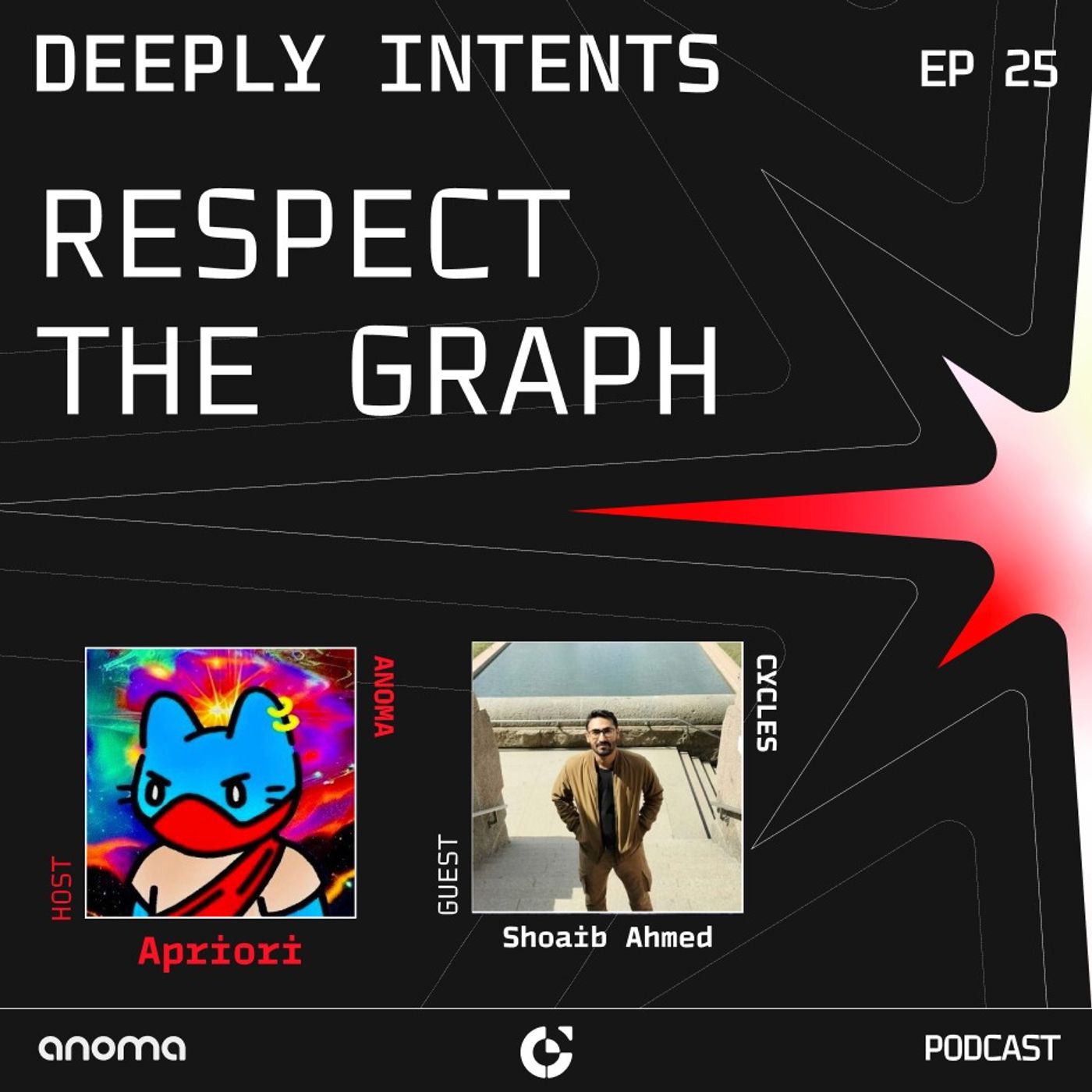
In this episode of Deeply Intents, I talk to Shoaib Ahmed, researcher and engineer for Cycles Money / Informal Systems. We begin the episode with Shoaib's background, including his time working on SlockIt. Thereafter, we begin to unpack Cycles Money, discussing the concept of bringing liabilities on-chain, examples of debt-clearing cycles, and different types of settlement. Later, we discuss QuanTEEum, a new research paper published by Shoaib. Here we discuss the notion of quantum money and a marketplace for decentralized quantum compute. We conclude the episode by discussing the Cosmos ecosystem and trade-offs between building products and protocols.Timestamps(00:00) - God was a protocol designer(02:28) - SlockIT experience(03:53) - Gödel's incompleteness theorems(10:19) - CoFi & Speculation resistance(16:43) - Cycles Money(22:26) - Bringing liabilities onchain(29:49) - Walking through a cycle example(33:57) - Settlement(37:00) - Atomicity and blockchains(42:24) - Quartz, remote attestations & ZKPs(45:28) - Product(53:10) - QuanTEEum and One shot signatures(58:31) - Endgame: decentralized quantum compute(1:03:58) - Quantum Money(1:09:55) - The Cosmos ecosystem(1:12:23) - Protocol design vs. product
DisclaimerNothing in this episode should be interpreted as financial, technical, or legal advice. The host does contract work for Heliax, a public goods laboratory, focusing on Anoma.
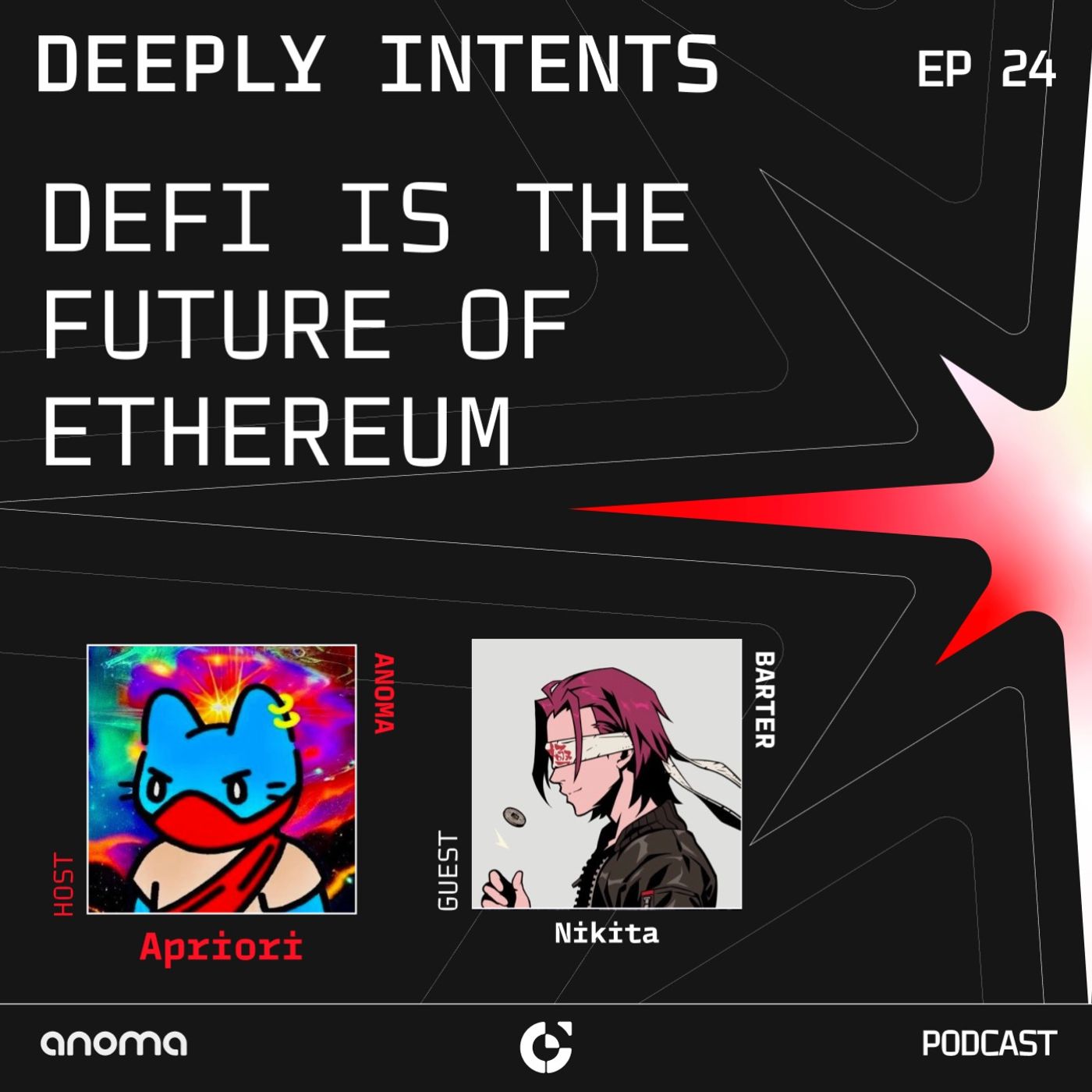
In this episode of Deeply Intents, I chat with Nikita, CEO of Barter. In this conversation, we begin by discussing Nikita's background in Ethereum DeFi. Next, we discuss how solvers work, hooks and composability, and liquidity provision. Thereafter, we discuss Superposition, which provides a fundamentally new approach to decentralized trading and liquidity provision. From there, we discuss liquidity, distribution strategies, and product philosophy. We conclude the conversation by discussing some best practices for BD and general optimism about Ethereum DeFi.Timestamps(00:00) - Discovering crypto(05:05) - DeFi Summer(06:08) - Learnings from time at 1inch(10:50) - Building a solver and getting hacked(16:43) - How solvers work(18:45) - Hooks and compossability(24:22) - Competition and acquisition(29:49) - Market is consolidating(34:54) - Who are the passive LPs?(40:48) - Superposition story(47:30) - Making AMMs outdated(51:58) - Endgame liquidity solution(55:42) - Passion and building teams(1:00:42) - Distribution strategy(1:05:38) - Cross-chain game(1:10:09) - Product philosophy(1:15:33) - Connect with anyone in crypto(1:19:06) - Ethereum is the place to be(1:20:51) - Advise for young business developers(1:25:00) - Find synergies(1:28:22) - WAGMI
DisclaimerNothing in this episode should be interpreted as financial, technical, or legal advice. The host does contract work for Heliax, a public goods laboratory, focusing on Anoma.
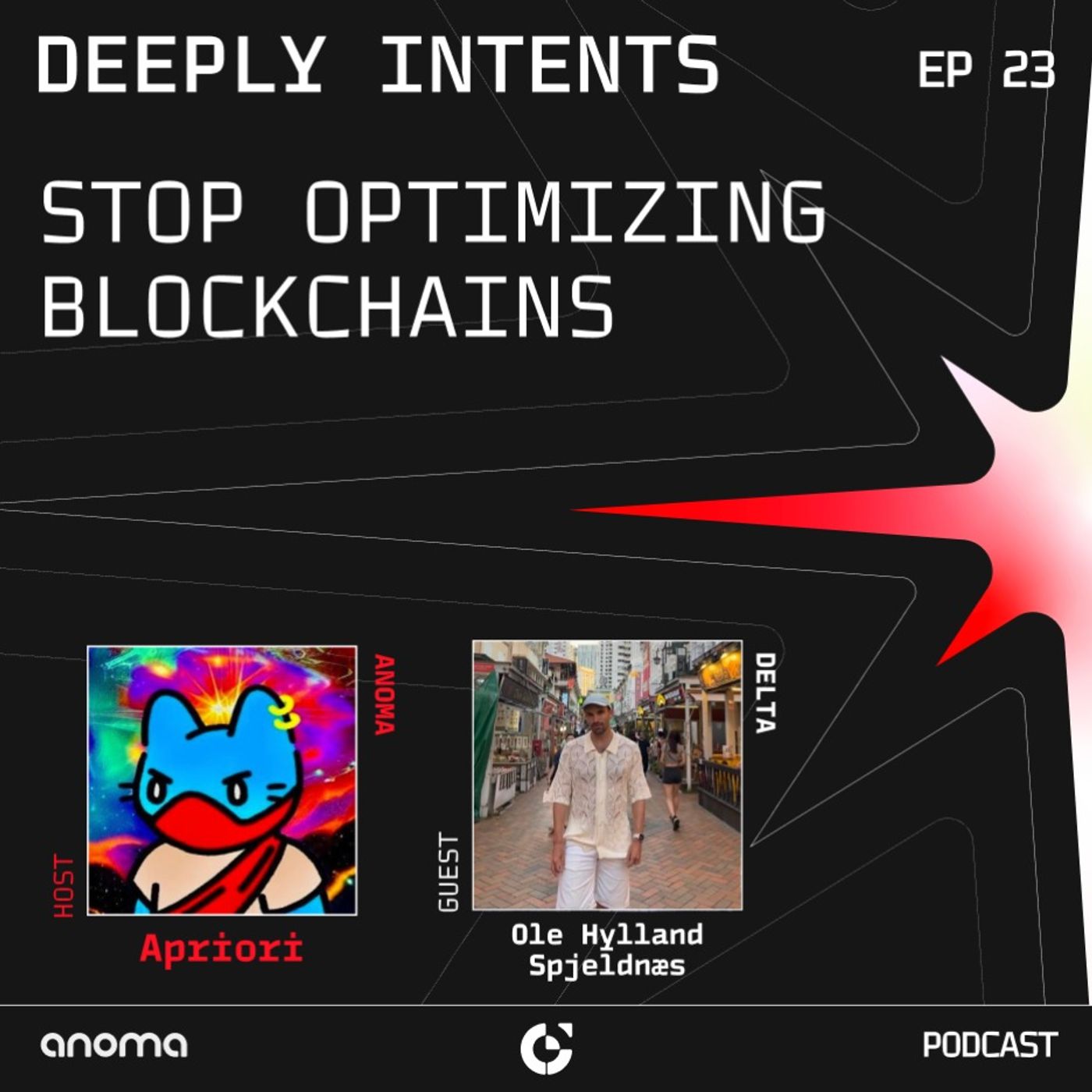
In this episode of Deeply Intents, I chat with Ole Spjeldnæs, Founder and CEO of Delta Network. We begin the episode by discussing Ole's background in mathematics and what led him to blockchain. Next, we unpack Delta by discussing verifiability, shared state, and architectural affordances, including Domains. We finish up the conversation on Delta by discussing Byzantine eventual consistency, design philosophy, and credible neutrality. Thereafter, we discuss the product and go-to-market philosophy before concluding with a discussion refuting crypto dogma. Timestamps(00:00) - From Math to Delta(02:33) - Category Theory(04:56) - Finding blockchain(09:04) - Levels to B.S.(11:20) - Verifiability and shared state(16:50) - Reducing friction with verifiability(21:08) - Shared state and compossability(27:30) - Delta architecture(32:38) - State diff lists(35:13) - Integrability(41:09) - Domains, network effects, and trust(49:01) - Byzantine eventual consistency(53:34) - Design philosophy(1:01:20) - Scalability is oversold(1:05:07) - Approach to product(1:09:05) - GTM products(1:13:46) - Credible neutrality(1:20:37) - Context switching(1:22:51) - Crypto dogma(1:29:26) - User feedback
DisclaimerNothing in this episode should be interpreted as financial, technical, or legal advice. The host does contract work for Heliax, a public goods laboratory, focusing on Anoma.
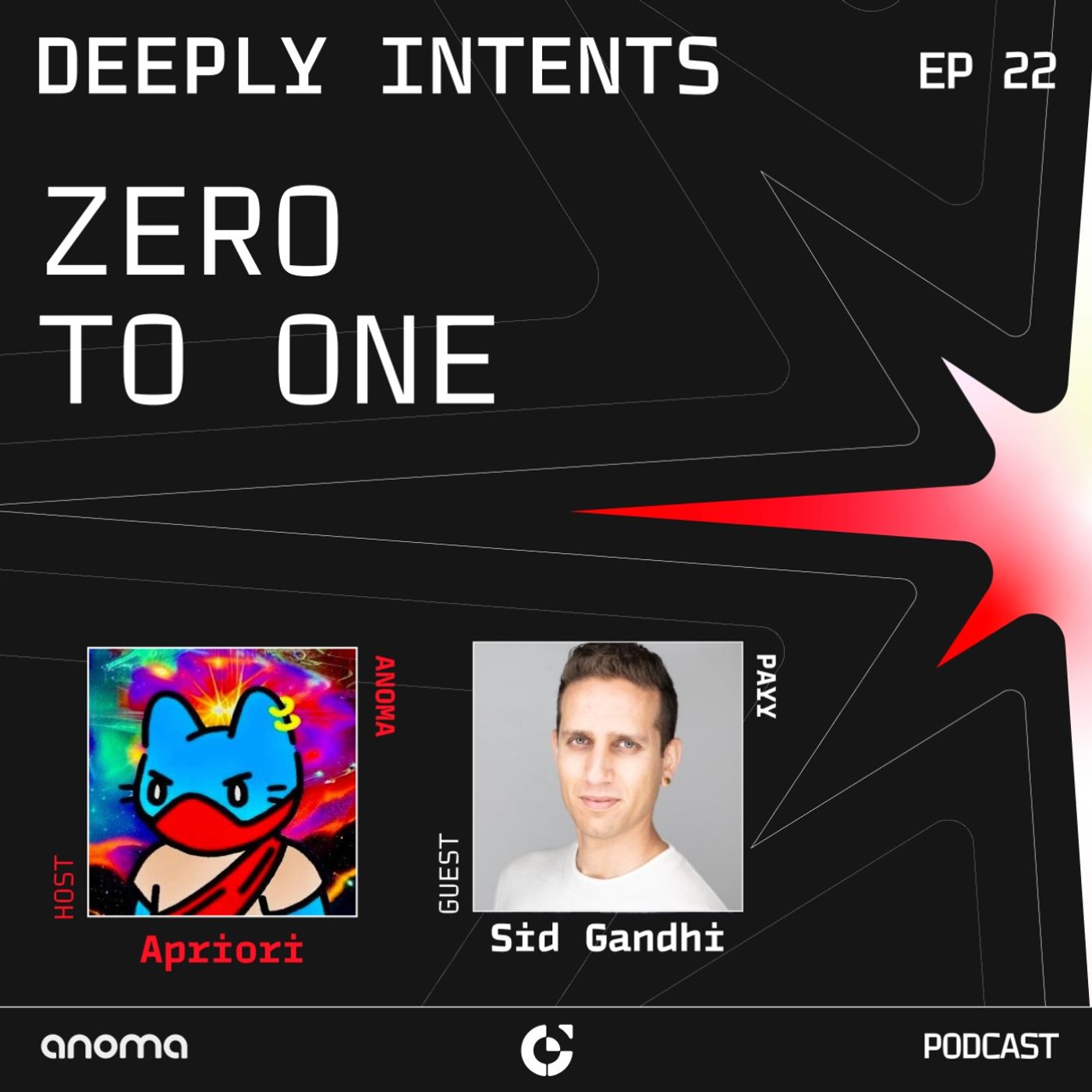
In this episode of Deeply Intents, I sit down with Sid Gandhi, CEO of Payy. We begin the conversation discussing Sid's product background at Apple and how that led him to build Payy. We then discuss Private payments, proof of lineage, and the particulars of Payy wallet and network. Thereafter, we spend time discussing product strategies, including ideal customer profiles, market segments, and finding product-market fit. We conclude the conversation by outlining the trade-offs associated with adding product features and following industry narratives. Timestamps(00:00) - Product at Apple(03:32) - Build for a real human(08:55) - Private payments(09:54) - Proof of lineage(12:57) - Deliver value to the user(17:52) - Finding PMF across ICP segments(24:08) - Raising the bar on product(28:06) - Is it 10x better?(36:28) - Navigating trade-offs(38:00) - Resisting industry narratives(40:57) - Talking to users(47:49) - Balancing the product roadmap(54:19) - Product features, when and how(58:13) - Product led marketing(1:02:16) - Play long-term games
DisclaimerNothing in this episode should be interpreted as financial, technical, or legal advice. The host does contract work for Heliax, a public goods laboratory, focusing on Anoma.

In this episode of Deeply Intents, I have a conversation with 0xprincess, founder of NuConstruct. We begin by diving into 0xprincess' journey through the world of arbitrage and the notorious dark forest, examining how MEV competition on Ethereum has evolved into today's competitive landscape. For the centerpiece of our discussion, 0xprincess breaks down TOOL (Trustless Orderflow Operations Layer), which effectively transforms Ethereum into a one second blocktime chain without requiring protocol modifications. After the TOOL deep dive, we examine ePBS (enshrined Proposer-Builder Separation), which leads to a thoughtful discussion on the EIP process itself, what works and how to improve it. Following this, we discuss the unique attributes that make Ethereum special, particularly its credibility. We close the episode with reflections on pseudoanon culture in crypto.Timestamps(00:00) - Nuconstruct origins(03:14) - DEX to DEX arbitrage(04:15) - Into the dark forest(08:30) - MEV competition today(13:28) - Liquidity network effects(19:42) - Trustless Orderflow Operations Layer (TOOL)(23:06) - Leader based consensus(29:06) - Open auction for orderflow(30:55) - Early confirmations and 1s bock times(36:00) - Trust Domain Extensions (TDX)(43:09) - Validator adoption of TOOL(47:30) - Fundraising(53:08) - Product mindset(57:28) - EIP-7732: ePBS(1:03:58) - Improving the EIP process(1:07:08) - Product discovery(1:16:34) - EIP Process is well polished(1:18:03) - Ethereum ossification risks(1:22:50) - Ethereum has credibility(1:29:24) - Price is not correlated with tech(1:33:00) - Anon and pseudo-anon culture(1:40:34) - The TOOL is live! (testnet)
DisclaimerNothing in this episode should be interpreted as financial, technical, or legal advice. The host does contract work for Heliax, a public goods laboratory, focusing on Anoma.
In this episode of Deeply Intents, I talk to Josh Bowen [founder of Astria]. We begin the conversation discussing Josh's background as an SWE at Google and his experience working on The Graph and Celestia before founding Astria. We discuss shared sequencers, the regulatory environment, and existential questions around use cases. Next, we move to a robust discussion on product design, application categories, vertical integration, and regulatory arbitrage. Later, we discuss live and dead players, as well as upcoming trends such as mobile apps and spend-focused adoption strategies. We conclude the conversation on MEV metagames, including the minutiae of PBS auctions. Timestamps(00:48) - Folding at home(02:45) - Data Availability 101(07:45) - Most startups are an act of desperation(12:04) - The shared lazy sequencer(19:00) - Scaling bottlenecks(21:00) - Navigating regulations(25:10) - Existential question of use cases(29:45) - Pragmatic product design(37:14) - The victory of the social technology(43:00) - Perps, yield bearing stables, & reg arb(47:49) - Equity perps and 24/7 trading(50:49) - FX trading onchain(54:59) - Prediction Markets(57:48) - Payments(1:05:39) - Orderflow and vertical integration(1:18:28) - Venture funding game(1:26:16) - Growth strategies(1:32:17) - No one knows what they are doing(1:43:00) - Live and Dead Players(1:48:13) - Mobile apps and wearables(1:57:43) - Airdrops and growth mechanisms(2:05:46) - Referrals and adoption strategies(2:18:24) - MEV Metagames(2:25:57) - Second-Price Sealed-Bid Auctions
DisclaimerNothing in this episode should be interpreted as financial, technical, or legal advice. The host does contract work for Heliax, a public goods laboratory, focusing on Anoma.
In this episode of Deeply Intents, I sit down with Murat Akdeniz (founder of Primev). We begin by discussing Murat's background in tracking FX rates of the USD against the Turkish Lira. Next, we dive into MEV-Commit, including the Devcon lore, applications you can build with MEV-Commit, and application-specific sequencing. Murat then schools us on everything product. In particular, product-centric building, advocating for the user from the research process to implementation, along with some general product management best practices. Later, we discuss the MEV redistribution trade-off and design space and the impact of regulatory reform on tokens. We finish the conversation on a light note where Murat shares his experience as a dad.(00:21) - FX origins(01:56) - Family Ties(04:59) - Devcon Lore(08:30) - MEV-Commit(13:09) - Preconfs for Bridges(17:16) - Building with Ethereum(20:41) - Compossability(25:00) - Product Leadership(30:44) - Trade-off space(35:07) - Designing auctions (38:33) - Native apps on MEV-Commit chain?(41:30) - A.S.S. [App Specific Sequencing](44:00) - Product adoption cycle(49:21) - Raising the bar(54:44) - Stable coin existential risks(1:00:11) - Endgame(1:06:54) - MEV redistribution(1:09:25) - Tokenized MEV(1:16:35) - Regulatory reform(1:21:11) - Being a Dad(1:25:27) - Encrypted Mempools need Love
DisclaimerNothing in this episode should be interpreted as financial, technical, or legal advice. The host does contract work for Heliax, a public goods laboratory, focusing on Anoma.
In this episode of Deeply Intents, I sit down with Ellie Davidson (Head of R&D at Espresso). We begin the episode by discussing Ellie's background working on products for Vanguard, her passion for technology, and her early time at Espresso as a consensus researcher. Next, we spend some time breaking down the different flavors of sequencing before getting into balancing Ethereum coordination with her role at Espresso. After, we spend some time on the Open Intents framework by discussing the ideal use cases for intents and solver economics. We end the episode by discussing Ellie's experience building the Compassable Podcast and how to maintain neutrality on the microphone. (01:03) - Working at Vanguard(02:31) - Innit for the tech(03:58) - Espresso loves privacy(06:03) - Shared vs Centralized Sequencing(13:51) - Espresso and Ethereum Leadership & Coordination(20:50) - Open Intents Framework(26:05) - Standards and Coordination(34:11) - Fast Finality for Ethereum(38:12) - Rainbow Staking(40:22) - Fast confirmations and native assets(45:13) - Intents are perfect for that(52:50) - High bootstrapping cost for solvers(55:10) - Podcasting skills(1:01:00) - Credible Neutrality(1:08:38) - Contributing to Ethereum(1:10:58) - Ethereum dictator for a day
DisclaimerNothing in this episode should be interpreted as financial, technical, or legal advice. The host does contract work for Heliax, a public goods laboratory, focusing on Anoma.
In this episode of Deeply Intents, I chat with Joshua Gunn [Co-founder of Aori]. The conversation is action-packed. We begin by discussing Josh's background in market making and then move to unpacking DEX design. Next, we spend some time understanding intents in the context of single-chain and cross-chain applications, including bridging risks, finality, and market microstructure. From there, we spice things up by deconstructing Arbitrum's Time-Boost, where Josh shares his spicy yet correct takes. Later, we discuss the challenges of shipping viable products, product philosophy, and distribution. We close the episode by examining Ethereum in the context of vibes-based analysis. Timestamps(00:22) - Steel and metallurgy (02:59) - Building a Solver(08:16) - The Evolution of DEXs(10:00) - Value leakage in AMMs(11:14) - Fixing deadweight loss with order books(14:34) - Auctions are trash(17:00) - Off-chain order book with on-chain settlement(23:00) - Single-chain vs. cross-chain Intent platforms(30:38) - Intents are the first real idea that can supersede Tradfi(34:31) - Rebalancing across chains(40:00) - Heterogeneous finality(42:44) - Mint/Burn is a solver's dream(46:06) - All markets are the same(49:16) - Flash Boys, Auctions & Arbitrum(56:27) - Time-boost was a bad decision(1:02:00) - Sunk cost fallacy(1:06:01) - Product development challenges(1:12:07) - How fast can you launch a token?(1:16:52) - Product shipping philosophy(1:20:33) - Vibes-based distribution(1:24:00) - The medium is the message(1:30:55) - Ethereum lost its vibes
DisclaimerNothing in this episode should be interpreted as financial, technical, or legal advice. The host does contract work for Heliax, a public goods laboratory, focusing on Anoma.

In this episode of Deeply Intents, I speak to Tabasco [COO of Particle, Chief Yapping Officer of UniversalX] about his journey in crypto, starting with mining Dogecoin and building Discord bots. After, we spend time discussing the latest in conference trends and how to do better (reflecting primarily on ETH Denver). We converse on how to survive and thrive in this market by building great products. Later, we spend time unpacking chain abstraction, standards, and disrupting incumbent service providers, including product-led growth and customer acquisition strategies. In the final segment, Tabasco discusses his personal North Star and why he continues to build in crypto.(01:28) - 19 Years Old(04:22) - Mining Dogecoin(06:30) - Building a tip bot on Discord(12:16) - Running a business(17:17) - Conference BS and high context events(26:57) - Watch out for FEDs and regulators(37:39) - Survival of the fittest(48:53) - Revenue is good(55:35) - UniversalX and products(1:06:23) - Lightbulb moment for Chain Abstraction(1:12:42) - Chain Abstraction is computer(1:26:53) - Who can build something that people want to use?(1:37:05) - Standards & Universal Accounts(1:46:58) - Smart accounts, 7702, 4337, Pectra(1:54:44) - Pivot to Chain Abstraction(2:05:00) - Disrupting incumbent wallet providers(2:14:29) - Customer acquisition strategy(2:19:32) - Tabasco's North Star
DisclaimerNothing in this episode should be interpreted as financial, technical, or legal advice. The host does contract work for Heliax, a public goods laboratory, focusing on Anoma.

In this episode of Deeply Intents, I talk to 0xTaker (MEV janitor at searcher.dev) about his journey in crypto beginning with Bitcoin, progressing to building exchanges, operating as a market maker, and co-founding Aori. 0xTaker takes us down the MEV rabbit hole. We converse on welfare maximization, ASS, and Intents. Later, we spent time discussing chain abstraction through the lens of user experience, coming out on the other side with a discussion on culture and protocol development. We also discussed tokens. In particular, their different use cases. In the final segment 0xTaker opens up about his personal philosophy of building remote startups, autonomy, and purpose.Timestamps(00:00) - Origins(01:26) - Starting with gaming(06:10) - Bitcoin solving payments in 2014(07:21) - Building an exchange(19:36) - Down the MEV rabbit hole(26:50) - Welfare maxing(29:55) - ASS Experimentation(33:04) - Intents(37:04) - Hyperfinancialization(42:18) - Accelerationsim(46:23) - Chain Abstraction(53:36) - Chain Abstraction is inevitable(58:18) - Protocol development & Aggregation(1:00:41) - Culture, Product, Brand(1:05:00) - User experience(1:09:49) - Aggregation breakouts(1:11:16) - Talk about tokens(1:16:36) - Trust me bro tokens(1:25:18) - VC backed infra tokens(1:28:35) - Token use cases(1:37:50) - Building remote startups(1:42:57) - Autonomy vs. employment(1:46:18) - Advice to a younger self
DisclaimerNothing in this episode should be interpreted as financial, technical, or legal advice. The host does contract work for Heliax, a public goods laboratory, focusing on Anoma.

Comments

Download from Google Play

Download from App Store
 United States