


 Claim Ownership
Ideas Untrapped
Subscribed: 32Played: 416
Subscribe

© Ideas Untrapped
Description
We are a social science podcast and publication about turning good ideas and research on economic growth and development into practical policy - with a particular focus on Africa. We interview experts and researchers from all sectors.
75 Episodes
Reverse

Welcome to Ideas Untrapped podcast. In this episode, I talk with economist Robin Hanson. This episode is about an everyday exploration of some of Robin's biggest ideas. We discussed the hidden motives behind our everyday behaviours and how they shape institutions like education, healthcare, and government. We explore his ideas on signalling, innovation incentives, and alternative governance models like futarchy. Robin also discussed his latest idea of Culture Drift: how humanity's superpower of cultural evolution can tend towards a maladaptive direction. Robin thinks this explains worrying trends like persistent low fertility at a time of material abundance, and he also explains why we are reluctant to confront this problem despite our common practice of cultural entrepreneurship. Robin Hanson is a professor of economics at George Mason University. He has written two fantastic books, Age of Em and The Elephant in the Brain (co-authored with Kevin Simler).You can find all of the ideas discussed in Robin's books (linked above) and on his popular and immensely brilliant blog Overcoming Bias.TRANSCRIPTTobi: Welcome Robin, to the show. It's an honour to talk to you, and I look forward to our conversation. Robin: Let's get started. Tobi: Okay. So I'd like to start with your book, with Kevin Simler, The Elephant in the Brain. You argue that much of our supposedly noble behaviour from charity to healthcare to politics is actually driven by hidden self-serving motives like signalling and status seeking. If so much of human activity is essentially about showing off or gaining social points, what does that imply for how we should design or reform institutions? Robin: Well, the key idea of the book is that in many areas of life, our motives aren't what we like to say. And this fact is well known to psychologists, but not so well known to the people who do policy in each of these areas, like say education or medicine or politics. The people who do policy in those areas tend to take people at their word for their motives and they analyse those areas in terms of stated motives, and our claim is that you are misunderstanding these areas if you take people at their word and you'll get a better sense of what's going on there and therefore what you can do if you would consider that people might not be honest about their motives. Tobi: Yeah, I mean, for example, schools, hospitals, and other public or perhaps even private institutions that we interact with openly acknowledge or accommodate our signalling drives rather than pretend that we're always pursuing high-minded ideals. What are the hard parts to reconcile about these facts of the human nature? Robin: Uh, well, for example, people in the United States are most surprised by our medicine chapter, where we say that in fact on average people who get more medicine aren't any healthier and therefore they're spending way too much on medicine for the purpose of getting healthier. That's very surprising to people and it, of course, suggests that we don't need to spend as much as we do. Instead of subsidising it, maybe we should even tax it. But it also helps understand why we are doing as much as we're doing because we're using it as a way to show we care about each other rather than a way to get healthier. And so if you want to spend less on medicine, you'll have to ask, how can we find other ways to show that we care about each other instead of overspending on medicine? Tobi: On a personal level, has recognising these uncomfortable hidden motives changed how you live your own life or conduct research? Do you ever catch yourself in acts of self-deception or signalling and you then consciously adjust your behaviour? Robin: I think many people are tempted to try to look inside themselves to figure out what their hidden motives might be, and I don't think that's going to work very well. So my approach is just to look at how people on average are, and ask what motives best explain typical human behaviour and then just assume I'm like everybody else. So, I have come to terms with accepting that my behaviour is driven by motives that are probably not too different from the motives that drive most people, most of the time. So if other people are going to the doctor to show they care. I probably do too. If other people are going to school to show off how conscientious and intelligent they are, then that may be what I'm doing as well. And I'm just going to accept that I'm just not going to be that different from other people. Tobi: Over the past, I would say six years or so, particularly with the rise of what is generally termed as woke, the phrase virtue signalling became quite popular. And this is something that you have been writing about before it gained that currency. You've noted that humans, when times are good, devote more energy to visibly displaying values either through charity, moral causes, patriotic posturing, as a way to boost our social standing. How do your theories of hidden motives and signalling help explain the way people behave online? And how does that affect the rise of political polarisation in the US perhaps? Robin: So the term virtue signalling is usually used to describe behaviour that the speaker doesn't think is very virtuous. Um, so when we signal in general, typically our signals are effective and that we are actually showing the thing we claim to have. So if by going to school you show that you are smart and conscientious and conformist, then typically if you go to more school than other people, you are in fact more conscientious and conformist and intelligent than other people. You are successfully showing that. So the analog, if you took it literally for virtue signalling, would be that you are showing that you are virtuous. And that should be good. Maybe it's not so great that you are so eager to show it, but it is a good thing about you that you'd be showing. So the phrase virtue signalling is instead a criticism of people who are trying to appear virtuous without actually being very virtuous. That's, I think, the implication of the claim. And so that certainly could be happening and we should certainly wonder whether people who are claiming to be virtuous actually are virtuous. So certainly a lot of what's happened on the internet in the last ten years is what they call cancel culture and so that's where a particular person is accused of being bad or doing bad and then a mob, you know, jumps all over them and maybe gets them fired, gets them, uh, you know, thrown out of an organisation, gets people to quit their YouTube channel, et cetera, because they have been accused of being bad. Then the question is, well, if in fact they are bad, and if in fact these sort of responses are the appropriate response to someone who is bad in the way they are claimed to be bad, this wouldn't be such a terrible thing. Uh, the claim is that in fact they are accusing people of things they aren't guilty of or vastly exaggerating their guilt. And then it's bad if people are going way overboard to cause them harm without good cause. So certainly one of the things that's going on in the world is the difference between gossip and law. So, uh, law didn't really exist until, say, 10,000 or so years ago. Before that, for maybe a million years, we had gossip. And the way we managed people doing bad things and dealing with that was by gossiping about it. And we mostly lived in pretty small groups who knew each other pretty well, so it wasn't that hard for people to gossip and figure out what's really going on and then react by whatever way they chose to do when they talked about it together. But in much larger societies that we've created in the last 10,000 years, gossip doesn't work so well. Because there's this incentive to a rush to judgment. When somebody comes to you with a complaint about somebody else, your main incentive is to agree with this person in front of you who you know better than the other person being complained about. And so in gossip, people tend to believe whatever they're told and they don't get the whole story. They don't ask for the other side of the dispute. And law was invented substantially to overcome this problem with gossip wherein there's a central place that you take an accusation to and that central place's job is to hear all the evidence before they make a decision. And then that overcomes the rush to judgment. But when we have things people disapprove of that aren't illegal, then we revert back to gossip and then we have the problems of gossip wherein people are too quickly agreeing with an accusation before they've looked at the full, um, evidence from the other side. That's something that's going on lately with new social media when there are many accusations that many sympathize with that are things that aren't and not, in fact, illegal. But these are all relatively minor variations on the basic thesis of our book, which is that people are trying to look good and they do many things in order to look good, but when they do, they are actually good. On average, they are showing things that are actually good in order to look good. Tobi: An idea that also become quite popular first in scholarly circles, but I mean, I see it almost everywhere now, maybe that's not a statistical fact, but it's the idea that evolutionarily, humans are not truth-seeking, we are coalition-seeking and our reasoning is basically to get people on our side. Looking at social media and how people use it, would you say that it's fundamentally amplified our worst signalling instincts by rewarding outrage and performative statements? And do you think it can somehow be a harnessed to improve honesty and information sharing? Robin: So the thing I can be the most sure about is just looking overall at human behaviour across the world, across history, and roughly describing the middle of the distribution of that human behaviour and what's going on there. That's what the point of o

Welcome to Ideas Untrapped podcast. In this episode, I speak with economist Sugandha Srivastav about the hidden political economy of electricity in developing countries. Using examples from her study of Pakistan's electricity market, we explored how opaque power purchase agreements, regulatory capture, and poor procurement practices drive high costs and unreliable supply in many developing countries that are in desperate need of energy. Sugandha also shares bold insights on how competitive markets and renewable energy, especially solar, can transform the power sector and deliver affordable electricity for all. Dr Sugandha Srivastav is a Lecturer in Environmental Economics and a Senior Research Associate at the University of Oxford - and a Fellow at Energy for Growth Hub.TranscriptTobi: Welcome to Ideas Untrapped. It's nice to have you on the show. I've been looking forward to this, so thank you so much for doing this with me. Sugandha: Yeah, thanks for having me, Tobi. Tobi: Yeah. So, why I wanted us to have this conversation was I read your paper on power. By power, I mean electricity, and the corruption, and basically surrounding power purchasing agreements in Pakistan last year. So briefly, can you just summarise what that paper was about, what you found, and what were the general lessons that we can draw from that? Sugandha: Yeah, sure, so basically about two years ago, we started looking into contracts in the power sector. And as all of your listeners know, electricity is so important to all of our lives. It's very important for businesses. It is hard to overstate how critical electricity is to our lives, so we were just really curious about how is electricity being procured by the government? What are the contracts that underpin this electricity? And, um, can we learn something about how much we are paying for electricity? So we wanted to dig into these power purchase agreements, which is what the contracts are called, but we very quickly realised that they're not disclosed most of the time. So even though this is government money, which is going towards paying for something as basic as electricity. The public has very, very little information on what these contracts are and one of the few places in the world where we could find information about power purchase agreements was Pakistan because they actually released a law which said that tariff agreements have to be disclosed. So what we then did was we spent, many, many months actually downloading all of these agreements and contracts and, in the end, I think it was over 6000 PDFs with very detailed contract information and we put together a database. And that's when we started discovering a lot of very interesting things. It became very obvious to us that some of these contracts seemed extremely generous and that raised some questions on why electricity is being procured with these particularly generous terms and conditions. And whether that means that the electricity sector is enabling transfers from the public to a certain groups of vested interests. So the long and short of it is that we think that these contracts are really important to study, and what we found from our investigative work is that a lot of these contracts are extremely lopsided and, you know, there isn't any competitive procurement, and we know when there isn't competitive procurement, you have no idea whether you're getting value for money, whether you're getting the best product. They're just being solicited bilaterally through these very, very opaque contracts. Tobi: So, I mean, in that situation, and reading through your paper. After going through all the details and all, did you find out whether that was specific to Pakistan or is there a pattern across poor countries who have no power generally. Sugandha: It's definitely a pattern. So one of the striking things is that across so many parts of the world electricity is not procured competitively and by competitively I just mean the normal process of firms submitting bids and choosing the least cost bid. You know, that seems like an obvious way to do this, but that isn't what's happening. To give examples of countries where there are these very opaque power purchase agreements, um, Indonesia has them. Ghana has them. I think Nigeria, by the way, also has them. Mozambique has had them. And till date, we have just had very limited evidence. So what typically happens is that some journalist goes out there and finds a very specific scandal related to this power purchase agreement. And they report that. So, for example, in Pakistan, journalists have said that the cost of coal being used by these power plants is much more than the market rate. Sometimes it's 50% higher than the market rate. And that's a very strange thing to observe. You know, why aren't power plants using cheaper coal? It turns out that power plants get reimbursed for the cost of coal. So if they say it's more expensive, they get a bigger reimbursement and that is the incentive behind lying. We've also seen that happen in India. So, to answer your question, this type of rent-seeking behaviour in the power sector is not unique to one country. We have seen it across the developing world. And one of the reasons it's there is that there isn't competitive procurement and a symptom is that the price of electricity becomes higher. And it also becomes more unreliable. And in general, you have this situation where public money is not being used efficiently. Unfortunately, yeah, it is a common story. Tobi: Yeah. to use Nigeria example, not that I want you to respond to that specifically. Um, so in Nigeria, all sides of the bargain in the electricity market is complaining. Uh, the government complained about the fiscal burden of the subsidies. Consumers, citizens complaining because the electricity supply is not stable and the power companies do complain that they are not charging market rates, they are not making money, they are heavily indebted. What is it about the structure of the electricity market that creates this kind of dysfunction? So, for example, some will argue that power purchase agreements are so structured because electricity is capital incentive and hence you need these lopsided contracts as an incentive for people who are willing to invest that kind of money. So what is it about the structure of that market broadly?Sugandha: Yeah, so you do need risk reduction to incentivise entry in developing countries. I mean, that is a feature of developing countries. The question is how much risk reduction do you need? So you want enough so that people invest in your electricity sector, but if you give too much, then you'll create a debt crisis. And so there's a sweet spot in the middle where you allow entry into your electricity sector, but you're not going to create a debt crisis which creates havoc for your government. This is where we think that some of these power contracts have gone too far on the other side. They're creating way too much burden on the government, and to put some numbers here, you know, often like the return on equity that is offered in these contracts, at least in Pakistan, we've seen can be up to 30%. But when you account for the corruption and cheating, so for example, as I mentioned before, power producers can get reimbursed for input costs. So sometimes they lie about their input costs and say that they're higher than in reality because they get reimbursed. So once you factor that in, we've seen some power plants making a return on equity of 83%. Which is much, much higher than the contracted value of 30%. So in that case, what we're documenting is actually explicit cheating. Now to go back to your question of why this causes dysfunction in the entire power sector? If you think about it, essentially each step of the system is breaking and you know, so the power producers are making super normal profits in some cases. Then the utility, which is in between the power producer and the customers, they often can't charge higher tariffs because they're politically constrained. So they are buying this expensive electricity, but at the same time they can't pass on the higher cost. So they're making a loss. Then because they're making a loss, what they do is that they cut off power. So, because they make a loss per unit, they don't want their total losses to go above a certain threshold. So then their option is to simply switch off the power. That's something called economic load shedding. So to your listeners, you can have load shedding for many reasons. Sometimes it's because of technical losses. Sometimes it's because you don't have electricity supply. But other times it can be just because your utility turns it off. Because they're not making a profit or in fact they're probably making a loss per unit of power, so they just turn it off. And that's a very under-appreciated reason why electricity is unreliable because it has nothing to do with supply. It has to do with the economics of it. And then you go to the government side because now that the utility is making a loss, eventually this utility has to be bailed out and the government does the bailing out. So then the government fiscally is in a bad position. This is how the entire system starts basically breaking down and the solution is simple. I mean, we need to have a meritocratic electricity system. So if an electricity generator can provide good quality, low cost electricity, they should be able to enter the market, sell and outcompete the old generation. It's as simple as that. And if that's risky, then you can provide risk hedging mechanisms that don't fundamentally distort the market the way they are doing now. Because right now it's a broken market, which is happening over and over again across the world. Tobi: Yeah, so suppose I'm a developing country that is democratic. And I happen to inherit these contracts, uh, as problematic as they are. We also know that they are also notoriously long

Hello, everyone, and this is Ideas Untrapped podcast. In this episode, I explored the challenges of acceptance of free market ideas in Africa with my guest, Tinashe Murapata. We talked about how the struggles of free market ideas can be traced back to historical misinterpretations that link capitalism with colonial oppression. We also discussed the weaknesses of Africa’s electoral politics in prioritizing economic issues and emphasised the need for cultural change to embed economic freedom in public discourse. The conversation concludes with a vision for localized, community-driven solutions to reduce state dependency and encourage market-driven development. Tinashe Murapata is the Chief Executive Officer of Leon Africa, an investment holding company in Zimbabwe. he is also a former executive at Barclays Bank and host of a popular Youtube show called Friday Drinks about economics and policy.Episode SummaryIntroductionTobi:Welcome to Ideas Untrapped. It's fantastic to speak to you. I love what you do so much—I’m a huge follower of your YouTube channel. It's nice to speak to a fellow ideas merchant on the continent. So, welcome to the show.Tinashe:Thank you very much. I really appreciate this.The Paradox of Free Markets in AfricaTobi:A couple of weeks ago, I was speaking to an Indian economist on the show, and he said something fascinating. He observed that in America, when he speaks to his colleagues about free markets, they claim the U.S. doesn’t have free markets. Instead, he tells them, “Come to Africa—where you can be in traffic for five minutes, and there are vendors all around trying to sell you one thing or another. That’s the real free market.”I found that interesting. But later that day, ironically—or unironically—I saw a news report that Nigeria’s communication agency was petitioning Elon Musk’s Starlink for increasing prices without government approval. And I laughed—so much for free markets!This got me thinking. Price control and general illiberalism in economic policy are deeply embedded across Africa. You’re from Zimbabwe, I’m from Nigeria, and we see this pattern across the continent.So, my first broad question is: What do you think is holding back the acceptance—or even tolerance—of free market ideas, particularly among the elites and economic policymakers?Historical Misconceptions and African Economic ThoughtTinashe:That’s a very good question, Tobi. And thank you again for having me.The answer, I believe, predates us. It’s rooted in Africa’s transition from colonialism to independence. There were two ideological sides at play—the West and the East. Colonialism was associated with the West, which championed capitalism. Meanwhile, the East, which supported African independence, was viewed as the antithesis of capitalism, embracing socialism and communism.This led to the flawed perception that capitalism was the ideology of the colonizer, while socialism was the ideology of liberation. However, this is historically inaccurate. Both socialism and capitalism originated in the West. Karl Marx himself was European, and socialism predates him—it was fervently supported by Europeans.Unfortunately, the narrative that communism and socialism “freed” Africa while capitalism “oppressed” it became ingrained in our political and intellectual culture. That misconception remains a significant obstacle today.To move forward, we need to disentangle ourselves from these historical misinterpretations and critically evaluate which economic system actually leads to human flourishing. And without a doubt, capitalism—particularly from the 18th and 19th centuries—played a key role in advancing global civilisation.The Role of Economics in African ElectionsTobi:My next two questions are related.Sometimes, it feels like the economic well-being of Africans isn’t a central issue in electoral politics. Electoral competition on the continent is still more about politics in the traditional sense—identity, ethnicity, and power struggles—rather than economic policies that affect people's lives.For example, look at the recent U.S. elections. Donald Trump won, and all post-mortem analyses suggest it was largely due to voters' perceptions of inflation. People didn’t feel the economic boom in their pockets, so they voted for change.Now, in Nigeria, we are suffering from high inflation—especially food inflation, which has reached over 40%. People complain about it, yet when it comes to elections, they don’t express the same anger at the polls. Economic issues do not seem to drive political competition the way they do elsewhere.So, is this part of the problem? And does the way Africa’s economic challenges are portrayed in international media—where we are always framed as victims—affect how we think about holding our leaders accountable?Understanding Africa’s Young DemocraciesTinashe:I see your point, but I think we need to be kinder to African nations.We are young democracies. Zimbabwe has been independent for just 44 years; Nigeria, around 60 years. In the life of nations, that is still infancy. Meanwhile, colonialism lasted much longer. In South Africa, it was close to 400 years.Our democratic institutions and political culture are still evolving. Many of our governance systems were built within a history of disenfranchisement, where political competition wasn’t based on broad economic accountability. That legacy lingers.This is not to excuse bad policies. Inflation is effectively a tax on the poor, and we should demand better governance. But we must recognize that political maturity takes time. Sometimes, societies learn through bad policies.There are two ways to build a great society:* The Meritocratic Approach – You start with the best people in leadership, ensuring competence from the outset.* The Competitive Ideas Approach – You allow different ideas to compete over time, and eventually, society discards what doesn’t work.Africa has largely followed the latter path. Socialist and paternalistic ideas are seductive, so people are often drawn to them. But over time, as failures become evident, they start to reconsider.This means free-market ideas may take longer to gain traction. But our job is to keep advocating and ensuring these ideas are in the public square. Even if we don’t see the change in our lifetime, it will happen eventually.The Free Market and the Battle of IdeasTobi:I view politics as a battle of ideas. Even identity-based politics is ultimately a form of idea competition. Political actors present their vision, and electorates choose.Yet, in Africa, the marketplace of ideas seems weak when it comes to free markets. Civil society is filled with advocates for democracy and governance reforms, but very few champion economic freedom. Even in academia, free-market thought is largely absent.Why is this? Is it just a matter of being “too young,” as you said, or has our education and civic discourse gone astray?Changing the Culture, Not Just the PoliticsTinashe:This is a crucial issue. Politics is downstream from culture. Politicians do not create ideas—they simply pick up what is already popular in society.If free-market ideas are not resonating in the culture, politicians will not advocate them. So, our focus should not be on convincing politicians. Instead, we must embed these ideas in the culture—in conversations, in media, and in everyday interactions.Historically, ideas spread not through institutions but through cultural discourse. That’s why platforms like Ideas Untrapped are important. We need to ensure these ideas are part of the public conversation. Over time, as they gain traction, politicians will naturally follow.Final Thought: A Vision for Localised SolutionsTobi:One final question—it's a tradition on the podcast.What is the one idea you’d love to see spread everywhere?Tinashe:Local provision of essential goods and services—such as water, streetlights, and electricity—organised at the community level rather than by the state.If communities own their schools, manage their waste collection, and control basic infrastructure, they become self-reliant. This reduces dependence on government and proves that the state is not always necessary for progress. If this idea spreads, more people will recognise the power of markets and decentralised decision-making.. This is a public episode. If you would like to discuss this with other subscribers or get access to bonus episodes, visit www.ideasuntrapped.com
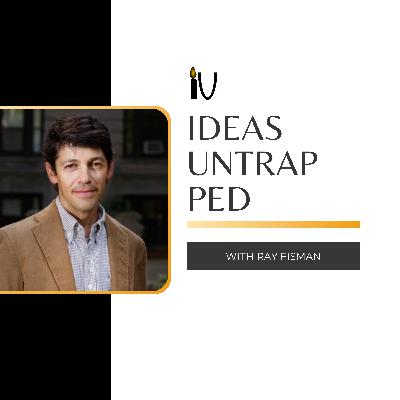
Welcome to another episode of Ideas Untrapped podcast. My guest on this episode is Raymond Fisman, who is the Slater Family Professor in Behavioural Economics at Boston University. He is one of the foremost researchers on corruption and institutional behaviour in the last three decades, and I have been looking forward to talking to him. The main theme of our conversation was the re-election of Donald Trump as the new U.S president and his swift embrace of corporate oligarchs as his new inner circle and power proxies. We also discussed why corporate America is rushing to fall in line and "kiss the ring". This was an enlightening conversation for me, and I do hope you find it useful as well. I also hope to have Raymond back on the podcast for a more global exploration of the topics he covered.TranscriptTobi: Hi, everybody. This is Ideas Untrapped Podcast. My guest today is Professor Raymond Fisman. He's the Slater Family Professor in Behavioral Economics at Boston University. He's a brilliant, brilliant economist that I've been looking forward to talking to for a while. It's a pleasure to have you, Raymond.Raymond Fisman: It's a pleasure to be here. I'll tell my children that someone said I was brilliant. They'll find that very funny.Tobi: I think the interesting place I would say to start is what was your reaction to the inauguration two days ago? [This conversation was recorded on January 22, 2025 two days after Donald Trump was inauguarated for a second time as the President of the United States of America] I mean, in some kind of mildly amusing horror, like, I would say I was at the open blatant embrace of the core of American government of oligarchy and downstream of that, corruption. What were your thoughts?Raymond Fisman: Yeah, I think it's a little hard to know where to begin because there is so much to say and literally relevant news and so far as self-dealing is concerned, as well as obsequiousness of business elites in the U.S. is coming so quickly that if we had this conversation six hours from now, there'd probably be yet more to say about it.On the one hand, I would say that it was horror, not mildly amused, except that it does almost transcend satire, what's going on, like, you can't make it up sort of thing. But something that I want to be very careful to emphasise throughout is that I really don't want to pin this on a particular party or make this about partisanship, as opposed to we have an individual who has been elected to the highest office in the land, that I think is doing a lot that runs counter to good government. And those are the issues I want to emphasise.And I do think that we've seen a lot of troubling signs. I did not watch the inauguration. I'm following the advice of my friend, Marianne, who said that to stay sane, she just reads the news in a physical newspaper. Otherwise, it just comes at you too often and too fast.But some of the things that have emerged in recent days that are really quite troubling are signals that the U.S. is moving towards a much more, if you like, personalistic approach to policymaking. And there's always been a role for connections in the way the U.S. is governed. But it does feel like it's just going to a different scale.The most recent and high profile example is that of TikTok, where Trump had been in favour of a ban of the app, he met with the CEO and before that, a billionaire Republican mega donor, and he flipped his position on it. Now he is going to be TikTok's saviour. So that's on the one side. On the other side, you see TikTok entirely aware that they need to engage in flattery. So, you know, they personally thanked Trump for his intervention Monday morning after it was brought back from a very brief ban and now has a 90 day extension. But again, Trump has sworn to save it.So it's this kind of very personalised, very public favour trading is clearly sending a message to business that they need to fall in line in order to remain profitable in Trump's America. And you can easily, or I shouldn't say easily, you can imagine sliding into a system in which we have something closer to what's termed competitive authoritarianism, where you do hold elections, but the media, as well as the levers of government, are so commanded by the party in power that oppositions are playing from such a disadvantage. We've seen this emerge to some degree in India. We've seen it emerge in Hungary. We've seen it with X. We've seen it with other sites. We've seen it, to some extent, with Facebook very recently. You can see it potentially emerging in the U.S.So I do see a lot of troubling signs, and it is certainly a collective project to push back against these trends.Tobi: One thing that I was surprised, you might not be, given that do work in this area is how quickly people fell in line once Trump won or it looked like he was going to be the next president and you know you had this scrambling for people to get face time in Mar-a-lago to book hotels and to basically make deals and then it does make me wonder that, yeah, like you said, the U.S. is shifting to a more personalistic type of governance. But do you think that the quickness or the way that this shift is rapidly happening before our eyes has something to do with perhaps grievances in whatever form with good governance generally or impersonal bureaucracies? You know, because there's so much gripe about the elites or the deep states and how they have failed. And this is how the people are getting the power back. But of course, we know that's not what it really is. But what exactly about the status quo stopped working to give us this shift we are seeing to a new equilibrium?Raymond Fisman: I'm sure there are many things and one always runs the risk of naming the thing that you think is most important, or even worse, the first thing that comes to mind, and presenting kind of a monocausal case. So I'll say that I'm going to name the thing that I think is most important. It's the first thing that comes to my mind. I'm sure there are many factors that are pushing in this direction, including what you described, people being perhaps dismayed - that it's going to be related to what I say, including what you say about the seeming gridlock of the U.S. government.But what troubles me most and what I think is perhaps enabling the most is increased polarisation, which is more extreme in America than elsewhere, but is also a global phenomenon. It shows up very clearly in the data. The extent to which people identify as left versus right has been steadily widening over the past few decades. And somehow it tinges everything, including people's views of good governance, with a partisan lens. So somehow all that has come to matter is, is he my guy or is he not my guy? As opposed to, is this an honest, competent guy or a dishonest, incompetent one? So somehow people's views, people's attention is entirely drawn to partisan questions, rather than good versus bad government questions.The fact that businesses fell in line so quickly, it is kind of hard to fault them, given the opening example of TikTok. That seems to have already reaped tremendous dividends for the company. If I take at face value, the stock price of Tesla as some summary measure of how valuable it is to have the president's sympathies. It went up by around 30% in the week following the election. There are lots of companies that appreciated in value for reasons that can easily be tied to policies. For-profit prison companies went up by a lot. That's because of anticipated immigration policies. Other carmakers, and especially electric carmakers, did not do so well. So what's special about Tesla, that's not like a big secret. It's that its biggest shareholder, Elon Musk, was a tremendous financial and personal backer of Trump. So if you say, well, being well-connected to this government is worth 30%, that's a pretty good incentive to fall in line.I will note as an aside, or maybe not as an aside, something that's very directly related. So my PhD thesis was on the value of political connections in Suharto's Indonesia in the mid-1990s. And my thesis looked at what happened to the value of well-connected companies when there were threats to Suharto's health. And if you take the results of my PhD thesis at face value, connections in America now are worth something comparable to what they were worth back in mid-90s Indonesia, which at the time was viewed as one of the most corrupt countries in the world.Tobi: I mean, a recent example in Nigeria is a particular oil company that was in trouble for a while, running to about five years, was on the edge of bankruptcy and could not even publish its annual reports. And after the the last election, we've had a new government now for 18 months. After the last election, due to the perceived closeness - I mean, it's an open secret - of this same company to the new president, it's recovered tremendously. Its financial fortunes have recovered tremendously to the point that during the Christmas party last December, this same nearly bankrupt company hosted the three biggest musical artists in Nigeria to its annual Christmas party.So I read the Indonesia paper a long time ago, and one thing I want to draw your attention to, maybe with a bit more of an international lens, is the role of ideas here. I know you talked about partisanship, and I hope we'll get to unpack that a little later. So there is a general acceptance now, especially in the subfield of what we call development economics or international development scholarship generally, that some form of corruption is not so bad, right?Since you… I don't know how much you followed that field, but a lot has happened since your paper. You know, there's this subfield of political science meshed with economics that talks about political settlements. Scholars like Mushtaq Khan have said that, well, some corruption can be beneficial to growth and not all corruptions are bad. You can see the

Happy New Year to our listeners. This is the first episode of the year, and I had a conversation with Oliver Harman about global value chains (GVCs), foreign direct investment (FDI), and regional governance in economic development. Oliver and I discussed how GVCs have evolved, the crucial role of multinational enterprises in knowledge transfer, and why regional governments—rather than national ones—are often better positioned to shape policies that maximize benefits from global trade. The conversation highlights the importance of GVC-sensitive policies, investment promotion agencies, and upgrading strategies to help economies move up the value chain and develop their economy. Oliver Harman is an economist. He specialises in spatial economics and economic geography. He is a Senior Policy Economist for the International Growth Centre at the London School of Economics and Political Science. He is also a Research Associate at the Blavatnik School of Government, University of Oxford. His book with Ricardo Crescenzi, which was the subject of this podcast, can be found here. TranscriptIntroductionTobi:Welcome, Oliver, to Ideas Untrapped Podcast. It's wonderful to have you here. I have to say that your work, along with Riccardo Crescenzi, is one of the most refreshing things I've read in the last couple of years on global value chains. It's a wonderful book. I'll put up links to how people can access it in the show notes, and I think everyone should read it.I want to start with the basics. The phrase global value chain is frequently used in economic discourse, particularly in discussions about geopolitics. But what exactly are global value chains? How would you describe them?What are Global Value Chains?Oliver:Thank you for having me, Tobi, and for your kind words on the book—it is much appreciated. I can provide you with an open-access overview of the book for your listeners who may not be ready to purchase the e-book but want a taste of its content.To answer your question, global value chains (GVCs) have gained prominence academically since the 2000s. Before then, there was little academic literature on them, and even less in policy discussions. This book emerged from that gap.A useful way to conceptualize GVCs is through an evolution of economic thought. Traditionally, economists described trade in terms of final goods—like the classic example of England producing cloth and France producing wine, and then trading them. GVCs, however, break down final goods into intermediate parts.Take the bicycle as an example. Many think of it as a single product, but a Canadian photographer once disassembled one and found 571 intermediate components, all researched, designed, produced, packaged, and marketed in different regions across the world. The same applies to more complex products like smartphones, where an iPhone or Samsung device contains thousands of parts sourced globally.GVCs have completely reshaped how we think about trade—moving beyond final goods to the intricate networks of intermediate goods and services that contribute to production.Evolution of Global Value ChainsTobi:How have global value chains evolved over time? What key events have shaped their trajectory over the past 20 to 30 years?Oliver:That’s a great question. GVCs have gone through different stages of transformation.* 1990s-2000s Boom: Trade became more fragmented, and participation in GVCs surged. Nearly every industry saw increased participation, with 40-50% of trade occurring through GVCs.* Post-2008 Financial Crisis: GVC expansion plateaued. The crisis led to economic restructuring, stabilizing GVC participation at previous levels.* Recent Trends (COVID-19 and Beyond): The pandemic disrupted global supply chains, causing temporary shocks. While GVCs held steady, they are now evolving in response to technological advancements and geopolitical changes.This makes it more critical for economies to find the right GVC for their development, rather than just benefiting from an overall expansion of trade.Multinational Enterprises and Governance in GVCsTobi:Your book highlights three key aspects of GVCs:* Multinational Enterprises (MNEs)* Foreign Direct Investment (FDI)* Regional GovernanceAs a Nigerian, I’m particularly interested in MNEs. We've seen many multinationals exit the country in the past six or seven years. Some policymakers argue that local investors can replace them, so it's not a big deal. But can you elaborate on the governance role that MNEs play in GVCs?Oliver:Absolutely. Multinationals are the governing arm of GVCs. They control and structure value chains by determining how production and trade flow across different regions.For regional policymakers, engaging with MNEs is crucial. They are at the frontier of technology and knowledge, and when properly integrated, they can transfer expertise to local firms. This is particularly important for emerging economies—it allows them to leapfrog to higher-value production.However, MNEs can also be extractive if not managed properly. So, it’s important for governments to structure policies that maximize benefits while minimizing exploitative practices.Governance Policies for Maximizing Benefits from GVCsTobi:How can governments and policymakers structure governance around MNEs to ensure they enhance local economic growth?Oliver:We argue for Global Value Chain-Sensitive Policies, which explicitly consider how policies interact with GVCs. Some examples:* Investment Promotion Agencies (IPAs):* These agencies attract the right investors suited for the local economy.* Evidence shows that subnational IPAs (e.g., at the state level) are often more effective than national ones.* Skills Development Aligned with GVCs:* Training programs should be customized based on industry needs.* Example: The Penang Skills Development Centre in Indonesia worked with MNEs to align workforce skills with global industry demands, leading to economic transformation.Foreign Direct Investment (FDI) and Upgrading in GVCsTobi:Some countries like Vietnam, Poland, and Malaysia have effectively used FDI to upgrade their economies. What are the general lessons from their success?Oliver:The key takeaway is that quality of FDI matters more than quantity.* Traditional Thinking: Measure FDI by the sheer amount of money coming in.* More Effective Thinking: Assess what type of FDI is being attracted.For example:* $100 million in basic assembly work adds less value than* $10 million in high-tech R&D investment, which has long-term benefits.Upgrading within GVCs involves moving from low-value tasks (e.g., assembling phones) to higher-value tasks (e.g., designing microchips). This is the essence of economic transformation.Regional Governments and GVC PolicyTobi:You emphasize regional (subnational) governments as key players in GVC policy. Why focus on regional rather than national governments?Oliver:There are two reasons:* Granularity of Data:* National policies aggregate data, ignoring local variations.* For instance, a port city has different needs from an inland capital city.* Local Expertise:* The people of Lagos understand their economic strengths better than the national government in Abuja.Empowering subnational governments allows for more tailored, effective policies.Challenges in GVC Data CollectionTobi:How can regional governments access reliable data to guide policy?Oliver:Data is crucial but often lacking in emerging markets. Solutions include:* GVC Mapping Exercises: Identify key industries and their global connections.* Global Datasets:* Inter-Country Input-Output Tables* OECD’s Trade in Value Added (TiVA) database* Firm-to-firm transaction dataFinal Question: One Idea Worth SpreadingTobi:What is one idea you’d like to see widely adopted?Oliver:The value of global trade and specialization.Many policymakers today are pushing for economic nationalism—wanting everything made domestically. But different regions have comparative advantages, and trade creates mutual benefits.We must resist mercantilist policies and embrace efficient global cooperation.Closing RemarksTobi:That’s a fantastic idea. Hopefully, we move past the current mercantilist mindset. Thank you, Oliver, for being on Ideas Untrapped.Oliver:Thank you, Tobi. I appreciate the opportunity to discuss these ideas with you and your listeners This is a public episode. If you would like to discuss this with other subscribers or get access to bonus episodes, visit www.ideasuntrapped.com

Comments

Download from Google Play

Download from App Store
 United States